Gemini hits agent parity, Meta opts Instagram into Muse, DeepSeek designs a chip
Google matches OpenAI on agents, Meta opts Instagram into AI photos, and DeepSeek designs its own inference chip after Huawei fails.
Gemini hits agent parity, Meta opts Instagram into Muse, DeepSeek designs a chip
TL;DR
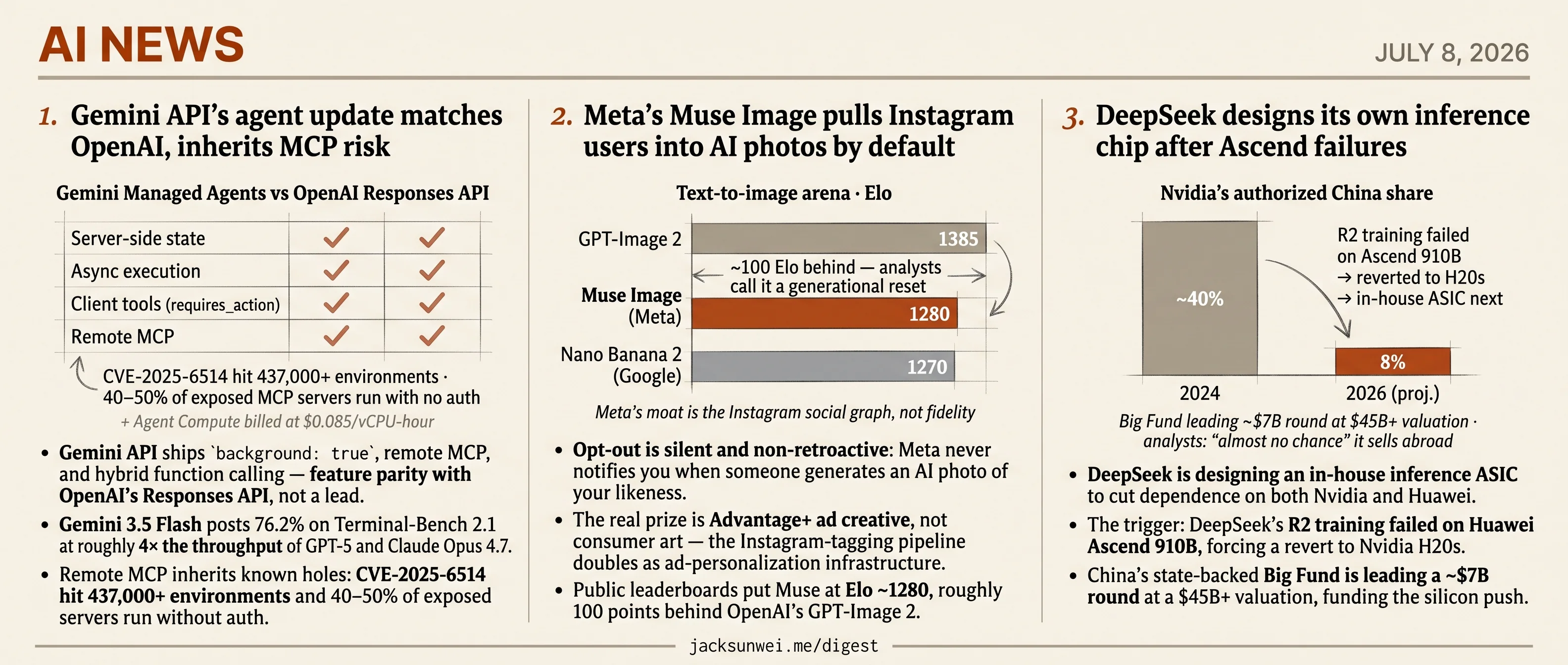
- Gemini API ships background execution and remote MCP, reaching parity with OpenAI’s Responses API.
- Gemini 3.5 Flash hits 76.2% on Terminal-Bench 2.1 at roughly 4× GPT-5 throughput.
- Meta’s Muse Image launches on Instagram with opt-out silent and non-retroactive by default.
- DeepSeek is designing an in-house inference ASIC after R2 training failed on Huawei Ascend 910B.
- China’s Big Fund leads a ~$7B round at a $45B+ valuation to back the silicon push.
Three vendor ships today, and each one’s real story sits a layer below the product announcement. Google’s Gemini API update reads as agent parity with OpenAI, but the news underneath is a new Agent Compute meter that bills separately from tokens — plus inherited MCP vulnerabilities Google didn’t build but now ships against. Meta’s Muse Image looks like a consumer image generator; the pipeline it lays down is Advantage+ ad-creative infrastructure, with Instagram-tagging as the training-data on-ramp and opt-out silent by default. DeepSeek’s in-house inference ASIC is pitched as cost control after Huawei’s Ascend 910B failed R2 training, but the plan only pencils out because the Big Fund is leading a ~$7B round at a $45B+ valuation — a state-backed sovereignty bet the chip can’t be sold outside China to service.
The briefs echo the theme from the other side of the ledger: Microsoft trimming AI spend by routing more workloads to in-house models, and a TechCrunch read arguing open source and frontier labs are splitting the market by workload life cycle rather than colliding.
Gemini API’s agent update matches OpenAI, inherits MCP risk
Source: google-ai-blog · published 2026-07-07
TL;DR
- Gemini API ships
background: true, remote MCP, and hybrid function calling — feature parity with OpenAI’s Responses API, not a lead. - Gemini 3.5 Flash posts 76.2% on Terminal-Bench 2.1 at roughly 4× the throughput of GPT-5 and Claude Opus 4.7.
- Remote MCP inherits known holes: CVE-2025-6514 hit 437,000+ environments and 40–50% of exposed servers run without auth.
- Background execution bills on compute, not just tokens — Agent Compute is $0.085/vCPU-hour on top of model spend.
The features are real, but they close a gap
Google’s expansion of Managed Agents in the Gemini Interactions API adds three things developers have been asking for: background: true async execution with a poll-later interaction ID, direct connections to remote Model Context Protocol servers, and hybrid function calling that pauses the loop with a requires_action state when a client-side tool fires. A fourth — credential refreshing that preserves sandbox state across a new environment_id — quietly solves the “my long-running agent died because a token expired” problem.
All four are overdue. OpenAI’s Responses API shipped the equivalent stateful IDs, background mode with webhook delivery, and encrypted reasoning items ahead of the Assistants API sunset on August 26, 2026 1. The two vendors have converged on the same shape:
| Capability | Gemini Managed Agents | OpenAI Responses API 1 |
|---|---|---|
| Server-side state | environment_id | previous_response_id |
| Async execution | background: true + polling | Background mode + webhooks |
| Client tools | requires_action step matching | requires_action with tool outputs |
| Remote MCP | Direct connection from sandbox | Hosted MCP tool |
Google’s differentiator is the managed Linux sandbox and Gemini 3.5 Flash’s speed — 76.2% on Terminal-Bench 2.1, 83.6% on MCP Atlas, and about 289 output tokens/sec 2. Reviewers still flag that Flash-tier reasoning is not enough for hard coding tasks, and a late-May schema break burned early adopters badly enough to color reception of this release 2.
The remote-MCP pitch buries a security bill
“Managed agents can now connect directly to remote MCP servers” is the headline feature, and it’s where the launch post handwaves the most. Sandbox isolation protects Google’s infrastructure from a misbehaving tool; it does not protect the caller from a misbehaving upstream.
flowchart LR
    U[End user] -->|request| A[Managed agent<br/>in Google sandbox]
    A -->|agent's own creds| M[Remote MCP server]
    M -->|elevated access| D[(Internal DB /<br/>observability)]
    M -. Confused Deputy .-> X{{Acts with server<br/>privilege, not user's}}
Cloud Security Alliance researchers document the Confused Deputy pattern where a remote MCP server executes with its own high-level credentials instead of the requesting user’s, silently escalating privilege 3. CVE-2025-6514 in the mcp-remote proxy alone affected over 437,000 environments, and independent scans found 40–50% of publicly exposed MCP servers running with no authentication at all 4. Google’s post says nothing about OAuth 2.1, PKCE, or per-user credential propagation — the exact primitives that would make “connect to your internal database” safe.
Background mode has a compute meter
The other under-discussed cost: managed agents don’t just bill tokens. Agent Compute runs $0.085 per vCPU-hour, and the forthcoming Memory Bank adds $0.30/GiB-month plus 1 vCPU-hour per 3M reads 5. A background task that polls, reconnects, and keeps sandbox state warm accumulates compute charges independent of token counts — the exact failure mode HN commenters flag in the broader Antigravity 2.0 rollout this API sits inside, alongside flaky auth, weak WSL support, and token burn “significantly faster than Claude” for comparable work 6.
The plumbing is solid and the throughput is genuinely competitive. The open question is whether Flash-tier reasoning plus sandbox lock-in justifies moving workloads off Claude or the Responses API 16 — and whether teams wiring internal systems into remote MCP have read past the marketing copy 34.
Meta’s Muse Image pulls Instagram users into AI photos by default
Source: the-verge-ai · published 2026-07-07
TL;DR
- Opt-out is silent and non-retroactive: Meta never notifies you when someone generates an AI photo of your likeness.
- The real prize is Advantage+ ad creative, not consumer art — the Instagram-tagging pipeline doubles as ad-personalization infrastructure.
- Public leaderboards put Muse at Elo ~1280, roughly 100 points behind OpenAI’s GPT-Image 2.
- Muse Image is Superintelligence Labs’ debut model, now live in Instagram, WhatsApp and the Meta AI app.
The launch is really an ad-tech move
Meta shipped Muse Image on Tuesday as the debut model from its new Superintelligence Labs, wired directly into Instagram, WhatsApp and the Meta AI app. The Verge and TechCrunch cover it as a consumer creative tool. Forbes puts the strategy more plainly: “Meta’s new image model isn’t competing with Midjourney — it’s competing for your ad budget” 7. Advantage+ Creative is the destination — thousands of personalized ad variants generated in-house, keyed to the same social graph that Muse now taps when a user types “put me and my friend Sarah on a beach.”
That reframes the feature the Verge headline flagged. The Instagram-likeness pipeline isn’t a novelty mode bolted onto a general-purpose model; it’s the same graph query that will eventually populate ad creative with faces users have engaged with. The “social context” plumbing and the ad-personalization plumbing are one system.
On quality alone, Muse isn’t leading. The Arena.ai text-to-image leaderboard has it in a preliminary second at Elo ~1280, effectively tied with Google’s Nano Banana 2 (1270) and trailing GPT-Image 2 by roughly 100 Elo points — a gap analysts describe as a “generational reset” 8. Meta’s moat is distribution and the social graph, not fidelity.
flowchart LR
    A[Instagram public photos<br/>+ social graph] --> B{Muse Image}
    C[User prompt<br/>'me + @sarah'] --> B
    B --> D[Consumer AI photos<br/>in IG/WA/Messenger]
    B --> E[Advantage+ Creative<br/>personalized ad variants]
    D -. training + engagement signal .-> A
The consent design is the story
The opt-out has two properties Meta’s announcement glosses. First, it’s non-retroactive: flipping the toggle stops future generations but leaves any existing AI derivatives of your face in place on Meta’s platforms. Second, subjects are never notified when someone else uses their public content to generate an image of them 9. In practice, “consent” means a setting most users won’t find, applied after the fact, with no audit trail.
That design is on a collision course with EU law. NOYB’s Max Schrems is already framing Meta’s legal basis as claiming it can use “any data from any source for any purpose… as long as it’s done via ‘AI technology’” and calling it “clearly the opposite of GDPR compliance” 10. Expect the EU rollout to look materially different from the US launch, with the Instagram-tagging feature the most legally exposed surface.
Guardrails ship pre-broken
Meta’s technical answer to misuse is Content Seal, an invisible watermark engineered to survive cropping, compression and screenshots 11. The problem is that the guardrails around it are trivially defeated. Independent Financial Times testing found frontier-model safety layers can be “stripped like a sticker” in under ten minutes 11, and CNET’s Katelyn Chedraoui reportedly deepfaked a colleague as a pirate in under a minute using the shipped Muse product — no jailbreak required 12.
The through-line: Muse Image is a distribution and ad play, not a quality play. The controversy over Instagram-likeness pull-in isn’t a launch-week edge case — it’s the feature that makes the ad economics work, and it’s the one regulators and safety testers will hammer first.
Further reading
- Meta just launched a new AI generator, Muse Image, and users are already pushing back over use of their photos — techcrunch-ai
DeepSeek designs its own inference chip after Ascend failures
Source: ars-technica-ai · published 2026-07-07
TL;DR
- DeepSeek is designing an in-house inference ASIC to cut dependence on both Nvidia and Huawei.
- The trigger: DeepSeek’s R2 training failed on Huawei Ascend 910B, forcing a revert to Nvidia H20s.
- China’s state-backed Big Fund is leading a ~$7B round at a $45B+ valuation, funding the silicon push.
- Analysts see “almost no chance” the chip sells abroad — HBM and lithography ceilings keep it captive to China.
The trigger was Huawei, not just Washington
The Ars framing — export controls forcing DeepSeek into silicon — is only half the story. The immediate provocation was Huawei’s software stack. Beijing pressured DeepSeek through 2025 to train its R2 model on Ascend 910B GPUs, and despite an on-site Huawei engineering team the lab “failed to complete a single successful full-scale training run,” citing unstable interconnects and an immature CANN toolkit 13. R2 training moved back to Nvidia H20s, with Ascend relegated to inference duty for that model. A custom inference ASIC is the logical next step: if the domestic training path is broken and the sanctioned Nvidia path is capped, own the layer where you actually have volume.
Why Nvidia is watching closely
Jensen Huang has said the quiet part out loud. On the Dwarkesh podcast he called it a “horrible outcome” if DeepSeek fully optimized its stack for Huawei — because that breaks CUDA lock-in inside China and eventually beyond it 14. The market math backs the anxiety: Nvidia’s authorized China share is projected to collapse from roughly 40% to about 8% in 2026, with Huawei picking up as much as 50% 15. A DeepSeek ASIC accelerates the Nvidia exit but also carves a slice out of Huawei’s projected windfall. The two Chinese champions are now competing for the same substrate.
flowchart LR
    A[R2 training] -->|failed on Ascend| B[Nvidia H20s]
    A -->|inference only| C[Huawei Ascend]
    D[New: DeepSeek ASIC] -->|captive inference| E[DeepSeek models]
    C -.displaced by.-> D
    B -.long-term target.-> D
The memory wall is the ceiling
Independent analysts think the chip matters domestically and almost nowhere else. Richard Windsor of Radio Free Mobile argues DeepSeek has “almost no chance” of selling silicon abroad without access to leading-edge nodes or HBM 16. ChinaTalk’s export-controls work reinforces the point: CXMT’s domestic HBM still trails SK Hynix on yield and density, and US controls on the deposition and lithography tools needed to close that gap keep tightening 17. SMIC’s 7nm DUV line — the presumed fab route — trails TSMC by generations. Workable for captive inference where you eat the cost. Not workable against Blackwell.
The money is the story
The Ars piece underplays the financing. The FT reports China’s Big Fund is in talks to lead a ~$7B round valuing DeepSeek above $45B 18. That is the number that turns a chip announcement from vaporware into a program: an in-house ASIC — masks, EDA, packaging, a software team to build the kernels Huawei couldn’t — is a nine-figure-a-year commitment before first silicon. State capital of this size means Beijing is treating DeepSeek as national infrastructure, not a private lab.
Net: this is a defensive captive-inference play, hemmed in by HBM and lithography ceilings, funded like strategic infrastructure. It weakens Nvidia in China faster than it threatens Nvidia anywhere else — and it puts DeepSeek and Huawei on a collision course inside the same protected market.
Round-ups
Microsoft leans on in-house models to trim AI spend
Source: techcrunch-ai
Microsoft joins the Silicon Valley pullback on AI outlays by routing more workloads to its own models instead of OpenAI and Anthropic, aiming to cut token costs as inference volumes climb. The shift mirrors similar belt-tightening across hyperscalers this year.
Open-source AI isn’t eating Anthropic’s lunch, yet
Source: techcrunch-ai
Frontier labs and open-source models are splitting the market by life-cycle stage rather than competing head-on, with Anthropic capturing new high-value workloads while open weights absorb mature, cost-sensitive ones. Enterprise buyers like Decagon use both tiers in tandem.
AI data-center power demand squeezes Rust Belt manufacturers
Source: ars-technica-ai
Surging electricity draw from AI data centers is driving up industrial power bills across the Rust Belt, undercutting the cost math behind Trump’s Made-in-America manufacturing push. Grid operators warn the strain on regional supply will worsen as new clusters come online.
Anthropic brings Claude Cowork to mobile and web
Source: the-verge-ai, techcrunch-ai
Claude Cowork, previously locked to the macOS and Windows desktop apps, now runs on phones and browsers starting Tuesday, rolling out to Max subscribers first and other plans in the coming weeks. Users can kick off a task at their desk and collect results on mobile.
Forterra deploys 100+ autonomous ATVs to Ukraine front lines
Source: techcrunch-ai
Forterra has fielded more than 100 self-driving all-terrain vehicles in Ukrainian conflict zones, marking the first American autonomous ground vehicles in active combat. The deployment tests unmanned logistics and reconnaissance under real electronic warfare conditions.
Discord AI moderation bug wrongfully bans users since May
Source: techcrunch-ai
Discord confirmed its automated image moderation had been flagging harmless uploads and banning accounts since May, with another 200 users hit over the weekend before engineers isolated and patched the bug. Affected accounts are being restored.
Lilian Weng distills 35 papers on harness engineering for RSI
Source: latent-space
Weng’s survey compresses 35 recent papers into a single read on harness engineering for recursive self-improvement, covering the scaffolding, evaluation loops, and tool interfaces that let models iterate on their own training. The roundup lands on a slow news day tailor-made for catch-up reading.
Footnotes
-
OpenAI Developers Blog — Responses API — https://developers.openai.com/blog/responses-api
↩ ↩2 ↩3The Assistants API will be sunset on August 26, 2026; the Responses API adds stateful IDs, background mode with webhook delivery, and encrypted reasoning items so clients don’t have to resend history.
-
Thomas Wiegold — Antigravity/Gemini 3.5 Flash review — https://thomas-wiegold.com/blog/google-antigravity-review-i-tested-gemini-3-5-flash/
↩ ↩2Gemini 3.5 Flash hits 76.2% on Terminal-Bench 2.1 and 83.6% on MCP Atlas at roughly 289 output tokens/sec — about 4× faster than GPT-5 and Claude Opus 4.7 — but a late-May schema break and Pro delays left teams doubting Flash is enough for high-reasoning coding.
-
Cloud Security Alliance — Agentic MCP Security Best Practices — https://labs.cloudsecurityalliance.org/agentic/agentic-mcp-security-best-practices-v1/
↩ ↩2A remote MCP server can suffer a ‘Confused Deputy’ problem where the server executes actions with its own high-level credentials rather than those of the requesting user, leading to unintended privilege escalation.
-
re-entry.ai — MCP CVE tracking gap — https://www.re-entry.ai/blog/mcp-server-cve-tracking-gap-ai-coding-agents
↩ ↩2CVE-2025-6514, a critical command injection vulnerability in the mcp-remote proxy, affected over 437,000 environments; independent scans found roughly 40–50% of publicly exposed MCP servers operate without any authentication.
-
Google Cloud — Gemini Enterprise Agent Platform pricing — https://cloud.google.com/products/gemini-enterprise-agent-platform/pricing
↩Agent Compute bills at $0.085 per vCPU-hour (~15,000 gateway calls); Memory Bank (Sept 2026) at $0.30/GiB-month with reads consuming 1 vCPU-h per 3M ops — costs that scale with background reasoning steps, not just tokens.
-
Hacker News discussion on Antigravity 2.0 — https://news.ycombinator.com/item?id=48223956
↩ ↩2Buggy release with authentication issues and poor WSL support; token consumption reaches limits significantly faster than Claude, and the models still lag GPT and Claude Opus in complex abstract reasoning.
-
Forbes (Gabriela Linzainescu) — https://www.forbes.com/sites/gabrielalinzainescu/2026/07/08/metas-new-image-model-isnt-competing-with-midjourney-its-competing-for-your-ad-budget/
↩Meta’s new image model isn’t competing with Midjourney — it’s competing for your ad budget.
-
Arena.ai Text-to-Image Leaderboard — https://arena.ai/leaderboard/text-to-image
↩Muse Image holds a preliminary second-place ranking with an Elo of 1280, narrowly edging Google’s Nano Banana 2 (1270) but trailing GPT-Image 2 (Medium) at ~1385, described by analysts as a generational reset.
-
Gadgets Now / Times of India — https://gadgetsnow.indiatimes.com/tech-news/why-metas-new-muse-image-ai-has-sparked-a-privacy-backlash-in-a-day/articleshow/132254063.cms
↩Disabling the setting only prevents future generations; any AI content already created using a user’s likeness remains on Meta’s platforms, and Meta’s policy explicitly states users will not be notified when someone else uses their public content to generate an AI image.
-
Silicon Republic (on NOYB / Max Schrems) — https://www.siliconrepublic.com/enterprise/meta-collection-ai-data-eu-response-irish-dpc-request
↩Meta is basically saying that it can use ‘any data from any source for any purpose’… as long as it’s done via ‘AI technology.’ This is clearly the opposite of GDPR compliance.
-
The Hans India — https://www.thehansindia.com/technology/tech-news/meta-launches-ai-image-generator-muse-image-controversy-erupts-immediately-1095145
↩ ↩2Meta introduced Content Seal, an invisible watermarking system designed to survive cropping, compression, and screenshots — but independent testing by the Financial Times showed guardrails on Meta’s frontier models can be ‘stripped like a sticker’ in under ten minutes.
-
gagadget (citing CNET’s Katelyn Chedraoui) — https://gagadget.com/en/717671-metas-muse-image-is-its-first-in-house-ai-image-generator-and-its-already-in-instagram-and-whatsapp-amp/
↩CNET’s Katelyn Chedraoui successfully ‘deepfaked’ a colleague as a pirate in under a minute to demonstrate how easily the tool bypasses traditional consent boundaries.
-
↩DeepSeek reportedly urged by Chinese authorities to train new model on Huawei hardware after multiple failures — R2 training to switch back to Nvidia hardware while Ascend GPUs handle inference
-
The Next Web (Jensen Huang on Dwarkesh Podcast) — https://thenextweb.com/news/nvidia-huang-deepseek-huawei-chips-horrible-outcome
↩if major Chinese AI labs like DeepSeek successfully optimize their models for Huawei’s hardware, it would represent a ‘horrible outcome’ for U.S. technological leverage
-
Huawei Central — https://www.huaweicentral.com/huawei-to-own-50-of-chinese-ai-chip-market-by-2026-report/
↩Nvidia’s authorized market share in China is projected to collapse from nearly 40% to roughly 8% by 2026, domestic champions like Huawei are expected to capture up to 50% of the market
-
MLQ.ai citing Richard Windsor (Radio Free Mobile) — https://mlq.ai/news/deepseek-designing-proprietary-ai-inference-chip-to-cut-nvidia-huawei-dependence/
↩DeepSeek has ‘almost no chance’ of selling silicon outside China without access to leading-edge manufacturing and High-Bandwidth Memory (HBM)
-
ChinaTalk — ‘Export Controls and HBM’ — https://www.chinatalk.media/p/export-controls-and-hbm
↩Domestic HBM production still lags behind global leaders like SK Hynix in yield and density, and the US has repeatedly tightened controls on the manufacturing equipment necessary for HBM
-
Financial Times — https://www.ft.com/content/eb984646-6320-4bfe-a78d-a1da2274b092?syn-25a6b1a6=1
↩China’s state-backed ‘Big Fund’ is in talks to lead a massive $7 billion funding round for DeepSeek, valuing the firm at over $45 billion