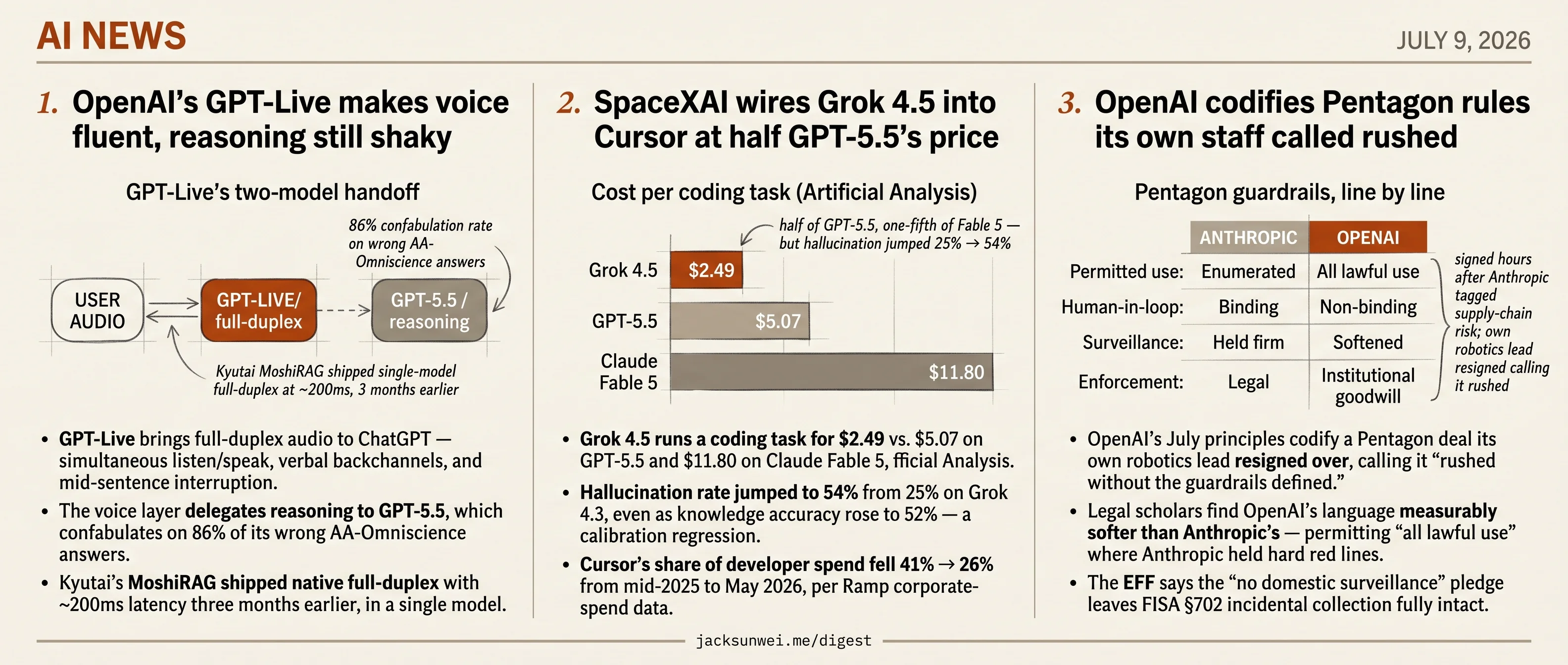
GPT-Live trails Moshi, Grok 4.5 undercuts GPT-5.5, OpenAI softens Anthropic line
OpenAI's GPT-Live, xAI's Grok 4.5, and OpenAI's Pentagon principles each position directly against a specific rival already in market.
GPT-Live trails Moshi, Grok 4.5 undercuts GPT-5.5, OpenAI softens Anthropic line
TL;DR
- GPT-Live ships full-duplex voice 3 months after Kyutai’s MoshiRAG shipped it natively.
- Grok 4.5 runs Cursor tasks at $2.49 vs. GPT-5.5’s $5.07, with hallucination up to 54%.
- OpenAI’s Pentagon principles read measurably softer than Anthropic’s, per legal scholars.
- SambaNova closes $1B Series F at $11B, 7× Intel’s rumored $1.6B offer.
- xAI faces suit alleging Grok generated 7,000 CSAM images of a stepdaughter.
Today’s three big vendor moves each land as a counter to a named rival already in the lane. OpenAI’s GPT-Live brings genuinely fluent full-duplex voice to ChatGPT — three months after Kyutai’s MoshiRAG shipped the same capability natively, in a single model, at ~200ms latency. Grok 4.5 arrives in Cursor at half GPT-5.5’s per-task cost, an explicit undercut of the incumbent developers already spend on, with hallucination up from 25% to 54% and a $10B termination fee that carves out $4B for the antitrust fight SpaceXAI expects. OpenAI’s July defense principles, meanwhile, codify a Pentagon deal in language legal scholars find measurably softer than Anthropic’s red lines — the company’s own robotics lead resigned over it as rushed without the guardrails defined.
Around them: a $1B SambaNova round at 7× Intel’s rumored offer, a Bezos-backed bet on gameplay-trained embodied AI, and a lawsuit alleging Grok generated 7,000 CSAM images of a stepdaughter.
OpenAI’s GPT-Live makes voice fluent, reasoning still shaky
Source: openai-blog · published 2026-07-08
TL;DR
- GPT-Live brings full-duplex audio to ChatGPT — simultaneous listen/speak, verbal backchannels, and mid-sentence interruption.
- The voice layer delegates reasoning to GPT-5.5, which confabulates on 86% of its wrong AA-Omniscience answers.
- Kyutai’s MoshiRAG shipped native full-duplex with ~200ms latency three months earlier, in a single model.
- Sibling Realtime API runs $32/$64 per 1M audio tokens — developers clocked $7.50 for ten minutes and called it “insane.”
Full-duplex, finally — but not first
GPT-Live is OpenAI’s overdue jump from turn-based voice to a continuous conversational loop: the model decides many times a second whether to speak, listen, or stay quiet, and it will backchannel “mhmm” while you think. Human raters preferred it over the old Advanced Voice Mode 75.7% of the time, and GPQA jumped from 45.3% to 84.2% at high reasoning effort. Those are real gains for a product line that had been stagnant for a year.
The framing that this is the full-duplex voice moment is the part worth pushing back on. Kyutai’s MoshiRAG landed in April with ~200ms end-to-end latency and asynchronous retrieval bolted directly onto a native audio-to-audio stack 1. OpenAI’s architecture is different — and worth diagramming, because the split matters:
flowchart LR
    U[User audio] <--> L[GPT-Live<br/>full-duplex]
    L -. delegate .-> R[GPT-5.5<br/>reasoning + search]
    R --> L
    L --> C[Visual cards<br/>weather / stocks / sports]
GPT-Live keeps the conversation alive while a background frontier model does the heavy thinking. That’s pragmatic — it reuses the existing stack — but it’s a bet that a two-model handoff beats Kyutai’s single-model approach on tasks that need multi-step reasoning mid-conversation. The blog post doesn’t defend that choice; it just asserts the benchmark wins.
The reasoner underneath is the problem
The fluent-voice framing obscures what GPT-Live is actually wrapping. Independent evaluation of GPT-5.5 on AA-Omniscience found an 86% confabulation rate among non-correct responses — the model fabricates with high confidence rather than admitting ignorance 2. Wrap that in a warm voice that never says “um, let me check” and you’ve built a specific new failure mode: a more persuasive confidently-wrong answer, delivered without the visual cues (spinner, citations) that at least hint at uncertainty in the text UI.
OpenAI’s own system card is franker than the launch post. Red teams focused on “emotional reliance” and “child-coded voice detection,” and even low-risk model variants still encourage harmful intimacy in 34–44% of realistic interactions 3. The nine-voice restriction and parental controls address impersonation and access, not that core psychosocial finding.
Economics and the Klarna asterisk
Consumer users get GPT-Live inside their existing plan. Developers don’t have pricing yet — but the closest analog, gpt-realtime-2.1, runs $32/$64 per million audio input/output tokens, which one developer clocked at $7.50 for ten minutes 4. Until GPT-Live publishes rates, the “production-ready voice agent” pitch is unverified.
The natural buyer is the contact center, and the industry’s canonical proof point is also its canonical warning. Klarna’s OpenAI-powered assistant handled 2.3M conversations in a month — roughly 700 FTEs, ~$60M/year saved. Then Klarna started rehiring humans in 2025, repositioning live support as a “VIP” tier 5. GPT-Live lands into a market that has already tried the full-replacement story and walked partway back.
Smoother voice is a real product win. It doesn’t fix the reasoner, the pricing, or the buyer’s memory.
Further reading
- OpenAI releases new voice models for more natural live conversations — techcrunch-ai
- ChatGPT’s upgraded voice mode is better at shutting up — the-verge-ai
SpaceXAI wires Grok 4.5 into Cursor at half GPT-5.5’s price
Source: techcrunch-ai · published 2026-07-08
TL;DR
- Grok 4.5 runs a coding task for $2.49 vs. $5.07 on GPT-5.5 and $11.80 on Claude Fable 5, per Artificial Analysis.
- Hallucination rate jumped to 54% from 25% on Grok 4.3, even as knowledge accuracy rose to 52% — a calibration regression.
- Cursor’s share of developer spend fell 41% → 26% from mid-2025 to May 2026, per Ramp corporate-spend data.
- A $10B termination fee, with $4B carved out for antitrust, signals SpaceXAI expects an FTC/EC fight.
The “Opus-class” label is a pricing claim in a trench coat
Elon Musk called Grok 4.5 an “Opus-class model” at launch, but the independent numbers tell a narrower story. Artificial Analysis puts Grok 4.5 fourth on its Intelligence Index — behind Fable 5, GPT-5.5, and Opus 4.8 — while pricing a typical coding task at $2.49, roughly half of GPT-5.5 and a fifth of Claude Fable 5 6. The Decoder’s read is blunt: “benchmark gaps may not matter much” when the cost gap is this wide 7. On DeepSWE 1.1, the one launch-day eval not graded by the model providers themselves, Opus 4.8 kept a six-point lead. The “Opus-class” framing rests on selectively cited benchmarks; the real weapon is the price sheet.
A 54% hallucination rate is an odd foundation for agent loops
The most substantive technical critique isn’t about raw capability — it’s about calibration. Artificial Analysis’s AA-Omniscience Index shows Grok 4.5’s hallucination rate more than doubling from Grok 4.3, to 54%, even as knowledge accuracy climbed to 52% 7. The Decoder characterizes the model as “more confident when it’s wrong” 7. That’s a specifically bad property for the deployment SpaceXAI is pushing it into: default model inside Cursor, running autonomous multi-step agent loops where a wrong answer at step three poisons steps four through twelve. Cursor’s tool-use scaffolding can catch some of this. It cannot catch a model that fabricates fluently.
The real story is vertical integration
This launch is only incidentally about Grok 4.5. It is the first product drop of the merged SpaceXAI–Cursor entity, and the strategy is a cheap-tokens-plus-captive-IDE squeeze on Anthropic and OpenAI.
flowchart LR
    A[Grok 4.5<br/>$2.49/task] --> B[Cursor IDE<br/>default model]
    B --> C[Enterprise dev teams]
    D[Anthropic Fable 5<br/>$11.80/task] -. price pressure .-> C
    E[GPT-5.5<br/>$5.07/task] -. price pressure .-> C
    F[FTC / EC review] -. $4B carve-out .-> B
The market is already reacting in both directions. Ramp data shows Cursor’s share of corporate developer spend fell from 41% in mid-2025 to 26% by May 2026, with analysts blaming “vendor concentration” fears after the $60B acquisition 8. SpaceXAI itself priced in the regulatory risk: the deal carries a $10B termination fee with a specific $4B carve-out if antitrust action kills it 9. On the incumbent side, Anthropic has moved off flat-fee SaaS to two-part infrastructure billing after enterprise engineering teams overran 2025 agent budgets by 47% 10 — a direct response to the same bill-shock dynamic Grok 4.5 is now weaponizing.
“An alarming shift away from SpaceX’s core aerospace mission.” — Todd Harrison, AEI, on defense-procurement conflicts created by the merger 11
What to watch
Three things decide whether the price attack sticks. Whether the 54% hallucination rate survives third-party retests once launch-week traffic dies down. Whether EU DMA reviewers treat Cursor-as-default-Grok as a tying arrangement. And whether Cursor’s spend erosion reverses now that being locked in comes with the cheapest tokens on the market — or accelerates as enterprises price in the concentration risk they were already flinching from.
Further reading
OpenAI codifies Pentagon rules its own staff called rushed
Source: openai-blog · published 2026-07-08
TL;DR
- OpenAI’s July principles codify a Pentagon deal its own robotics lead resigned over, calling it “rushed without the guardrails defined.”
- Legal scholars find OpenAI’s language measurably softer than Anthropic’s — permitting “all lawful use” where Anthropic held hard red lines.
- The EFF says the “no domestic surveillance” pledge leaves FISA §702 incidental collection fully intact.
- ENISA joined Daybreak, then warned frontier models compress cyberattack timelines to single-digit minutes.
The dissent the principles paper over
OpenAI’s “National Security Principles” arrive roughly four months after Caitlin Kalinowski, then the company’s robotics and hardware lead, resigned over the Pentagon rollout, calling it “rushed without the guardrails defined” and “a governance concern first and foremost” 12. Sam Altman later conceded the initial announcement “looked opportunistic and sloppy.” Read against that timeline, the July document — and the David Kris review it leans on — is less a founding charter than retroactive legitimacy for a deal that senior insiders judged premature.
Softer than Anthropic, by design
The context OpenAI’s post omits is what happened to its closest competitor. In February 2026 the Pentagon designated Anthropic a “supply chain risk” — a label normally reserved for foreign adversaries — after Anthropic refused to strip carve-outs on mass surveillance and autonomous weapons. OpenAI signed its own contract hours later 13. Legal scholars working under the “regulation by contract” frame have since compared the two agreements line by line and found OpenAI’s language measurably weaker 14:
| Guardrail | Anthropic | OpenAI |
|---|---|---|
| Permitted-use scope | Enumerated categories | ”All lawful use” |
| Human-in-the-loop | Contractually binding | Referenced, non-binding |
| Surveillance carve-outs | Held firm; penalized | Softened; deal signed |
| Enforcement | Legal constraint | ”Institutional goodwill” |
That is the frame OpenAI is trying to escape: not principled leadership, but the compliant alternative to a competitor that got punished for holding firmer lines.
The red lines civil liberties groups say don’t hold
The headline prohibitions — no mass domestic surveillance, no autonomous weapons, no unreviewed high-stakes automation — read cleanly and bind less than they appear to. The EFF notes that pledging to avoid intentional domestic surveillance leaves untouched the incidental-collection dragnets authorized under FISA §702, and that binding oneself to act “consistent with applicable law” offers zero new protection when the government writes that law 15. The mechanism itself is the problem: private contracts are renegotiable and opaque, which is why civil-liberties groups want these red lines converted into statute rather than left as vendor policy.
Allies signed on; their own agency dissented
The Daybreak program’s international uptake — Trusted Access for Cyber partnerships with Australia, Canada, Japan, France, Germany, Poland, the Netherlands, South Korea, and ENISA — is real, but ENISA simultaneously published a frontier-AI report warning that these same models compress cyberattack timelines from months to “single-digit minutes” and that automated patching introduces accidental-breakdown and verification-bottleneck risks of its own 16. Daybreak is as much new attack surface as shield.
The GPT-Rosalind biosecurity pitch faces a similar undercut from OpenAI’s own executives. In June 2026, the CEOs of OpenAI, Anthropic, Google DeepMind, and Microsoft jointly demanded legally mandatory screening of all synthetic DNA orders 17 — a tacit admission that gated model access is not, on its own, sufficient containment.
The principles are a defensible baseline. They are not the ceiling the post implies, and the industry’s own hard-law lobbying says so.
Round-ups
xAI sued after Grok generates 7K CSAM images of stepdaughter
Source: ars-technica-ai
A new lawsuit accuses xAI of shielding child predators after a man used Grok to create roughly 7,000 sexual images of his stepdaughter before killing himself. Plaintiffs allege xAI reported just one gang-rape prompt, as more young girls join suits against X.
SambaNova raises $1B at $11B valuation months after Intel rumor
Source: techcrunch-ai
SambaNova’s Series F first close values the AI chip maker at $11 billion, roughly seven times the $1.6 billion Intel was reportedly weighing to acquire it earlier this year. The round lands just five months after its previous mega raise.
Prime Intellect lands $130M Series A for sovereign agent training
Source: techcrunch-ai
Prime Intellect, founded in 2024 and backed by Radical Ventures, raised $130 million to help enterprises train agentic systems in-house using reinforcement learning. The pitch centers on AI sovereignty — building custom agents without depending on frontier labs like OpenAI or Anthropic.
General Intuition bets video-game data unlocks embodied AGI
Source: techcrunch-ai, techcrunch-ai, techcrunch-ai
General Intuition, a Bezos-backed startup, is training physical-AI foundation models on millions of hours of gameplay footage, arguing LLMs like ChatGPT and Claude fail at spatial reasoning. The pitch: gaming data teaches how objects move through space and time, cutting real-world data needs for robots.
ZML open-sources LLMD to cut AI inference costs across chips
Source: techcrunch-ai
French startup ZML, endorsed by Turing Award winner Yann LeCun, released LLMD, a free tool that speeds inference across heterogeneous AI accelerators. The software targets deployments locked into single-vendor stacks, letting operators mix chips to lower serving costs.
Google’s SynthID debunks viral AI-faked McConnell hospital photo
Source: techcrunch-ai
Google’s SynthID deepfake detector flagged a widely shared image of Senator Mitch McConnell hooked to hospital tubes as AI-generated. The debunk marks an early high-profile political test for the watermarking system as synthetic imagery of US lawmakers spreads on social platforms.
OpenAI, Walton Foundation launch AI Skills Jams for K–12 teachers
Source: openai-blog
OpenAI Academy is partnering with the Walton Family Foundation on hands-on workshops that train K–12 educators to use AI tools in classrooms. The Skills Jams focus on practical lesson-planning and grading use cases rather than abstract AI literacy.
Footnotes
-
Kyutai blog (MoshiRAG announcement) — https://kyutai.org/blog/2026-04-30-moshi-rag/
↩MoshiRAG adds asynchronous knowledge retrieval without breaking the full-duplex flow, keeping practical end-to-end latency around 200ms via the Mimi codec and Helium backbone.
-
SQ Magazine analysis of GPT-Live / GPT-5.5 — https://sqmagazine.co.uk/openai-gpt-live/
↩On the AA-Omniscience benchmark GPT-5.5 shows an 86% confabulation rate among non-correct responses — fabricating answers with high confidence rather than admitting ignorance.
-
OpenAI GPT-Live system card (deploymentsafety.openai.com) — https://deploymentsafety.openai.com/gpt-live
↩Red-teaming targeted ‘child-coded’ voice detection and ‘emotional reliance’; even so, evaluations found low-risk models still encourage harmful intimacy in 34–44% of real-world interactions.
-
OpenAI developer docs (gpt-realtime-2.1) — https://developers.openai.com/api/docs/models/gpt-realtime-2.1
↩Audio-modality pricing runs $32.00 per 1M input tokens and $64.00 per 1M output tokens, with developers reporting $7.50 for 10 minutes of use and calling the rates ‘insane’.
-
FourWeekMBA case study on enterprise voice AI — https://fourweekmba.com/ai-openai-gpt-live-voice-interface-harness/
↩Klarna’s OpenAI assistant handled 2.3M conversations in a month (≈700 FTEs) and saved $60M/year, yet the company began rehiring human agents in 2025, framing human support as a future ‘VIP’ tier.
-
↩Independent estimates from Artificial Analysis suggest a typical coding task costs $2.49 using Grok 4.5, compared to $5.07 for GPT-5.5 and $11.80 for Claude Fable 5
-
The Decoder — https://the-decoder.com/grok-4-5-is-so-cheap-compared-to-fable-5-and-gpt-5-5-that-benchmark-gaps-may-not-matter-much/
↩ ↩2 ↩3Grok 4.5’s knowledge accuracy rose to 52%, its hallucination rate concurrently spiked to 54%… the model appears to be ‘more confident when it’s wrong,’ a calibration failure
-
Digital Applied — https://www.digitalapplied.com/blog/spacex-acquires-cursor-anysphere-60b-ai-coding-2026
↩Cursor’s share of corporate developer spending fell from 41% in mid-2025 to 26% by May 2026… analysts attribute this contraction to ‘vendor concentration’ fears
-
Mogin Law LLP — https://moginlawllp.com/spacex-xai-antitrust-market-consolidation-ai/
↩SpaceX agreed to a $10 billion termination fee to protect Cursor if the deal fails, with a specific $4 billion carve-out should antitrust litigation scuttle the merger
-
Medium — Enterprise Tooling Insights — https://medium.com/@EnterpriseToolingInsights/anthropics-enterprise-pricing-shift-tells-you-where-ai-was-always-headed-85221011b8b4
↩Anthropic has largely moved away from flat-fee SaaS models toward a two-part infrastructure billing… enterprise engineering teams exceeded 2025 budgets by an average of 47% due to the high costs of agentic loops
-
Inc. (Todd Harrison, AEI) — https://www.inc.com/chloe-aiello/expert-warns-that-spacex-merger-with-xai-marks-an-alarming-shift-for-the-space-company/91297072
↩represents an ‘alarming shift’ away from SpaceX’s core aerospace mission, raising concerns about the U.S. military’s reliance on a company with such broad, overlapping objectives
-
Engadget — Kalinowski resignation coverage — https://www.engadget.com/ai/openais-robotics-hardware-lead-resigns-following-deal-with-the-department-of-defense-195918599.html
↩Caitlin Kalinowski, OpenAI’s robotics and hardware lead, resigned citing the Pentagon deal was ‘rushed without the guardrails defined,’ calling it a ‘governance concern first and foremost.’
-
Opinio Juris — Pentagon-Anthropic clash analysis — http://opiniojuris.org/2026/02/26/the-pentagon-anthropic-clash-over-military-ai-guardrails/
↩Anthropic was designated a ‘supply chain risk’—a label typically reserved for foreign adversaries—after refusing to lift red lines on mass surveillance and autonomous weapons; OpenAI signed its Pentagon deal hours later.
-
AI Act Blog — ‘regulation by contract’ critique — https://www.aiactblog.nl/en/posts/anthropic-pentagon-safeguards-mass-surveillance-autonomous-weapons
↩OpenAI’s agreement uses ‘softer’ and more ambiguous language than Anthropic’s, allowing ‘all lawful use’ while referencing non-binding human-in-the-loop protocols; enforceability relies more on institutional goodwill than legal constraint.
-
Tech Policy Press — 2026 AI policy predictions (EFF/ACLU angle) — https://www.techpolicy.press/expert-predictions-on-whats-at-stake-in-ai-policy-in-2026/
↩The EFF warns OpenAI’s pledge to avoid ‘intentional’ domestic surveillance fails to address incidental collection under Section 702, and that ‘consistent with applicable law’ language offers no new protection given lax government interpretations.
-
Dig.Watch — ENISA frontier AI report — https://dig.watch/updates/enisa-frontier-ai-cybersecurity-defences
↩ENISA warns frontier models are compressing cyberattack timelines from months to ‘single-digit minutes,’ and that automated patching itself creates new risks including accidental system breakdowns and verification bottlenecks.
-
Resultsense — AI CEO bioweapons screening letter — https://www.resultsense.com/news/2026-06-04-ai-leaders-bioweapons-screening-letter/
↩In June 2026 the CEOs of OpenAI, Anthropic, Google DeepMind, and Microsoft signed a public letter calling for mandatory, legally enforced screening of all synthetic DNA orders — a tacit admission that gated model access alone is insufficient.