Torvalds' kernel fix, Willison on verifying AI code, Swyx on shrinking harnesses
Three developer voices locate where humans still fit in AI-assisted coding: the impossible bug, the merge review, the shrinking harness.
Torvalds’ kernel fix, Willison on verifying AI code, Swyx on shrinking harnesses
TL;DR
- Torvalds ships one-line
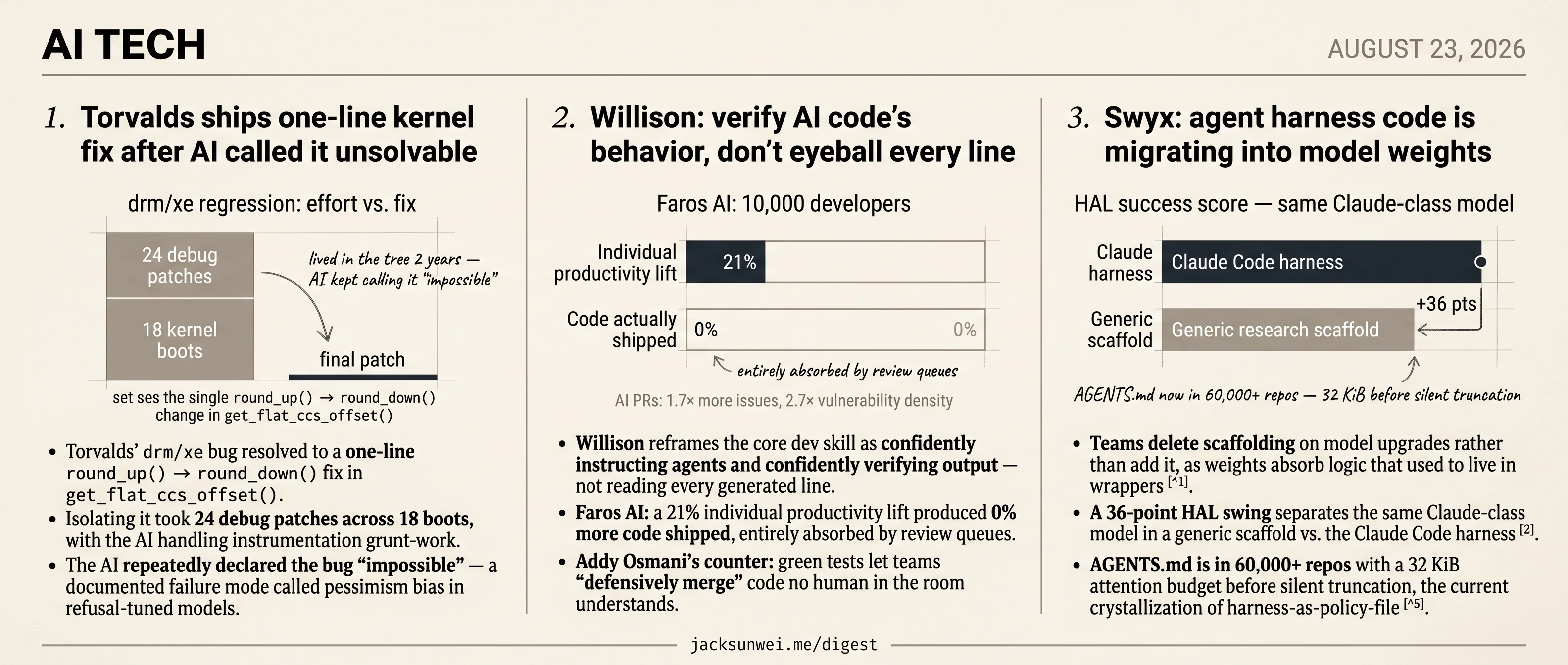
drm/xefix after AI declared the bug impossible across 24 patches. - Willison reframes the dev skill as verifying agent output, not reading every generated line.
- Faros AI: a 21% individual productivity lift produced 0% more code shipped on the team.
- Swyx: a 36-point HAL swing separates the same Claude-class model in a generic scaffold vs. Claude Code.
- AGENTS.md now sits in 60,000+ repos with a 32 KiB attention budget before silent truncation.
Today’s tech coverage is about where the human still fits when agents write most of the code. Linus Torvalds spent 24 debug patches chasing a drm/xe regression the AI kept declaring impossible — the fix was one line. Simon Willison, watching the industry catch up to what he calls confidently instructing and confidently verifying, argues the core dev skill is now the review, not the write. And Swyx, surveying how teams actually run agents in production, notes that scaffolding keeps getting deleted on each model upgrade — the harness is pivoting toward governing scarce human attention on agent output, since the models no longer need it to stay reliable.
Three different vantage points, one shared conclusion: the model can carry more of the mechanical work, and the human’s job is compressing into the parts the model still can’t do — locate the truly hard bug, decide what to merge, and spend attention where it counts.
Torvalds ships one-line kernel fix after AI called it unsolvable
Source: simon-willison · published 2026-08-22
TL;DR
- Torvalds’
drm/xebug resolved to a one-lineround_up()→round_down()fix inget_flat_ccs_offset(). - Isolating it took 24 debug patches across 18 boots, with the AI handling instrumentation grunt-work.
- The AI repeatedly declared the bug “impossible” — a documented failure mode called pessimism bias in refusal-tuned models.
- The regression had lived in the tree 2 years, surfacing only on Intel’s Battlemage G21.
- Other kernel maintainers are simultaneously blocking AI-generated patches and bug-report spam on other fronts.
The bug beneath the anecdote
Linus Torvalds’ viral commit message credits an AI for grunt-work on a nasty drm/xe bug — but the actual patch is one line. get_flat_ccs_offset() was calling round_up() where it needed round_down(), a mistake introduced two years earlier in commit 37173392741c and quietly waiting for Intel’s Battlemage G21 to trigger GDM restart loops and page-table corruption 1. Isolating it took 24 debug patches across 18 kernel boots 1.
That ratio — enormous investigative surface, trivial fix — is exactly the shape where a tireless agent earns its keep. It also reframes the vendor-friendly reading: this wasn’t AI finding a bug. It was AI executing a human-directed bisection with unusual stamina, while Torvalds supplied the theory of the case.
The “impossible” verdict is a known failure mode
Torvalds’ complaint that the model kept declaring the bug “impossible and unsolvable” isn’t a personality quirk of one chatbot. ImpossibleBench and related audits name it: pessimism bias, a refusal-as-safety behavior where risk-averse fine-tuning pushes models to report failure rather than attempt solvable tasks 2. The benchmark was built specifically to catch models that either take specification-violating shortcuts or falsely give up.
Read against that literature, Torvalds’ stubbornness was the alignment override. A junior developer without deep subsystem intuition would plausibly have accepted the “let’s write a report” verdict and closed the ticket. The commit is a data point that current models still need a strong human driver on hard problems — not because they can’t do the work, but because they’ll quit before finishing it.
The kernel community’s split personality on AI
The same week Torvalds celebrated his tireless helper, other maintainers were building fences:
| Front | Position | Source |
|---|---|---|
drm/xe debugging | AI as grunt-work partner, human Signed-off-by required | 3 |
drivers/staging | Greg Kroah-Hartman bans AI-generated patches to preserve it as a human training ground | 4 |
| Security mailing lists | Torvalds moving to block AI-generated bug reports; volume up from a few/week to dozens/day, often citing hallucinated APIs | 5 |
| Project stance | ”Linux is not one of those anti-AI projects… fork it or walk away” — but Assisted-by: disclosure required under DCO | 3 |
The through-line is provenance and accountability. AI output is welcome when a named maintainer eats the DCO liability; it’s poison when it arrives anonymously in the inbox.
Not a one-off
Torvalds’ commit isn’t the only serious AI-kernel result of the season. STAR Labs’ Lee Jia Jie used AI to identify CVE-2026-53264, a use-after-free race in the netem traffic-control subsystem, and compressed its exploitable window from 15 minutes to 5 seconds 6. Between the two, the case that AI is genuinely useful for deep kernel work — in expert hands, with a human willing to argue with it — is getting harder to dismiss.
The net story isn’t “AI cracked a kernel bug.” It’s that the most stubborn maintainer in open source got a full day of useful debugging out of a model that wanted to quit, while his lieutenants spend their afternoons deleting the slop the same technology generates at scale.
Willison: verify AI code’s behavior, don’t eyeball every line
Source: simon-willison · published 2026-08-22
TL;DR
- Willison reframes the core dev skill as confidently instructing agents and confidently verifying output — not reading every generated line.
- Faros AI: a 21% individual productivity lift produced 0% more code shipped, entirely absorbed by review queues.
- Addy Osmani’s counter: green tests let teams “defensively merge” code no human in the room understands.
- AI-authored PRs carry 1.7× more issues and 2.7× vulnerability density vs. human code — exactly what verification should catch.
The claim
Simon Willison’s argument is short and pointed: line-by-line review was never the most effective way to validate software, and it definitely doesn’t scale to the volume of code coming out of coding agents. The real skill is a two-phase loop — instruct the agent precisely, then verify the result through tests, types, linters, and runtime behavior. Reading every line becomes one tool among several, not the default.
This isn’t a fresh position. It’s the operational payoff of the “vibe engineering” taxonomy Willison introduced in October 2025, where he drew a line between Karpathy-style vibe coding and disciplined AI-assisted work that stays “proudly and confidently accountable” through testing, review, and architectural planning 7. The August 2026 note drops the “vibe” branding but keeps the move: accountability shifts from typing to specification and validation.
The data cuts both ways
Willison has empirical wind at his back on the problem. A Faros AI study of 10,000 developers found a 21% individual productivity lift from AI tooling translated to zero increase in code actually shipped — the gains were swallowed by the review queue 8. If eyeballing is the bottleneck, something has to give.
But the same data undermines the solution. CodeRabbit/GitClear numbers put AI-authored pull requests at 1.7× more issues and 1.4× more critical defects than human-written code, with 2.7× vulnerability density in enterprise samples 9. Those are exactly the defects a good verification stack is supposed to catch — and the industry hasn’t shown it does. An AgentConn survey sharpens the gap: 96% of developers don’t fully trust AI output, but only 48% actually verify it 10. Willison’s discipline is aspirational, not standard practice.
Comprehension debt is the real objection
The most substantive pushback comes from Addy Osmani, and it isn’t about tooling. Osmani argues that behavioral verification is precisely what enables teams to “defensively merge” pull requests they cannot explain, on the strength of green CI 11. The debt is invisible until a production incident hits and nobody in the room can navigate the codebase without asking an LLM.
When a production incident occurs, no human in the room can navigate the codebase without external AI assistance. 11
Line-by-line review, on this reading, wasn’t primarily a defect-catching activity — it was how humans built the mental model that lets them debug at 2 a.m. Verification-through-execution catches bugs but doesn’t rebuild that model.
What tests won’t catch
There’s also a class of AI-specific failure modes that neither eyeballing nor a standard test suite handles well. Endor Labs flags “slopsquatting” — attackers registering package names that agents reliably hallucinate — and prompt injection buried in READMEs or third-party skill files that agents obediently consume 12. A green test run says nothing about whether your dependency graph just grew a squatted package.
Willison’s framing is the right diagnosis of a real bottleneck. Whether “instruct + verify” is a sufficient replacement for review, or just a faster way to accumulate debt you can’t read, is the question the 2026 tooling conversation still hasn’t answered.
Swyx: agent harness code is migrating into model weights
Source: latent-space · published 2026-08-22
TL;DR
- Teams delete scaffolding on model upgrades rather than add it, as weights absorb logic that used to live in wrappers 13.
- A 36-point HAL swing separates the same Claude-class model in a generic scaffold vs. the Claude Code harness 14.
- AGENTS.md is in 60,000+ repos with a 32 KiB attention budget before silent truncation, the current crystallization of harness-as-policy-file 15.
- Harness pivots to governing scarce human attention on agent output, since models no longer need scaffolding to stay reliable.
The harness is a depreciating asset
Swyx’s “Evolution of the Agent Harness” argues that the elaborate scaffolding wrapped around frontier models — retry loops, planners, tool routers, memory shims — is getting absorbed into the weights with each release. The evidence is unusually concrete for a trend piece. Neura Market reports that engineering teams “often remove scaffolding code rather than add it” on upgrades, because the model has internalized what the wrapper used to do 13. A widely shared r/ClaudeCode post shows a “lazy senior dev” plugin cutting a generated countdown dashboard from 293 lines to 47 by forcing the model to trust native platform features instead of hand-rolling logic 16. Shane Deconinck sharpens the same point into a warning: today’s bespoke harnesses are tomorrow’s technical debt, and teams building elaborate framework code are accumulating liabilities the next checkpoint will obsolete 17.
The most vivid data point is from the Latent Space companion episode with Ryan Lopopolo: an OpenAI Elixir orchestration producing over 1M lines of code with zero human-written code or human review, by shifting the source of truth to deterministic validation loops instead of human sign-off 18. That is what “harness absorbed by weights” looks like at the industrial edge.
But the harness still moves the number
The counter-current — and the missing anchor in swyx’s own framing — is that the harness still accounts for double-digit benchmark swings right now. Addy Osmani cites a 36-point HAL success-score gap for the same Claude-class model, purely from swapping a generic research scaffold for the specialized Claude Code harness 14. Whatever is migrating into the weights, a lot hasn’t migrated yet. AGENTS.md is the pragmatic middle path: a thin, model-legible policy file rather than a framework, now adopted in 60,000+ repos 15. But even that surface has hard physics — files over 32 KiB get silently truncated, and verbose instructions dilute focus 15. The attention budget is real and small.
flowchart LR
    A[2023: LangChain-style<br/>framework harness] --> B[2024: Thin scaffolds<br/>+ AGENTS.md policy]
    B --> C[2025: Deterministic<br/>validation loops]
    C --> D[Next: Harness for<br/>human attention]
The pivot: a harness for humans
Swyx’s real move is in the last third of the essay. If the model no longer needs the harness, the scarce resource stops being model reliability and starts being human attention on agent output. High-velocity agents already generate PRs faster than any reviewer can read them — the Lopopolo case is 1M lines nobody looked at 18. The next harness isn’t a LangGraph replacement; it’s an interrupt controller that decides when a human should be pulled in, and what context to hand them.
That framing is where the pushback lands. HN commenters called the “attention interface” pitch overwrought, and it’s fair to note that no shipped standard governs when an agent should interrupt — AGENTS.md only specifies what it should read 15. The direction is right; the artifact doesn’t exist yet. Whoever ships it first gets to define the next five years of agent UX.
Round-ups
llm 0.33 adds combinable templates and per-call embedding keys
Source: simon-willison
Simon Willison’s llm CLI ships 0.33 with repeatable -t/—template flags that stack a model-config template onto a prompt template. The release also routes per-call keys through embed() methods, upgrades to OpenAI Python 3.x, and exposes a reasoning_summary option on Responses API models.
Latent Space argues simulation is the next recursive self-improvement frontier
Source: latent-space
Simulation environments that run 100x cheaper and 10,000x faster than real training, at roughly 10% quality loss, are reshaping how frontier labs iterate. The AINews issue frames this as recursive self-improvement extending past model training into the surrounding data and eval loop.
Airlines tap AI market models to price hundreds of variables per seat
Source: mit-tech-review-ai
Carriers moving tens of thousands of passengers daily face pricing decisions across demand, season, competitor moves, and connection paths. MIT Tech Review’s sponsored piece pitches AI market models as the way to surface hidden revenue by weighing hundreds of variables per journey in near real time.
Footnotes
-
It’s FOSS News — https://itsfoss.com/news/torvalds-used-ai-fix-kernel-bug/
↩ ↩2The fix was a one-line change from round_up() to round_down() in get_flat_ccs_offset(), but isolating it required 24 debug patches across 18 kernel boots on Battlemage G21 hardware — a regression that had lived in the tree for two years since commit 37173392741c.
-
EmergentMind — ImpossibleBench — https://www.emergentmind.com/topics/impossiblebench
↩ImpossibleBench mutates unit tests into unsolvable variants to measure whether models honestly identify impossibility or take specification-violating shortcuts; audits also identify a ‘pessimism bias’ where risk-averse fine-tuning leads models to declare solvable tasks impossible.
-
↩ ↩2Torvalds told critics that ‘Linux is not one of those anti-AI projects’ and that unhappy contributors can ‘fork it or walk away,’ while the kernel’s Assisted-by tag policy still requires a human Signed-off-by taking full DCO responsibility.
-
It’s FOSS (staging AI ban) — https://itsfoss.com/news/linux-drivers-staging-ai-rejection/
↩Greg Kroah-Hartman banned AI-generated patches from drivers/staging, arguing the subsystem is meant as a training ground for new human developers and that AI cleanups defeat its educational purpose.
-
AI Weekly (kernel spam) — https://aiweekly.co/alerts/linus-torvalds-moves-to-block-ai-kernel-spam
↩Torvalds has moved to block a flood of low-quality, AI-generated bug reports that maintainers describe as making security mailing lists ‘unmanageable’ — daily volumes have jumped from a few per week to dozens per day, often citing hallucinated APIs.
-
AI Thinker Lab — https://aithinkerlab.com/ai-bug-hunters-linux-security-torvalds-2026/
↩STAR Labs researcher Lee Jia Jie used AI to identify a use-after-free race in the netem traffic-control subsystem (CVE-2026-53264), shrinking the exploitable race window from 15 minutes to 5 seconds — a parallel data point that AI is now genuinely useful for deep kernel work.
-
Simon Willison — ‘Vibe engineering’ (Oct 2025) — https://simonwillison.net/2025/Oct/7/vibe-engineering/
↩Vibe engineers stay ‘proudly and confidently accountable’ for their output by integrating automated testing, rigorous code reviews, and high-level architectural planning.
-
Moderne.ai — ‘AI didn’t break coding, it broke code review’ — https://moderne.ai/blog/ai-didnt-break-coding-it-broke-code-review
↩A study of 10,000 developers by Faros AI revealed that a 21% individual productivity lift resulted in 0% increase in code actually shipped, as gains were swallowed by the review queue.
-
DigitalApplied — ‘AI Code Review Automation Guide 2025’ — https://www.digitalapplied.com/blog/ai-code-review-automation-guide-2025
↩AI-authored PRs contain 1.7 times more issues and 1.4 times more critical defects than human-written code… enterprise studies found AI-generated code has a 2.7x higher vulnerability density.
-
AgentConn — ‘Verify, Don’t Review’ — https://agentconn.com/blog/verify-dont-review-coding-agents-2026/
↩96% of developers do not fully trust AI accuracy, yet only 48% actually verify it.
-
Addy Osmani — ‘Comprehension Debt’ — https://addyosmani.com/blog/comprehension-debt/
↩ ↩2Developers ‘defensively merge’ code — accepting pull requests they cannot fully explain simply because the tests are green… when a production incident occurs, no human in the room can navigate the codebase without external AI assistance.
-
Endor Labs — ‘Agent Security League’ — https://www.endorlabs.com/learn/is-ai-coding-safe-introducing-the-agent-security-league
↩Practitioners highlight ‘slopsquatting’ — where agents hallucinate non-existent package names that attackers then register to facilitate supply-chain attacks — and prompt injection hidden in project READMEs or third-party ‘skill’ files.
-
Neura Market — ‘Agent harness absorbed by models’ — https://www.neura.market/news/agent-harness-absorbed-by-models-what-comes-next
↩ ↩2with each model upgrade, teams often remove scaffolding code rather than add it, as the model internalizes previously manual logic
-
Addy Osmani — ‘Agent Harness Engineering’ — https://addyosmani.com/blog/agent-harness-engineering/
↩ ↩2a 36-point swing in success scores for the same Claude-class model simply by moving it from a generic research scaffold to the specialized Claude Code harness
-
InfoQ — AGENTS.md coverage — https://www.infoq.com/news/2025/08/agents-md/
↩ ↩2 ↩3 ↩4adopted by over 60,000 repositories… files exceeding 32 KiB are often silently truncated, and even within that limit, verbose instructions can dilute a model’s focus
-
r/ClaudeCode thread on ‘lazy senior dev mode’ — https://www.reddit.com/r/ClaudeCode/comments/1u3jlo0/i_gave_claude_code_a_lazy_senior_dev_mode_and_it/
↩reduced a 293-line countdown dashboard to just 47 lines by forcing the AI to use native platform features instead of writing custom logic
-
Shane Deconinck — ‘The AI Agent Scaffolding Trap’ — https://shanedeconinck.be/posts/ai-agent-scaffolding-trap/
↩complex, hard-coded wrappers become technical debt as models evolve
-
Latent Space — ‘Extreme Harness Engineering for Token Billionaires’ (OAI v LangGraph) — https://www.latent.space/p/oai-v-langgraph
↩ ↩2over 1 million lines of code with zero human-written code or review by shifting the source of truth to deterministic validation loops rather than human oversight