Claude Fable lists at 2× Opus while Gemini 3.1 Flash sits 99.7% below GPT-4
Claude Fable prices at 2× Opus while Gemini 3.1 Flash runs 99.7% below the 2023 GPT-4 baseline, stratifying the stack.
Claude Fable lists at 2× Opus while Gemini 3.1 Flash sits 99.7% below GPT-4
TL;DR
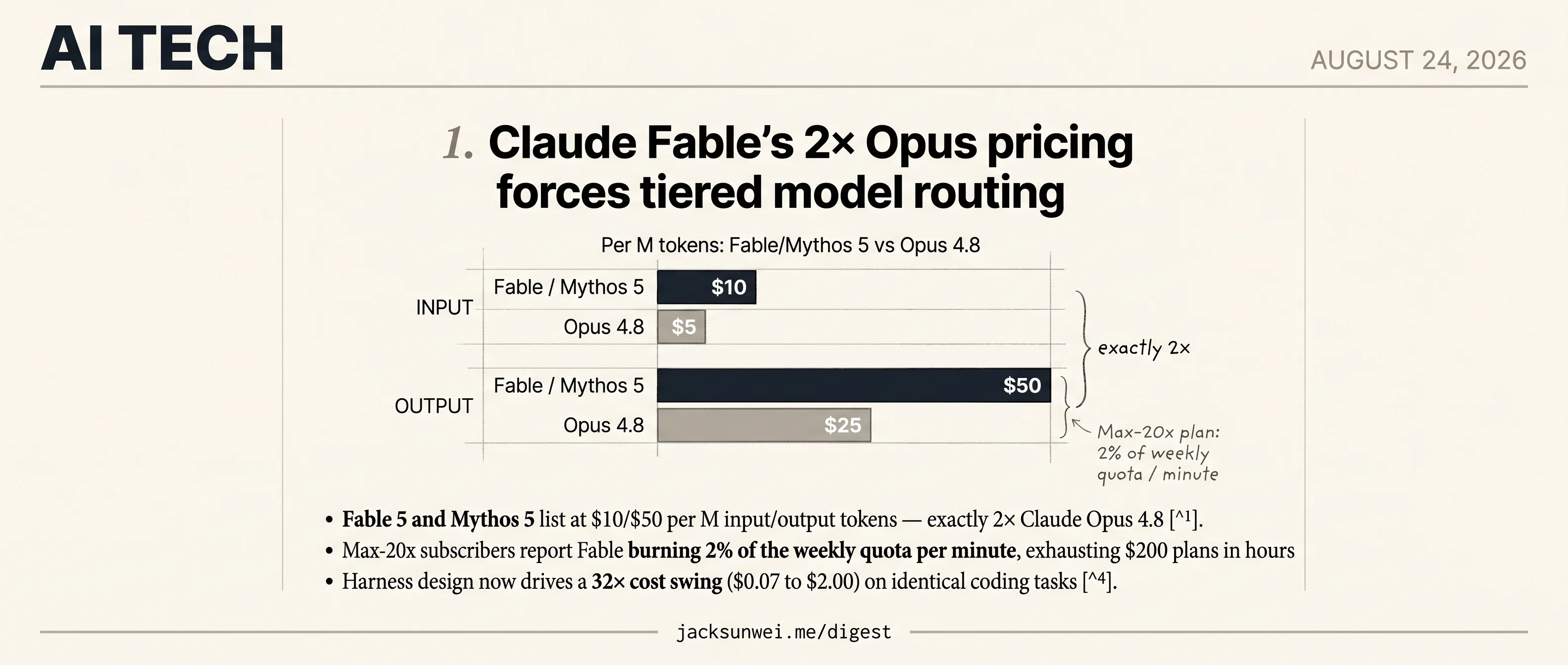
- Claude Fable 5 lists at $10/$50 per M tokens, exactly 2× Opus 4.8.
- Max-20x subscribers report Fable burning 2% of weekly quota per minute.
- Harness design drives a 32× cost swing ($0.07 to $2.00) on identical coding tasks.
- Gemini 3.1 Flash runs 99.7% below the 2023 GPT-4 baseline.
Today’s tech drop is really two prices moving in opposite directions. Anthropic’s new Fable 5 and Mythos 5 list at $10/$50 per million input/output tokens — exactly 2× Claude Opus 4.8, and enough to burn a $200 Max-20x subscription in an afternoon. Meanwhile the cheap tier keeps collapsing: Gemini 3.1 Flash now runs 99.7% below the 2023 GPT-4 baseline on the same work.
The gap between those two numbers is where the engineering happens. Harness design alone swings the cost of identical coding tasks by 32× — $0.07 versus $2.00 — which means picking a model is no longer a default at the top of a config file. It’s a per-task routing decision, and the routing logic is now doing more work than either end of the price range.
Claude Fable’s 2× Opus pricing forces tiered model routing
Source: simon-willison · published 2026-08-23
TL;DR
- Fable 5 and Mythos 5 list at $10/$50 per M input/output tokens — exactly 2× Claude Opus 4.8 1.
- Max-20x subscribers report Fable burning 2% of the weekly quota per minute, exhausting $200 plans in hours 2.
- Harness design now drives a 32× cost swing ($0.07 to $2.00) on identical coding tasks 3.
- Dissent: the cheap tier is still collapsing — Gemini 3.1 Flash is 99.7% below the 2023 GPT-4 baseline 4.
The free lunch ran out at the top of the menu
Drew Breunig’s argument, quoted approvingly by Simon Willison, is that Anthropic’s Fable-class release ended the era where you could ignore your coding harness and wait six months for a cheaper, smarter model to paper over the problem. Fable is smarter — BenchLM ranks Mythos 5 first of 224 models at 83.0, with coding singled out as its standout axis 5 — but CloudZero’s teardown pins the sticker at $10 per million input tokens and $50 per million output, precisely double Opus 4.8 1. That is the first frontier release in the Claude line where the price/capability curve bent the wrong way.
The pain is not theoretical. A Reddit thread from Claude Max-20x subscribers documents Fable consuming 2% of a weekly quota per minute during ordinary agentic sessions — a $200/month plan drained inside a working morning 2. When your best model meters like that, “just use the best model” stops being a strategy.
Tiered orchestration, in one picture
Breunig’s prescription is to route work by complexity. The shape looks like this:
flowchart LR
    A[Incoming task] --> B{Complexity router}
    B -->|Architecture, novel debugging| C[Fable / Mythos 5<br/>$10 / $50 per M]
    B -->|Standard features| D[Opus 4.8, Claude 5.6, Kimi K3<br/>~$5 / $25 per M]
    B -->|Boilerplate, lint, tests| E[GLM 5.3, Gemini Flash<br/>cents per M]
    C --> F[Merged output]
    D --> F
    E --> F
The router itself is the “coding harness” Breunig says teams stopped investing in during the free-lunch years. The 2026 Coding Agent Index puts a hard number on why that matters: the same model, wrapped in different scaffolding, produces a 32× cost swing on identical tasks — $0.07 versus $2.00 3. Harness now dominates model choice for total spend.
The dissent: the lunch just moved downstairs
Not everyone buys the elegy. The 2026 pricing survey at aimagicx points out that Gemini 3.1 Flash is down 99.7% against the GPT-4 2023 baseline, and open-weight contenders like GLM 5.3 and Kimi K3 land within three points of Opus 5 on the Artificial Analysis Intelligence Index 4. On that read, Breunig is describing a ceiling, not a trend — the free lunch persists for the 90% of workloads that never needed a frontier model, and the winning move is arbitraging volume down to the cheap tier rather than re-engineering around Fable.
Both framings converge on the same playbook, though: stop treating the model as a fungible commodity you swap quarterly. Willison has been making the adjacent case in security, where he frames defensive posture as literally proportional to token spend — “a system is only as hardened as the volume of tokens its owners spend on discovery compared to what an attacker spends on exploitation” 6. Once inference cost becomes a first-class engineering variable, it shows up everywhere: coding, red-teaming, evaluation.
The takeaway
The “wait for the next release” reflex is dead at the frontier and increasingly irrational everywhere else. Whether you agree with Breunig that the free lunch ended or with the aimagicx camp that it relocated, the operational answer is identical: a router, a harness, and a defensible reason for every token you send to the $50-output tier.
Footnotes
-
CloudZero — Claude Mythos pricing breakdown — https://www.cloudzero.com/blog/claude-mythos-pricing/
↩ ↩2Both Fable 5 and Mythos 5 are priced at $10 per million input tokens and $50 per million output tokens, exactly double the rate of Claude Opus 4.8.
-
Reddit r/claude — ‘Fable 5 is eating my Max 20x plan at 2%/minute’ — https://www.reddit.com/r/claude/comments/1u1cwkl/fable_5_is_eating_my_max_20x_plan_at_2_per_minute/
↩ ↩2Users on the $200/month Claude Max plan have documented cases where a single morning of heavy coding consumed 2% of their weekly limit per minute, effectively exhausting their quota in hours.
-
Medium — Coding Agent Index 2026 (Wasowski) — https://medium.com/@wasowski.jarek/coding-agent-index-2026-benchmarking-full-agent-stacks-model-harness-4183305e4b90
↩ ↩2The same model, wrapped in different harnesses, can result in a 32x difference in cost for identical tasks—ranging from $0.07 to over $2.00 per task.
-
aimagicx — LLM Pricing Collapse Developer Guide 2026 — https://www.aimagicx.com/blog/llm-pricing-collapse-developer-guide-building-cheap-ai-2026
↩ ↩2Gemini 3.1 Flash offered a 99.7% price reduction compared to the GPT-4 baseline of 2023… the constraint is no longer the ‘cost of a token,’ but rather the ‘cost of an accepted result.’
-
BenchLM — Claude Mythos 5 leaderboard entry — https://benchlm.ai/models/claude-mythos-5
↩BenchLM currently ranks Claude Mythos 5 as #1 of 224 models with a score of 83.0, citing its particular strength in coding.
-
Simon Willison — Cybersecurity as Proof of Work (Apr 2026) — https://simonwillison.net/2026/Apr/14/cybersecurity-proof-of-work/
↩A system is only as hardened as the volume of tokens its owners spend on discovery compared to what an attacker spends on exploitation.