Tau's cleaning humanoid is teleoperated, 77 points short on BEHAVIOR-1K
Tau's humanoid home-cleaner is remote-piloted through the hard tasks, with a 77-point sim-to-real gap and 210K gig workers filming replacements.
Tau’s cleaning humanoid is teleoperated, 77 points short on BEHAVIOR-1K
TL;DR
- Tau Robotics’ cleaning humanoid is remote-piloted through stairs, beds, and laundry.
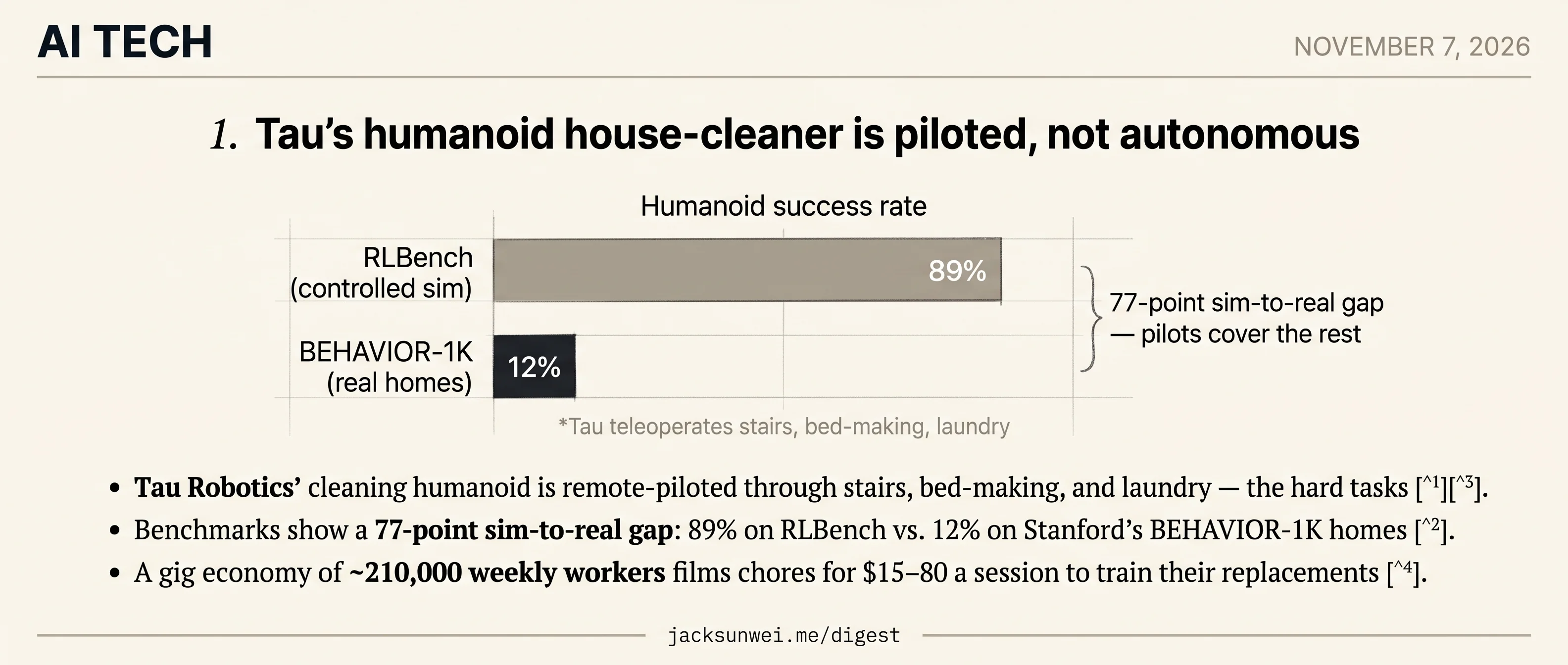
- RLBench 89% vs BEHAVIOR-1K 12% — a 77-point sim-to-real gap on real homes.
- ~210,000 weekly workers film chores for $15–80 to train their replacements.
- Tau’s ToS reportedly grants a perpetual, royalty-free license to home footage.
Today’s AI Tech slot is one story, and it earns the slot. Tau Robotics is demoing a humanoid that cleans homes — stairs, bed-making, laundry, the long tail that has broken every previous consumer-robot pitch. The demo works. It works because a human is driving. The autonomy stack lands at 12% on Stanford’s BEHAVIOR-1K versus 89% on the sim benchmark RLBench — a 77-point gap that is exactly the gap between a scripted lab and somebody’s actual kitchen.
The rest of the story is how Tau plans to close that gap: a gig workforce of roughly 210,000 weekly contributors filming their own chores for $15–80 a session, under a ToS that reportedly grants Tau a perpetual royalty-free license to the footage with no deletion path. The product being sold to homeowners and the product being built from homeowners are, for now, two different things.
Tau’s humanoid house-cleaner is piloted, not autonomous
Source: mit-tech-review-ai · published 2026-11-06
TL;DR
- Tau Robotics’ cleaning humanoid is remote-piloted through stairs, bed-making, and laundry — the hard tasks 12.
- Benchmarks show a 77-point sim-to-real gap: 89% on RLBench vs. 12% on Stanford’s BEHAVIOR-1K homes 3.
- A gig economy of ~210,000 weekly workers films chores for $15–80 a session to train their replacements 4.
- Tau’s ToS reportedly grants a perpetual, royalty-free license to home footage, with no way to “untrain” models after deletion 5.
A cohort launch, not a lone glimpse
MIT TR frames Tau Robotics as a taste of the future, but it’s one entrant in an SF humanoid-cleaning cohort that popped up in 2026. Gatsby claims the first U.S. consumer humanoid cleaning back in May 2026, runs a robot-agnostic software layer, and charges a flat $150/visit against Tau’s $30–60/hour 1. 1X’s Neo is shipping into the same homes at $20,000 outright or $499/month 2. Three different business models — hourly service, flat-rate visit, consumer hardware — are all betting the same bet: that a humanoid in your kitchen is the right wedge.
The autonomy gap is the story
Independent benchmarks tell a harsher version of the demo. Stanford’s BEHAVIOR-1K, cited in Forbes, shows humanoids scoring ~89% success on RLBench’s controlled simulations and collapsing to ~12% in unpredictable household settings 3. The WSJ’s Neo trial reportedly ran 100% teleoperated — every task driven by a remote human 2. Hacker News commenters invoked Moravec’s Paradox to argue the “hockey-stick” manipulation curve is marketing, not measurement 6. Tau’s own admission that pilots handle the hard bits fits the pattern cleanly.
That reframes what the robot is. It’s less an autonomous appliance than a mocap suit with legs — a way to collect expert demonstrations in situ, in real homes, at a price point where customers pay to be the training set.
flowchart LR
    A[Customer books clean] --> B[Humanoid enters home]
    C[Remote pilot] -. teleop .-> B
    B --> D[Video + telemetry capture]
    D --> E[Large Behavior Model training]
    E -. future autonomy .-> B
Whose labor, whose data
Two threads the original piece soft-pedals carry the weight. First, labor: platforms like DoorDash Tasks and Scale AI have recruited roughly 210,000 weekly uploaders — often former cleaners and delivery drivers — to wear motion-capture sensors and film chores for $15–80 a session, explicitly to build Large Behavior Models that will automate their trades 4. Tau’s pilot-cleaners are the on-site variant of the same pipeline, doing the training runs under a humanoid chassis instead of a GoPro.
Second, data. Tau’s terms reportedly grant the company a “perpetual, worldwide, royalty-free license” to all recorded footage and telemetry, and Tau concedes it cannot “untrain” a model already influenced by a customer’s data before a deletion request lands 5. HN called constant in-home recording a dealbreaker 6. Neo inherits the same problem: its remote operators are, by design, watching the living room 2.
What’s actually at stake
The headline isn’t “a robot cleaned my tub.” It’s that an entire category is launching on a subsidized-teleoperation business model, funded by customers who are simultaneously the users, the training data, and — if the 12% real-home success rate 3 ever closes — the eventual churn. The sustainable question is which breaks first: the unit economics of paying pilots, the privacy backlash to perpetual home video 5, or the gig pipeline training its own replacements 4.
Footnotes
-
Aron Frishberg — ‘Gatsby’ writeup — https://www.aronfrishberg.com/gatsby
↩ ↩2Gatsby… claimed the first historical humanoid cleaning for a U.S. consumer in May 2026… charges a flat fee of $150 per session regardless of home size… robot-agnostic distribution layer.
-
Forbes — Erik Kain on 1X Neo — https://www.forbes.com/sites/erikkain/2025/10/29/this-20000-neo-robot-will-clean-your-home-but-theres-a-catch-and-its-kind-of-terrifying/
↩ ↩2 ↩3 ↩41X Neo’s primary business model relies on ‘Expert Mode,’ where a remote human operator assists the robot with unfamiliar tasks… WSJ noted that 100% of tasks in their session were teleoperated
-
Forbes — John Koetsier, ‘Humanoid Robots 88% Fail Rate’ — https://www.forbes.com/sites/johnkoetsier/2026/04/14/humanoid-robots-88-fail-rate-completing-home-tasks/
↩ ↩2 ↩3humanoid robots achieve an 89.4% success rate in controlled simulations (RLBench), [but] their success rate drops to just 12.4% when performing the same tasks in unpredictable households (BEHAVIOR-1K)
-
Metaintro — ‘Gig Workers Training Humanoid Robots 2026’ — https://www.metaintro.com/blog/gig-workers-training-humanoid-robots-2026
↩ ↩2 ↩3DoorDash Tasks… and Scale AI have recruited over 210,000 weekly uploaders… workers—often former cleaners or delivery drivers—wear motion-capture sensors… to build ‘Large Behavior Models’… essentially training their own automated replacements for roughly $15 to $80 per session
-
MartinCid — Tau Robotics Terms analysis — https://www.martincid.com/technology-sv/tau-robotics-humanoid-cleaning-robots-remote-pilots-100-visit/
↩ ↩2 ↩3customers grant Tau Robotics a ‘perpetual, worldwide, royalty-free license’ to all recorded footage and telemetry… they cannot ‘untrain’ a model that has already been influenced by a user’s data before the deletion request was processed
-
Hacker News discussion — https://news.ycombinator.com/item?id=48145142
↩ ↩2developers cited Moravec’s Paradox… as a reason to doubt the immediate feasibility of fully autonomous domestic robots… significant security and privacy concerns were raised regarding the ‘dealbreaker’ requirement for constant video recording of users’ homes