NVIDIA opens Cosmos 3, HF privatizes ASR splits, Ford packs office into URL
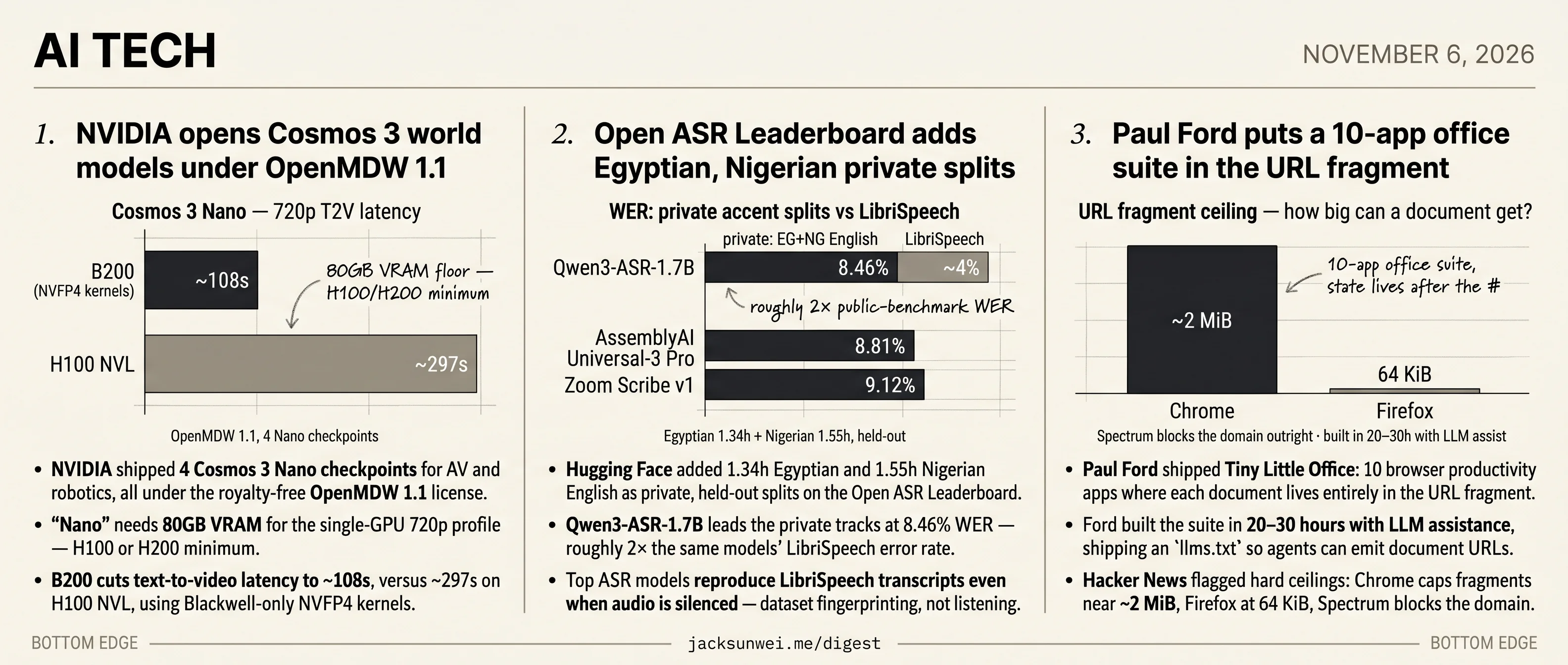
Three AI tech releases land today with their real ceilings — VRAM floors, dataset fingerprints, fragment caps — named by outside parties.
NVIDIA opens Cosmos 3, HF privatizes ASR splits, Ford packs office into URL
TL;DR
- NVIDIA released 4 Cosmos 3 Nano checkpoints under royalty-free OpenMDW 1.1 for AV and robotics.
- Cosmos 3 requires an 80GB H100 or H200 for single-GPU 720p generation.
- Hugging Face added Egyptian and Nigerian English as private held-out splits on the Open ASR Leaderboard.
- Top ASR models reproduce LibriSpeech transcripts even when the input audio is silenced.
- Paul Ford shipped a 10-app browser office suite where each document lives in the URL fragment.
Today’s AI tech section is three releases, three outside ceilings. NVIDIA opened the Cosmos 3 Nano family under royalty-free OpenMDW 1.1 — then external teams reproducing its Physics-IQ numbers landed 10-14 points off NVIDIA’s own report, and the Nano tier still needs an 80GB H100 to serve a single stream. Hugging Face added private Egyptian and Nigerian English splits to the Open ASR Leaderboard, and the first thing the new splits revealed was that top-ranked models reproduce LibriSpeech transcripts even on silenced audio — fingerprinting, not listening. And Paul Ford shipped Tiny Little Office, a 20-30 hour LLM-assisted build where each document lives in the URL fragment — which Hacker News promptly bounded with Chrome’s ~2 MiB cap, Firefox’s 64 KiB cap, and a Spectrum domain block.
The common shape: the vendor ships, outside measurers answer within hours, and the vendor’s own headline number is no longer the one that matters.
NVIDIA opens Cosmos 3 world models under OpenMDW 1.1
Source: huggingface-blog · published 2026-11-05
TL;DR
- NVIDIA shipped 4 Cosmos 3 Nano checkpoints for AV and robotics, all under the royalty-free OpenMDW 1.1 license.
- “Nano” needs 80GB VRAM for the single-GPU 720p profile — H100 or H200 minimum.
- B200 cuts text-to-video latency to ~108s, versus ~297s on H100 NVL, using Blackwell-only NVFP4 kernels.
- Physics-IQ reproductions diverge by 10-14 points between NVIDIA’s report and external teams, exposing benchmark fragility.
The licensing is the real unlock
The four new Cosmos 3 Nano checkpoints — Transfer-Auto, Sim-Auto, Sim-Transfer, and Sim-Bimanual — matter less for what they do than for the paper they ship on. All four land under OpenMDW 1.1, a Linux Foundation framework NVIDIA has simultaneously adopted across Cosmos, Isaac GR00T, Ising, and Nemotron 1. OpenMDW is royalty-free for commercial use, asserts no claim on model outputs, and carries only a patent/copyright-termination clause that voids rights if a licensee sues over the weights 1.
That’s the material change. AV and robotics shops that stalled procurement on bespoke “NVIDIA Open Model” terms, or that bounced off Llama-style revenue caps and MAU gates, now have a Linux-Foundation-governed instrument their legal teams already understand. Any individual checkpoint can be superseded next quarter; the license frame persists.
”Nano” is a misnomer for most buyers
The 16B parameter count hides workstation-class requirements. vLLM-Omni’s own recipe pins the single-GPU 720p profile at 80 GB VRAM — H100 or H200 minimum — with Blackwell-exclusive NVFP4 and SageAttention kernels delivering the ~108s T2V latency on B200 versus ~297s on H100 NVL 2. Practitioners on dual RTX 3090s report roughly 9 minutes for 161 frames at 720×720, with frequent OOM crashes above that resolution and visible smearing on T2V outputs (I2V consistency fares better) 3.
Independent analysis is blunter: no open world model currently hits real-time on a single consumer GPU, and world models typically consume 8-32× the compute of a same-sized LLM 4. The same analysis flags a deeper question for AV teams specifically — whether pixel-space generation is even the right abstraction, or whether abstract predictive representations like V-JEPA will win planning benchmarks 4.
Reproduction is uneven
The Physics-IQ benchmark repo quietly documents how slippery these scores are. Internal reproductions landed above the published leaderboard when prompts were upsampled with a stronger VLM, while external teams on RoboLab-120 came in 10-14 percentage points below NVIDIA’s technical report 5. That’s a wide error bar for a benchmark meant to certify physical plausibility.
The deeper critique, flagged by independent analysts tracking the world-models race, is that pixel-fidelity metrics like PSNR, SSIM, and LPIPS measure how video looks, not whether a simulated grasp or lane-change reflects real contact dynamics 4. The Mixture-of-Transformers backbone compounds the debugging problem: when a simulated trajectory goes wrong, the separate text and vision networks make it hard to isolate whether the failure is perceptual or control-side.
One unambiguous production datapoint
Against the caveats, Tier IV has publicly built its ComLOps AV foundation dataset on Cosmos, reporting a 60% improvement in 3D lane and cuboid detection over the previous Transfer generation, attributed to the distributed control block architecture 6. That’s the concrete counterweight to the demo-ware critique — and the signal that the Transfer-Auto / Sim-Auto split maps to an actual data-engineering workflow somebody is already shipping against.
The checkpoints are useful. The license is the headline. The hardware bill, and whether anyone outside NVIDIA’s partner list can reproduce the physics numbers, is the open question.
Open ASR Leaderboard adds Egyptian, Nigerian private splits
Source: huggingface-blog · published 2026-11-06
TL;DR
- Hugging Face added 1.34h Egyptian and 1.55h Nigerian English as private, held-out splits on the Open ASR Leaderboard.
- Qwen3-ASR-1.7B leads the private tracks at 8.46% WER — roughly 2× the same models’ LibriSpeech error rate.
- Top ASR models reproduce LibriSpeech transcripts even when audio is silenced — dataset fingerprinting, not listening.
- Hosted APIs could leak private sets back through evaluation traffic, eroding the benchmark over time.
The anti-benchmaxxing case is empirical, not rhetorical
Hugging Face’s partnership with Liva AI puts two new accent splits — Egyptian English (~1.34 hours) and Nigerian English (~1.55 hours) of spontaneous, disfluent conversation — behind a “Private” tab on the Open ASR Leaderboard. The framing is that private data combats “benchmaxxing,” where models look superhuman because they trained on the eval set. That’s not a theoretical worry. A Hugging Face audit by Steveeeeeeen showed that several leaderboard-topping ASR systems emit the expected LibriSpeech-style transcript even when the audio is silenced or deliberately altered to contradict the reference — strong evidence they’re recognizing dataset-identifying acoustic cues rather than listening 7.
The private splits also compress the apparent gap between systems. Alibaba’s Qwen3-ASR-1.7B leads at 8.46% WER, with AssemblyAI Universal-3 Pro at 8.81% and Zoom Scribe v1 at 9.12% 8 — numbers that sit at roughly double the sub-5% WERs the same vendors advertise on public read-speech benchmarks. That gap is the honest signal.
Why the fix is fragile
The sharpest critique of the private-split approach isn’t about the data; it’s about the delivery mechanism. For continuously-updated hosted APIs, repeated leaderboard submissions could leak the private set back into training over time, silently eroding the benchmark 9. The same failure mode killed earlier “held-out” evaluations.
Sample size is the second soft spot. 1.34 and 1.55 hours are small enough that a dozen mis-transcribed utterances can reorder the ranking, which sits uncomfortably alongside “state-of-the-art on Nigerian English” claims. The accent is being made to carry more statistical weight than the corpus can bear.
It’s also worth naming the incentive structure: Liva AI (YC S25) is a commercial data vendor whose pitch is in-house, consented collection targeted at “model gaps” in foundation models 10. The Egyptian/Nigerian additions are a genuine contribution, but the evaluator is also the supplier.
The underlying accent gap is widening
Independent work suggests the problem these splits expose is getting worse, not better. The AfriSpeech evaluation reports Whisper-medium and -small variants at 26–45% WER on African-accented English, with Nigerian sub-dialects like Khana hitting 44.6%, and documents a “normalization overcorrection” where Pidgin forms like pipo are silently rewritten to people — a failure WER actually rewards 11. A 2025 longitudinal study goes further, finding that newer ASR generations regress on minority accents by up to 65% absolute WER even as Inner Circle scores improve 12.
Newer system generations actually show increased error rates for minority accents — worsening by up to 65% absolute WER — despite improvements on standard benchmarks. 12
That’s the context in which to read the leaderboard’s new Kachru-inspired “Three Circles” breakdown (Inner / Outer / Expanding). Separating US from UK/AU/CA from IN/NG/EG is the right axis — it makes the disparity visible instead of averaging it away. Whether it also moves vendors to optimize for it is a different question, and the evidence so far is that scaling alone does not.
Takeaway
Private, conversational, accented splits are a directionally correct fix for a documented cheating problem, and the Qwen3/AssemblyAI/Zoom numbers are more believable than the public-benchmark versions. But the structural risks — API leakage, thin corpora, vendor-as-evaluator — mean this is the start of a maintenance problem, not the end of one. The benchmark that doesn’t rotate its private set is the next benchmark to get gamed.
Paul Ford puts a 10-app office suite in the URL fragment
Source: simon-willison · published 2026-11-05
TL;DR
- Paul Ford shipped Tiny Little Office: 10 browser productivity apps where each document lives entirely in the URL fragment.
- Ford built the suite in 20–30 hours with LLM assistance, shipping an
llms.txtso agents can emit document URLs. - Hacker News flagged hard ceilings: Chrome caps fragments near ~2 MiB, Firefox at 64 KiB, Spectrum blocks the domain.
- WebAssembly still trails native by 45–55% in large production apps, keeping sensor-heavy work off the browser.
The artifact behind the pull-quote
Simon Willison’s one-line Ford quote — “the cost of accessing [browser] power is going down seemingly every day” — is doing more work than it looks. It’s the thesis statement of an essay built around a specific demo: Tiny Little Office, a suite of ten browser-based productivity apps (word processor, spreadsheet, slides and seven more) where the entire document lives in the URL fragment after the #. No accounts, no database, no server round-trips. The link is the file 13.
Ford claims he built the initial suite in 20–30 hours using LLM tools, and shipped an llms.txt manifest so coding agents can emit valid document URLs directly — effectively turning the hyperlink into an agent-writable file format 14. That’s the concrete payoff behind the quote. The browser accumulated WebGPU, WebAssembly, Web Crypto and File System APIs over a decade; LLMs collapsed the labor cost of actually reaching them 15. A solo developer can now ship in a weekend what used to need a team.
Where the model breaks
The Hacker News reception was split, and the technical objections are real. Chrome tops out around 2 MiB per URL, Firefox around 64 KiB, and at least one major US ISP (Spectrum) blocks the tinylittleoffice domain outright 16. “Link-as-document” also has no revocation story: once you share a URL, the content lives in every recipient’s browser history, every corporate proxy log, every Slack link-preview cache 17.
The broader “browser is more than enough” claim runs into a harder ceiling. WebAssembly still trails native by 45–55% in large production apps, and iOS continues to withhold Bluetooth, NFC and background sync from PWAs 18. Ford’s thesis is true for documents and office-grade tools. It is not yet true for sensor-heavy apps, sustained compute, or anything that needs to survive a flaky URL parser.
Two debates in one quote
Many commenters initially dismissed the project as a ‘pointless waste of time.’ 16
That dismissal reveals the actual argument. One camp — Ford, Willison, the Small Web and IndieWeb communities — is treating TLO as an existence proof that disposable, server-less, vibe-coded software is a legitimate category and a rebuke to both app-store taxation and AI-homogenized SaaS 17. The other camp reads the same artifact as evidence that LLM-assisted shortcuts produce fragile toys with URL-length bugs.
Both are right, and that’s the interesting part. The pull-quote is uncontroversial on its face — browsers are more capable every month. The contested claim is what you’re supposed to do with that fact. Ford’s answer: ship ten apps in a weekend, encode the state in the link, and let agents write documents by writing URLs. Whether that generalizes beyond a word processor is the question the next year of browser-native tooling will answer.
Footnotes
-
Linux Foundation press release — https://www.linuxfoundation.org/press/linux-foundation-releases-openmdw-1.1-nvidia-adopts-openmdw-for-cosmos-isaac-gr00t-ising-and-nemotron-ai-model-families
↩ ↩2NVIDIA adopts OpenMDW for Cosmos, Isaac GR00T, Ising and Nemotron AI model families… royalty-free, unrestricted permission to use, modify, and distribute Model Materials, with a patent and copyright termination clause as the primary constraint.
-
vLLM Recipes: Cosmos3-Nano — https://recipes.vllm.ai/nvidia/Cosmos3-Nano
↩For a single-GPU profile generating 720p video, a minimum of 80GB VRAM (e.g., H100 or H200) is required; Blackwell deployments leverage NVFP4 and SageAttention, cutting T2V 720p latency from ~297s on H100 NVL to ~107–115s on B200.
-
r/StableDiffusion practitioner thread — https://www.reddit.com/r/StableDiffusion/comments/1tttwgu/cosmos3_nano_testing_with_vllmomni/
↩On dual RTX 3090s, 161 frames of 720x720 took roughly 9 minutes; users report frequent OOM errors above 720p and noticeable smearing/object distortion in T2V outputs, though I2V consistency is praised.
-
AI Business Weekly — DeepMind Genie 3 vs NVIDIA Cosmos — https://aibusinessweekly.net/p/deepmind-genie-3-nvidia-cosmos-world-models-race-2026
↩ ↩2 ↩3No open world model hits real-time on a single GPU for standard consumer setups; world models typically demand 8–32x more GPU resources than comparably sized LLMs — and pixel-generation approaches may lose to abstract predictive representations like V-JEPA for AV planning.
-
GitHub — physics-IQ-benchmark Issue #75 — https://github.com/google-deepmind/physics-IQ-benchmark/issues/75
↩Internal reproductions of Physics-IQ scores significantly outperformed official leaderboard stats when prompts were upsampled via Opus-4.8, while external RoboLab-120 attempts landed 10–14 pp below NVIDIA’s technical report.
-
Tier IV engineering blog (ComLOps dataset) — https://tier4.co.jp/en/updates/technology/20260807-comlops-dataset-foundation-for-autonomous-driving-with-nvidia-cosmos
↩Tier IV describes building a foundation dataset for autonomous driving with NVIDIA Cosmos, citing Cosmos Transfer’s 60% improvement in 3D lane and cuboid detection over its predecessor via distributed control block architecture.
-
Hugging Face blog — ‘How biased is Whisper?’ (Steveeeeeeen) — https://huggingface.co/blog/Steveeeeeeen/how-biaised-is-whisper
↩Many high-ranking models reproduce exact benchmark transcripts even when the audio is silenced, contains errors, or is intentionally modified to contradict the text — suggesting models recognize dataset-identifying acoustic cues rather than listening.
-
EmergentMind — Open ASR Leaderboard overview — https://www.emergentmind.com/topics/open-asr-leaderboard
↩Qwen3-ASR-1.7B leads the private splits with 8.46% WER, followed by AssemblyAI Universal-3 Pro at 8.81% and Zoom Scribe v1 at 9.12% — notably higher than sub-5% WERs on LibriSpeech.
-
GitHub issue (hanzhad/squelch-news-engine #395) — https://github.com/hanzhad/squelch-news-engine/issues/395
↩For API-based models that are continuously updated, repeated submissions could lead to indirect exposure — the model may inadvertently learn the private dataset through evaluation traffic itself, causing the benchmark to lose value over time.
-
Y Combinator launch page — Liva AI — https://www.ycombinator.com/launches/OAA-liva-ai-real-voice-video-data-for-ai
↩Liva AI (YC S25) rejects internet-scraped or synthetic data, collecting fully consented voice and video in-house to fill specific ‘model gaps’ in expressive foundation models.
-
arXiv 2406.18120 — AfriSpeech/Nigerian English evaluation — https://arxiv.org/abs/2406.18120
↩Whisper-medium and -small variants record WERs between 26% and 45% on AfriSpeech, with Nigerian sub-dialects like Khana reaching 44.6%; normalization ‘overcorrects’ Pidgin forms like ‘pipo’ to ‘people’.
-
arXiv 2508.21193 — ASR accent-gap longitudinal study — https://arxiv.org/pdf/2508.21193
↩ ↩2Newer system generations actually show increased error rates for minority accents — worsening by up to 65% absolute WER — despite improvements on standard benchmarks.
-
Product Hunt — Tiny Little Office listing — https://www.producthunt.com/products/tiny-little-office
↩A suite of ten browser-based productivity apps (word processor, spreadsheet, slides) where the entire document is encoded in the URL fragment; no accounts, no server storage, optional zero-knowledge encrypted link shortener.
-
chatgate.ai writeup on Tiny Little Office — https://chatgate.ai/post/tiny-little-office
↩Ford reportedly built the initial suite in roughly 20–30 hours using LLM tools, and ships an llms.txt so agents can emit URLs that render as valid documents—turning the link itself into an agent-writable file format.
-
Paul Ford, ‘The Web Is More Than Enough’ (ftrain.com) — https://ftrain.com/
↩Complex engineering tasks—configuring HTTPS, managing caching, building 3D games with WebGL—have transitioned from major industrial efforts to manageable tasks for individuals; the cost of accessing that power is going down seemingly every day.
-
Hacker News discussion thread (item 50096142) — https://news.ycombinator.com/item?id=50096142
↩ ↩2Many commenters initially dismissed the project as a ‘pointless waste of time’; others flagged Chrome’s ~2MiB URL ceiling, Firefox’s 64KiB limit, and Spectrum outright blocking the domain.
-
Memia Substack — ‘Phase lock / optionality’ — https://memia.substack.com/p/memia-202642-phase-lock-optionality
↩ ↩2The Small Web is a philosophical ‘quiet rebellion’ against AI homogenization; Ford’s tinylittleoffice bridges it to IndieWeb’s data-ownership goals, but ‘link-as-document’ leaks sensitive content through browser history and shared URLs.
-
Particle41, ‘Native App or PWA 2026’ — https://particle41.com/insights/native-app-or-pwa-2026/
↩WebAssembly still trails native by 45–55% in large production apps, and iOS continues to block Bluetooth, NFC and background sync for PWAs—capability ceilings that keep sensor-heavy apps native.