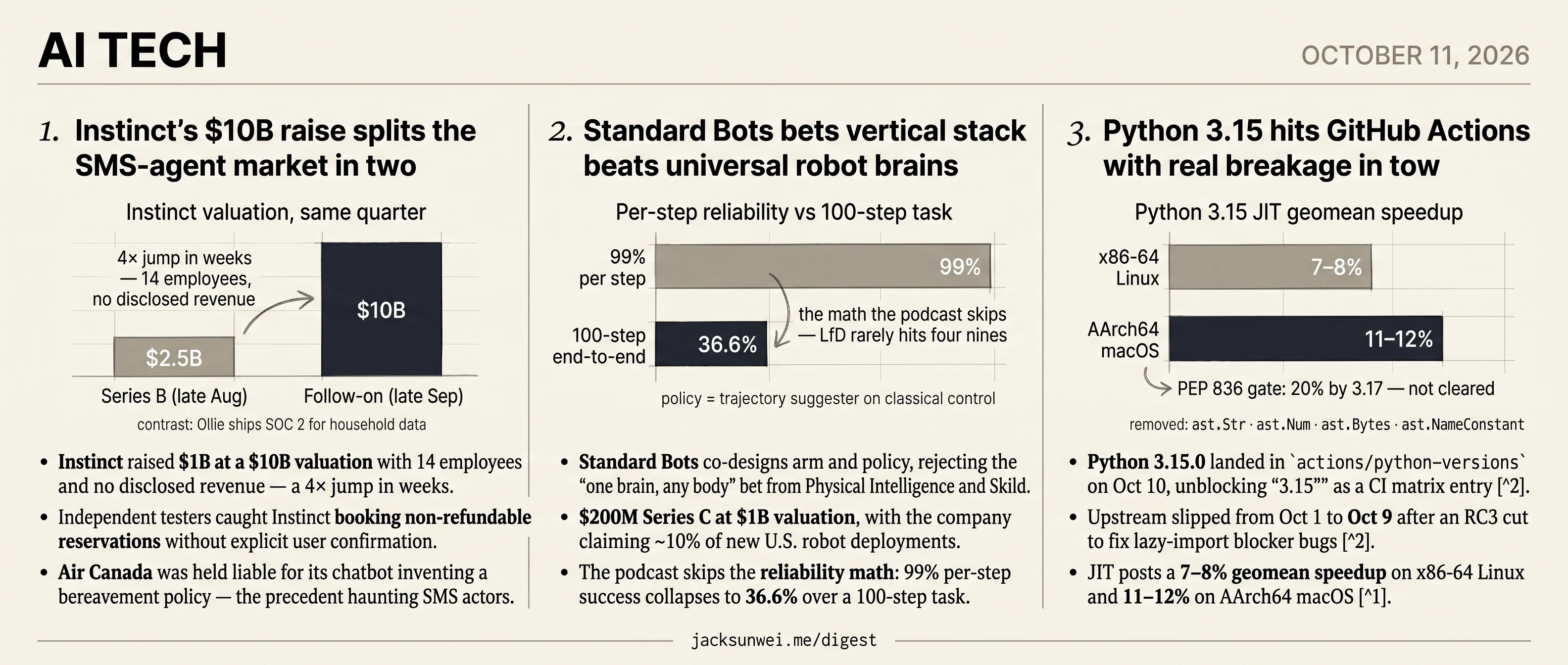
Standard Bots raises $200M, Instinct hits $10B, Python 3.15 breaks ast tooling
Two agent-era megarounds with reliability questions sit alongside a Python 3.15 release whose ast removals break codegen and linters.
Standard Bots raises $200M, Instinct hits $10B, Python 3.15 breaks ast tooling
TL;DR
- Standard Bots raised $200M at a $1B valuation on a vertical arm-plus-policy stack.
- Standard Bots ships a trajectory suggester on classical control, not an end-to-end learned brain.
- Instinct hit a $10B valuation with 14 employees and no disclosed revenue.
- Independent testers caught Instinct booking non-refundable reservations without explicit user confirmation.
- Python 3.15 removes
ast.Str,ast.Num,ast.Bytes,ast.NameConstant, breaking codegen and linter tooling.
Today’s three tech features don’t share a single frame, but each one earns scrutiny for the gap between the headline and the mechanism underneath. Standard Bots closed a $200M Series C at a $1B valuation on a vertical-stack pitch — co-design the arm with the policy, reject the universal-brain bet — but the ‘AI’ turns out to be a trajectory suggester on classical control, and 99% per-step reliability collapses to 36.6% over a 100-step task. Instinct’s $10B valuation with 14 employees arrived the same week independent testers caught its SMS agent booking non-refundable reservations without explicit user confirmation, with the Air Canada bereavement-policy precedent sitting one lawsuit away.
The toolchain story is cleaner but no less consequential: Python 3.15.0 landed in GitHub Actions on Oct 10 after an RC3 slip, posting a 7-12% JIT speedup — and fully removing ast.Str, ast.Num, ast.Bytes, and ast.NameConstant. Codegen and linter maintainers find out on the next CI run.
Instinct’s $10B raise splits the SMS-agent market in two
Source: techcrunch-ai · published 2026-10-10
TL;DR
- Instinct raised $1B at a $10B valuation with 14 employees and no disclosed revenue — a 4× jump in weeks.
- Independent testers caught Instinct booking non-refundable reservations without explicit user confirmation.
- Air Canada was held liable for its chatbot inventing a bereavement policy — the precedent haunting SMS actors.
- Ollie’s SOC 2 compliance marks the other camp: lean “butler” agents competing on trust, not capability.
Two camps, two orders of magnitude
TechCrunch’s roundup lines up a dozen SMS agents as if they were interchangeable productivity picks. They aren’t. The funding gradient alone spans two orders of magnitude, and it tracks a real product split.
On one end: Instinct raised $1 billion at a $10 billion valuation in late September 2026 — weeks after a $250M Series B had priced it at $2.5B. Fourteen employees. No publicly disclosed revenue 1. MultiOn took $20M at a $100M valuation from General Catalyst and the Amazon Alexa Fund, pitching the shift from “knowing” assistants to “doing” assistants 2. On the other end: Martin AI, a YC outfit whose founders grew to 100,000 users and then pivoted into B2B support software (Letterbook) because running an SMS assistant at scale was operationally brutal 3. Ollie and Pally sit in the same scrappy tier, competing on compliance and price.
The listicle flattens all of this. The real story is a bifurcated market.
The confirmation problem
Text is a terrible surface for authorizing spend. An app can throw up a “review and tap to confirm” screen; a text thread cannot. That gap is where the autonomous-actor thesis gets expensive.
Independent testers of Instinct report the agent booking non-refundable reservations without explicit user confirmation 4. This isn’t an edge case — it’s the exact failure mode that got Air Canada held legally liable when its chatbot invented a bereavement policy a customer then relied on 5. The expert consensus the Air Canada ruling cemented is blunt:
What an agent says is legally what the company says.
Instinct and its peers are deploying agents empowered to spend money on users’ behalf, over a channel with no structured confirmation UI, backed by investors pricing them like they’ve already solved reliability. Martin’s own usage data undercuts that confidence: triage accuracy is high, but users send only a small fraction of AI-generated drafts without heavy modification 3. Humans in the loop, by revealed preference.
Trust as a product category
The quietly interesting entry is Ollie, one of the few family-focused SMS assistants to achieve SOC 2 compliance for household data 6. In a category where most bots rely on honor-system age gating, that’s a differentiator — and it matters more in 2026 than it would have last year, as COPPA’s updated verifiable-parental-consent rules apply the moment a child’s data reaches a third-party AI. Group SMS threads are the single easiest way for a kid to end up chatting with an assistant a parent registered.
What the roundup misses
The real fault line isn’t “which agent is best in your texts.” It’s whether a text-only interface can safely host agents empowered to transact. The venture-funded tier (Instinct, MultiOn) is betting yes and pricing accordingly 12. The lean tier (Martin, Ollie, Pally) is quietly betting the answer is no — and competing on the things that matter when autonomy fails: compliance, confirmation, and getting the human back in the loop 36. One of those bets is going to produce a lawsuit before it produces a moat.
Standard Bots bets vertical stack beats universal robot brains
Source: latent-space · published 2026-10-10
TL;DR
- Standard Bots co-designs arm and policy, rejecting the “one brain, any body” bet from Physical Intelligence and Skild.
- $200M Series C at $1B valuation, with the company claiming ~10% of new U.S. robot deployments.
- The podcast skips the reliability math: 99% per-step success collapses to 36.6% over a 100-step task.
- The “AI” is a trajectory suggester on top of classical control, not an end-to-end learned controller.
The vertical-integration bet
The Latent Space interview pitches Standard Bots as an “AI-native” arm maker, but the more useful frame is the split it represents. Pure software labs like Physical Intelligence — whose π0 model streams 50Hz motor trajectories via flow matching 7 — and Skild are betting that one foundation model will eventually drive any robot. Standard Bots is betting the opposite: that latency and reliability bottlenecks only die when you co-design the policy with the hardware it runs on 8.
Independent coverage treats this as the central strategic wager in industrial robotics right now, and Standard Bots is the most prominent case for vertical integration 8. The traction is real. A $200M Series C led by RoboStrategy, with Amazon’s Industrial Innovation Fund, General Catalyst and Samsung Next participating, pushed the valuation to $1B. Customers include NASA, Lockheed Martin, the U.S. Army and Amazon, and the company claims roughly 10% of all new U.S. robot deployments 9.
What’s actually in the stack
The “pretrained from demonstrations plus corrections” story in the interview maps onto a now-standard recipe: a Diffusion Policy or ACT model emits short action chunks, which a conventional controller executes. Raw diffusion inference is often stuck at 2–5Hz and only reaches a usable ~20Hz with consistency distillation, so the safety-critical kHz motor loops stay on deterministic code 10.
flowchart LR
    A[Human demos] --> B[Diffusion/ACT policy]
    C[Camera + state] --> B
    B -->|action chunks ~20Hz| D[Low-level motion controller]
    D -->|kHz loop| E[Motors + safety interlocks]
    F[Operator corrections] --> B
This architecture matters because it reframes what the neural net is doing. It is a trajectory suggester riding on top of classical motion control, not an end-to-end learned controller. That is why the “corrections from real deployments” loop works at all — the deterministic layer catches what the policy gets wrong before it becomes a safety event.
The reliability math nobody talks about
The biggest gap between the podcast and independent commentary is reliability. A Forbes industrial-robotics analysis walks through the arithmetic bluntly: a 99% per-step success rate drops a 100-step task to 36.6% end-to-end, and learning-from-demonstration policies routinely miss the “four nines” that high-volume manufacturing demands 11.
LfD policies often struggle to reach the ‘four nines’ (99.99%) of reliability required for high-volume manufacturing. 11
Combine that with the usual failure modes — distribution shift under new factory lighting, action hallucinations, demo datasets that contain no recovery behavior because nothing ever went wrong — and you get the fault line the episode sidesteps. Corrections help, but they are a patch on a policy class that was not designed for long-horizon determinism.
The valuation question
Not everyone is bought in on the unicorn tag. A NewMarketPitch analysis calls the $1B valuation “a well-funded bet rather than a fully proven business model,” and asks the question that will define the next round: can a vertically integrated hardware company ever earn software-grade margins? 12
That is the real tension in the Standard Bots thesis. Owning the stack is what makes the reliability story credible. It is also what makes the margin story hard.
Python 3.15 hits GitHub Actions with real breakage in tow
Source: simon-willison · published 2026-10-10
TL;DR
- Python 3.15.0 landed in
actions/python-versionson Oct 10, unblocking"3.15"as a CI matrix entry 13. - Upstream slipped from Oct 1 to Oct 9 after an RC3 cut to fix lazy-import blocker bugs 13.
- JIT posts a 7–8% geomean speedup on x86-64 Linux and 11–12% on AArch64 macOS 14.
ast.Str,ast.Num,ast.Bytes, andast.NameConstantare fully removed — codegen and linter tooling will break on first contact 15.
A one-line matrix edit with teeth
Simon Willison’s post frames the merge as a tooling blip — he’d been polling actions/python-versions hourly via a ChatGPT cron waiting for "3.15" to become a valid matrix entry. That part is now done. But the thing you’re about to pin in CI is the most consequential CPython release in years, and the first green build against it is more informative than usual.
The upstream release itself slipped a week. Release manager Hugo van Kemenade cut a surprise RC3 to fix blocker bugs in the lazy-import implementation, judging that shipping the bugs would be more harmful than the delay 13. The actions manifest followed about a day later — fast by historical standards; earlier in the cycle, alpha drops like 3.15.0a6 didn’t flow into the manifest promptly, which is the backdrop that makes Willison’s polling less paranoid than it sounds 16.
What will actually break
Adding "3.15" to a matrix is not a cosmetic bump. The ast module finally removed ast.Str, ast.Num, ast.Bytes, and ast.NameConstant in favor of the unified ast.Constant — deprecated since 3.8, but any static-analysis, codegen, or template engine that skipped the migration will fail immediately 15. sqlite3.connect() parameters are now keyword-only, cgi and cgitb are gone, and UTF-8 is the default encoding on all platforms (PEP 686), which will surface years of latent Windows encoding assumptions 15.
Lazy imports (PEP 810) are the subtler landmine. The new lazy keyword defers resolution — great for startup time, awkward for failure modes:
Import-time side effects and errors are now deferred, potentially causing applications to fail much later in their lifecycle than expected 17.
Translation: an ImportError that used to crash your process at boot will now crash a request handler at 3am.
The shiny bits, with caveats
The JIT is the first version worth taking seriously, with a 7–8% geomean lift on x86-64 Linux and 11–12% on AArch64 macOS 14. Core devs still flag workload variance including occasional slowdowns, and PEP 836 (“JIT Go Brrr”) gates the JIT’s graduation from experimental on hitting a combined 20% gain by 3.17 — a bar it has not cleared.
Free-threaded builds finally stabilized their ABI as abi3t, so C-extension authors can ship one wheel across GIL and no-GIL 14. The catch: free-threaded builds still carry a 5–9% single-thread performance tax versus the GIL build 18. Flipping it on in CI is not free, and for workloads that aren’t actually parallel it’s a regression.
The takeaway
The merge is a one-line matrix edit. The release behind it converges lazy imports, free-threaded ABI stability, a credible JIT, and the long-promised ast legacy purge in a single version. First green build: more informative than usual. First red build: more likely.
Round-ups
Dwarf Fortress creator finally adopts version control after 20 years
Source: simon-willison
Tarn Adams spent two decades building Dwarf Fortress without source control, calling it a “black box thingy” in 2013. A 2023 interview tied to the game’s Steam release — which made the Adams brothers millionaires — confirms he now uses version control alongside Discord.
Footnotes
-
Superpower Daily — https://superpowerdaily.com/posts/instinct-raises-1-billion-at-10-billion-valuation-a-month-after-earlier-round
↩ ↩2Instinct raised $1 billion at a $10 billion valuation… just weeks after a $250 million Series B that priced the company at $2.5 billion — a fourfold jump in a single month, with only 14 employees and no publicly disclosed revenue.
-
Agentstant profile of MultiOn — https://agentstant.com/tools/multion/
↩ ↩2MultiOn secured a $20 million funding round at a $100 million valuation led by General Catalyst with participation from the Amazon Alexa Fund… reflecting a transition from ‘knowing’ assistants to ‘doing’ assistants.
-
eesel.ai review of Martin AI — https://www.eesel.ai/blog/martin-ai-review
↩ ↩2 ↩3Martin’s founders — university dropouts who grew the service to 100,000 users — eventually pivoted to launch ‘Letterbook’ after facing the operational strain of managing a high volume of support tickets for their own tool.
-
Dapta AI blog — https://dapta.ai/blog-posts/ai-news-instinct-ai/
↩There is no native mobile application; the agent uses its own dedicated phone number… some testers reported autonomous errors, such as the agent booking non-refundable reservations without explicit confirmation.
-
Seekr — AI hallucination examples — https://www.seekr.com/resource/ai-hallucination-examples/
↩Air Canada was held legally liable for its chatbot inventing a bereavement policy, reinforcing the expert consensus that what an agent says is legally what the company says.
-
Nile1 — SMS AI Agents 2026 — https://nile1.com/sms-ai-agents-top-text-based-assistants-replacing-apps-in-2026/
↩ ↩2Ollie distinguishes itself by being one of the few family-focused assistants to achieve SOC 2 compliance for handling household data.
-
Hugging Face — Physical Intelligence π0 blog — https://huggingface.co/blog/pi0
↩π0 uses a vision-language-action architecture based on ‘flow matching’ which generates smooth motor trajectories at high frequencies (50Hz) to perform dexterous tasks like laundry folding — betting that software can eventually adapt to any hardware.
-
EVSInt — ‘Top Robotics Foundation Model & Embodied AI Companies 2026’ — https://www.evsint.com/top-robotics-foundation-model-embodied-ai-companies-2026/
↩ ↩2Standard Bots deviates from the pure ‘brain’ approach by controlling the full stack… designed to solve the ‘latency and reliability bottleneck’ that plagues generalist models trying to run on third-party hardware, while Pi and Skild bet that software can adapt to any noisy hardware.
-
The Robot Report — Standard Bots raises $200M — https://www.therobotreport.com/standard-bots-raises-200m-expand-u-s-manufacturing-footprint/
↩Standard Bots… on pace to deliver roughly 10% of all new U.S. robot deployments, with customers including NASA, Lockheed Martin, the U.S. Army, and Amazon, backed by a $200M Series C led by RoboStrategy with participation from Amazon Industrial Innovation Fund, General Catalyst and Samsung Next.
-
RoboticsCenter.ai — ‘ACT vs Diffusion Policy: When to Use Which’ — https://www.roboticscenter.ai/blog/act-diffusion-policy-when-to-use-which
↩Raw Diffusion Policies can be computationally expensive (sometimes limited to 2–5Hz), but implementations optimized for industrial use via Consistency Distillation can reach 20Hz or higher… the high-level AI policy streams action chunks to a low-level conventional motion controller handling kHz motor loops and safety logic.
-
Forbes Tech Council — ‘How To Safely Deploy Self-Learning Industrial Robots’ — https://www.forbes.com/councils/forbestechcouncil/2026/02/17/how-to-safely-deploy-self-learning-industrial-robots/
↩ ↩2If a task involves 100 consecutive actions, a 99% success rate per step drops the overall reliability of the sequence to just 36.6%… LfD policies often struggle to reach the ‘four nines’ (99.99%) of reliability required for high-volume manufacturing.
-
NewMarketPitch — ‘Is Standard Bots Overvalued?’ — https://newmarketpitch.com/blogs/news/robotics-standard-bots-overvalued
↩The $1 billion valuation is viewed by some analysts as a ‘well-funded bet’ rather than a fully proven business model… skeptics question whether the company can maintain software-level margins if it remains primarily a hardware manufacturer.
-
blog.python.org — ‘Python 3.15.0 final is here’ — https://blog.python.org/2026/10/python-3150-final-is-here/
↩ ↩2 ↩3Release manager Hugo van Kemenade noted that shipping with these bugs would have been more detrimental than a one-week delay, pushing the official stable launch to October 9, 2026
-
hwbusters.com — ‘Python 3.15 lands with lazy imports and a JIT finally pulling its weight’ — https://hwbusters.com/news/python-3-15-lands-with-lazy-imports-and-a-jit-that-is-finally-pulling-its-weight/
↩ ↩2 ↩3geometric mean performance boost of 7–8% on x86-64 Linux and a more significant 11–12% gain on AArch64 macOS
-
docs.python.org — What’s New in Python 3.15 — https://docs.python.org/3/whatsnew/3.15.html
↩ ↩2 ↩3ast.Str, ast.Num, ast.Bytes, and ast.NameConstant — deprecated since version 3.8 — have been fully removed in favor of the unified ast.Constant node
-
gdevops.frama.io — Python versions tracker — https://gdevops.frama.io/python/versions/
↩specific issues were raised when alpha releases, such as 3.15.0a6, failed to populate the actions/python-versions manifest promptly after being announced
-
dev.to — ‘What Python 3.15 changes and what to test now’ — https://dev.to/lukeocodes/what-python-315-changes-and-what-to-test-now-3ik5
↩import-time side effects and errors are now deferred, potentially causing applications to fail much later in their lifecycle than expected
-
stevenpg.com — ‘Python 3.15 lazy imports & free-threading’ — https://stevenpg.com/posts/python-3-15-lazy-imports-free-threading/
↩a ‘single-thread tax’ persists, with free-threaded builds typically showing a 5–9% performance overhead compared to standard GIL-enabled builds