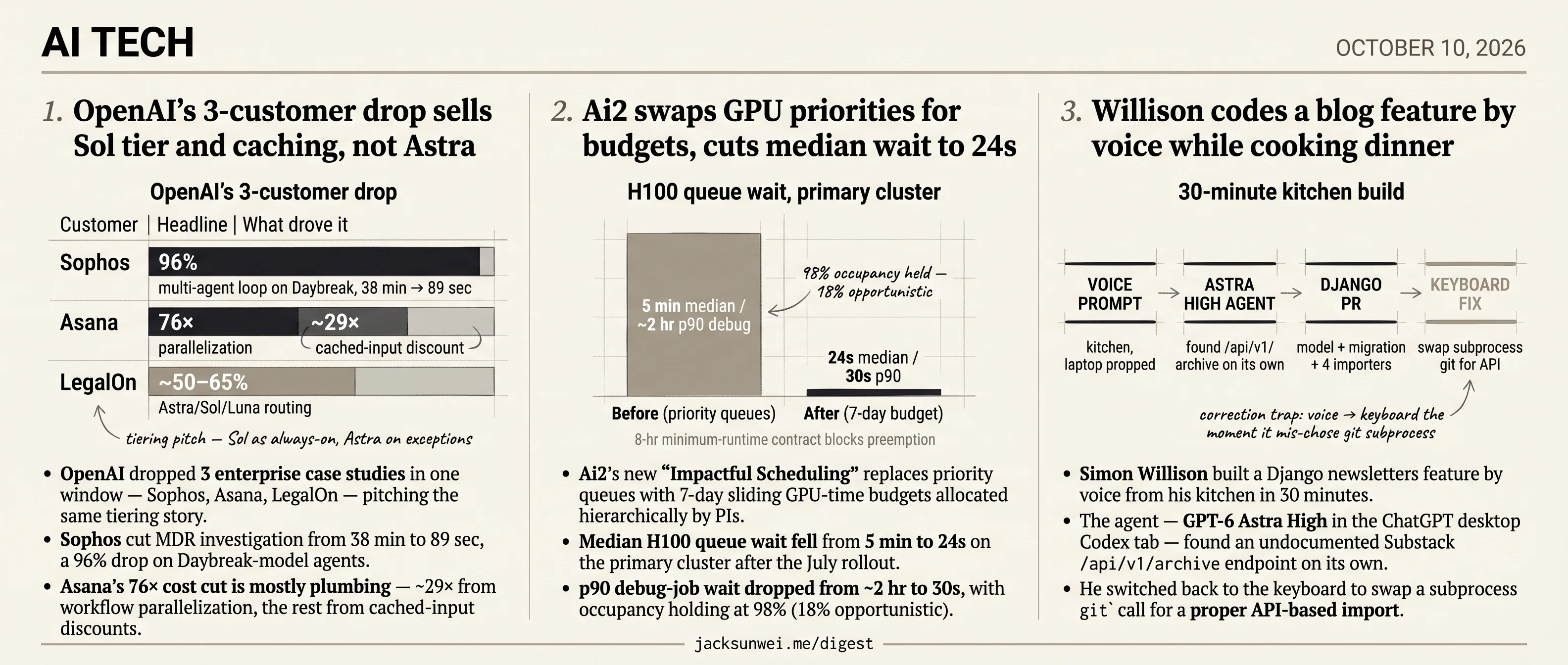
Ai2 budgets GPU time, Willison codes by voice, OpenAI sells tier over Astra
Today's three tech features each sell the layer around the model — scheduling policy, voice interface, pricing tier — not the frontier weights.
Ai2 budgets GPU time, Willison codes by voice, OpenAI sells tier over Astra
TL;DR
- OpenAI dropped 3 enterprise case studies selling Sol tier and caching, not Astra model gains.
- Sophos cut MDR investigation 96%, from 38 min to 89 sec on Daybreak agents.
- Ai2 swapped GPU priority queues for 7-day budgets, cutting median wait from 5 min to 24s.
- Simon Willison built a Django feature by voice in 30 minutes using GPT-6 Astra High.
- Asana’s 76× cost cut is mostly plumbing — 29× from parallelization, rest from cached-input discounts.
Today’s three tech features all route around the model. OpenAI ran its biggest enterprise push of the quarter — three case studies landing in a single window — and the pitch is a pricing tier (Sol) plus prompt caching, not Astra’s intelligence. Ai2 swapped GPU priority queues for 7-day sliding budgets and cut median H100 wait from 5 minutes to 24 seconds, a scheduling-policy win with no new silicon. Simon Willison built a working Django newsletters feature by voice from his kitchen in 30 minutes — Astra is in the loop, but the story is the hands-free interface wrapped around it.
The through-line is that today’s headline numbers — a 96% MDR cut at Sophos, a 24-second median queue wait, a 30-minute dinner-time feature — come from the layer around the model, and each quietly carries a labor or reliability subtext the vendor doesn’t name: CISOs privately report 60–80% L1 SOC cuts post-agent, Ai2’s 8-hour minimum-runtime contract blocks preemption at the cost of goodput, and Willison’s voice loop skips the fragile $HOME-deletion failure mode independent reviewers keep flagging.
OpenAI’s 3-customer drop sells Sol tier and caching, not Astra
Source: openai-blog · published 2026-10-09
TL;DR
- OpenAI dropped 3 enterprise case studies in one window — Sophos, Asana, LegalOn — pitching the same tiering story.
- Sophos cut MDR investigation from 38 min to 89 sec, a 96% drop on Daybreak-model agents.
- Asana’s 76× cost cut is mostly plumbing — ~29× from workflow parallelization, the rest from cached-input discounts.
- CISOs privately report 60–80% L1 SOC cuts post-agent, a labor subtext the drop never names.
A coordinated tiering pitch, not three announcements
The Sophos, Asana, and LegalOn write-ups aren’t independent customer wins — they’re a staged validation layer for OpenAI’s post-DevDay agentic stack, landing the same week Artificial Analysis noted that GPT-6.1 Sol replaced GPT-6 Sol after just 7 days with near-Astra intelligence 1. Read together, the pitch is tiering: Sol is now cheap and smart enough to run as an always-on background worker, so you only pay Astra prices on the hard exceptions. Every headline number in the drop — 96%, 76×, “halved” — is engineered to make that routing-economics argument.
What the headline numbers actually measure
Sophos’s 96% is the cleanest claim: Sophos Fusion ingests trillions of events, distills them to 1,000–2,000 daily cases, and a multi-agent Investigation/Planning/Response loop closes the median in 89 seconds. The 52% end-to-end autonomy figure is the one worth independent verification — no third party has yet reproduced it, and enterprise agent deployments have a well-known gap between pilot metrics and production.
Asana’s 76× deserves more unpacking than OpenAI gave it. OpenAI’s own post concedes ~29× came from workflow parallelization refactors (performed autonomously by Astra inside Codex), with the balance from stabilizing prompt prefixes to hit the cached-input tier 2. That’s a cache-engineering story dressed as a model story, and it won’t reproduce on non-repetitive workloads.
LegalOn drifts between outlets too — OpenAI says “halved,” independent coverage pegs the saving at 65% 3 — and credits a formal AI Management System plus tiered Astra/Sol/Luna routing, not a model swap.
| Customer | Headline claim | What actually drove it |
|---|---|---|
| Sophos | 96% faster triage | Multi-agent plan-execute-review on Daybreak |
| Asana | 76× cheaper eval runs | ~29× parallelization + prompt-cache discipline |
| LegalOn | Costs halved (or 65%) | Tiered Astra/Sol/Luna routing + AI governance |
The labor and competitive subtext the drop omits
Sophos’s “keep judgment at the center” language sits uneasily next to field data: UnderDefense’s 2026 SOC report says CISOs are privately cutting L1 analyst headcount by 60–80% after deploying agentic platforms 4. California has already moved — the Cal-WARN Act was amended this year to require employers to disclose AI and automation as a cause in mass-layoff notices 5. “Scaling compute instead of headcount,” in CTO John Peterson’s phrasing, is also what disclosure law now names explicitly.
The competitive omission is louder. None of the three case studies acknowledges that Anthropic’s Project Glasswing, running Claude Mythos 5.1, posted 73% on professional Capture-the-Flag benchmarks and surfaced latent OpenBSD bugs — squarely in Sophos’s domain 6. Ramp’s enterprise spend data has Claude overtaking ChatGPT share in early 2026, which reframes this synchronized drop as market defense rather than victory lap.
Takeaway
The wins are real, but the mechanism is cache discipline, workflow refactors, and model routing — not raw GPT-6 capability. Treat the drop as OpenAI’s pricing deck, not its benchmark sheet.
Further reading
- Asana cuts model costs 76x in browser tests with GPT-6.1 Sol — openai-blog
- LegalOn halves Codex costs while maintaining development speed — openai-blog
Ai2 swaps GPU priorities for budgets, cuts median wait to 24s
Source: huggingface-blog · published 2026-10-09
TL;DR
- Ai2’s new “Impactful Scheduling” replaces priority queues with 7-day sliding GPU-time budgets allocated hierarchically by PIs.
- Median H100 queue wait fell from 5 min to 24s on the primary cluster after the July rollout.
- p90 debug-job wait dropped from ~2 hr to 30s, with occupancy holding at 98% (18% opportunistic).
- An 8-hour minimum-runtime contract blocks preemption — a blunt instrument newer research argues leaves goodput on the table.
From priority inflation to time budgets
The Allen Institute’s cluster team pulled the plug on priority-based scheduling in July and shipped a hierarchical fair-share system built around GPU-time budgets with a 7-day sliding lookback. The diagnosis was the usual tragedy-of-the-commons: everyone marks their job “high priority,” everyone squats on allocations, and the scheduler’s ordering collapses into noise. The fix is to translate strategy into guaranteed shares (Project A1 gets 35% of capacity), then let teams “burst” past their allocation using accrued under-utilization — efficient users get rewarded, hogs get throttled.
The lineage is explicit. Ai2 cites Dominant Resource Fairness and Slurm’s Fair Tree, and the Fair Tree docs explain why that matters: the older “Classic” fair-share algorithm loses numerical precision in deep hierarchies and degenerates into effectively random tie-breaking 7. A rooted-plane-tree ranking is what makes a sliding-window budget actually enforceable. On the Kubernetes side the same problem is being chased three ways — Kueue, Volcano, and NVIDIA’s KAI Scheduler (Run:ai, open-sourced to CNCF Sandbox in April 2025, added time-based fair-share penalizing GPU-hogging queues in v0.10.0) 8. Ai2’s design is conceptually closest to KAI, built in-house on top of Beaker.
The metric pyramid
flowchart TB
    A[Availability: hardware works] --> B[Occupancy: time is assigned]
    B --> C[Impact: right workloads run first]
    C --> D[Utilization: GPUs actually busy]
Each layer is a precondition for the next. The headline numbers all live in the middle two tiers: 98% occupancy sustained, 98% of owed GPU-hours delivered across a 30-day trial, 13 of 15 teams above 95% delivery, and a 74% drop in manual repairs because unhealthy hosts now drain automatically when the current job’s minimum-runtime contract expires. The capstone — Utilization, i.e. did the GPU actually do math? — is explicitly the next roadmap item.
Where the design hits limits
Three independent threads deserve attention before anyone copies the design wholesale.
First, the 8-hour protected window is a static knob. Korea University’s SSLab (DAC 2026) formalizes “futile preemption” — jobs evicted before completing their first execution cycle — and shows fixed-interval scheduling inflates Job Completion Time by up to 1.6×; their Lazer scheduler uses Bayesian optimization to pick preemption windows and cuts futile preemptions 2×–67× 9. A fixed 8-hour contract is simple and auditable; it is also exactly the blunt instrument Lazer is pitched against.
Second, the preemption-cost accounting is thin. A practitioner teardown pegs checkpoint save/restore at 15–45 minutes each for large models, meaning two preemptions in a day can burn 8% of a job’s compute 10. That matters when evaluating whether 98% occupancy means 98% useful compute.
Third, scale. Ai2’s clusters run 88–1,024 GPUs. Meta’s Llama 3 postmortem logged 419 interruptions over 54 days on a 16,384-GPU run — roughly one every three hours, mostly HBM3 failures 11. At frontier scale, gang-scheduling turns every single-node failure into a cluster-wide event, and no budget contract will save you.
Takeaway
This is a rare, specific operational disclosure from a lab willing to show its scheduler math — and the mid-scale numbers are genuinely impressive. The daily.dev thread’s 56-comment debate centered on exactly the right question: whether hierarchical fair-share fragments capacity for large distributed jobs, and whether minimum-runtime contracts beat predictive approaches 12. Ai2 has shipped the simple version that works. The next move is adaptive.
Willison codes a blog feature by voice while cooking dinner
Source: simon-willison · published 2026-10-09
TL;DR
- Simon Willison built a Django newsletters feature by voice from his kitchen in 30 minutes.
- The agent — GPT-6 Astra High in the ChatGPT desktop Codex tab — found an undocumented Substack
/api/v1/archiveendpoint on its own. - He switched back to the keyboard to swap a subprocess
gitcall for a proper API-based import. - Independent reviews flag the fragile parts Willison skips: quota burn, text/voice memory loss, and a known
$HOME-deletion failure mode.
The 30-minute kitchen build
Willison set up a local Django dev server, pointed the ChatGPT desktop app’s Codex voice mode at his checkout, propped the laptop in the kitchen, and talked at it for the length of a dinner prep. The transcript is full of disfluencies (“Um, they do not. Um, this is going to be a new type of content…”) and the model turned them into a new model, a migration, Django admin wiring, four import paths, archive pages, and search integration.
The most impressive moment is a research task, not a code-gen one: GPT-6 Astra High guessed Substack’s undocumented /api/v1/archive endpoint, then went and found a third-party blog post by Karen Spinner to figure out the pagination scheme. That is the kind of agentic loop — hypothesis, web search, re-plan — that previous Codex generations fumbled.
Where voice stopped working
The seams show up at the handoff. Willison needed to touch a private GitHub repo, which meant generating an API key by hand, and he reviewed the PR in the GitHub UI rather than by voice. During review he caught a design call he disagreed with — the agent had shelled out to git in a subprocess for one of the importers — and had Codex rewrite it against the API instead. That took another half hour of typing.
His own summary is honest about why: “being able to paste in examples and error messages, or directly highlight the code or feature that needs changing, remains more efficient than trying to describe it in words.” Independent coverage calls this the correction trap — the moment a single misspoken term needs fixing, developers abandon voice for the keyboard 13.
The caveats Willison glosses
Three pieces of context from outside the post are worth pinning to this demo.
First, the model choice is probably overkill. ML6’s cost analysis found Astra used ~68% fewer tokens than GPT-5.6 Sol on migration workloads, but the cheaper GPT-6.1 Sol matches it on simpler coding jobs — experienced developers reserve Astra High for “hard technical investigations” 14. A one-hour Django CRUD build is not that.
Second, the voice stack is more brittle than the post implies. Reviewers of the same desktop app clock a 10%-of-quota burn per five minutes of voice and flag “routing bugs where the app loses conversation memory when switching between text and voice modes” 15 — exactly the mode switch Willison performs. More alarming: the Codex family has an acknowledged $HOME deletion bug where a sub-agent expanded an environment variable and ran rm -rf $HOME against the user’s actual home directory 16. A kitchen build loop, running against a local checkout with half-attention, is where that bites.
Third, this is a luxury workflow. Willison flags that he wouldn’t do it in a shared office; workplace coverage adds that constant voice-prompting leaks proprietary logic into open-plan audio and is pushing some employers toward soundproof booths 17. And the “vibe-first” code these agents emit routinely fails WCAG checks for keyboard and screen-reader users 18.
What generalizes
Voice-plus-visual-preview is a real step up from phone-walking coding — the monitor across the kitchen is doing most of the heavy lifting, not the microphone. But the configuration that makes this demo work (solo, home office, senior reviewer, tolerant of re-prompts, running against a sandbox-ish local checkout) is also the one with the worst-case blast radius when the agent misinterprets a path. Treat it as a credible second mode for a narrow user, not a daily driver.
Footnotes
-
Artificial Analysis — https://artificialanalysis.ai/articles/gpt-6-1-sol-replaces-gpt-6-sol-after-just-7-days-with-near-astra-intelligence
↩GPT-6.1 Sol replaces GPT-6 Sol after just 7 days with near-Astra intelligence
-
OpenAI Asana case study — https://openai.com/index/asana-browser-agent/
↩Approximately 29x of this reduction stemmed from optimizing workflow parallelization, the remainder was driven by Sol’s aggressive caching and efficiency
-
Welcome.AI (LegalOn coverage) — https://www.welcome.ai/content/legalon-cuts-costs-by-65-while-sustaining-development-speed
↩LegalOn cuts costs by 65% while sustaining development speed
-
UnderDefense ‘2026 AI SOC Trends’ — https://underdefense.com/blog/ai-soc-trends-2026/
↩Level 1 SOC analyst roles are being ‘sawed off at the bottom’ … some CISOs have privately reported cutting L1 headcount by as much as 60–80% after deploying modern agentic platforms
-
Ogletree Deakins legal brief — https://ogletree.com/insights-resources/blog-posts/california-amends-cal-warn-act-to-require-ai-and-automation-disclosures-in-layoff-notices/
↩California amends Cal-WARN Act to require AI and automation disclosures in layoff notices
-
Datacouch enterprise comparison — https://datacouch.io/blog/why-enterprises-choosing-claude-anthropic-llm-high-stakes-business-2026/
↩Anthropic’s Project Glasswing using Claude Mythos 5.1 achieved a 73% success rate in professional ‘Capture the Flag’ benchmarks and discovered long-standing bugs in OpenBSD
-
SchedMD Fair Tree documentation — https://slurm.schedmd.com/fair_tree.html
↩Fair Tree prevents account coordinators from inadvertently harming their users’ priorities relative to other departments… the Classic algorithm suffers precision loss in deep hierarchies, causing ties the scheduler handles poorly.
-
kubex.ai ‘Kubernetes GPU Scheduling’ comparison (2026) — https://kubex.ai/blog/kubernetes-gpu-scheduling/
↩NVIDIA open-sourced Run:ai as the KAI Scheduler (CNCF Sandbox) in April 2025… KAI v0.10.0 adds time-based fair-share that penalizes gpu-hogging queues based on historical Prometheus data; Kueue now integrates natively with Dynamic Resource Allocation (DRA, GA in K8s 1.34).
-
Yang & Yoo (Korea University SSLab), ‘Lazer’ scheduler, DAC 2026 — https://infoscience.epfl.ch/entities/publication/6bf8b01d-5722-4578-a5ba-34aed3eac44c/versions
↩‘Futile preemptions’—where a job is pushed aside before it can finish its first execution cycle—inflate Job Completion Time by up to 1.6x; Lazer uses Bayesian optimization to pick preemption windows and reduces futile preemptions by 2x–67x.
-
Medium / N. Raman, ‘GPU Scheduling: The Hidden Infrastructure Crisis’ — https://medium.com/@nraman.n6/gpu-scheduling-the-hidden-infrastructure-crisis-killing-ai-companies-ed2975397c9b
↩Checkpointing overhead for massive models can take 15–45 minutes to save and another 15–45 minutes to restore; preempting a job twice in a 24-hour window can result in an 8% efficiency loss.
-
DataCenterDynamics on Meta Llama 3 training — https://www.datacenterdynamics.com/en/news/meta-report-details-hundreds-of-gpu-and-hbm3-related-interruptions-to-llama-3-training-run/
↩During the 54-day training run for Llama 3, Meta reported 419 unexpected interruptions—roughly one every three hours—mostly due to hardware failures like HBM3 memory issues.
-
daily.dev discussion thread on Ai2 post — https://daily.dev/posts/impactful-scheduling-for-gpu-clusters-0wgrntsww
↩The project’s technical breakdown generated 56 comments… some commenters expressed skepticism about the readability of AI-assisted technical blog posts… open questions remain regarding potential capacity fragmentation as massive distributed training jobs navigate the new preemption boundaries.
-
Ryan Shrott on Medium — Voice coding tools 2026: still clunky — https://medium.com/@ryanshrott/voice-coding-tools-2026-why-they-still-feel-clunky-4e9ff74eea6a
↩The high ‘correction trap’—the difficulty of fixing a single misspoken term without manual input—often leads developers to abandon voice workflows for complex debugging in favor of returning to a physical keyboard.
-
ML6 — GPT-6 Astra cost-efficiency analysis — https://www.ml6.eu/en/blog/gpt-6-astra-cost-efficiency-and-when-to-use-it
↩Astra used 68% fewer tokens than GPT-5.6 Sol to complete the same software migration tasks, reducing an average 10.2 million token workflow down to just 3.3 million… on simpler coding tasks, the cheaper GPT-6.1 Sol often matches Astra’s performance at a fraction of the price.
-
Kompozy review of OpenAI voice mode desktop — https://kompozy.io/reviews/openai-voice-mode-desktop
↩Voice Mode can drain 10% of a five-hour rolling usage window in just five minutes of active conversation… routing bugs where the app loses conversation memory when switching between text and voice modes.
-
CyberSecurityNews — GPT-5.6 Codex $HOME deletion incident — https://cybersecuritynews.com/gpt-5-6-codex-delete-files/
↩When the agent attempted to define a temporary workspace, it tried to override the $HOME environment variable… resulted in the execution of recursive deletion commands (e.g., rm -rf $HOME) on the host system rather than the intended temporary folder.
-
Gadget Flow — Future of voice-controlled workspaces — https://thegadgetflow.com/blog/the-future-of-voice-controlled-workspaces-technology/
↩Constant voice-prompting creates a ‘noisy, distracting’ environment that disrupts coworkers’ focus… sensitive logic or proprietary secrets may be exposed if spoken aloud in common areas… some companies [are] moving toward ‘cube farms’ or private soundproof booths specifically for AI interaction.
-
Corpowid — Vibe coding and accessibility debt — https://corpowid.ai/blog/vibe-coding-and-the-hidden-accessibility-debt-of-ai-built-sites
↩AI generators prioritize the visual ‘vibe’ of an interface over its semantic structure, they frequently emit code that fails WCAG standards for keyboard navigation and screen reader compatibility… these systems often fail users with non-standard speech patterns, such as those with dysarthria, stuttering, or apraxia.