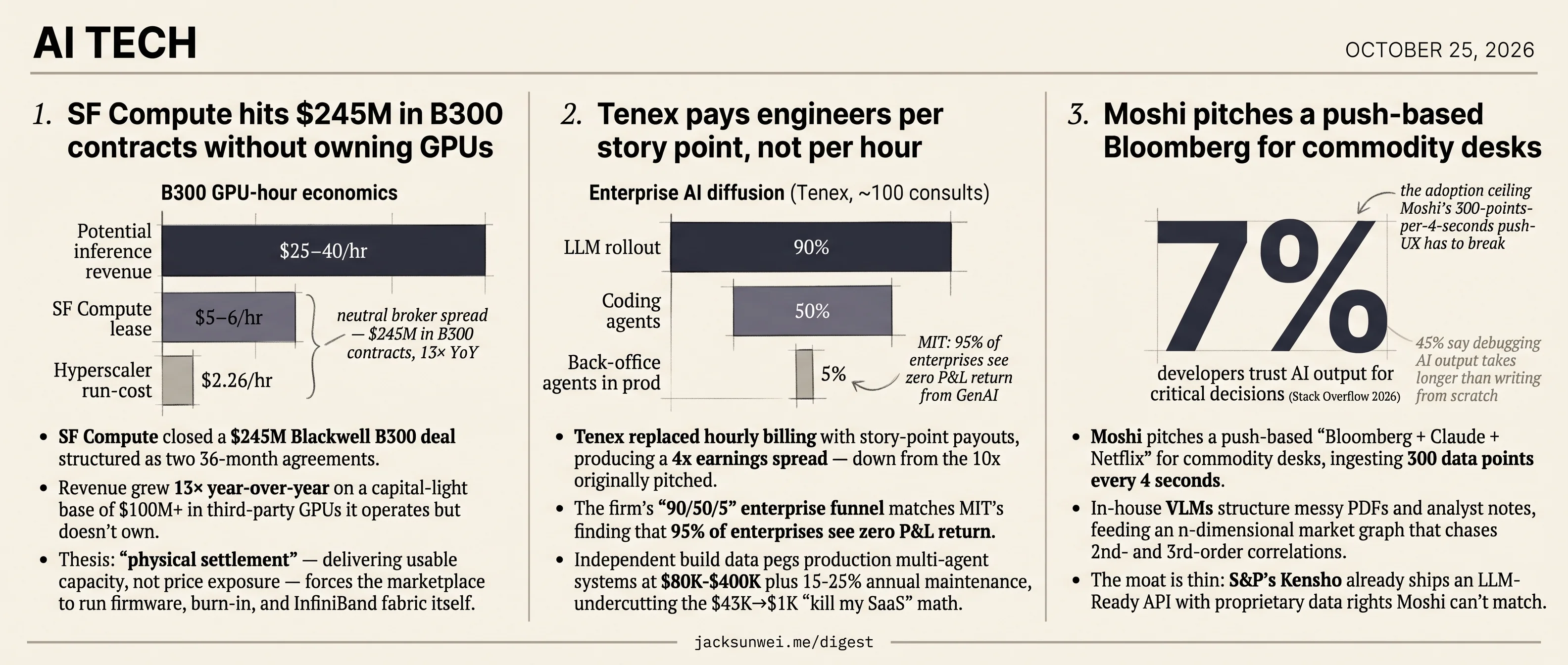
SF Compute closes $245M, Moshi pitches commodity desks, Tenex pays per point
Three AI startups ship novel commercial models — GPU leasing, commodity terminals, story-point billing — each riding one visible, contestable bet.
SF Compute closes $245M, Moshi pitches commodity desks, Tenex pays per point
TL;DR
- SF Compute closed $245M in Blackwell B300 contracts without owning the GPUs.
- Moshi pitches a push-based commodity terminal ingesting 300 data points every 4 seconds.
- Tenex swapped hourly billing for story points, producing a 4× earnings spread.
- Claude Opus 5.5 rewrote WebSocket netcode for Willison’s 4-player Battledrones map.
- Ben’s Bites runs sourcing, drafting, and publishing on Claude-powered personal agents.
Today’s tech beat is three AI startups proposing new commercial structures — compute leasing, vertical market data, engineering labor — and each pitch travels with a single load-bearing assumption the market can audit in real time. SF Compute’s $245M Blackwell book depends on near-full utilization to clear the $5-6/hr-vs-$25-40/hr arbitrage. Moshi’s push-based commodity terminal depends on a moat that S&P’s Kensho already has with proprietary data rights. Tenex’s story-point billing depends on a 90/50/5 enterprise funnel that MIT’s 95%-see-zero-return finding punctures.
Round-ups close with two solo-operator stories: Simon Willison’s Battledrones game jumps to 4-player multiplayer on netcode written entirely by Claude Opus 5.5, and Ben’s Bites publishes a template for running newsletter production on Claude personal agents.
SF Compute hits $245M in B300 contracts without owning GPUs
Source: latent-space · published 2026-10-20
TL;DR
- SF Compute closed a $245M Blackwell B300 deal structured as two 36-month agreements.
- Revenue grew 13× year-over-year on a capital-light base of $100M+ in third-party GPUs it operates but doesn’t own.
- Thesis: “physical settlement” — delivering usable capacity, not price exposure — forces the marketplace to run firmware, burn-in, and InfiniBand fabric itself.
- Arbitrage pitch: a B300 leases at $5–6/hr vs. $25–40/hr of potential inference revenue, with the spread resting on near-full utilization.
From matching engine to hotel operator
Evan Conrad’s framing on Latent Space is that a GPU marketplace is a hotel: customers show up for a room, then need cleaning, security, and room service, and before long you are running the building. SF Compute (formerly Junark) started as a sublease matching engine. It now operates the “full operating capacity of a cloud” against hardware it doesn’t own — site visits, PDUs, DPUs, switch config, and firmware patching on early H100 and B300 batches that routinely ship buggy.
The pitch borrows the commodities term physical settlement: unlike cash-settled markets where you bet on a price index, a buyer here must receive working capacity. Conrad claims naive VM overhead on a GPU can cost 40% of kernel-launch throughput and MFU, which is why generic “GPU hours” don’t clear reliably. The engineering flourish is programmable InfiniBand — customers subdivide fabric via API instead of filing a support ticket — which is what lets the order book price “live inference” (months of preemption notice) differently from “batch inference” (minutes).
The arbitrage, and who actually captures it
The economics Conrad quotes line up with NVIDIA’s own math. A GB300 NVL72 rack is projected at ~$75M of token revenue over three years, or roughly $40/GPU-hour gross against as little as $2.26/hr in hyperscaler run-cost 1. SF Compute’s lease prices ($5–6/hr for a B300) sit between those two numbers, which is exactly where a neutral broker should sit if the spread is real.
The caveat the podcast glides past: that $40/hr assumes near-full utilization on reasoning workloads at today’s token prices. NVIDIA has every reason to project it; the people underwriting 36-month B300 contracts have to believe it. SF Compute’s “several hundred million in volume” number is anchored by the one $245M headline deal 2, not by a deep, diffuse order book — only 5% of their capacity is public today.
Where the neutrality moat frays
Conrad’s “Switzerland” argument — that NVIDIA, AWS, and CoreWeave can’t run a neutral exchange because they also sell inference — is the cleanest part of the thesis, and comparative work backs it: Prime Intellect’s vertical integration into inference and evals makes it structurally non-neutral 3. But Vast.ai runs a genuinely neutral P2P market without SF Compute’s operator overhead, which suggests the real moat is operational depth, not neutrality per se.
Two sharper counters sit under the surface. First, Conrad himself conceded on Hacker News that the platform was in “VERY beta” with weekly outages, and the sub-$2/hr H100 pricing that drew scam accusations was effectively a reliability discount 4. Second, an ICDE 2026 paper calls GPUs “snowflakes”: neutral exchanges miss native NVLink topology and interconnect homogeneity, degrading multi-node training in ways cohorts and order-book dimensions can’t easily price 5. That hits exactly the “SF offtake” segment — frontier labs doing large-cluster training — that Conrad positions as his highest-value demand. The $40M Series A at a ~$300M valuation 6 bets that operational depth outruns both problems.
The company has graduated from GPU Craigslist to project-managing sovereign builds. Whether “programmable data center” survives contact with frontier training workloads is the open question the arbitrage math doesn’t answer.
Tenex pays engineers per story point, not per hour
Source: latent-space · published 2026-10-21
TL;DR
- Tenex replaced hourly billing with story-point payouts, producing a 4x earnings spread — down from the 10x originally pitched.
- The firm’s “90/50/5” enterprise funnel matches MIT’s finding that 95% of enterprises see zero P&L return from GenAI.
- Independent build data pegs production multi-agent systems at $80K–$400K plus 15–25% annual maintenance, undercutting the $43K→$1K “kill my SaaS” math.
- Vertical AI firms like Harvey and Tempus win on liability assumption, not data — a direct rebuttal to Tenex’s bearish framing.
The pay model is the pitch — and the lightning rod
Tenex’s founders, Alex Lieberman and CJ Hess, built their 75-person applied-AI firm around a single provocation: if an engineer uses Claude to finish a ticket in half the time, hourly billing punishes them. So Tenex pays per completed story point, polices quality with a parallel “AI Strategist” role incentivized on retention, and reports engineering output has roughly doubled since early 2024.
The compensation model is also the most-contested claim in the episode. Hacker News and podcast commentators reached for Goodhart’s Law immediately — once story points become the paycheck, they stop measuring complexity and start measuring negotiation 7. Lieberman has quietly walked back the headline “$1M engineer” framing: actual dispersion between top and bottom performers is closer to 4x than the originally implied 10x 7. The AI Strategist check is itself an admission that the metric needs a human referee.
The 90/50/5 funnel is real — and reads darker from outside
Based on roughly 100 enterprise consultations, Lieberman pegs diffusion at 90% LLM rollout, 50% coding agents, and 5% back-office agents in production. Independent surveys corroborate the shape but reframe the opportunity:
| Tenex framing | Independent reading |
|---|---|
| 5% of enterprises run back-office agents | 95% see zero P&L return from GenAI 8 |
| Big opportunity for applied-AI partners | >40% of agentic projects cancelled by 2027 9 |
| Standardize processes, then automate | Only 5% of firms are “highly prepared” for agent autonomy 9 |
Hess’s line — “you can’t automate a process that doesn’t exist” — is really a restatement of the industry-wide readiness ceiling, not a consulting wedge.
”Kill my SaaS” works until the maintenance bill arrives
The team’s showcase anecdote is replacing a $43,000/year speaker-management tool with a $1,000 custom-built agent. Lieberman himself hedges with a “cognitive load” caveat for Fortune 2000 buyers, and the hedge is doing real work. Production-grade multi-agent systems typically cost $80K–$400K to build with annual maintenance at 15–25% of initial build 10. And Psychology Today’s recent reporting on agent oversight finds that “80% finished” outputs convert workers from doers into “highly-taxed supervisors,” feeding Microsoft’s “infinite workday” pattern 11. The savings math only closes when the replaced tool is narrow and the maintainer is already AI-fluent.
Vertical AI isn’t dying; it’s absorbing liability
Lieberman’s bearish view — that frontier models will “gobble up” vertical startups — is directly contradicted by the firms it dismisses. Observers tracking Harvey (legal) and Tempus (health) argue the durable moat is no longer data but workflow depth plus liability assumption that horizontal labs explicitly refuse to underwrite 12.
A moat is no longer built on data alone, but on deep workflow integration and the assumption of liability that general providers refuse to touch. 12
Which is pointed, because Tenex is itself a services firm absorbing exactly that liability for its Fortune 2000 clients. The “bearish on vertical SaaS” posture is also competitive positioning: Tenex wants to be the custom-build partner, not compete with vertical-AI incumbents. The diagnostic numbers in the episode hold up. The prescriptions are where the industry disagrees.
Moshi pitches a push-based Bloomberg for commodity desks
Source: latent-space · published 2026-10-22
TL;DR
- Moshi pitches a push-based “Bloomberg + Claude + Netflix” for commodity desks, ingesting 300 data points every 4 seconds.
- In-house VLMs structure messy PDFs and analyst notes, feeding an n-dimensional market graph that chases 2nd- and 3rd-order correlations.
- The moat is thin: S&P’s Kensho already ships an LLM-Ready API with proprietary data rights Moshi can’t match.
- Founder’s “solo engineer replaces a team of 10” framing collides with only 7% of developers trusting AI for critical decisions.
The product bet: kill the dashboard
Anekha Sokhal’s wager with Moshi is that traders don’t need another dashboard — they need something that interrupts them at exactly the right moment. The pitch stitches together three reference points: Bloomberg’s data breadth, Claude’s interactive reasoning, and Netflix’s push-based personalization. The system is tuned for energy derivatives, commodities, and macro desks, where a 30-second edge on a correlation (LNG tanker rerouting through Hormuz → physical oil → energy equities) is the product.
The operational numbers Sokhal cites are aggressive. Moshi claims to process and “learn” roughly 300 new data points every 4 seconds, pulling from the X firehose (at a reported ~$300K/month commercial fee), satellite imagery, ship tracking, structured futures feeds, and the user’s own private analyst notes. A confidence-scoring layer flags divergent sources — when Reuters and the WSJ disagree, that gap becomes a tradeable signal rather than noise to suppress.
The architecture
flowchart LR
    A[X firehose, news, podcasts] --> V[VLM ingestion]
    B[PDFs, analyst notes] --> V
    C[Futures, technicals] --> G
    D[LNG tracking, satellite] --> G
    V --> G[n-dimensional market graph]
    G --> R{RecSys: 2nd/3rd-order correlations}
    R -->|push| U[Trader's book]
The architecturally interesting choice is doing VLM extraction in-house rather than piping sensitive docs through third-party APIs — a non-negotiable for buy-side firms. The graph layer has real support: FinReflectKG-style retrieval has shown ~24% correctness improvements over pure text RAG at lower token cost 13. But the same research warns that most financial KG projects collapse under “relation overloading” and rigid ontologies as they scale 13, and 300 points per 4 seconds is squarely in the zone where traditional graph databases strain. The interview glosses the implementation; that’s where the real question lives.
The competitive reality the interview skips
Moshi is launching into a crowded aisle. S&P’s Kensho already ships Figure Extraction for complex PDF visualizations plus an LLM-Ready API that pipes structured S&P data straight into enterprise agents 14 — overlapping Moshi’s VLM claim, with proprietary data rights Moshi doesn’t have. On the agent reasoning side, F2 reports 95.25% on SpreadsheetBench Verified by natively evaluating formulas rather than summarizing them 15, raising the auditability bar institutional buyers now expect. Neither owns real-time commodities, which is Moshi’s genuine wedge — but neither is standing still.
”You are the team” — half-true
Sokhal’s framing of solo AI engineers replacing ten-person squads has real backing: top AI-native firms now clock ~$3.7M revenue per employee, roughly 10× SaaS norms 16. The 2,500 applicants in four days for a single Moshi role suggest the labor market believes it.
The counter-evidence is less flattering. HBS researchers find U.S. developer employment fell only 3–7% in 2025, nowhere near the 50% displacement executives have forecast, with much of the “AI layoffs” narrative being rebranded pandemic-overhire correction 17. Stack Overflow’s 2026 survey adds the kicker:
Only 7% of developers trust AI output for critical decision-making, and 45% say debugging AI output takes longer than writing code from scratch. 18
For a tool where a hallucinated figure moves a trader’s book, that 7% is the adoption ceiling Moshi’s push-UX philosophy has to break through. The graph and the VLMs are the easy part; earning the right to interrupt a PM mid-trade is the hard one.
Round-ups
Battledrones v14 adds 4-player Compass Rose map via Claude Opus 5.5
Source: simon-willison
Simon Willison’s vibe-coded Battledrones game jumps from 2-player to 4-player online matches with a new rotationally symmetric ‘Compass Rose’ map. Claude Opus 5.5 generated the map and rewrote the WebSocket netcode from a single prompt, adding purple and green robot teams alongside the existing blue and red.
Ben’s Bites details running a newsletter on Claude agents
Source: bens-bites
A walkthrough shows how Ben Tossell delegates newsletter production to Claude-powered personal agents, covering the specific workflows that handle sourcing, drafting, and publishing. The piece doubles as a template for solo operators looking to offload recurring knowledge work onto agentic loops.
Footnotes
-
NVIDIA Perspectives — hyperscaler accelerator economics 2026 — https://perspectives.nvidia.com/real-cost-ai-scale-hyperscaler-accelerator-economics-2026/
↩a single GB300 NVL72 rack can generate approximately $75 million in token revenue over three years … roughly $40 per GPU-hour in gross revenue, while the actual cost to run the hardware at hyperscaler volume is estimated as low as $2.26 per hour
-
Daily Dropout — ‘SF Compute: the stock market for GPUs’ — https://dailydropout.substack.com/p/sf-compute-the-stock-market-for-gpus
↩landmark $245 million sale of NVIDIA Blackwell B300 clusters … structured as two 36-month agreements; revenue grew more than 13x over 2025 levels
-
Lyceum Technology — GPU marketplace comparison — https://lyceum.technology/magazine/runpod-vs-vast-ai-which-gpu-marketplace-fits/
↩Prime Intellect’s vertical integration into inference, evaluations, and synthetic data generation makes it more of a full-stack platform than a pure, neutral market
-
Hacker News thread (Conrad reply) — https://news.ycombinator.com/item?id=41807040
↩the platform was in a ‘VERY beta’ state, often experiencing complete outages weekly
-
HPI ‘Green or Greedy’ ICDE 2026 paper — https://hpi.de/oldsite/fileadmin/user_upload/fachgebiete/rabl/publications/2026/green-or-greedy-icde2026.pdf
↩GPUs are ‘snowflakes’ … neutral exchanges often lack the native NVLink optimization required for massive distributed training, leading to significant performance degradation in multi-node jobs
-
eWeek — SF Compute Series A coverage — https://www.eweek.com/news/sf-compute-ai-funding/
↩$40 million Series A … valued the company at $300 million; manages over $100 million in third-party hardware rather than owning GPUs
-
BigGo podcast summary of Latent Space Tenex episode — https://finance.biggo.com/podcast/e2eb530d1dcaad69
↩ ↩2Critics point to Goodhart’s Law — when a measure (story points) becomes a target, it ceases to be a good measure — likely leading to ticket bloating or technical debt… 18 months after the original ‘$1M salary’ claim, Lieberman admitted the actual productivity dispersion among their top performers was closer to a 4x spread rather than the initially projected 10x.
-
MIT Project NANDA — State of AI in Business 2025 — https://mlq.ai/media/quarterly_decks/v0.1_State_of_AI_in_Business_2025_Report.pdf
↩95% of organizations are currently seeing zero measurable P&L return from GenAI, with only an elite 5% of integrated AI pilots extracting significant value.
-
WorkflowDesigner.ai — ‘AI Agents Hit Production, Most Are Getting Pulled Back’ — https://workflowdesigner.ai/blog/ai-agents-hit-production-most-are-getting-pulled-back
↩ ↩2Gartner predicts more than 40% of agentic AI projects will be canceled by the end of 2027 due to escalating costs and ‘prompt drift’; only 5% of organizations believe their business processes are ‘highly prepared’ for the autonomy agents require.
-
SageIT — ‘Hidden Costs of DIY AI Agent Infrastructure’ — https://sageitinc.com/blog/hidden-costs-diy-ai-agent-infrastructure
↩Production-grade multi-agent systems can cost between $80,000 and $400,000 to develop, with annual maintenance typically requiring 15–25% of the initial build cost.
-
Psychology Today — ‘AI and the Rise of Cognitive Overload’ — https://www.psychologytoday.com/us/blog/the-mindful-epidemiologist/202603/ai-and-the-rise-of-cognitive-overload
↩Agents often deliver ‘80% finished’ work that requires human verification, shifting the employee’s role from ‘doer’ to ‘highly-taxed supervisor’… Microsoft describes ‘infinite workdays’ where the pace of work exceeds human cognitive capacity.
-
VNTR.vc — ‘Why Vertical AI Startups Are Winning the Last Mile’ — https://www.vntr.vc/media/why-vertical-ai-startups-are-winning-the-last-mile-battle-against-foundation-models
↩ ↩2The consensus among successful vertical players like Harvey (legal) and Tempus (health) is that a moat is no longer built on data alone, but on deep workflow integration and the assumption of liability that general providers refuse to touch.
-
Bigdata.com — Knowledge Graphs in Finance — https://bigdata.com/blog/what-is-a-knowledge-graph-in-finance-and-why-ai-needs-one
↩ ↩2FinReflectKG demonstrates that using a KG-guided retrieval process for financial analysis can improve answer correctness by 24% while drastically reducing token cost compared to traditional text-based models, though most KG projects fail due to over-reliance on rigid ontologies or ‘relation overloading’.
-
S&P Global / Kensho — https://investorfactbook.spglobal.com/sp-global/kensho-sp-globals-hub-for-ai-innovation-and-transformation/
↩Kensho’s Figure Extraction technology extracts structured data from complex PDF visualizations with high numerical accuracy, and its LLM-Ready API feeds structured S&P data directly into enterprise AI agents.
-
F2.ai competitive comparison — https://f2.ai/blog/f2-vs-hebbia-ai-underwriting-comparison
↩F2 scored 95.25% on SpreadsheetBench Verified by natively evaluating formulas rather than just summarizing text, outperforming Hebbia on deterministic Excel reasoning.
-
Lean AI Leaderboard (Henry Shi, Substack) — https://henrythe9th.substack.com/p/launching-the-official-lean-ai-leaderboard
↩Top AI-native companies now generate approximately $3.7 million in revenue per employee—nearly ten times the SaaS industry standard.
-
Harvard Business School Working Knowledge — https://www.library.hbs.edu/working-knowledge/ai-hasnt-spurred-widespread-layoffs-yet-why-not
↩Total U.S. software developer employment declined by an estimated 3–7% in 2025, far short of the 50% displacement predicted by some industry leaders… many firms are practicing ‘AI-washing,’ citing AI as the cause for layoffs that are actually corrections for pandemic-era overhiring.
-
Stack Overflow 2026 Developer Survey (daily.dev) — https://daily.dev/posts/stack-overflow-s-2026-survey-developers-use-ai-daily-but-only-7-trust-it-for-important-decisions-wdlwix8dk
↩Only 7% of developers trust AI output for critical decision-making… 45% of developers find that debugging AI output takes more time than writing code from scratch.