Qwen pages 51B off-GPU, Gemini defers to LiveKit, Bun logs 27K unsafe blocks
Three developer drops each post a headline win by pushing the cost onto a layer their own numbers do not count.
Qwen pages 51B off-GPU, Gemini defers to LiveKit, Bun logs 27K unsafe blocks
TL;DR
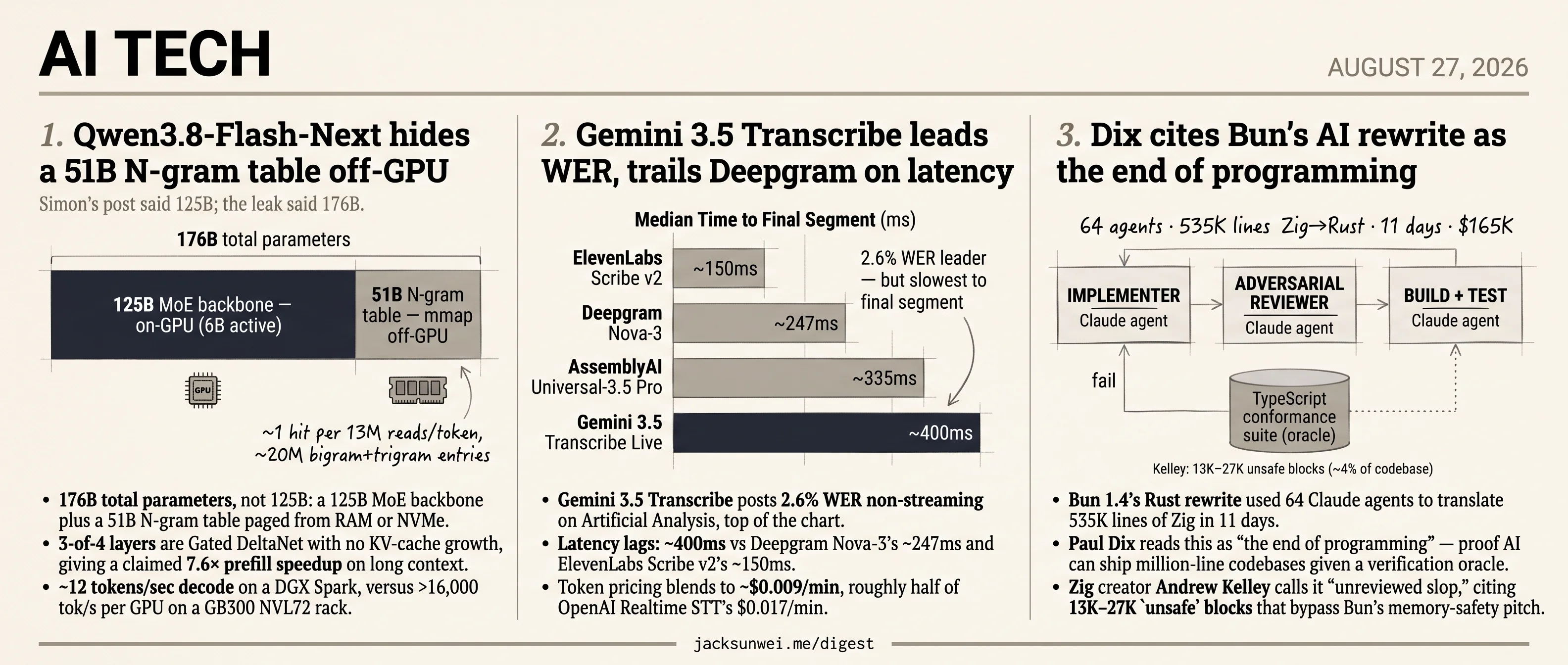
- Qwen3.8-Flash-Next pages a 51B N-gram table off-GPU, making the advertised 125B MoE actually 176B.
- Gemini 3.5 Transcribe takes WER at 2.6% at ~400ms latency — 1.6× Deepgram’s Nova-3.
- Bun 1.4’s Rust rewrite used 64 Claude agents to translate 535K Zig lines in 11 days.
- Zig creator Andrew Kelley flags Bun’s 13K-27K
unsafeblocks as unreviewed slop. - Gemini Live still needs LiveKit’s WebRTC front-end for production voice agents on TCP WebSockets.
Three developer-facing drops today share an accounting quirk: each posts a headline win, and each does so by moving the cost somewhere the number doesn’t have to include it. Qwen3.8-Flash-Next advertises 125B MoE parameters but pages a 51B N-gram table off the GPU into RAM or NVMe. Gemini 3.5 Transcribe leads Artificial Analysis on word-error rate while running roughly 1.6× Deepgram’s latency and still needing a WebRTC front-end for real voice agents. And Paul Dix’s claim that Bun 1.4’s 11-day Rust rewrite marks the end of programming rests on 13K–27K unsafe blocks that Zig’s own creator, Andrew Kelley, calls unreviewed slop.
None of these are refutations. Qwen’s hybrid architecture, Gemini’s WER lead, and Bun’s shipped Rust binary are all real artifacts. The question each drop leaves open is whether the substrate the headline offloads to — RAM/NVMe paging, LiveKit’s WebRTC, hand-written unsafe — is a cost the buyer has to price back in before the number means what the pitch says it means.
Qwen3.8-Flash-Next hides a 51B N-gram table off-GPU
Source: simon-willison · published 2026-08-26
TL;DR
- 176B total parameters, not 125B: a 125B MoE backbone plus a 51B N-gram table paged from RAM or NVMe.
- 3-of-4 layers are Gated DeltaNet with no KV-cache growth, giving a claimed 7.6× prefill speedup on long context.
- ~12 tokens/sec decode on a DGX Spark, versus >16,000 tok/s per GPU on a GB300 NVL72 rack.
- Qwen Community License 1.0 replaces Apache, forcing MaaS and coding-assistant vendors into separate commercial deals.
The real architecture: recurrence plus a lookup table you page off-GPU
Simon’s post frames this as “125B total, 6B active.” The independent write-ups tell a more interesting story. Flash-Next is actually 176B parameters: a 125B Mixture-of-Experts backbone stitched to a 51B N-gram embedding table of roughly 20M bigram and trigram entries, wired in at layer 2 1. Because that table is addressed sparsely — about one read per 13 million possible entries per token — Alibaba explicitly designed it to be mmap’d off the accelerator, into host DRAM or even NVMe 1. Commentators reading the tea leaves call this what it is: a strategic workaround for Chinese labs under US export controls on HBM, buying capacity with cheap DRAM instead of expensive VRAM 2.
The 6B active compute path is also a hybrid. Three of every four layers use Gated DeltaNet, a linear/recurrent attention variant that eliminates KV-cache growth entirely; the fourth is Qwen Sparse Attention for precise retrieval at micro-block granularity. Together they yield the 7.6× long-context prefill speedup Alibaba is advertising 3.
flowchart LR
    T[Input tokens] --> L2[Layer 2: N-gram lookup]
    L2 -. ~1 hit per 13M reads .-> NG[(51B N-gram table<br/>RAM / NVMe mmap)]
    L2 --> GDN[Gated DeltaNet<br/>3 of 4 layers, no KV cache]
    GDN --> QSA[Qwen Sparse Attention<br/>1 of 4 layers]
    QSA --> MoE[125B MoE<br/>6B active experts]
    MoE --> O[Output]
Local throughput is viable, not interactive
Simon ran the Unsloth GGUFs on a DGX Spark; NVIDIA’s own developer blog puts numbers on that setup. At nvfp4, a single Spark decodes at ~12 tok/s with ~80 tok/s prefill. A rack-scale GB300 NVL72 does over 16,000 tok/s per GPU 4. In other words, a DGX Spark is fine for offline agentic loops and evals, but nobody is running interactive chat on this locally. Community reports below Unsloth’s UD-Q2_K_XL tier describe NaN outputs and infinite repetition when the N-gram shard isn’t split off from GPU-resident weights — the memory-hierarchy trick only works if your loader respects it.
Benchmarks are shaky and the license shifted
Two things missing from the primary post deserve airtime. First, Unite.ai flagged that Alibaba graded its Humanity’s Last Exam runs with GPT-4o rather than the benchmark’s native grader — a real bias vector 2. An HN tester reports that in brief trials Flash-Next did no better than the much smaller Qwen3.8-4B-Distill, and that the default “xhigh” reasoning effort can burn an entire 8K token budget on internal chain-of-thought without emitting a final answer 5. That undermines the “Flash” branding pretty directly.
In brief trials the model performed no better than the much smaller Qwen3.8-4B-Distill. 5
Second, and more consequential for anyone building on this: this is not Apache 2.0. It ships under the Qwen Community License 1.0, which requires a separate commercial license for any Model-as-a-Service or AI coding assistant regardless of revenue, and mandates Qwen branding above 100M MAU or $20M monthly revenue 6. That’s a meaningful narrowing versus the sibling Qwen3.8-27B Apache release — and it carves out precisely the commercial use cases most open-weights adopters care about.
Gemini 3.5 Transcribe leads WER, trails Deepgram on latency
Source: deepmind-blog · published 2026-08-26
TL;DR
- Gemini 3.5 Transcribe posts 2.6% WER non-streaming on Artificial Analysis, top of the chart.
- Latency lags: ~400ms vs Deepgram Nova-3’s ~247ms and ElevenLabs Scribe v2’s ~150ms.
- Token pricing blends to ~$0.009/min, roughly half of OpenAI Realtime STT’s $0.017/min.
- “Smart disfluency cleanup” is what legal analysts flag as spoliation risk in regulated transcripts.
- Production voice agents still need LiveKit’s WebRTC front-end because Gemini Live rides TCP WebSockets.
The accuracy story is real. The latency story isn’t.
DeepMind’s launch post pitches Gemini 3.5 Transcribe as a category leader, and on Word Error Rate that’s defensible: 2.6% WER non-streaming and 4.0% streaming on Artificial Analysis, plus a genuine 70% cut in time-to-final-transcription over Chirp 3. But independent testing puts the latency crown elsewhere. Deepgram Nova-3 posts a median Time to Final Segment near 247ms, AssemblyAI Universal-3.5 Pro Realtime lands at 335ms, and ElevenLabs Scribe v2 claims ~150ms in specialized runs — versus Gemini 3.5 Transcribe Live at roughly 400ms 7.
| Model | Median TTFS |
|---|---|
| ElevenLabs Scribe v2 | ~150ms |
| Deepgram Nova-3 | ~247ms |
| AssemblyAI Universal-3.5 Pro | ~335ms |
| Gemini 3.5 Transcribe Live | ~400ms |
For voice-agent UX, the tail matters more than the median, and AssemblyAI is noted for tighter P95 behavior 7. Google is competitive here, not dominant.
The infrastructure and pricing story Google skipped
The launch names LiveKit, Vercel, and Agora as partners without explaining why they’re load-bearing. LiveKit’s own engineering writeup says the quiet part out loud: the Gemini Live API uses TCP WebSockets, which are prone to packet queuing under network jitter, so production deployments front the model with LiveKit’s UDP-based WebRTC transport to prevent audible lag 8. If you’re building a voice agent on Gemini, you’re building on two vendors, not one.
Pricing is the other omission. Input audio tokens run $3.50/M and output text tokens $21/M, which blends to roughly $0.009 per minute — materially cheaper than OpenAI’s Realtime STT at ~$0.017/min 9. That’s a real competitive lever DeepMind chose not to press in the announcement.
”Smart cleanup” is the feature and the liability
The disfluency removal Google leads with — stripping “um”s, resolving “Tuesday—no, Wednesday” to just “Wednesday” — is exactly the behavior that gets contested in regulated contexts. Legal analysts warn that a cleaned transcript destroys the verbatim record needed for intent and credibility disputes, and that editing an already-logged AI transcript can be characterized as spoliation of evidence 10.
The healthcare angle is sharper. Independent audits of Gemini’s health-related responses found 20–50% of outputs “problematic or potentially harmful,” with the model pattern-matching rather than reasoning clinically 11. A patient’s hedged “maybe” auto-corrected into an affirmation is precisely the failure mode WER benchmarks don’t measure — and Google is pushing this model toward medical dictation.
Even the consumer demo has friction
The Gboard “Rambler” feature is the flagship consumer showcase, but 9to5Google’s hands-on notes an unusual pattern: no live text preview during recording, just a waveform, with the transcript only appearing after a confirmation tap 12. Early users describe it as an adjustment — you have to trust the model before you see what it heard. For a dictation product, asking users to give up the real-time feedback loop is a bet, not a given.
Gemini 3.5 Transcribe is a strong entry in a crowded field. It is not, on the evidence, the new default.
Dix cites Bun’s AI rewrite as the end of programming
Source: simon-willison · published 2026-08-26
TL;DR
- Bun 1.4’s Rust rewrite used 64 Claude agents to translate 535K lines of Zig in 11 days.
- Paul Dix reads this as “the end of programming” — proof AI can ship million-line codebases given a verification oracle.
- Zig creator Andrew Kelley calls it “unreviewed slop,” citing 13K–27K
unsafeblocks that bypass Bun’s memory-safety pitch. - A 2025 survey found 80% of organizations traced at least one production outage to AI-generated code in the past year.
The load-bearing anecdote
Paul Dix’s “end of programming” essay, boosted by Simon Willison, rests on a single artifact: the Bun 1.4 rewrite from Zig to Rust. Dix’s telling is deliberately abstract — 1M lines, months of automated refinement, software now running on millions of developer machines. The independent reporting fills in the numbers he elides. Roughly 535,000 lines of Zig were translated by ~64 parallel Claude agents in 11 days for about $165,000 in API fees, producing 128 bug fixes, a 20% smaller binary, and a 2–5% throughput bump 13.
The methodology is the actual news. Bun’s team ran a three-agent pipeline gated by the project’s pre-existing TypeScript conformance suite — the “oracle” Dix nods at without naming 14:
flowchart LR
    Z[Zig source file] --> I[Implementer agent]
    I --> R[Adversarial reviewer agent]
    R --> B[Build-and-test agent]
    B -->|fail| I
    B -->|pass| M[Merged Rust]
    O[(TS conformance suite)] -.oracle.-> B
This is the concrete mechanism behind Dix’s hand-wavy “verification system” claim. It also explains why the case generalizes badly: Bun succeeded because a decade of hand-written Zig tests already existed to grade every candidate translation.
Kelley’s dissent is technical, not vibes
Zig creator Andrew Kelley has publicly labeled the output “unreviewed slop” and pointed to 13,000–27,000 unsafe blocks — roughly 4% of the codebase — plus failing Miri soundness checks 15. His argument: the AI-generated Rust bypasses the exact memory-safety guarantees Bun cited as the reason to leave Zig. Kelley reframes Bun’s original memory bugs as symptoms of engineering culture (TigerBeetle being his disciplined-Zig counterexample), not a language problem the rewrite could fix.
“unreviewed slop… 13,000 to 27,000
unsafeblocks… effectively bypassed the very memory safety guarantees cited as the reason for leaving Zig” 15
That’s the most substantive technical pushback in the debate, and it comes from someone with standing to make it.
The verification bottleneck is real; the extrapolation isn’t
Dix’s stronger claim — that programming itself is ending — needs more than one well-scoped translation task to carry it. A DevOps.com-reported survey of 400+ executives found 80% traced a production outage or customer-impacting defect to AI-generated code in the past year 16. A METR study found experienced developers were 19% slower with AI on familiar codebases despite reporting they felt faster 17. And a practitioner memoir describes hitting ~900,000 AI-generated LOC before feeling like a “passenger” in their own product, unable to confidently make manual changes 18 — same order of magnitude as Bun, opposite conclusion about human agency.
The honest read: Bun’s rewrite is a real milestone for agentic engineering, but it’s a port with an oracle, not a greenfield build. Dix’s essay is at its most useful when it names the bottleneck — verification, not code generation — and least useful when it generalizes from one Rust translation to an entire discipline. The interesting engineering question isn’t whether AI can produce a million lines. It’s whether you can build the conformance suite that makes those lines trustworthy, and whether the codebase you already have deserves one.
Footnotes
-
r/Qwen_AI leak thread — https://www.reddit.com/r/Qwen_AI/comments/1vy5z0n/qwen38flashnext_drops_tomorrow_125b_moe_51b_ngram/
↩ ↩2176B total parameters — a 125B main MoE plus a 51B N-gram embedding table of ~20M bigram/trigram entries integrated at layer 2, accessed roughly 1 in 13 million reads per token, making it ideal for mmap offload to system RAM or NVMe.
-
Unite.ai — https://www.unite.ai/qwen3-8-flash-next-previews-qwen4-architecture-with-6b-active-parameters/
↩ ↩2Independent observers flagged the use of GPT-4o to grade Humanity’s Last Exam results rather than the benchmark’s native grader as a potential source of bias, and note the N-gram lookup is ‘a strategic workaround for Chinese labs facing export controls on high-bandwidth chips.’
-
The Decoder — https://the-decoder.com/alibaba-releases-qwen3-8-flash-next-targeting-ultimate-cost-efficiency/
↩Three out of every four layers employ Gated DeltaNet to compress historical context into a fixed-size recurrent state, while the remainder use Qwen Sparse Attention for precise retrieval at micro-block granularity — reportedly reducing long-context prefill latency by up to 7.6x.
-
NVIDIA Developer Blog (GB300 NVL72) — https://developer.nvidia.com/blog/experiment-with-qwen3-8-flash-next-on-nvidia-gb300-nvl72-for-agentic-coding/
↩On a single DGX Spark with nvfp4 quantization, decode runs at ~12 tokens/sec and prefill at ~80 tokens/sec, versus over 16,000 tokens/sec per GPU on rack-scale GB300 NVL72.
-
HN comment (item 49448210) — https://news.ycombinator.com/item?id=49448210
↩ ↩2In brief trials the model performed no better than the much smaller Qwen3.8-4B-Distill, and by default the ‘xhigh’ reasoning setting can burn an entire 8,000-token budget on internal chain-of-thought without producing a final answer.
-
TheNextWeb — https://thenextweb.com/news/alibaba-charge-big-users-open-source-qwen
↩Governed by the Qwen Community License 1.0 rather than Apache 2.0 — any Model-as-a-Service or AI Work Assistant business must obtain a separate commercial license regardless of revenue, and products exceeding 100M MAU or $20M monthly revenue must display Qwen branding.
-
OrcaRouter comparison (Gemini 3.5 Transcribe vs Whisper Large v3 Turbo) — https://www.orcarouter.ai/blog/gemini-3-5-transcribe-vs-whisper-large-v3-turbo
↩ ↩2Deepgram Nova-3 remains the industry leader for raw speed with a median Time to Final Segment of approximately 247ms… AssemblyAI Universal-3.5 Pro Realtime follows at 335ms, while ElevenLabs Scribe v2 claims roughly 150ms in specialized tests.
-
LiveKit engineering blog — https://livekit.com/blog/real-time-voice-agents-vs-model-apis
↩Developers favor LiveKit because it uses UDP-based WebRTC rather than standard WebSockets (TCP), which prevents the packet queuing that causes audio lag in voice agents.
-
Google AI Gemini API pricing page — https://ai.google.dev/gemini-api/docs/pricing
↩Input audio tokens cost $3.50 per 1M tokens (~$0.005/min) and output text tokens cost $21.00 per 1M tokens… blended rate ~$0.009 per minute, significantly cheaper than OpenAI’s Realtime API ($0.017/min for streaming STT).
-
Umevo.ai — legal liability of hallucinated meeting notes — https://www.umevo.ai/blogs/ume-all-posts/when-ai-transcription-makes-things-up-the-legal-liability-of-hallucinated-meeting-notes
↩If a human edits an AI-generated transcript that has already been logged on a server, it could be characterized as spoliation — the destruction or alteration of evidence.
-
AICerts news — Gemini health summary errors — https://www.aicerts.ai/news/google-faces-gemini-health-fallout-after-summary-errors/
↩Independent audits of popular chatbots, including Gemini, found that approximately 20% to 50% of health-related responses were problematic or potentially harmful, with models often pattern-matching rather than reasoning clinically.
-
9to5Google — Gboard Rambler coverage — https://9to5google.com/2026/08/26/gemini-3-5-transcribe/
↩It does not provide a real-time live preview of text; instead, users see a waveform animation while speaking, and the final text only appears after tapping a checkmark. Some users find this lack of immediate feedback ‘an adjustment’.
-
grigio.org – Bun Rust vs Zig analysis — https://grigio.org/bun-rust-vs-zig-who-gets-it-right-according-to-ai/
↩64 parallel Claude agents to rewrite approximately 535,000 lines of Zig into Rust in just 11 days, at a cost of roughly $165,000 in API fees… 128 bugs fixed, a 20% reduction in binary size, and a 2–5% runtime performance boost
-
daily.dev – Bun 1.4 Rust rewrite drama — https://daily.dev/posts/bun-1-4-finally-ships-the-rust-rewrite-drama-isn-t-over—fdy7op2yl
↩an ‘adversarial reviewer’ pattern: for every file translated by one agent, a second agent was assigned specifically to find bugs, while a third handled automated build-and-test loops
-
KuCoin news summary of Andrew Kelley critique — https://www.kucoin.com/news/flash/bun-project-rewrites-1m-lines-of-code-in-11-days-using-ai-sparks-debate
↩ ↩2Kelley dismissed the 11-day automated migration as producing ‘unreviewed slop’… the new codebase contained approximately 13,000 to 27,000
unsafeblocks—comprising roughly 4% of the project—which effectively bypassed the very memory safety guarantees cited as the reason for leaving Zig -
DevOps.com survey coverage — https://devops.com/survey-surfaces-rising-tide-of-production-issues-traced-back-to-ai-code/
↩80% of organizations have traced at least one production outage or customer-impacting defect back to AI-generated code in the past year
-
Level Up Coding – Spec-driven development critique — https://levelup.gitconnected.com/why-ai-generated-code-breaks-in-production-what-spec-driven-teams-do-differently-f18e9eefbf48
↩a 2025 METR study found that experienced developers were actually 19% slower when using AI on familiar codebases, despite believing they had gained speed
-
clauding.de – Ende der Programmierung analysis — https://clauding.de/en/posts/ende-der-programmierung-bun-fable
↩one experiment reached 900,000 lines of code before the author felt like a ‘passenger’ in their own product, unable to make confident manual changes