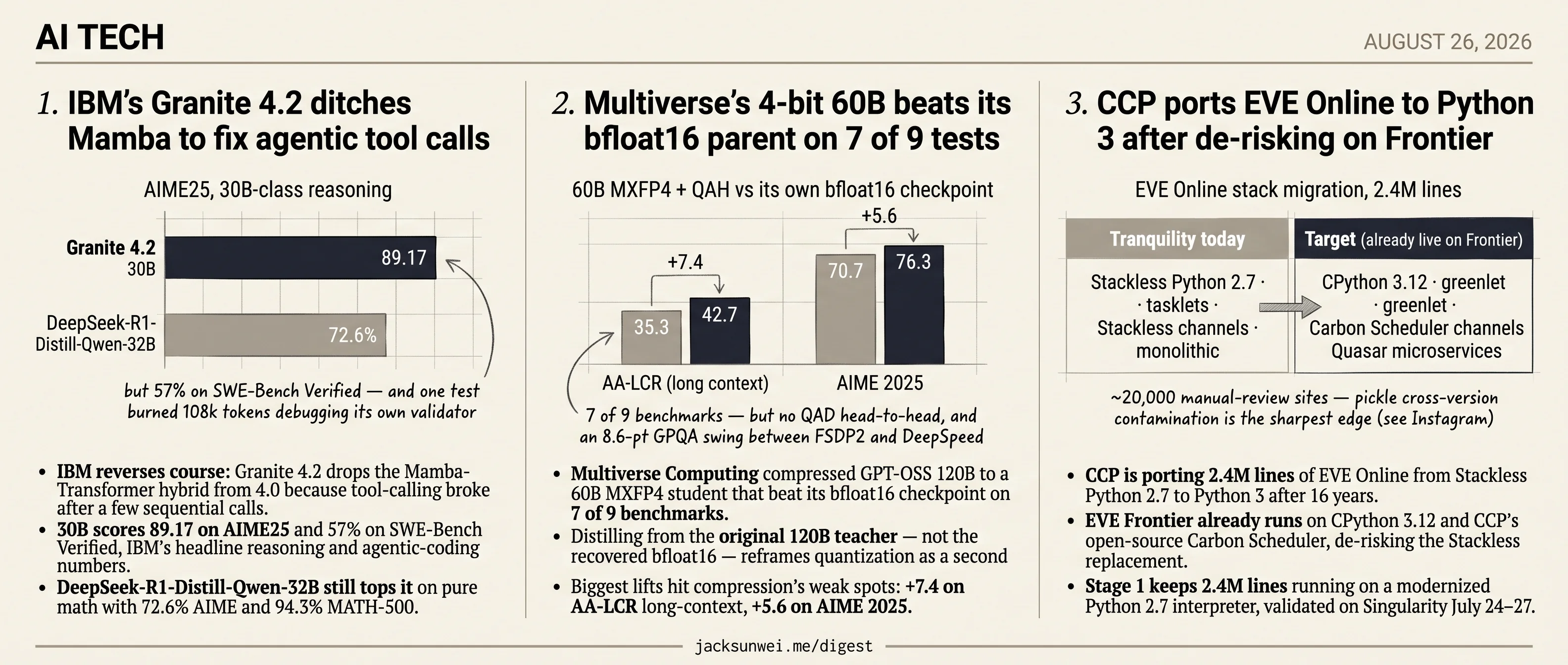
IBM drops Mamba, Multiverse skips bfloat16 recovery, CCP retires Stackless
Three developer tech drops today each score their headline win by cutting an intermediate layer — exotic runtime or recovered checkpoint — most builds keep.
IBM drops Mamba, Multiverse skips bfloat16 recovery, CCP retires Stackless
TL;DR
- IBM’s Granite 4.2 drops the Mamba-Transformer hybrid after tool-calling broke across sequential agent calls.
- Multiverse’s 4-bit 60B beats its bfloat16 parent on 7 of 9 benchmarks by distilling straight from the 120B teacher.
- CCP begins porting 2.4M lines of EVE Online from Stackless Python 2.7 to Python 3.
- Granite 30B scores 89.17 on AIME25 and 57% on SWE-Bench Verified, trailing DeepSeek-R1-Distill on pure math.
- EVE Frontier already runs on CPython 3.12, de-risking CCP’s Stackless replacement path.
Every one of today’s developer tech drops posts its headline win by removing an intermediate layer most builds treat as load-bearing. IBM’s Granite 4.2 yanks the Mamba-Transformer hybrid that headlined 4.0, because the state-space layer was quietly corrupting tool calls a few hops into an agent loop. Multiverse Computing’s 60B MXFP4 student beats its bfloat16 parent on 7 of 9 benchmarks — but only by distilling directly from the original 120B teacher, skipping the recovered bfloat16 checkpoint the field treats as the natural intermediate. CCP is finally porting EVE Online off Stackless Python 2.7, sixteen years in, after de-risking the whole migration on a sibling game already running CPython 3.12.
The pattern to notice: three unrelated teams all found the win sitting one substrate lower than their previous release stack assumed. The engineering work went into proving the exotic middle layer wasn’t buying what its inclusion implied.
IBM’s Granite 4.2 ditches Mamba to fix agentic tool calls
Source: huggingface-blog · published 2026-08-25
TL;DR
- IBM reverses course: Granite 4.2 drops the Mamba-Transformer hybrid from 4.0 because tool-calling broke after a few sequential calls.
- 30B scores 89.17 on AIME25 and 57% on SWE-Bench Verified, IBM’s headline reasoning and agentic-coding numbers.
- DeepSeek-R1-Distill-Qwen-32B still tops it on pure math with 72.6% AIME and 94.3% MATH-500.
- Agentic RL runs on GB200 NVL72 via NeMo-Gym, with 64-turn terminal rollouts and LLM-judged multi-hop web search.
- Testers caught the 30B burning 108k tokens debugging validator scripts it wrote itself, then rejecting a correct answer.
The Mamba retreat nobody’s calling a retreat
Granite 4.0 shipped barely months ago with a 9:1 Mamba-2-to-attention layer ratio and a ~70% GPU memory reduction as its headline claim 1. Granite 4.2 throws that architecture out. The 3B, 8B, and 30B models are dense decoder-only transformers with vanilla GQA, RoPE, and SwiGLU — the same shape as everyone else’s reasoning stack.
IBM doesn’t frame it as a reversal, but the reasons are concrete: practitioners found the hybrid’s tool-calling degraded after a handful of sequential calls, and llama.cpp/GGUF support required bespoke kernels 1. For an agentic workhorse, ecosystem compatibility and long-horizon tool reliability beat memory efficiency. Read 4.2 as a fork, not an increment.
The agentic RL harness is the real news
The substantive novelty is the training pipeline, not the weights. IBM’s 8B and 30B go through a GRPO-based agentic RL stage across three live environments: OpenHands SWE tasks, a sandboxed terminal running rollouts up to 64 turns, and multi-hop web search graded by an LLM judge 2. The whole thing sits on GB200 NVL72 clusters, with NeMo-Gym driving NeMo-RL over an OpenAI-compatible HTTP server so the environments themselves stay CPU-only 2.
flowchart LR
    A[NeMo-RL trainer<br/>GB200 NVL72] <-->|OpenAI-compatible HTTP| B[NeMo-Gym]
    B --> C[OpenHands SWE repos]
    B --> D[Terminal sandbox<br/>≤64 turns]
    B --> E[Multi-hop web search<br/>LLM judge]
That decoupling — GPU trainer on one side, CPU environments on the other, connected by a standard chat API — is the piece rival labs will crib.
Benchmarks with an asterisk
IBM’s headline numbers land in a benchmark landscape that’s openly distrusted. OpenAI stopped using SWE-bench Verified in early 2026 after finding roughly 60% of its tasks were unsolvable or contaminated, and on the cleaner SWE-bench Pro, Qwen 3.8-27B posts 61.7% versus Granite 4.2 30B’s 57% on the older Verified set 3. On pure math, DeepSeek-R1-Distill-Qwen-32B still reports 72.6% on AIME and 94.3% on MATH-500 — ahead of Granite in that lane 4.
Granite’s actual differentiator isn’t raw score. It’s being the only model in this size class with sandboxed agentic RL against live terminals and repos, plus full training-data transparency and ISO 42001 certification 5. Unite.ai frames it bluntly: a “workhorse” for structured enterprise tool-calling and classification, not open-ended dialogue where developers reach for Qwen or Llama 5.
The validation death spiral
The overthinking failure mode is worth naming. On r/LocalLLaMA, testers watched the 30B produce a correct primary implementation, then spend roughly 100 minutes and more than 108k tokens debugging a “recursive reflection validator” it wrote itself — ultimately discarding the right answer because its referee code had an off-by-one error 6.
The 30B spent a 100-minute reasoning saga debugging referees it wrote itself.
This is the shadow side of the chain-of-verification pitch. The low-effort thinking toggle exists precisely to cap this behavior, but leaning on it undercuts the reasoning-model differentiator. Buyers evaluating 4.2 for agent workloads should test with real time and token budgets, not just pass@1 on a static benchmark.
Multiverse’s 4-bit 60B beats its bfloat16 parent on 7 of 9 tests
Source: huggingface-blog · published 2026-08-25
TL;DR
- Multiverse Computing compressed GPT-OSS 120B to a 60B MXFP4 student that beat its bfloat16 checkpoint on 7 of 9 benchmarks.
- Distilling from the original 120B teacher — not the recovered bfloat16 — reframes quantization as a second distillation pass.
- Biggest lifts hit compression’s weak spots: +7.4 on AA-LCR long-context, +5.6 on AIME 2025.
- Reviewers flag two gaps: a missing QAD head-to-head, an 8.6-point GPQA swing between distributed backends.
The recipe
Multiverse’s Quantization-Aware Healing (QAH) attacks a specific pain point: the standard “compress, then quantize, then heal” pipeline anchors healing on the already-degraded bfloat16 checkpoint, so the 4-bit student inherits a ceiling it can never break through. QAH instead distills the compressed-and-quantized student directly against the pre-compression teacher’s logits via KL-divergence. Because the loss is on output distributions, the teacher and student don’t need matching architectures — convenient when you’ve stripped layers and heads out of the student.
A chunked KL-divergence loss keeps 32k-token contexts within GPU memory by avoiding the full vocab-by-sequence materialization. That matters because long context is exactly where aggressive compression tends to shred a model. QAH also reaches peak accuracy in ~100 steps versus QAT’s ~700, without the cross-entropy collapse that plagues long QAT runs.
The numbers
On a GPT-OSS 120B compressed to a 60B MXFP4 student, QAH clears its own bfloat16 checkpoint almost everywhere:
| Benchmark | 60B BF16 | 60B MXFP4 + QAH | Δ |
|---|---|---|---|
| AA-LCR (long context) | 35.3 | 42.7 | +7.4 |
| AIME 2025 | 70.7 | 76.3 | +5.6 |
| GPQA Diamond | 65.7 | 67.4 | +1.7 |
| Aider (coding) | 38.2 | 40.9 | +2.7 |
| LiveCodeBench | 65.5 | 66.5 | +1.0 |
The 4-bit 60B even matches the 120B teacher on LiveCodeBench (66.5 vs. 66.0) with roughly half the compute per token and ~4× less weight memory. Artificial Analysis independently ranks the resulting Hypernova-60B in the “most attractive quadrant” of intelligence-vs-size for 40B–150B models, with an Intelligence Index of 29.3 7. Unite.ai takes the headline claim at face value and echoes Multiverse’s framing of quantization as an “extra opportunity” rather than a tax 8.
The caveats the blog glosses
The 4-bit-beats-bf16 result is real but softer than it reads. OpenTrain.ai’s review points out the paper never runs the obvious head-to-head — QAH vs. standard QAD distilling from the recovered bfloat16 checkpoint at matched compute — so the “intermediate checkpoint is a performance ceiling” claim is motivated, not measured 9. The paper itself concedes an 8.6-point GPQA Diamond swing between distributed backends (FSDP2 at 73.74 vs. DeepSpeed ZeRO-3 at 65.15), a large reproducibility flag for a recipe pitched as production-ready 10.
NVIDIA’s QAT-plus-distillation guidance treats staying within 1–2% of full precision as the normal ceiling and calls surpassing FP rare, usually crediting extra training signal rather than quantization itself 11. That reframing matters here.
Community testers of the pre-healing Hypernova-60B reported Aider Polyglot scores collapsing from the 120B teacher’s ~62% down to ~27%, and severe degradation in non-English languages such as Turkish 12.
Against that baseline, QAH’s 40.9 on Aider is recovering most of a self-inflicted regression from CompactifAI pruning — not conjuring free capability over the bfloat16 source. It also explains why the paper emphasizes AA-LCR and AIME: those are the axes where the pre-healed student was most broken.
Bottom line
QAH is a fast, stable recovery recipe, and the deployment math (4× less weight memory, half the compute per token) is genuinely attractive. But the “4-bit beats full precision” headline is best read as “our healed 4-bit student beats our pruned bf16 student,” not as evidence that quantization is now upside. The missing QAD baseline and the backend-dependent 8.6-point swing are the two experiments that would settle it.
CCP ports EVE Online to Python 3 after de-risking on Frontier
Source: simon-willison · published 2026-08-25
TL;DR
- CCP is porting 2.4M lines of EVE Online from Stackless Python 2.7 to Python 3 after 16 years.
- EVE Frontier already runs on CPython 3.12 and CCP’s open-source Carbon Scheduler, de-risking the Stackless replacement.
- Stage 1 keeps 2.4M lines running on a modernized Python 2.7 interpreter, validated on Singularity July 24–27.
- ~20,000 manual-review sites await, with pickle cross-version contamination likely the sharpest edge, as Instagram’s migration showed.
The announcement understates what already happened
The headline is a Tranquility-server event: CCP is running futurize against 2.4 million lines of code and hand-auditing roughly 20,000 sites where Python 2 and 3 semantics diverge (integer division, bytes-vs-unicode, dict view objects, and the rest of the usual list) 13. That’s the visible work.
The load-bearing work happened elsewhere. EVE Frontier — CCP’s newer survival spinoff — has been running on CPython 3.12 plus a bespoke scheduler for some time, explicitly because Stackless Python was effectively capped at 3.8 and had become a dead-end dependency 14. In July 2026, CCP’s tech org open-sourced the entire Carbon stack under MIT: the Scheduler, the Destiny physics module, the Trinity renderer, and a “Quasar” networking layer that pushes the architecture toward microservices 15. The Python 3 announcement is CCP cashing in that groundwork, not starting from scratch.
Replacing Stackless without rewriting the game logic
The clever part is the Carbon Scheduler’s design. It’s built on the greenlet C extension and deliberately mimics Stackless’s tasklet-and-channel semantics, with deterministic scheduling and channel-based messaging to keep game logic predictable across distributed server nodes 16. In other words: preserve the execution model the 20-plus-year-old codebase was written against, swap the interpreter underneath it.
| Old stack (Tranquility today) | New stack (Frontier, and Tranquility target) | |
|---|---|---|
| Interpreter | Stackless Python 2.7 (2010) | CPython 3.12 |
| Concurrency primitive | Stackless tasklets | greenlet via Carbon Scheduler |
| Messaging | Stackless channels | Carbon channels (same semantics) |
| Networking | Monolithic | Microservices via Quasar |
| License | Proprietary | MIT (open-sourced July 2026) |
That table is why a 2.4M-line lift is tractable at all. If CCP had to rewrite every yield-flavored coroutine to asyncio, this migration would be measured in decades.
Instagram is the closest precedent — and the warning
The best public benchmark for what CCP is attempting is Instagram’s Python 2→3 migration. Instagram reported 12% CPU savings and 30% memory reduction on Celery workers after full rollout — real, measurable wins 17. But the operational pain came from an unglamorous place: pickled data written under Python 2 was often unreadable under Python 3, forcing Instagram to isolate caches to prevent cross-version contamination 17.
For EVE, whose universe state — from asset databases to character skill points to market orders — is serialized everywhere, that’s the sharpest edge of the manual-review pile. A dual-running Python 2.7 and Python 3 fleet sharing any pickled cache is a data-corruption incident waiting to happen.
What the announcement doesn’t say
Frontier’s alpha coverage is a useful reality check: playable on low-end hardware, but with unstable frame rates and GPU spikes on macOS and high-end PCs in complex scenes 18. The migration target itself is still maturing.
The open question CCP won’t answer yet: does greenlet-based cooperative scheduling actually improve Time Dilation in thousand-pilot fleet fights, or does it just preserve the status quo on an interpreter that still gets security patches? That’s the number EVE players will judge this on — not the line count.
Round-ups
Gradio adds visual workflow builder for chaining AI apps
Source: huggingface-blog
Gradio’s new workflow guide walks developers through wiring multi-step AI pipelines inside a single Space, then deploying them without extra infrastructure. The tutorial covers connecting model calls, UI components, and outputs into reusable flows aimed at prototyping agentic apps on Hugging Face.
Radiologists keep their jobs as AI reshapes the workflow
Source: ars-technica-ai
Geoffrey Hinton’s 2016 prediction that AI would replace radiologists within five years has aged badly, with the specialty still growing. Instead, image-reading models are folding into triage and measurement tasks, shifting radiologists toward oversight rather than displacing them.
Footnotes
-
InfoWorld on Granite 4.0 hybrid Mamba-Transformer — https://www.infoworld.com/article/4067691/ibm-launches-granite-4-0-to-cut-ai-infra-costs-with-hybrid-mamba-transformer-models.html
↩ ↩2Granite 4.0 used a 9:1 ratio of Mamba-2 to transformer attention layers to cut GPU memory ~70%; 4.2 reverts to a dense decoder-only transformer because tool-calling broke down after a few sequential calls and GGUF/llama.cpp compatibility for hybrids required manual work.
-
MarkTechPost technical breakdown — https://www.marktechpost.com/2026/08/25/ibm-releases-granite-4-2-bringing-native-reasoning-and-agentic-rl-to-open-enterprise-models/
↩ ↩2The 8B/30B agentic RL block runs three environment stages (OpenHands SWE, live terminal with up to 64 turns per rollout, multi-hop web search judged by an LLM) on GB200 NVL72 clusters, with NeMo-Gym calling NeMo-RL over an OpenAI-compatible HTTP server so environments stay CPU-only.
-
CodingFleet SWE-bench Pro leaderboard notes — https://codingfleet.com/blog/swe-bench-pro-leaderboard-2026/
↩OpenAI ceased using SWE-bench Verified in early 2026, reporting roughly 60% of its tasks were unsolvable or contaminated; Qwen 3.8-27B scores 61.7% on the contamination-controlled SWE-bench Pro versus Granite 4.2 30B’s 57% on Verified.
-
MarkTechPost on distilled competitors — https://www.marktechpost.com/2026/08/25/ibm-releases-granite-4-2-bringing-native-reasoning-and-agentic-rl-to-open-enterprise-models/
↩DeepSeek-R1-Distill-Qwen-32B still reports 72.6% on AIME and 94.3% on MATH-500, frequently outperforming smaller Granite variants in pure math while lacking Granite’s sandboxed agentic RL for terminals and repos.
-
Unite.ai review — https://www.unite.ai/ibms-granite-4-2-models-learn-to-think-and-act-inside-environments/
↩ ↩2Granite 4.2 is differentiated by full training-data transparency and ISO 42001 certification, positioning it as a ‘workhorse’ for structured enterprise tasks like tool calling and classification rather than open-ended dialogue, where developers still prefer Qwen or Llama.
-
r/LocalLLaMA thread on Granite 4.2 30B — https://www.reddit.com/r/LocalLLaMA/best/
↩A correct primary implementation was discarded because the model’s own ‘recursive reflection validator’ had an off-by-one error; the 30B spent a 100-minute reasoning saga debugging referees it wrote itself, emitting >108k tokens of derivation.
-
Multiverse Computing / Artificial Analysis ranking — https://multiversecomputing.com/resources/hypernova-60b-the-world-s-most-efficient-model-in-its-category-according-to-artificial-analysis
↩Hypernova 60B was ranked the most efficient model in the 40B–150B parameter category, one of only two models in the ‘most attractive quadrant’ of the intelligence-versus-size analysis with an Intelligence Index of 29.3.
-
Unite.ai — https://www.unite.ai/multiverse-computings-4-bit-healing-beats-full-precision-model/
↩Multiverse Computing’s 4-bit healed model beats the full-precision original — a counterintuitive result the authors attribute to treating quantization as a second distillation pass rather than a lossy postprocess.
-
OpenTrain.ai paper review — https://www.opentrain.ai/papers/quantization-aware-healing-a-practical-recipe-for-recovering-compressed-4-bit-ll—arxiv-2608.20953/
↩The authors did not run a direct comparison between QAH and standard Quantization-Aware Distillation using the recovered bfloat16 checkpoint at matched configurations. Their claim that a recovered-teacher inherently ‘caps’ student performance remains a well-motivated hypothesis rather than a directly measured fact.
-
arXiv 2608.20953 (QAH paper, HTML) — https://arxiv.org/html/2608.20953v1
↩FSDP2 achieved a peak GPQA Diamond score of 73.74, while the strongest DeepSpeed ZeRO-3 configuration plateaued at 65.15 — an 8.6-point reproducible quality gap between distributed backends.
-
NVIDIA developer blog on QAT — https://developer.nvidia.com/blog/how-quantization-aware-training-enables-low-precision-accuracy-recovery/
↩Distillation allows quantized students to pick up nuanced patterns the original training data might not convey, typically keeping accuracy within 1–2% of the full-precision baseline; surpassing the FP baseline is rare and usually tied to data augmentation, not quantization itself.
-
Medium (Mahankali) commentary on Multiverse/CompactifAI — https://medium.com/@venkateshwararaomahankali/how-spains-multiverse-computing-just-shattered-the-ai-model-barrier-the-189m-quantum-leap-that-s-4855fdab83cd
↩Community testers of the pre-healing Hypernova-60B reported Aider Polyglot scores collapsing from the 120B teacher’s ~62% down to ~27%, and severe degradation in non-English languages such as Turkish — regressions QAH is designed to paper over.
-
CCP Games / EVE Online official announcement — https://www.eveonline.com/news/view/the-move-to-python-3-begins
↩The first stage… focuses on making the existing 2.4 million lines of code Python 3-compatible while they continue to run on a modernized Python 2.7 interpreter… CCP conducted critical mass tests on the Singularity test server from July 24–27, 2026.
-
EVE Frontier dev blog — ‘Moving Into The Future: Upgrading to Python 3’ — https://evefrontier.com/en/news/moving-into-the-future-upgrading-to-python-3
↩EVE Frontier already runs on the Carbon Scheduler and Python 3.12… allow[ing] CCP to bypass the limitations of Stackless Python, which was effectively capped at version 3.8.
-
Softonic — ‘EVE Online’s Carbon engine goes open source’ — https://en.softonic.com/articles/eve-onlines-carbon-engine-goes-open-source-trinity-and-destiny-hit-github
↩Fenris Creations open-sourced the Carbon engine, including the Scheduler, Destiny (physics), and Trinity (graphics) modules, under the MIT license… moving from a monolithic architecture toward microservices via the Quasar networking layer.
-
EVE Frontier dev blog (technical follow-up) — https://evefrontier.com/en/news/moving-into-the-future-upgrading-to-python-3
↩The Carbon Scheduler… leverages Greenlets as its low-level primitive to replicate the cooperative multitasking model of Stackless… focuses on deterministic scheduling and channel-based messaging to ensure game logic remains predictable across distributed server nodes.
-
Medium — ‘Behind Instagram’s Bold Move on Python 3’ — https://medium.com/h7w/behind-instagrams-bold-move-on-python-3-before-it-was-cool-0780e6d356ec
↩ ↩2Instagram reported a 12% CPU saving and a 30% reduction in memory usage for its Celery workers after the full rollout… pickled data from Python 2 was often unreadable in Python 3, forcing Instagram to isolate caches to prevent cross-version contamination.
-
PC Gamer — EVE Frontier coverage — https://www.pcgamer.com/games/mmo/eve-onlines-survival-spinoff-frontier-is-a-hardcore-space-sim-you-can-play-on-a-gamepad-thats-unlike-anything-else-out-there/
↩Alpha testers… suggest the engine remains highly accessible to ‘potato’ (low-end) hardware, though some users on macOS and high-end PCs have noted unstable frame rates and GPU spikes in complex scenes.