Gemini adopts Jev's Noul, Anthropic ports to AMD, DeepMind proves Signal
Google, Anthropic, and DeepMind each anchor today's frontier tech launch on a rival or external party's vocabulary, hardware, or protocol.
Gemini adopts Jev’s Noul, Anthropic ports to AMD, DeepMind proves Signal
TL;DR
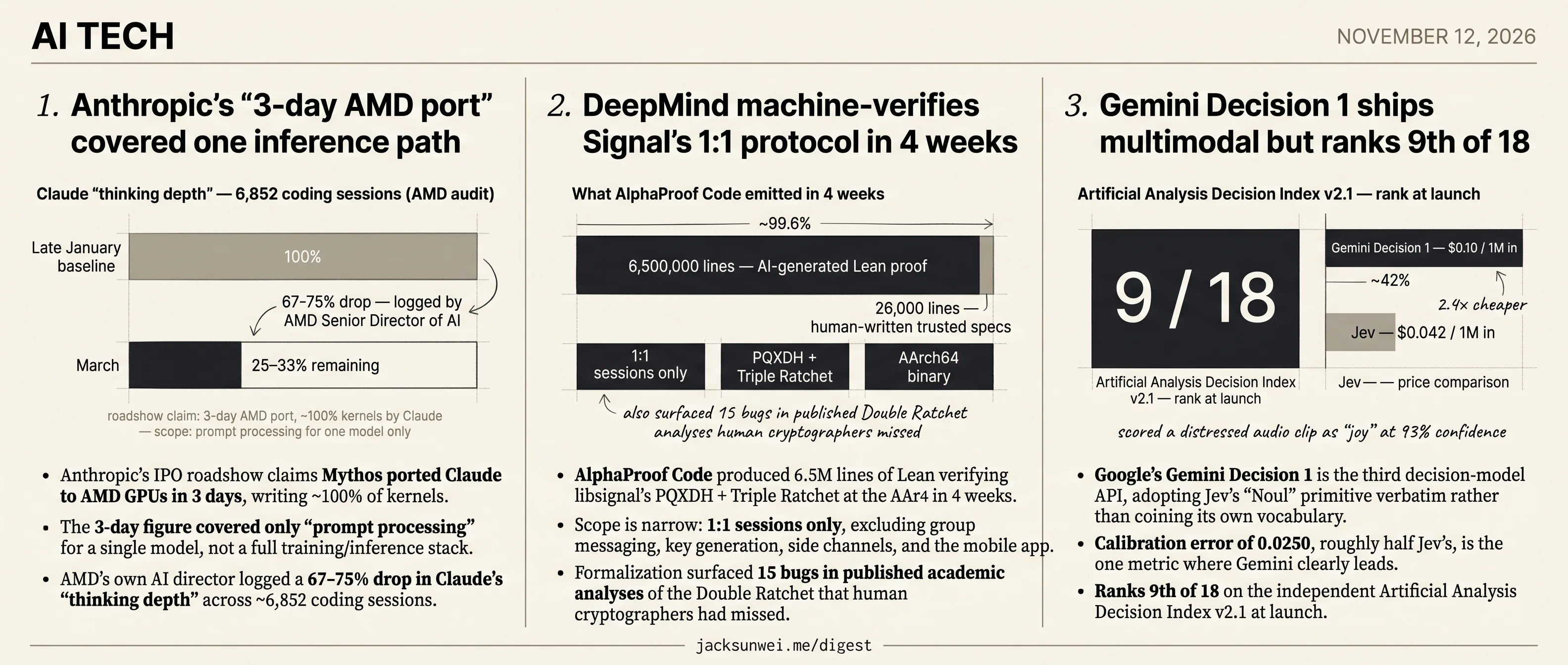
- Anthropic’s 3-day AMD port covered prompt processing on one model, not a full training or inference stack.
- DeepMind’s AlphaProof Code verified libsignal’s 1:1 sessions in 4 weeks, excluding groups, keys, and mobile.
- Gemini Decision 1 adopts Jev’s ‘Noul’ primitive verbatim as Google’s first entry in the category.
- Gemini Decision 1 ranks 9th of 18 on the Artificial Analysis Decision Index at launch.
- AWS shipped a local emulator built by an agent swarm writing 29,684 Rust commits in 3 weeks.
Three frontier tech launches today, and the throughline isn’t scale or scope — it’s that each one is anchored on a primitive somebody else defined. Google’s Gemini Decision 1 enters the decision-model category as the third API and adopts competitor Jev’s Noul vocabulary verbatim rather than coin its own, then lands 9th of 18 on the independent Artificial Analysis leaderboard. Anthropic’s IPO roadshow leads with a three-day AMD port — Mythos writing kernels for a silicon stack the lab doesn’t control — with the figure covering prompt processing on one model. DeepMind’s AlphaProof Code produces 6.5M lines of Lean verifying Signal’s PQXDH + Triple Ratchet, a protocol Moxie and Trevor shipped a decade ago.
Borrowing isn’t the story on its own; it’s how the news reads differently when you notice. The headline each vendor leads with is our capability, but the load-bearing noun in the sentence — Noul, AMD, libsignal — belongs to somebody else. That reframes the competitive move. Gemini is validating a Jev-coined category, not inventing one. Mythos is proving AMD, not Anthropic. AlphaProof Code is auditing Signal, not DeepMind’s own stack.
Anthropic’s “3-day AMD port” covered one inference path
Source: simon-willison · published 2026-11-11
TL;DR
- Anthropic’s IPO roadshow claims Mythos ported Claude to AMD GPUs in 3 days, writing ~100% of kernels.
- The 3-day figure covered only “prompt processing” for a single model, not a full training/inference stack.
- AMD’s own AI director logged a 67–75% drop in Claude’s “thinking depth” across ~6,852 coding sessions.
- METR audit confirms 1.9× R&D acceleration from AI — CI spans 1.3–3× with Anthropic redactions.
The pitch
Simon Willison pulled a clean transcript of Anthropic’s IPO roadshow video, and the Tom Brown segment is the one investors are meant to remember. Claude trains and serves across all four major chip families — NVIDIA, Google TPU, AWS Trainium, AMD — and the AMD bring-up, which historically takes “dozens of engineers months of work,” was allegedly done by an internal Claude variant called Mythos in three days, with the model writing or porting ~100% of the kernels itself. Brown pairs this with a “total effective compute” framing: physical capacity times stacking algorithmic multipliers, accelerating toward recursive self-improvement where Claude discovers new multipliers on its own.
It’s a tight pitch. It’s also the one part of the S-1 story where every headline number has a published asterisk.
What “three days” actually covered
The viral number compresses a much narrower achievement. Independent writeups indicate the three-day timeline applied specifically to prompt processing for a single model, not the numerical-precision parity, peak-throughput tuning, and training stack that a real multi-chip production deployment requires 1. That’s standard “bring-up” work, not the months-long engineering the comparison implies — and nothing has shipped as a reproducible repo or technical post.
The counter-signal from inside AMD’s own org is harder to wave away. Senior Director of AI Stella Laurenzo filed a quantitative GitHub critique built on ~6,852 Claude Code sessions, documenting a 67–75% collapse in “thinking depth” and a Read-to-Edit regression severe enough that her team moved to a competitor 2. Veracode’s 2026 report puts a floor under the broader concern: 44% of AI-generated coding tasks shipped code with known CWEs — “syntax is solved, but security is not” 3. Those are awkward companions to a pitch deck claiming Claude can own kernel development on new silicon.
Claims vs. the paper trail
| Roadshow claim | What the record actually shows |
|---|---|
| 3-day AMD port, ~100% kernels by Claude | Covered prompt processing for one model 1 |
| Stacking compute multipliers compounding | Revenue-per-compute-dollar fell 2.08× → 1.72× in Q3 2026 4 |
| AI-accelerated internal R&D | METR confirms 1.9× but CI = 1.3–3×, with Anthropic redactions 5 |
| “Imminent” recursive self-improvement | Appears as an S-1 risk disclosure; critics call it an IPO stunt 6 |
METR’s embedded audit is the most supportive outside data point Anthropic has: a 1.9× acceleration in capability growth since October 2025, with roughly 80% attributed to AI-assisted R&D. But METR notes it had no unmediated access to unreleased models, and Anthropic exercised unilateral redaction on the evidence METR flagged as most informative 5. The financial side wobbles too — Anthropic’s own revenue-per-compute-dollar dipped from 2.08× to 1.72× in Q3 2026, which is the opposite direction a “stacking multipliers” story should trend 4.
RSI as a disclosure, not just a slogan
The recursive-self-improvement line isn’t only rhetoric. The amended S-1 warns Anthropic may “imminently” cross the Responsible Scaling Policy threshold for “dramatically accelerated progress attributable to AI” 6. Supporters frame this as responsible disclosure. Skeptics read it as a calculated narrative device engineered to justify the $1.2–1.5T valuation band — a safety warning functioning as a growth story 6. Both readings can be true. What’s harder to argue is that the roadshow’s triumphal numbers survive first contact with the people who’ve actually audited them.
DeepMind machine-verifies Signal’s 1:1 protocol in 4 weeks
Source: ars-technica-ai · published 2026-11-11
TL;DR
- AlphaProof Code produced 6.5M lines of Lean verifying libsignal’s PQXDH + Triple Ratchet at the AArch64 binary in 4 weeks.
- Scope is narrow: 1:1 sessions only, excluding group messaging, key generation, side channels, and the mobile app.
- Formalization surfaced 15 bugs in published academic analyses of the Double Ratchet that human cryptographers had missed.
- Matthew Green warns the real fallout is political, not mathematical: cheap verification kills the exploit supply agencies depend on.
What was actually proved
DeepMind’s AlphaProof Code pointed itself at libsignal v0.105.4, compiled to AArch64, and emitted machine-checked Lean proofs that the compiled binary correctly implements PQXDH and the Triple Ratchet for one-to-one sessions. That is a real first. Prior Tamarin and ProVerif work on Signal only reached the abstract protocol under Dolev-Yao “perfect cryptography” assumptions — it never touched compiled code 7. Four weeks of agent time versus the person-decades that got seL4 across the line is the scalability claim worth taking seriously.
The scope, however, is tighter than the headlines suggest. Group messaging, key generation, side channels, and the mobile app surface are all out of scope 8. The 6.5M lines of Lean sit on top of roughly 26,000 lines of human-written “trusted specifications” — if a human mis-specifies a property, the proof certifies the wrong thing with great confidence 8.
To validate the pipeline, DeepMind reintroduced two historical libsignal flaws: a weak-state handshake that let a mangled handshake reuse a session secret, and a missing small-subgroup check in the PQXDH responder. AlphaProof Code produced machine-checked refutations of both modified binaries 9.
The more interesting finding
Buried under the “Signal verified” framing is a sharper result: the act of formalizing Signal’s security goals into Lean surfaced 15 gaps or outright bugs in previously published computational analyses of the Double Ratchet — flaws in the theoretical models that expert peer review had missed 10. That is a stronger argument for AI-assisted formalization than the clean run on libsignal itself. The academic literature on one of cryptography’s most-scrutinized protocols had holes, and a proof assistant pointed at them found them.
The Lean community isn’t entirely sold
Reviewers reading the artifact describe some of the AI-generated proofs as “unorthodox” — induction on arbitrary constants, obscure tactics no human would reach for 11. More consequentially, the Lean kernel can no longer check proofs as fast as the model generates them. The bottleneck has moved from “can we write the proof” to “can we check it,” and from “can we check it” to “did the human write the right spec” 811.
The policy fight nobody is talking about
Matthew Green put the stakes plainly months before this result landed:
AI that can flawlessly verify code could make software ‘too secure’ — intelligence agencies that rely on exploit-based surveillance may go dark, which will restart aggressive backdoor and exceptional-access debates. 12
If four-week verification of a hardened cryptographic library generalizes to ordinary application code, the exploitable-bug supply that signals intelligence quietly depends on starts to dry up. The next fight is not whether Signal is secure — it is whether governments will tolerate software that provably is. That is the conversation the Ars writeup skirts, and it is the one this result actually opens.
Gemini Decision 1 ships multimodal but ranks 9th of 18
Source: simon-willison · published 2026-11-11
TL;DR
- Google’s Gemini Decision 1 is the third decision-model API, adopting Jev’s “Noul” primitive verbatim rather than coining its own vocabulary.
- Calibration error of 0.0250, roughly half Jev’s, is the one metric where Gemini clearly leads.
- Ranks 9th of 18 on the independent Artificial Analysis Decision Index v2.1 at launch.
- Full multimodal (video, audio, PDF) is the differentiator over Jev and GPT-6 Luna.
- Scored a distressed audio clip as “joy” at 93% confidence in independent testing.
- $0.10 per 1M input tokens, matching OpenAI’s GPT-6 Luna and 2.4× Jev’s $0.042.
A third entrant speaking its rival’s language
A year ago, decision-model APIs were one startup’s bet. Today they’re a category with three serious vendors and a shared vocabulary — and Google is the one playing catch-up. Gemini Decision 1 supports the same three question types as Jev (yes/no, choice, rubric-score) and borrows Jev’s primitive name “Noul” — a portmanteau of “Bernoulli” coined by TypeSafe founder Diogo Almeida 13. Vercel’s AI SDK already treats the three as drop-in substitutes through an experimental_decide abstraction 14, which tells you how commoditized the API surface has become. Commentators in the ecosystem are blunter, framing Google and OpenAI as “copycats” responding to Jev’s original launch on a two-week-to-two-month clock 15.
Calibration wins, leaderboard loses
The one place Gemini genuinely leads is probability calibration. Google reports a calibration error of 0.0250, nearly half Jev’s 16. That’s why Willison’s test returns 0.923 instead of a clean 1.0 — Gemini surfaces the uncertainty rather than rounding it away, and if the probabilities match ground-truth frequencies, that’s the right move for any downstream system doing custom thresholding.
The reasoning benchmarks are less flattering. On the independent Artificial Analysis Decision Index v2.1, Gemini Decision 1 placed 9th of 18 models at launch, and on the AA-Paperclip document task it hit perfect accuracy on only 33% of documents versus Drex Max’s 63% 17. Google’s “tops 7 of 9 benchmarks” marketing line should be read against that external ranking.
| Model | Input $/1M | Modalities | AA Index rank | Calibration error |
|---|---|---|---|---|
| Jev | $0.042 | Text/JSON | — | ~2× Gemini’s |
| GPT-6 Luna | $0.10 | Text + image | — | discrete output |
| Gemini Decision 1 | $0.10 | Text, image, audio, video, PDF | 9/18 | 0.0250 |
Multimodal is the pitch — and the weakness
The “full multimodal at $0.10/M” headline needs an asterisk. MindStudio’s real-world testing found Gemini Decision 1 labeled a highly distressed audio clip as “joy” with 93% confidence, and returned only 21% confidence detecting obviously AI-generated footage 18. This is the exact failure mode good aggregate calibration hides: average probabilities look well-tuned while specific modalities fail with high confidence. A moderation pipeline wiring Gemini Decision 1 to audio-sentiment triage on the strength of the 0.0250 calibration figure would ship confidently wrong answers.
What’s actually being contested
The API surface is settled — Noul, Choice, Score, JSON out, probability in. What practitioners argue still differentiates Jev isn’t the schema but the training recipe: Reinforcement Learning for Calibrated Decisions (RLCD), which the “copycats” haven’t matched 15. Google’s entry proves the category is real and forces price convergence at the $0.10 tier, but leaves Jev with both the pricing moat (2.4× cheaper) and the reasoning crown, while Gemini stakes out “the multimodal one, if you don’t need audio.”
The interesting signal isn’t Gemini Decision 1’s benchmarks — it’s that Google shipped a decision model at all, using someone else’s vocabulary, roughly seven weeks after Jev’s launch put the category on the map.
Round-ups
AWS ships official local emulator written by agent swarm in Rust
Source: simon-willison
AWS released an official local emulator for its services, removing the need for paid API keys during testing. The Rust codebase landed 29,684 commits in three weeks via an agent swarm, with Swami Sivasubramanian detailing the build on Werner Vogels’ blog. Docker is required on macOS and Windows.
LLM 0.37.2 patches bug leaking OpenAI keys to third-party endpoints
Source: simon-willison
Simon Willison’s LLM tool shipped 0.37.2 to fix two advisories from researcher Daniel de Araujo. The extra-openai-models.yaml mechanism for third-party OpenAI-compatible endpoints could forward the user’s real OpenAI key when a named key was unset or when responses-mode models ran with chat_completions enabled.
Hugging Face trains multi-vector embeddings with token pooling awareness
Source: huggingface-blog
Hugging Face details a training recipe that bakes token pooling directly into multi-vector embedding models, closing the quality gap that normally appears when pooled vectors replace full token sets at inference. The approach keeps retrieval accuracy while shrinking index size for ColBERT-style systems.
JioStar architect details AI discovery evals at 500M-user scale
Source: openai-blog
JioStar’s Vijay Seshadri walks through how the Indian streamer runs AI-powered content discovery for 500 million users, covering evaluation pipelines, guardrails, and the operational lessons from moving OpenAI models into production at that scale.
Simon Willison’s 244 vibe-coded tools gain tree-sitter tag browsing
Source: simon-willison
tools.simonwillison.net now sports tag-cloud navigation across its 244 tools, grouped by JavaScript library, web API, and CDN host. Willison built it with Fable 5.2 credits and tree-sitter code analysis, surfacing stats like 92 tools using ES modules and 69 using the Clipboard API.
Footnotes
-
AI Central Resources — technical scope caveat on the AMD port — https://www.aicentralresources.com/news/anthropic-amd-gpu-cuda-migration-ai-agents
↩ ↩2The ‘three-day’ timeline reportedly applied specifically to ‘prompt processing’ for a single model, rather than a full, production-ready training and inference stack.
-
TechRadar — on Stella Laurenzo (AMD AI Director) GitHub critique — https://www.techradar.com/pro/claude-cannot-be-trusted-to-perform-complex-engineering-tasks-amd-ai-head-slams-anthropics-coding-tool-after-months-of-frustration
↩Claude cannot be trusted to perform complex engineering tasks — based on analysis of nearly 7,000 coding sessions, with ‘thinking depth’ dropping 67–75% between late January and March.
-
Veracode 2026 GenAI Code Security Report — https://www.veracode.com/blog/2026-genai-code-security-report-ai-risk/
↩44% of AI-generated coding tasks resulted in code with known vulnerabilities (CWEs) — ‘syntax is solved, but security is not.’
-
The SaaS CFO — Anthropic revenue-per-compute-dollar — https://www.thesaascfo.com/anthropic-revenue-per-dollar-of-compute/
↩ ↩2Anthropic’s computing efficiency ratio actually dipped from 2.08x to 1.72x in Q3 2026, suggesting gains may not be as steady as the roadshow video implies.
-
MLQ.ai — METR audit of Anthropic R&D acceleration — https://mlq.ai/news/metr-finds-anthropics-model-progress-has-roughly-doubled-with-ai-driving-about-80-of-the-speedup/
↩ ↩2METR found a 1.9x acceleration in capability growth since October 2025, with ~80% credited to AI-assisted R&D, though the 95% confidence interval spans 1.3x to 3x and Anthropic redacted much of the most informative evidence.
-
TheAIWorld.org — on Anthropic’s S-1 RSI disclosure — https://theaiworld.org/news/anthropic-recursive-self-improvement-warning-in-ipo-filing
↩ ↩2 ↩3The amended S-1 warns Anthropic may ‘imminently’ meet the threshold for ‘dramatically accelerated progress attributable to AI’… critics dismiss the warning as a calculated ‘IPO stunt’ designed to manufacture a narrative of inevitability.
-
Cohn-Gordon et al. / Tamarin post-quantum Signal analysis (ResearchGate) — https://www.researchgate.net/publication/376644304_Formal_Verification_of_a_Post-quantum_Signal_Protocol_with_Tamarin
↩Prior Tamarin and ProVerif work verified Signal’s X3DH and Double Ratchet at the abstract protocol level under the Dolev-Yao ‘perfect cryptography’ assumption — never at the compiled machine-code level.
-
AI Weekly technical digest — https://aiweekly.co/alerts/deepminds-alphaproof-code-verifies-signal-protocol-in-four-weeks
↩ ↩2 ↩3The 6.5M lines of proof rest on ~26,000 lines of human-written ‘trusted specifications’; the verification covers only one-to-one PQXDH + Triple Ratchet sessions and excludes group messaging, key generation, side channels, and the mobile app.
-
Cortist (HN-style technical recap) — https://cortist.com/news/deepmind-alphaproof-code-signal-machine-code-verification-2026/
↩AlphaProof Code reintroduced two historical libsignal flaws — a weak-state handshake bug that let a mangled handshake create a second session with the same secret, and a missing small-subgroup check in the PQXDH responder — and produced machine-checked proofs that the modified binaries were insecure.
-
MLQ.ai — formalization findings — https://mlq.ai/news/google-deepminds-alphaproof-code-proves-key-security-properties-of-signals-code-at-the-machine-code-level/
↩Formalizing Signal’s security goals into Lean surfaced 15 gaps or bugs in previously published computational analyses of the Double Ratchet — flaws in the theoretical models that expert human cryptographers had missed.
-
Cortist — Lean community reaction — https://cortist.com/news/deepmind-alphaproof-code-signal-machine-code-verification-2026/
↩ ↩2Reviewers flagged AI-generated Lean as ‘unorthodox’ — induction on arbitrary constants, obscure tactics no human would use — and warned that the Lean kernel’s checking speed is now slower than model generation, making the checker itself the new bottleneck.
-
Matthew Green — Cryptography Engineering blog — https://blog.cryptographyengineering.com/2026/08/14/everything-is-about-to-go-dark/
↩AI that can flawlessly verify code could make software ‘too secure’ — intelligence agencies that rely on exploit-based surveillance may go dark, which will restart aggressive backdoor and exceptional-access debates.
-
TypeSafe Jev docs — Noul primitive — https://docs.typesafe.ai/primitives/noul
↩‘Noul’ is a portmanteau for Bernoulli; the probability itself serves as the measure of certainty, where a value of 0.5 indicates maximum ambiguity
-
Vercel AI SDK docs (ai-sdk.dev) — https://ai-sdk.dev/docs/ai-sdk-core/decisions
↩experimental_decide function… allows developers to swap between specialized models like TypeSafe AI’s Jev, OpenAI’s Decisions API, and Google’s Gemini Decision 1 with minimal code changes
-
remio.ai — ‘OpenAI Decisions API copies Jev’s fast decisions but agent control is the real test’ — https://www.remio.ai/post/openai-decisions-api-copies-jevs-fast-decisions-but-agent-control-is-the-real-te
↩ ↩2copycat models from giants like Google and OpenAI often miss the ‘hard part’: Reinforcement Learning for Calibrated Decisions (RLCD)
-
VentureBeat — https://venturebeat.com/technology/googles-gemini-decision-1-model-scores-up-to-1-000-questions-in-one-api-call
↩Google reported a calibration error of 0.0250, nearly half that of its closest rival, Jev
-
SuperpowerDaily — https://superpowerdaily.com/posts/google-launches-an-ai-decision-api-that-scores-up-to-1-000-questions-per-request
↩The Artificial Analysis Decision Index v2.1 ranked the model 9th out of 18 available decision models at launch… Gemini achieved perfect accuracy on only 33% of documents, trailing competitors like Drex Max (63%)
-
SuperpowerDaily (MindStudio real-world testing) — https://superpowerdaily.com/posts/google-launches-an-ai-decision-api-that-scores-up-to-1-000-questions-per-request
↩In an emotion-detection test, it erroneously classified a highly distressed audio clip as ‘joy’ with 93% confidence… only 21% confidence in detecting obviously AI-generated footage