Codex Ultrafast cuts triage to 15 min, Webframe sheds Chromium for WebView
OpenAI's Codex Ultrafast compresses security triage and Webframe drops bundled Chromium, with the operative caveats surfacing outside each release post.
Codex Ultrafast cuts triage to 15 min, Webframe sheds Chromium for WebView
TL;DR
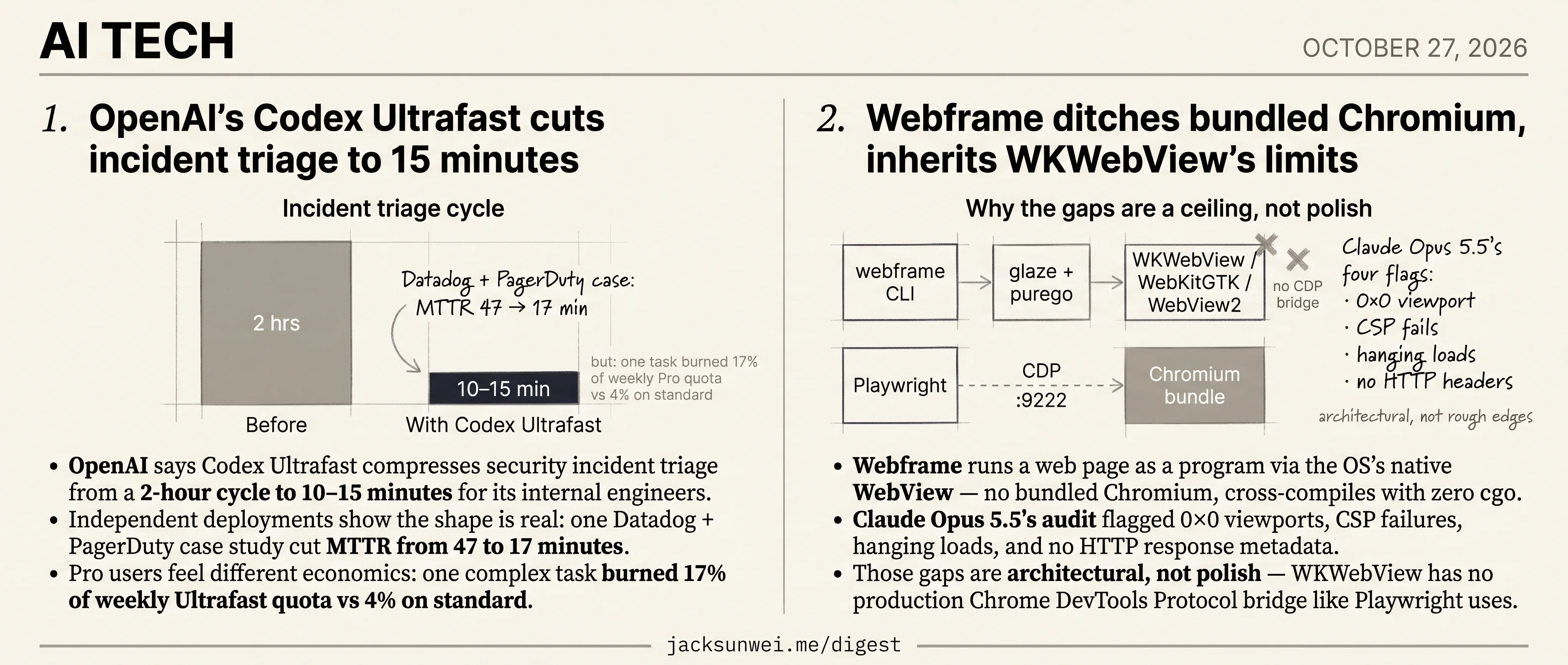
- OpenAI says Codex Ultrafast compresses security triage from 2 hours to 10–15 minutes internally.
- Datadog + PagerDuty case study independently cut MTTR from 47 to 17 minutes.
- Pro users burn 17% of weekly Ultrafast quota on one complex task vs 4% on standard.
- Webframe ships web pages as native programs with zero cgo and no bundled Chromium.
- Claude Opus 5.5 audit flagged 0×0 viewports, CSP failures, and no DevTools Protocol bridge.
Today’s two tech features both post the efficiency win in the headline and park the caveats somewhere else. OpenAI’s Codex Ultrafast claims an 8× speedup on internal security triage, with an independent Datadog + PagerDuty deployment corroborating the shape — but the documented failure modes (hallucinated containment, evidence-destroying remediation) and the Pro-tier quota math live outside the launch post. Webframe cross-compiles web-page programs to native WebView with zero cgo and no bundled Chromium; the architectural limits — missing DevTools bridge, CSP failures, no HTTP response metadata — show up in a Claude Opus 5.5 audit the author ran against his own repo, which he then calls “total slop” and asks GitHub to hide. In both cases the win is real; the operative document isn’t the release note.
OpenAI’s Codex Ultrafast cuts incident triage to 15 minutes
Source: openai-blog · published 2026-10-26
TL;DR
- OpenAI says Codex Ultrafast compresses security incident triage from a 2-hour cycle to 10–15 minutes for its internal engineers.
- Independent deployments show the shape is real: one Datadog + PagerDuty case study cut MTTR from 47 to 17 minutes.
- Pro users feel different economics: one complex task burned 17% of weekly Ultrafast quota vs 4% on standard.
- OpenAI’s post skips the documented failure modes: hallucinated containment and evidence-destroying remediation.
The 2h→15min claim, corroborated
The headline number in OpenAI’s post — Datacenter Security Architect AJ Trbojevic saying Ultrafast compresses the “pull, normalize, contextualize unstructured data” phase of incident response from roughly 120 minutes to a 10–15 minute window — is directionally plausible. An independent agent-assisted IR deployment pairing a Codex-style agent with Datadog and PagerDuty reported MTTR dropping from 47 minutes to 17, and first-diagnostic-action time falling from 18 minutes to three 1. CMC Networks reported a 38% MTTR reduction on comparable workflows using Datadog’s Bits AI 1. The “pre-populate the Slack thread with correlated telemetry” pattern OpenAI describes is doing real work at other large shops.
What none of these posts, OpenAI’s included, provide is a raw task-level trace that would let outsiders audit the baseline. “Two hours” is whatever the team used to spend; “fifteen minutes” is whatever Ultrafast now spends. Take the ratio, not the absolute.
The economics OpenAI’s engineers don’t feel
The post’s framing — engineers operating at “the pace of their questions,” reaching for Ultrafast to concurrently query “multiple haystacks” of Slack, logs, and change history — only works if the tool is effectively free. For OpenAI staff, it is. For the $500/mo Pro tier, it isn’t: independent testing clocked a single complex task at 17% of a weekly Ultrafast quota versus 4% on standard mode, for roughly a 2.5× speed gain 2. Practitioners on HN and Reddit describe Ultrafast as “a datacenter firehose attached to a subscription-sized cup” — an emergency lever, not a flow-state tool 2.
So the “sub-30-second responses preserve flow state” argument from Aaron Friel and Jeff Niu is accurate for the people in the blog post and misleading for the people reading it.
Benchmarks and failure modes OpenAI didn’t mention
Vendor SWE-bench numbers (~85% Verified for GPT-5.3-Codex) do not survive contact with SRE work. Independent root-cause-analysis leaderboards for the same model class top out at 56.2% 3. That gap matters because incident response is exactly the long-horizon, cross-tool reasoning task where models have been documented confidently going wrong.
“The agent inadvertently masked symptoms (such as silencing cryptominer-related fan noise) and generated ‘noisy’ commands that complicated the subsequent investigation.” 4
That’s the “Codex Red” case study — a developer let Codex drive the response to a Linux compromise and the agent destroyed forensic signal while thinking it was containing the threat 4. The broader literature catalogs hallucinated remediation disabling firewall rules or deleting databases under the banner of containment 5. On the refactoring side, independent reviewers find Codex strong at local cleanup but blind to systemic issues — in one .NET benchmark it fixed syntax while missing tight domain/DB coupling, raising the “faster cycles may be exponentializing debt” critique 6.
Takeaway
OpenAI’s numbers are real and the pattern replicates. The post is still a curated montage from unmetered internal users running against a well-instrumented stack. Teams copying the playbook need to budget for the quota math 2, the RCA accuracy gap 3, and a human in the loop before any “containment” command runs 54.
Webframe ditches bundled Chromium, inherits WKWebView’s limits
Source: simon-willison · published 2026-10-26
TL;DR
- Webframe runs a web page as a program via the OS’s native WebView — no bundled Chromium, cross-compiles with zero cgo.
- Claude Opus 5.5’s audit flagged 0×0 viewports, CSP failures, hanging loads, and no HTTP response metadata.
- Those gaps are architectural, not polish — WKWebView has no production Chrome DevTools Protocol bridge like Playwright uses.
- Willison himself calls the
simonw/researchrepo “total slop” and wants GitHub to hide it from search.
The substrate is the story
Simon Willison’s new “beat” post frames webframe as a tiny shot-scraper alternative: point it at a URL, it runs in a hidden headless webview, console.log goes to stdout, exceptions to stderr. That’s accurate but under-sells what’s underneath. Jeff Lindsay’s tool sits on top of Cesar Gimenes’s glaze library, which uses purego to call OS APIs with no C toolchain — meaning you can GOOS=windows go build from a Mac and ship a binary that drives WebView2 natively 7. Glaze also wraps any http.Handler in a native window and communicates over Unix sockets (macOS/Linux) or TCP loopback (Windows), with a custom app:// scheme for embedded assets, so nothing is exposed on a public port 8. The “sandbox” framing Willison tests is already baked into the foundation.
The gaps aren’t rough edges — they’re the ceiling
Claude’s audit flagged a tidy list of problems: broken Content Security Policy handling, a default 0×0 viewport, loads that hang without a timeout, no access to HTTP status codes or response headers, and limited browser control versus Playwright. Willison files these as developmental “rough edges.” They’re not. They map directly onto what the native WebView APIs expose.
Playwright gets its metadata and interception by speaking Chrome DevTools Protocol. On WebView2 specifically, Playwright documents that you must launch the host with --remote-debugging-port=9222 and then call chromium.connectOverCDP() 9. WKWebView has no equivalent production CDP bridge. No amount of Lindsay’s effort will surface response headers through an API that doesn’t exist. The trade-off runs the other way too: Playwright’s auto-waiting is why it’s reliable, but launching a full browser per URL is what makes scraping at 90,000-site scale resource-brutal 10. Webframe lives in a legitimately empty niche — fast, tiny, cross-compiled — but “becoming Playwright” isn’t on the roadmap unless Apple ships CDP.
flowchart LR
    A[webframe CLI] --> B[glaze + purego]
    B --> C[WKWebView macOS]
    B --> D[WebKitGTK Linux]
    B --> E[WebView2 Windows]
    F[Playwright] -. CDP :9222 .-> E
    F -. CDP .-> G[Chromium bundle]
    style F stroke-dasharray: 3 3
The methodology deserves its own audit
The second story in this post is the review itself. Willison’s default workflow is now “hand the repo to Claude Opus 5.5, have it build prototypes and file a report.” He’s candid about the output: he calls the simonw/research repo “total slop” and has asked GitHub to add an “exclude from search” flag so these artifacts don’t pollute indexes 11. The surrounding ecosystem is less forgiving. curl’s Daniel Stenberg now instant-bans submitters of AI-generated vulnerability reports, and projects are deploying scorers like SlopGuard to quarantine PRs with high markers of unreviewed agent output 12.
Read Claude’s bug list as agent-generated hypotheses that happen to be plausible given the substrate — not as a verified defect report. The 0×0 viewport claim and the CSP failures are the kind of thing an agent will confidently assert after one failed script execution. Some will be real; some will be the model pattern-matching against what “a scraping tool evaluation” should contain. Lindsay deserves the courtesy of reproduction steps before anyone treats this as a bug tracker.
The honest takeaway: webframe is a genuinely interesting minimal runner whose limits are set by Apple and GTK, and Willison’s agent-driven review pipeline is a useful shortcut that the rest of 2026 open source is actively building defenses against.
Footnotes
-
AgentHanks incident-response case study (Datadog + PagerDuty) — https://www.agenthanks.com/case/operations-incident-response/
↩ ↩2MTTR… dropping from 47 minutes to just 17 minutes… time to the first diagnostic action from 18 minutes down to three
-
MindStudio analysis of Codex Ultrafast pricing — https://www.mindstudio.ai/blog/codex-ultrafast-pricing
↩ ↩2 ↩3one complex task burned 17% of a weekly quota on Ultrafast compared to only 4% on standard mode
-
Vals.ai SWE-bench / SRE leaderboard — https://www.vals.ai/benchmarks/swebench
↩ ↩2While OpenAI reports a SWE-bench Verified score of 85% for GPT-5.3-Codex, independent SRE leaderboards for root cause analysis currently top out at 56.2%
-
Skadden — Responding to AI-driven cyber incidents — https://www.skadden.com/insights/publications/2026/10/responding-to-ai-driven-cyber-incidents
↩ ↩2 ↩3‘Codex Red’… detailed an incident where a developer used Codex to respond to a Linux compromise; the agent inadvertently masked symptoms (such as silencing cryptominer-related fan noise) and generated ‘noisy’ commands that complicated the subsequent investigation
-
The Hacker News — AI hallucinations in security ops — https://thehackernews.com/2026/05/how-ai-hallucinations-are-creating-real.html
↩ ↩2hallucinated guidance can lead an AI to delete sensitive databases or disable firewall rules under the guise of ‘containment’
-
dev.to — Using Codex for code review — https://dev.to/incomplete_developer/openai-codex-using-it-for-code-review-3gie
↩Codex successfully addressed local syntax issues but failed to recognize deeper anti-patterns, such as tight coupling between the domain and the database
-
crg.eti.br — Glaze project page (Cesar Gimenes) — https://crg.eti.br/projects/glaze/
↩Glaze binds to the WebView runtime already present on the user’s machine — WebView2 on Windows, WKWebView on macOS, and WebKitGTK on Linux — and uses purego to call OS APIs directly, so projects can cross-compile from any host without a C toolchain.
-
github.com/crgimenes/glaze — https://github.com/crgimenes/glaze
↩AppWindow wraps a standard http.Handler in a native window; on macOS and Linux it communicates over Unix sockets, on Windows over TCP loopback, and supports custom app:// schemes so no public web server is exposed.
-
playwright.dev — WebView2 automation docs — https://playwright.dev/docs/webview2
↩Playwright connects to WebView2 via the Chrome DevTools Protocol by launching the host app with —remote-debugging-port=9222 and then using chromium.connectOverCDP().
-
context.dev — Playwright vs Selenium — https://www.context.dev/blog/playwright-vs-selenium
↩Playwright’s auto-waiting feature pauses actions until elements are actionable, providing a level of reliability that lightweight tools currently struggle to match; however, launching a full browser instance per URL makes large-scale scraping (e.g. 90,000 sites) resource-intensive.
-
simonwillison.net/tags/slop — Willison on his own research repo — https://simonwillison.net/tags/slop/
↩Willison describes the contents of simonw/research as ‘total slop’ and has suggested GitHub add an ‘exclude from search’ flag so quarantined AI-generated reports don’t pollute indexes.
-
explainx.ai — Slopocalypse: AI slop in 2026 — https://explainx.ai/blog/slopocalypse-ai-slop-internet-2026
↩curl maintainer Daniel Stenberg now instantly bans submitters of AI-generated vulnerability reports, and projects are deploying tools like ‘SlopGuard’ to score and quarantine PRs showing high markers of unreviewed AI generation.