Zhang's recursive-harness bet lands with its own counter-evidence attached
Alex Zhang's RLM paper proposes recursively calling the model as a subroutine, but Apple's reasoning data cuts the other way.
Zhang’s recursive-harness bet lands with its own counter-evidence attached
TL;DR
- Zhang’s RLM paper gives a model Python REPL access to recursively call itself as a subroutine.
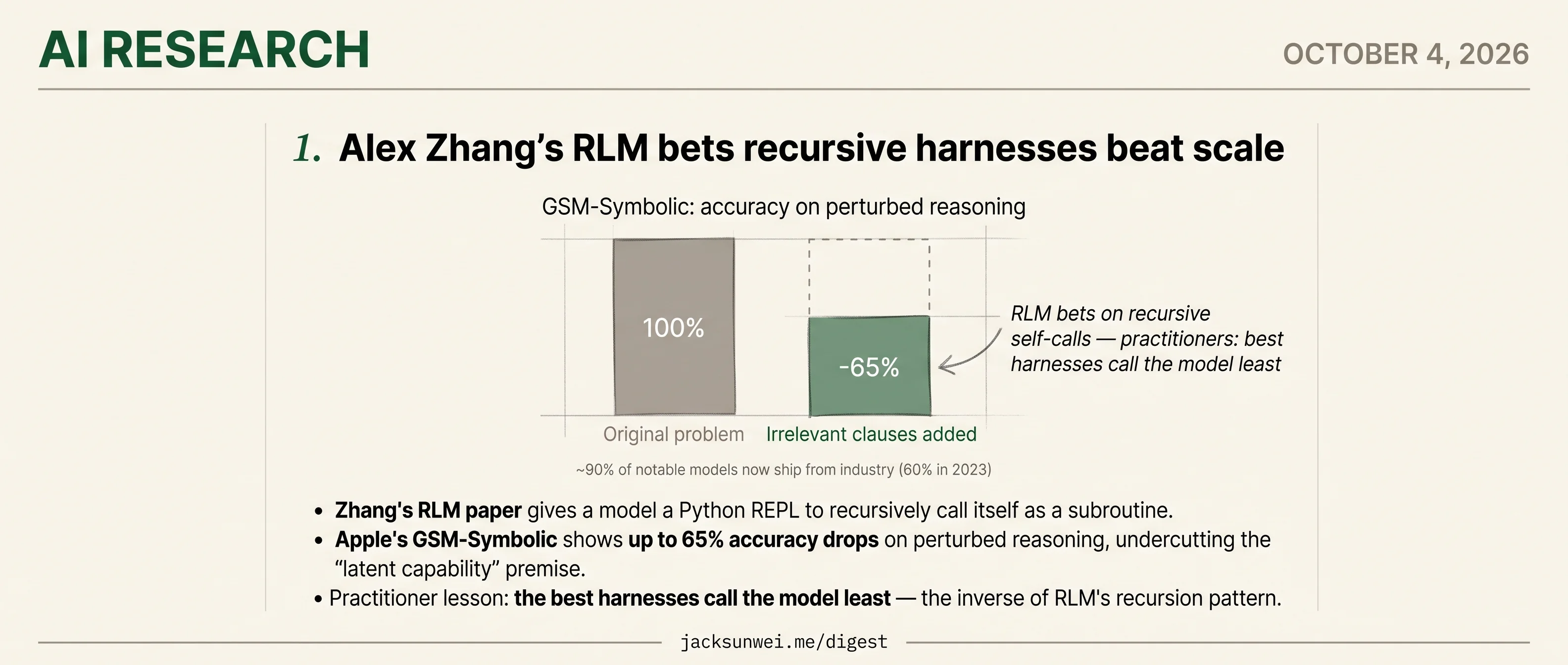
- Apple’s GSM-Symbolic shows 65% accuracy drops on perturbed reasoning, undercutting the latent-capability premise.
- Best harnesses call the model least, per practitioner telemetry — inverse of RLM’s recursion pattern.
- 90% of notable models now ship from industry, up from 60% in 2023.
The research beat is quiet today — one feature, Alex Zhang’s Recursive Language Model paper, which hands a model a Python REPL and lets it call itself as a subroutine. It’s the kind of structural swing academia has leaned into as industry absorbs the compute lane: if you can’t out-train the frontier, out-architect it. What makes the write-up worth reading is that the counter-case is already inside it. Apple’s GSM-Symbolic work shows reasoning accuracy falling by up to 65% on perturbed inputs — the latent capability RLM assumes a harness can unlock may not be sitting there in the first place. Practitioner telemetry runs the other direction too: the harnesses that work best call the model least, not recursively. And the backdrop — 90% of notable models now shipping from industry versus 60% in 2023 — reframes the academic ambition lane as a shrinking one. One paper, three pieces of friction, and no round-ups to dilute the question.
Alex Zhang’s RLM bets recursive harnesses beat scale
Source: latent-space · published 2026-10-02
TL;DR
- Zhang’s RLM paper gives a model a Python REPL to recursively call itself as a subroutine.
- Apple’s GSM-Symbolic shows up to 65% accuracy drops on perturbed reasoning, undercutting the “latent capability” premise.
- Practitioner lesson: the best harnesses call the model least — the inverse of RLM’s recursion pattern.
- ~90% of notable models now ship from industry, up from 60% in 2023 — reframing academia’s “ambition” lane.
The thesis, and who’s already there
Zhang’s Recursive Language Models paper proposes a simple move with large consequences: give the model a Python REPL and let it write code that calls itself as a subroutine, managing its own context and memory symbolically rather than through a hand-coded agent framework. The pitch is that this unlocks capability latent in the base weights — the OOLONG long-context and ARC-AGI-3 numbers in the paper are the evidence.
The Hacker News reception is pointed: “competent people are already using subagents” 1. The crowd reads RLM as a formalization of practice, not a breakthrough. Zhang’s defenders counter that symbolic recursion — the model authoring its own control flow — is the architectural distinction, and that this is what the benchmark numbers reward. The podcast under-plays that disagreement.
The caveats the podcast skips
Two independent lines of evidence cut against the stronger reading of the thesis.
First, security. Zhang’s own follow-up writing concedes a REPL-centric design opens arbitrary code execution and indirect prompt-injection surfaces, and recommends Docker or cloud sandboxing before anyone points RLM at real data 2. That’s not a footnote — it’s a precondition for deployment.
Second, the “latent capability” premise itself. Apple’s GSM-Symbolic study found frontier models losing up to 65% accuracy when irrelevant clauses were inserted into otherwise-solvable math problems 3. If a chunk of apparent reasoning is pattern-matching, no amount of recursive scaffolding recovers it. Practitioner surveys reinforce the skepticism: top agents land 30–42% completion on realistic workplace tasks, and the recurring lesson is that the most reliable harnesses are the ones that invoke the model least 4 — exactly the opposite of RLM’s recursive-call pattern.
The 95.5% ARC-AGI-3 figure cited around RLM is Prime Agent’s self-reported number and has not been verified by the ARC Prize Foundation. Treat it as a vendor claim, not a result.
”Academia is for ambition” against the compute divide
The episode’s title argument is the real editorial move, and it reads differently next to the Stanford 2025 AI Index: ~90% of notable AI models now originate in industry, up from 60% in 2023, and over 70% of AI PhDs go straight to private labs on graduation 5. Zhang frames academic research as the place to take big bets. The data suggests the bets available to academics are the ones industry has structurally conceded — interpretability, evaluation design, and harness research — because frontier pre-training is foreclosed by capex.
That reframes RLM honestly. It is a serious contribution to the one lane universities still own: figuring out how to extract more from models someone else trained. The podcast’s framing — ambition as a choice — elides that the choice was mostly made for them.
Jev, and whose problem hallucination is
The Jev tangent connects to TypeSafe AI’s late-2026 launch of a non-autoregressive “System One” model that returns calibrated probabilities via Noul/Choice/Score primitives. Armin Ronacher’s critique in InfoQ’s coverage lands the point: Jev “delegates the hallucination problem” to the developer, who still has to set the threshold 6. That’s the operational flip side of Zhang’s thesis. Moving intelligence into the scaffolding also moves responsibility there — and the harness author inherits every calibration decision the model used to make badly on its own.
Footnotes
-
Hacker News discussion — https://news.ycombinator.com/item?id=46974515
↩competent people are already using subagents
-
rlm.md — Zhang’s own blog on sandboxing the RLM REPL — https://rlm.md/blog/how-to-sandbox-the-rlm-repl.html
↩The use of a Python REPL to execute model-generated code raises significant security risks, specifically regarding arbitrary code execution and indirect prompt injection… developers are advised to use isolated sandboxes like Docker or cloud-based environments.
-
Apple GSM-Symbolic paper (arXiv 2410.05229) — https://arxiv.org/html/2410.05229v1
↩even frontier models suffer performance drops of up to 65% when irrelevant clauses are added or numerical values are changed
-
Medium — Kris Ledel on agent framework limitations — https://medium.com/@thekrisledel/the-fundamental-limitations-of-ai-agent-frameworks-expose-a-stark-reality-gap-7571affb56e5
↩even top agents often achieve only 30-42% completion rates on realistic workplace tasks… veteran developers warn that the most reliable harnesses are those that call the model the least
-
Forbes / Stanford 2025 AI Index coverage — https://www.forbes.com/sites/shannonmckeen/2026/06/29/industry-asks-one-question—academia-asks-two—ai-calls-for-both/
↩nearly 90% of ‘notable’ AI models now originate from industry, a significant jump from 60% in 2023… over 70% of AI PhD graduates entering the private sector
-
InfoQ coverage of Jev launch — https://www.infoq.com/news/2026/10/typesafe-ai-jev-released/
↩Jev ‘delegates the hallucination problem’ back to the developer, who must decide the threshold for acting on a specific probability