AstaBrief 8B drafts reports 3.5× faster, ServiceNow lifts Gemma 8pp on ITSM
Two synthetic-data distillation wins land today with strong student-model numbers but no shippable generator pipeline behind them.
AstaBrief 8B drafts reports 3.5× faster, ServiceNow lifts Gemma 8pp on ITSM
TL;DR
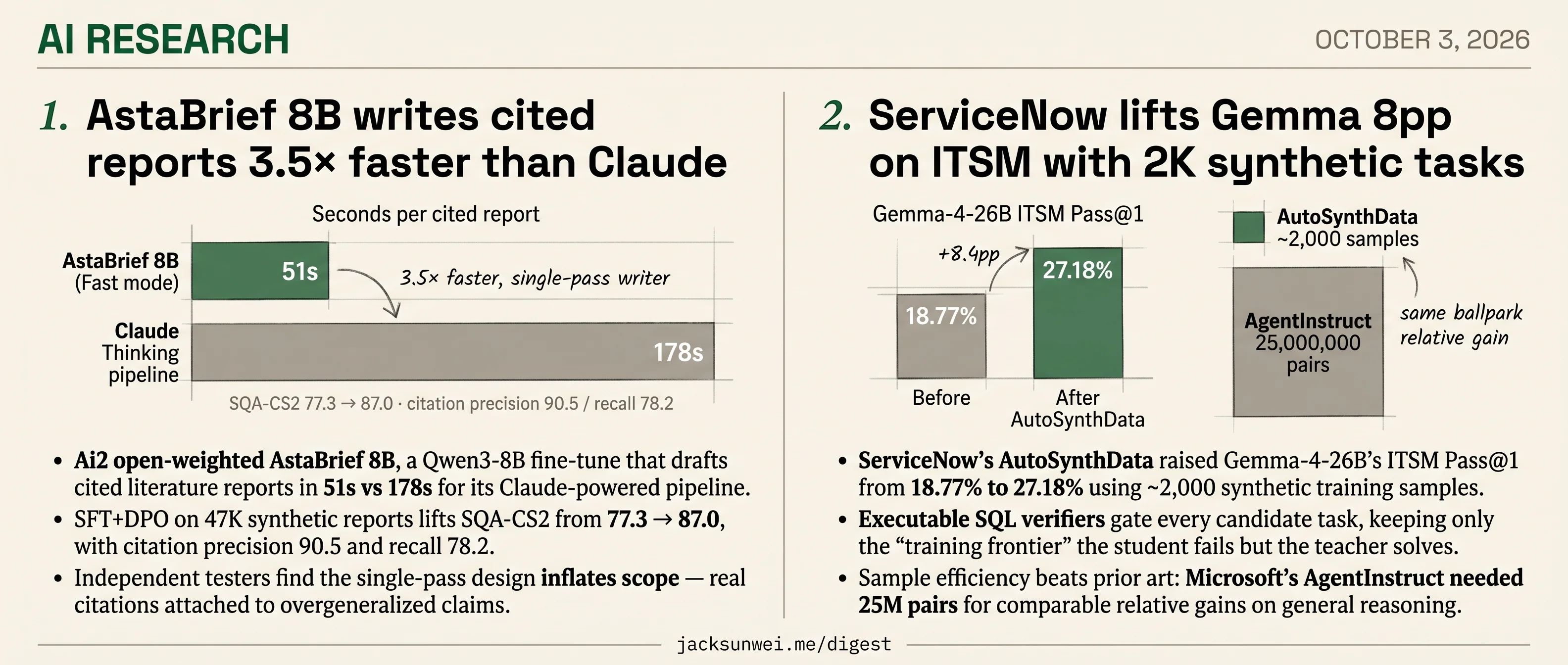
- Ai2’s AstaBrief 8B drafts cited reports in 51s vs 178s for its Claude teacher pipeline.
- ServiceNow lifts Gemma-4-26B on ITSM from 18.77% to 27.18% on ~2K synthetic tasks.
- AutoSynthData gates candidates through executable SQL verifiers, keeping only the student-fails/teacher-solves frontier.
- AstaBrief’s training corpus distilled from Claude, GPT-4.1 and o3 may carry non-commercial strings.
- ServiceNow withholds generator code, corpus, and safety-refusal delta — reproducibility rides on vendor numbers.
Today’s two research features look like different problems — AstaBrief 8B is a cited-literature report writer, ServiceNow’s AutoSynthData lifts a 26B model on IT service tasks — but they’re the same recipe. A frontier teacher generates synthetic training data, a filter keeps the useful subset, a smaller student is fine-tuned on the result, and the headline number is the student beating or matching something bigger.
What neither release ships is the pipeline itself. Ai2 open-weights AstaBrief under Apache 2.0, but the distilled corpus comes from Claude, GPT-4.1 and o3 outputs that may carry non-commercial strings. ServiceNow publishes the Pass@1 jump but withholds the generator code, the ~2K-sample corpus, and the safety-refusal delta. The students are reproducible; the thing that made them good is not.
AstaBrief 8B writes cited reports 3.5× faster than Claude
Source: huggingface-blog · published 2026-10-02
TL;DR
- Ai2 open-weighted AstaBrief 8B, a Qwen3-8B fine-tune that drafts cited literature reports in 51s vs 178s for its Claude-powered pipeline.
- SFT+DPO on 47K synthetic reports lifts SQA-CS2 from 77.3 → 87.0, with citation precision 90.5 and recall 78.2.
- Independent testers find the single-pass design inflates scope — real citations attached to overgeneralized claims.
- Training data distilled from Claude, GPT-4.1 and o3 may carry non-commercial strings despite the Apache 2.0 weights.
The writer half of a split stack
AstaBrief is not Ai2’s best open research model — DR Tulu-8B, Ai2’s own RL-trained agent, beats it on both DeepScholarBench (56.26 vs 53.50) and SQA-CS2 (88.8 vs 87.0) 1. Read against that, the AstaBrief release makes more sense as a role specialization than a flagship: DR Tulu plans and retrieves, AstaBrief does the fast single-pass synthesis once the evidence is in hand. The Hugging Face card spells out the shape — 36-layer decoder, 40,960-token context, citation precision 90.5 and recall 78.2 2 — a model tuned to omit supporting sources rather than fabricate them.
flowchart LR
    Q[Research query] --> R[Retriever / planner<br/>DR Tulu-style]
    R --> E[Evidence snippets]
    E --> W{AstaBrief 8B<br/>single-pass writer}
    W --> O[Cited report<br/>~51s]
The training recipe is deliberately boring. SFT on 47K reports distilled from Claude 3.5/3.7, GPT-4.1 and o3, then DPO on 6K preference pairs judged by GPT-4.1 and DeepSeek-R1 against a 95% human-alignment bar. No RL, no intermediate snippet summarization. The payoff is throughput: full Asta “Fast mode” averages 51.1s per report against 178.5s for the Claude-powered Thinking mode, and roughly 23% of users who tried Fast mode switched permanently.
Where single-pass design breaks
The sharpest independent critique is that AstaBrief’s citation-density filter — the paper’s own “most effective” grounding lever — buys surface fidelity at the cost of scope discipline. Reviewers document a recurring “sample-to-population” failure where a finding from “in 42 patients” becomes “in humans,” with a legitimate citation still attached 3. Hands-on testing extends the problem: fed bad snippets, the model stays “fluent and well-cited” and confidently writes about the wrong material, because it never verifies the retrievals it was handed 4.
AstaBrief operates in a single pass, [so] it lacks the iterative ‘thinking’ steps used by larger models to self-correct reasoning chains. 5
That shows up concretely in one documented batch-normalization report with reasoning errors and misreported numbers 5. The 23% stickiness figure should be read in that light — users are keeping Fast mode for speed on iterative drafts, not for final scientific claims. Citation precision of 90.5 means the sources exist; it does not mean they say what the paragraph says they say.
Licensing fine print
The Apache 2.0 weights are the headline, but the training-data pipeline was built on outputs from proprietary frontier models, and at least one reviewer flags that the derived datasets may carry downstream non-commercial restrictions requiring legal review before enterprise deployment 6. That is the usual tax on distillation-heavy recipes, and it is worth checking before anyone wires AstaBrief into a paid product.
The honest framing: AstaBrief is a useful, narrow artifact — a fast, cited drafter over supplied evidence. Treat its paragraphs as first drafts whose scope needs human tightening, not as finished synthesis.
ServiceNow lifts Gemma 8pp on ITSM with 2K synthetic tasks
Source: huggingface-blog · published 2026-10-02
TL;DR
- ServiceNow’s AutoSynthData raised Gemma-4-26B’s ITSM Pass@1 from 18.77% to 27.18% using ~2,000 synthetic training samples.
- Executable SQL verifiers gate every candidate task, keeping only the “training frontier” the student fails but the teacher solves.
- Sample efficiency beats prior art: Microsoft’s AgentInstruct needed 25M pairs for comparable relative gains on general reasoning.
- No generator code, corpus, or safety-refusal delta accompanies the release — reproducibility is entirely on vendor numbers.
The method: train on what the student can’t do yet
AutoSynthData frames training-data generation as a search problem. For each capability gap — a task where the target model fails but a stronger teacher succeeds — the system writes a “capability specification card” describing the tools, workflow, and success criteria, then generates executable task variants grounded in a specific enterprise environment. Every candidate passes through positive verification (does the known-good solution actually work?) and negative verification (do wrong answers correctly fail?), with a critic model repairing broken tasks before they enter the training set.
The setup matters because EnterpriseOps-Gym is brutal. Independent coverage notes that tasks average nine stateful steps, graded purely on terminal database state via SQL verifiers, with no undo 7. Moving an agent from 18.77% to 27.18% Pass@1 in that regime is real work — though it still leaves ~70% of ITSM tasks failing.
Sample efficiency vs. the AgentInstruct baseline
The headline comparison is scale. Microsoft’s AgentInstruct lifted a Mistral-7B base by 54% on GSM8K and 40% on AGIEval using 25 million synthetic pairs 8. AutoSynthData reports a 35% relative Pass@1 gain on Hybrid tasks from roughly 2,000 samples generated in 18 hours. The trade-off is scope: AgentInstruct targets general reasoning, AutoSynthData is deliberately narrow — a curriculum shaped to one model’s measured weaknesses in one environment.
One oddity worth flagging on Hybrid: the pipeline pushes the verifier success rate from 63.01% to 68.55%, while whole-task Pass@1 only reaches the high-20s. That spread suggests the system is better at producing checkable sub-outcomes than at producing agents that complete full nine-step workflows end-to-end.
The dissent: imitation gap and the missing safety number
Teacher-distillation pipelines have a well-documented failure mode. Researchers describe an “imitation gap” where students learn the surface format of a teacher’s reasoning without the underlying world model 9. Benchmark work from distillabs found that models trained on clean synthetic trajectories can underperform those trained on noisy human traces by 14–28 points, because they over-optimize to idealized paths 10.
AutoSynthData’s critique-and-repair loop plausibly scrubs exactly the kind of noise that would inoculate agents against messy production environments.
The sharper omission is safety. Third-party analysis of EnterpriseOps-Gym reports that the best models currently refuse harmful or policy-violating orders only 53.9% of the time 11. The AutoSynthData writeup does not report whether SFT on its synthetic curriculum moves that number up, down, or sideways — arguably the single metric an enterprise buyer most needs.
Reproducibility: vendor numbers on a vendor benchmark
As of launch, ServiceNow has published model cards and headline results but not the generator implementation, a price list, or the synthetic corpus 12. The 35% relative gain is a vendor-reported figure, on a vendor-built benchmark, trained with vendor-selected teachers. The verifier-grounded method is genuinely novel; the credibility of the claim won’t harden until an outside group replicates it — and until the safety-refusal delta is on the page next to the capability gains.
Footnotes
-
alphaXiv paper summary (DR Tulu vs AstaBrief) — https://www.alphaxiv.org/abs/2511.19399
↩On the DeepScholarBench—a 63-query long-form synthesis benchmark—DR Tulu-8B scored 56.26, surpassing AstaBrief’s 53.50… AstaBrief remains highly competitive on SQA-CS2, where it scored 87.0, trailing DR Tulu’s 88.8 only slightly.
-
Hugging Face model card (allenai/AstaBrief_8B) — https://huggingface.co/allenai/AstaBrief_8B
↩36-layer decoder-only Transformer with a 40,960-token context window… achieved an average score of 87.0 on ScholarQA-CS2, outperforming its SFT checkpoint (83.7) and base Qwen3 (77.3). Citation precision 90.5, citation recall 78.2.
-
nxcode.io analysis — https://www.nxcode.io/resources/news/astabrief-open-science-reports-evidence-scope-2026
↩Specific examples include sample-to-population generalization: converting a finding from a specific sub-group (e.g., ‘in 42 patients’) into a universal claim (‘in humans’)… AstaBrief utilizes citation-density filtering to ensure every claim is paired with a source, [so] these overclaims are particularly difficult to detect.
-
orcarouter.ai hands-on review — https://www.orcarouter.ai/blog/astabrief-8b-release
↩Hands-on testing highlighted that if provided with incorrect evidence, the model remains ‘fluent and well-cited’ but will produce a report about the wrong material, as it prioritizes citation support over independent verification of its sources.
-
orcarouter.ai (AstaBrief vs ContextPilot) — batch-norm failure case — https://www.orcarouter.ai/blog/astabrief-8b-vs-contextpilot-8b
↩ ↩2In one documented case, an AstaBrief report on ‘batch normalization’ was found to contain numerous errors in reasoning and the misreporting of numerical data… because AstaBrief operates in a single pass, it lacks the iterative ‘thinking’ steps used by larger models to self-correct reasoning chains.
-
orcarouter.ai release note — https://www.orcarouter.ai/blog/astabrief-8b-release
↩While the weights are open [Apache 2.0], the underlying datasets may carry separate non-commercial restrictions, necessitating careful legal review for enterprise applications.
-
MarkTechPost — EnterpriseOps-Gym coverage — https://www.marktechpost.com/2026/03/18/servicenow-research-introduces-enterpriseops-gym-a-high-fidelity-benchmark-designed-to-evaluate-agentic-planning-in-realistic-enterprise-settings/
↩the system uses SQL verifiers to inspect the final state of the underlying databases after a task is completed… Each task requires an average of nine steps, forcing agents to navigate complex data dependencies and persistent system changes without an ‘undo’ button
-
Microsoft Research — Orca AgentInstruct — https://www.microsoft.com/en-us/research/blog/orca-agentinstruct-agentic-flows-can-be-effective-synthetic-data-generators/
↩fine-tuning a Mistral-7B base with 25 million AgentInstruct pairs, the resulting Orca-3 model showed a 54% improvement on GSM8K and a 40% gain on AGIEval
-
Medium — synthetic data revolution survey — https://medium.com/@guidorusso95/the-synthetic-data-revolution-how-ai-is-learning-to-train-itself-5d81fad3b809
↩if an agent is trained solely on a teacher’s output, it may fall into an ‘imitation gap,’ learning the surface-level format of reasoning without internalizing the underlying world logic
-
distillabs.ai — traces vs synthetic benchmarks — https://www.distillabs.ai/blog/traces-vs-synthetic-benchmark/
↩when training traces include real-world noise, direct training performance can drop by 14–28 points compared to human-labeled benchmarks, as the model ‘over-optimizes’ for the narrow, idealized paths found in synthetic datasets
-
getmegabrain.com — EnterpriseOps-Gym safe-refusal analysis — https://getmegabrain.com/blog/enterpriseops-gym-safe-refusal-2026
↩the best-performing models currently fail to refuse harmful orders nearly half the time, succeeding in only 53.9% of safety checks
-
rohitai.com — AutoSynthData analyst review — https://rohitai.com/blog/servicenow-autosynthdata-enterprise-agent-training-data
↩ServiceNow has released model cards and benchmarks but has yet to provide a generator implementation, price list, or a public synthetic training corpus