XR-1 rides 100K hours, NYU ties RL to pretraining loss, Han caps verifier stacks
Three research leads each show the advertised technique isn't the lever — pretraining corpus, pretraining loss, and verifier decorrelation are.
XR-1 rides 100K hours, NYU ties RL to pretraining loss, Han caps verifier stacks
TL;DR
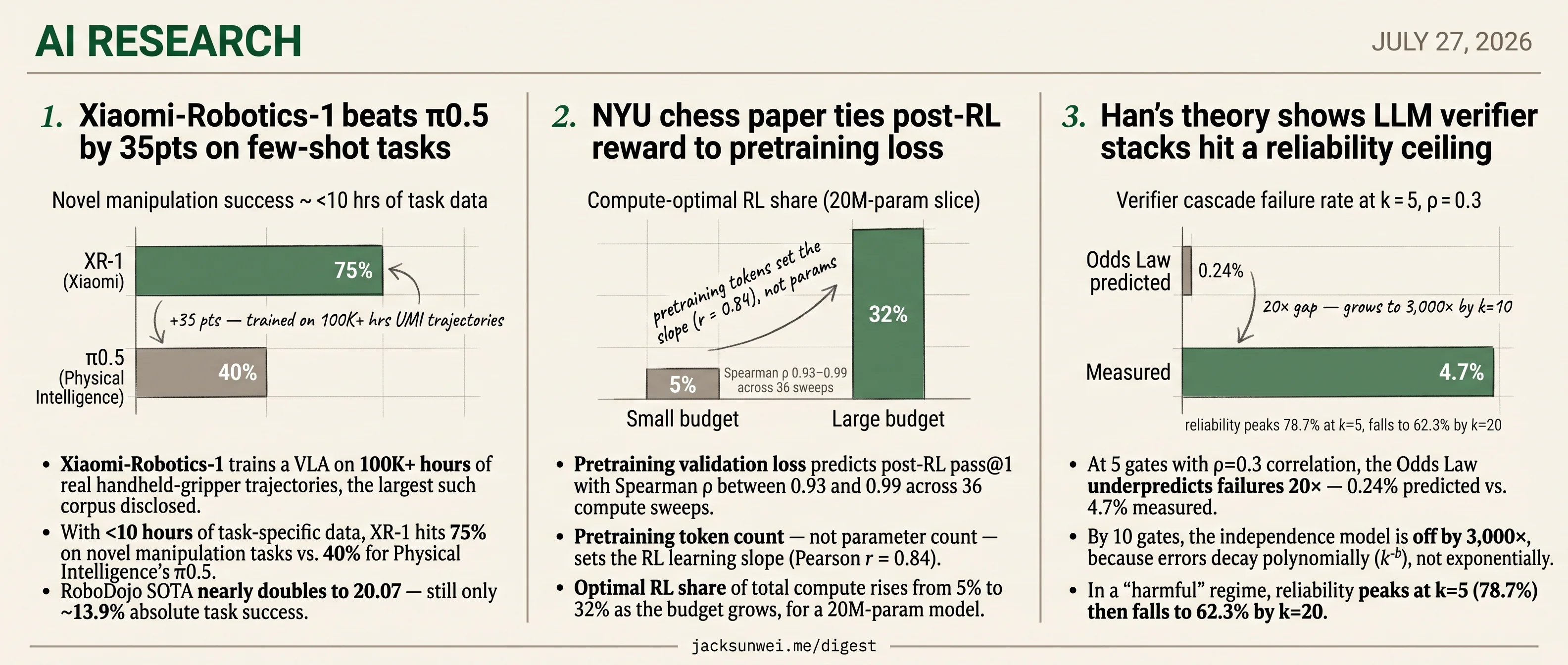
- Xiaomi XR-1 hits 75% on novel manipulation with <10 hours task data, 35pts over π0.5.
- Pretraining validation loss predicts post-RL pass@1 at ρ=0.93-0.99 across 36 compute sweeps.
- Optimal RL share climbs from 5% to 32% of total compute as pretraining budget grows.
- Verifier stacks peak at k=5 (78.7%) then fall to 62.3% by k=20 without decorrelation.
- Independence models underpredict 5-gate failures 20× and 10-gate failures 3,000×.
Three research leads today, and each one moves the story out from under its own headline. Xiaomi’s XR-1 beats Physical Intelligence’s π0.5 by 35 points on few-shot manipulation — but the disclosed moat is the 100K+ hours of real gripper trajectories underneath, not the fine-tuning recipe on top. An NYU chess paper ties post-RL pass@1 to pretraining validation loss at ρ=0.93-0.99, and finds pretraining token count — not parameter count — sets the RL learning slope. And Han’s verifier theory shows that stacking more gates of the same model family hits a reliability ceiling around k=5, because errors decay polynomially, not exponentially: the lever is decorrelation across families, modalities, or tools, not depth.
The through-line: whatever technique the paper advertises — a VLA, an RL curve, a verifier stack — the ceiling is set by the substrate underneath. Today’s round-ups extend the same shape into scaffolding, robot frames, and RLVR reward signals.
Xiaomi-Robotics-1 beats π0.5 by 35pts on few-shot tasks
Source: hf-daily-papers · published 2026-07-15
TL;DR
- Xiaomi-Robotics-1 trains a VLA on 100K+ hours of real handheld-gripper trajectories, the largest such corpus disclosed.
- With <10 hours of task-specific data, XR-1 hits 75% on novel manipulation tasks vs. 40% for Physical Intelligence’s π0.5.
- RoboDojo SOTA nearly doubles to 20.07 — still only ~13.9% absolute task success.
- Code and checkpoints remain “coming soon” past the stated July 16 release date.
The scaling claim
Xiaomi’s robotics group is making the loudest bet yet that LLM-style scaling laws transfer to manipulation. Xiaomi-Robotics-1 (XR-1) pairs a Qwen3-VL backbone with a Diffusion Transformer action head via a Mixture-of-Transformers architecture, and trains it on 100,000+ hours of real-world trajectories collected with handheld Universal Manipulation Interface (UMI) grippers, plus ~10K hours of on-robot post-training data across mobile and dual-arm platforms.
The scaling curves are the paper’s strongest evidence. Holding a 5B model fixed and sweeping pre-training data from 0% to 100%, real-robot success climbs monotonically from 26% to 75%. Model-size scaling from 2.6B to 10.5B helps too, but less — the authors conclude that at the billion-parameter scale, data volume, not parameters, is the binding constraint.
On benchmarks, XR-1 posts 57.6% on RoboCasa365 (prior best 46.6%), 74.5% average on RoboCasa, and 20.07 on RoboDojo (prior best 13.07). More striking: on novel long-horizon tasks like laundry loading and printer refilling, less than 10 hours of task data gets XR-1 to 75% success where π0.5 sits at 40%.
The reliability gap
The independent read is that these are real relative wins on curated evals — and still nowhere near deployable. AI Weekly’s analysis flags that RoboDojo’s headline 20.07 average translates to only ~13.9% absolute task success 1. RoboDojo is not a soft benchmark: it runs a cloud-evaluation pipeline with anti-cheating verification and hidden environment layouts specifically to prevent overfitting 2, which makes the low absolute number hard to write off as adversarial framing.
For a real-world comparator, deployments of Physical Intelligence’s OpenPI/π0.5 in warehouse picking report ~65 units-per-hour with a mean-time-between-failures of just 4 minutes 3. XR-1 will almost certainly hit the same MTBF wall the moment someone runs it outside a curated eval; the paper reports no continuous-operation reliability numbers.
The UMI data question
The 100K-hour figure hinges on UMI, and UMI has known limits. Independent reviews of handheld gripper data collection note that the devices are “substantially slower and less effective than bare hands” and fundamentally cannot capture the fingertip force transmission required for contact-rich manipulation 4. Prior UMI work also documents SLAM/VIO failures under motion blur and >100ms latency mismatches between demo and robot execution 4. XR-1’s report treats data volume as the current bottleneck, but that framing assumes quality scales with quantity — and the fine-manipulation ceiling from handheld collection remains unmeasured here.
Release friction
The community’s ability to interrogate any of this is currently gated: the official GitHub still lists code and weights as “coming soon” past the July 16, 2026 target 5, and only older Xiaomi-Robotics-0 artifacts are downloadable. That is a sharp contrast with Physical Intelligence’s OpenPI release cadence, and it makes the scaling claims — the load-bearing contribution of the paper — unreproducible for now. Hacker News commentary is already split between enthusiasm for the laundry demos and skepticism that a humanoid chassis is the right form factor for the capability at all 6.
The scaling result looks real. The question is whether UMI data and a locked repo can carry it from a benchmark win to a robot you can leave alone for more than four minutes.
NYU chess paper ties post-RL reward to pretraining loss
Source: hf-daily-papers · published 2026-07-16
TL;DR
- Pretraining validation loss predicts post-RL pass@1 with Spearman ρ between 0.93 and 0.99 across 36 compute sweeps.
- Pretraining token count — not parameter count — sets the RL learning slope (Pearson r = 0.84).
- Optimal RL share of total compute rises from 5% to 32% as the budget grows, for a 20M-param model.
- Pass@16 degrades even as pass@1 climbs, reopening debate over whether RL adds capability or just redistributes it.
The joint scaling law
Shen, Izmailov and collaborators built a controlled chess pipeline — Qwen3 dense models from 5M to 1B params, pretrained on 54B tokens of 2022 Lichess games, SFT’d on synthetic tree-search CoTs, then RL’d with GRPO against binary puzzle rewards — precisely so they could run the pretraining-through-RL loop 36 times and fit a scaling law. Two clean regularities fell out.
First, pretraining validation loss is a near-deterministic predictor of the reward a model reaches after RL saturates: Spearman correlations of 0.93–0.99. Second, the slope of RL improvement per unit of RL compute is governed by the log of pretraining tokens (r = +0.84), not by parameter count. Together they yield a log-linear joint law that says the compute-optimal RL share should grow with total budget — from ~20% to ~28% in the studied regime, and from 5% to 32% at the 20M-param slice. That direction matches what practitioners already report at the frontier, where RL now consumes roughly 3–10% of training compute versus a negligible fraction in the GPT-4 era 7.
The paper also reruns the experiment on a 1B OLMo-2 math model across 10B–200B pretraining tokens and reproduces both effects. Readers on alphaxiv have flagged that extrapolating the log-linear form past the 1B/54B-token regime yields rewards above 100%, so the law is empirically local and needs a saturation correction before anyone sizes a frontier run with it 8.
Does RL discover new moves, or just sharpen old ones?
The more contested claim is mechanistic. On easy puzzles, RL does what you’d expect — amplifies the SFT policy’s already-preferred move. On hard puzzles, the authors report “tail discovery”: correct moves with pre-RL probability below 0.05 get promoted into the top-k, alongside a less flattering “wrong-mode amplification.”
This lands directly in the crossfire of Yue et al. (Tsinghua), whose pass@k analysis argues the opposite:
RLVR-trained models significantly outperform their base versions on pass@1… but often fail to exceed, or even match, the base model’s pass@k for large k 9.
The pre2post paper concedes RL degrades pass@16 and recommends scaling pretraining, not RL, when you want diverse correct strategies. The Tsinghua camp reads that same fact as evidence the “discovery” framing is a pass@1 artifact — RL is narrowing the reasoning boundary, not expanding it. NVIDIA’s separate finding that injecting reasoning data at pretraining yields a 19% gain RL cannot replicate points the same way: RL as extractor, not inventor 10.
Chess is a good testbed with known ceilings
Using chess as a controlled reasoning drosophila is defensible — but DeepMind’s 270M searchless transformer already hit 2895 Lichess blitz Elo via pure supervised distillation from Stockfish 11, which raises the awkward question of how much of the RL delta here would survive a stronger SFT baseline. Independent chess-LLM evaluators also note that reasoning models collapse against amateur engines like Maia-1100 without a legal-move oracle 12, consistent with the paper’s own admission that RL improved search breadth but not depth beyond ~5 plies.
The compute-allocation guidance is the durable contribution. The mechanism story is a hypothesis the field is still arguing about.
Han’s theory shows LLM verifier stacks hit a reliability ceiling
Source: hf-daily-papers · published 2026-07-14
TL;DR
- At 5 gates with ρ=0.3 correlation, the Odds Law underpredicts failures 20× — 0.24% predicted vs. 4.7% measured.
- By 10 gates, the independence model is off by 3,000×, because errors decay polynomially (k⁻ᵇ), not exponentially.
- In a “harmful” regime, reliability peaks at k=5 (78.7%) then falls to 62.3% by k=20.
- The lever is decorrelation — different model families, modalities, or external tools — not deeper stacks of the same verifier.
The Odds Law was too optimistic
Serial LLM verifiers — accept an answer only if k independent judges all approve — were supposed to compound: the recent “Odds Law” showed posterior log-odds growing linearly in k, giving exponential failure decay. Jiangang Han’s arXiv:2607.13918 kills that promise for any realistic deployment. The moment verifiers share blind spots (and they do — Tsui’s Self-Correction Bench measured a 64.5% self-blind-spot rate across 14 open models 13), log-odds become concave in k, and failure decays only polynomially.
The gap is not academic. In Han’s synthetic-recovery experiments with a per-instance false-accept mean of 0.3 and correlation ρ=0.3, the independence model predicted a 0.24% failure rate at k=5. The measured rate was 4.7%. By k=10, the independence prediction was off by three orders of magnitude.
Concavity is forced by survivorship
The mechanism is straightforward once framed correctly. Treat the per-instance false-accept rate α as a latent variable drawn from a distribution G over the generator’s errors. The probability an error survives k gates is exactly the k-th moment E[αᵏ]. Because moment-generating functions are log-convex in the exponent, the log-odds of correctness are concave in k.
Physically: the errors that survive the first two gates aren’t average — they’re the high-α errors that specifically fool this verifier family. Each subsequent gate faces a harder-selected pool of survivors. This is Goodhart’s Law in miniature, and it lines up with NeurIPS 2025 work on reward-model overoptimization plateauing gold-metric performance well before the proxy saturates 14.
The harm regime is worse than a plateau
Include false rejections of correct answers (rate β) and things get sharper. Han identifies three regimes by comparing the upper-tail exponents of the error-acceptance and correct-acceptance distributions: help (asymptotic gains), plateau (a hard ceiling below 100%), and harm (accuracy actively declines past some k†).
In one simulated harm regime, reliability climbed to 78.7% at k=5 then slid to 62.3% by k=20 — while the independence model cheerfully predicted 99.999%. This is not a hypothetical: the generative-verifier literature reports the same pathology at large k, where best-of-k against a correlated judge selects candidates that exploit the verifier’s scoring flaws rather than candidates that are correct 15.
What practitioners can do this afternoon
The companion repo ships three estimators — moments, Beta-Binomial MLE, and NPMLE — that recover ρ_v and the latent α-distribution from ordinary accept/reject logs, with bit-for-bit reproducibility on the paper’s synthetic tables 16. Han shows that sampling each verifier just twice per instance (R=2) is enough to fit the correction and extrapolate to deeper cascades without running them. Teams operating LLM-as-judge panels can measure their own ceiling before committing compute to a deeper stack.
The caveats worth naming: the theory assumes exchangeable gates, so heterogeneous cascades (GPT-4 followed by Llama-3) are only a first-order projection. The scalar α compresses all shared structure into one number, missing patterns like “great at logic, terrible at arithmetic.” And dynamic failure modes — a verifier that stops checking after several “nothing actionable” verdicts, dubbed cascade fatigue in one practitioner bug report 17 — sit outside the exchangeable-α frame entirely. The cost-efficient-cascade literature adds the economic reframe: cascades were never really an intelligence-ceiling tool, only a way to reach the existing ceiling more cheaply 18.
The prescription that falls out is unambiguous: if you want more reliability, buy decorrelation, not depth.
Round-ups
Robot-centric pointmaps fix VLA camera-frame mismatch
Source: hf-daily-papers
Vision-language-action models observe scenes in camera coordinates but must act in the robot’s frame, a mismatch that breaks generalization across viewpoints. Davian Robotics proposes pointmaps expressed in the robot’s own 3D frame, aligning perception and action across aggregated multi-viewpoint demonstration datasets.
Brain-wave recordings enter physical AI training data
Source: techcrunch-ai
Frontier robotics models are moving past YouTube-scale video toward multi-camera rigs, dense annotation and now EEG-style brain-wave readings from human demonstrators, an emerging data modality aimed at teaching physical AI the intent behind observed motion.
Loopie MoE closes the looped-Transformer compute gap
Source: hf-daily-papers
Loopie ships two Mixture-of-Experts looped Transformers — a 20B model with 2B active parameters and a 6B with 0.6B active — that finally match the returns of scaling parameters N-fold when pre-training compute grows N-fold, a long-standing weakness of looped architectures.
Delta signal reshapes on-policy distillation rewards
Source: hf-daily-papers
On-policy distillation gets a new reward from Naver AI: instead of imitating the teacher’s full output distribution, the delta signal supervises tokens by the gap between teacher and student, offering an alternative to reward-model-based RL post-training. Code is on GitHub.
Contrastive Policy Optimization replaces entropy in RLVR
Source: hf-daily-papers
Reinforcement learning with verifiable rewards typically shapes advantages using entropy, which conflates useful uncertainty with confusion. CPO instead scores token-level disagreement between reference-guided and vanilla generations, giving a correctness-aware signal backed by theoretical and empirical results.
Harness-in-the-loop training co-evolves agents and scaffolds
Source: hf-daily-papers
Agent harnesses are recast as data-generating components whose traces train future foundation models. The paper studies optimizing user-built harnesses in a task-specific loop, avoiding the cost of continually updating provider-built scaffolds while improving both immediate agent performance and downstream training data quality.
DSWorld predicts data-science steps before execution
Source: hf-daily-papers
Autonomous data science agents burn compute on trial-and-error. DSWorld introduces a Data Science World Model that predicts environment state transitions from the current workflow, letting agents simulate the effect of an operation before actually running it and cutting wasted execution.
Footnotes
-
AI Weekly analysis — https://aiweekly.co/alerts/xiaomi-robotics-1-tops-vla-benchmarks-on-100k-hour-dataset
↩absolute success rates on complex benchmarks remain low (around 13.9% for RoboDojo), suggesting that these gains may not yet translate to 100% reliable performance in uncurated real-world environments
-
EmergentMind RoboDojo overview — https://www.emergentmind.com/videos/robodojo-unified-benchmark-for-manipulation-9b870a17
↩RoboDojo utilizes a cloud-evaluation pipeline with anti-cheating verification and hidden environment layouts to prevent task-specific overfitting
-
Medium (Siamak Yousefi) on OpenPI/π0.5 — https://medium.com/@siamak.yousefi.1984_58741/robotics-foundation-models-by-physical-intelligence-openpi-663dc55aa9d3
↩π0.5 (OpenPI) currently achieves approximately 65 units-per-hour in warehouse picking tasks, but suffers from a Mean Time Between Failures of only 4 minutes
-
Moonlight review of UMI — https://www.themoonlight.io/en/review/universal-manipulation-interface-in-the-wild-robot-teaching-without-in-the-wild-robots
↩ ↩2even refined handheld grippers are substantially slower and less effective than bare hands… The handheld design also fails to capture fingertip-level force transmission, which is critical for fine-grained tasks
-
Xiaomi-Robotics-1 GitHub README — https://github.com/XiaomiRobotics/Xiaomi-Robotics-1/blob/main/README.md
↩the official Xiaomi-Robotics-1 GitHub repository still lists code and model weights as ‘Coming soon,’ despite a previously stated target date of July 16, 2026
-
Hacker News discussion — https://news.ycombinator.com/item?id=48975600
↩human-like robots are less efficient than specialized designs… while a humanoid ‘Metal Bro’ is impressive for public relations, it may not be the most pragmatic solution for actual labor
-
Vector Labs practitioner brief — https://vector-labs.ai/insights/pretraining-choices-you-made-six-months-ago-are-constraining-your-rl-gains-today
↩Pretraining choices you made six months ago are constraining your RL gains today — for mid-range frontier models, RL now accounts for approximately 3% to 10% of total training compute, a massive leap from the negligible fractions used in GPT-4 era models.
-
alphaxiv discussion of ‘Understanding Reasoning from Pretraining to Post-Training’ — https://www.alphaxiv.org/abs/2607.16097
↩While the log-linear law holds for the models tested (up to 1B parameters), direct extrapolation to extreme compute scales (e.g., 1e25 tokens) produces mathematically ‘impossible rewards’ exceeding 100%… the law likely faces a ceiling effect or requires a non-linear adjustment at the scale of frontier LLMs.
-
LessWrong summary of Yue et al. (Tsinghua) — https://www.lesswrong.com/posts/s3NaETDujoxj4GbEm/tsinghua-paper-does-rl-really-incentivize-reasoning-capacity
↩RLVR-trained models significantly outperform their base versions on pass@1… but often fail to exceed, or even match, the base model’s pass@k for large k… In many math and coding benchmarks, the base model achieves a higher pass@k score once k is sufficiently large — sometimes as low as k=4 — indicating it possessed a broader potential reasoning boundary that RL training actually constrained.
-
MLWorks (Medium) — ‘Decoding AI Reasoning’ — https://medium.com/mlworks/decoding-ai-reasoning-the-pretraining-to-reinforcement-learning-scaling-law-d8f61050ffcf
↩NVIDIA research supports this ‘front-loading’ philosophy, demonstrating that incorporating diverse reasoning patterns during pretraining yields a 19% performance gain that cannot be replicated by RL alone… RL is less an inventor of intelligence and more an efficient extractor of latent capabilities established during the earlier, high-compute pretraining phase.
-
Ruoss et al., ‘Grandmaster-Level Chess Without Search’ (DeepMind, arXiv:2402.04494) — https://arxiv.org/abs/2402.04494
↩A 270M-parameter transformer, trained via supervised learning on 10 million games annotated by Stockfish, reached a Lichess blitz Elo of 2895 — solving grandmaster-level puzzles without any explicit search.
-
Ardy Wibowo blog — ‘LLM Reasoning in Chess’ — https://ardywibowo.com/post/llm-reasoning-in-chess/
↩Even top-tier reasoning models frequently fail to beat amateur-level engines like Maia-1100 when they cannot access external legal move lists, highlighting a persistent gap between fluency and robust logical execution.
-
Tsui 2025, Self-Correction Bench (arXiv:2507.02778) — https://arxiv.org/abs/2507.02778
↩Models exhibit an average 64.5% blind spot rate… simply appending a minimal ‘Wait’ prompt reduced blind spots by 89.3% in some tests.
-
NeurIPS 2025 workshop (San Diego, item 122384) on reward model scaling — https://neurips.cc/virtual/2025/loc/san-diego/122384
↩Scaling laws for reward models demonstrate that overoptimization against a proxy verifier is a manifestation of Goodhart’s Law, plateauing gold-metric performance well before the proxy saturates.
-
Emergent Mind, ‘Generative Verifiers’ topic page — https://www.emergentmind.com/topics/generative-verifiers
↩Optimizing too aggressively against a proxy verifier eventually causes ‘gold’ (ground truth) performance to plateau or even decline… at high values of k, the verifier is more likely to select a candidate that exploits its own scoring flaws rather than a candidate that is truly correct.
-
GitHub: jianganghan/harness-verifier-cascades — https://github.com/jianganghan/harness-verifier-cascades
↩estimators.py provides three methods for recovering the latent false-accept distribution: M1 (Moments), M2 (Beta-Binomial MLE), and M3 (NPMLE)… bit-for-bit reproducibility using fixed RNG seeds.
-
GitHub issue, NOVA-Openclaw/nova-mind #324 (‘cascade fatigue’) — https://github.com/NOVA-Openclaw/nova-mind/issues/324
↩A model may stop performing rigorous checks after several consecutive ‘nothing actionable’ results, essentially pattern-matching on its own previous success to skip later gates.
-
ICML 2024 poster on cost-efficient LLM cascades — https://icml.cc/virtual/2024/37712
↩Cascades can reduce inference costs by over 60%, [but] they do not necessarily raise the intelligence ceiling; they merely make reaching the existing ceiling more affordable.