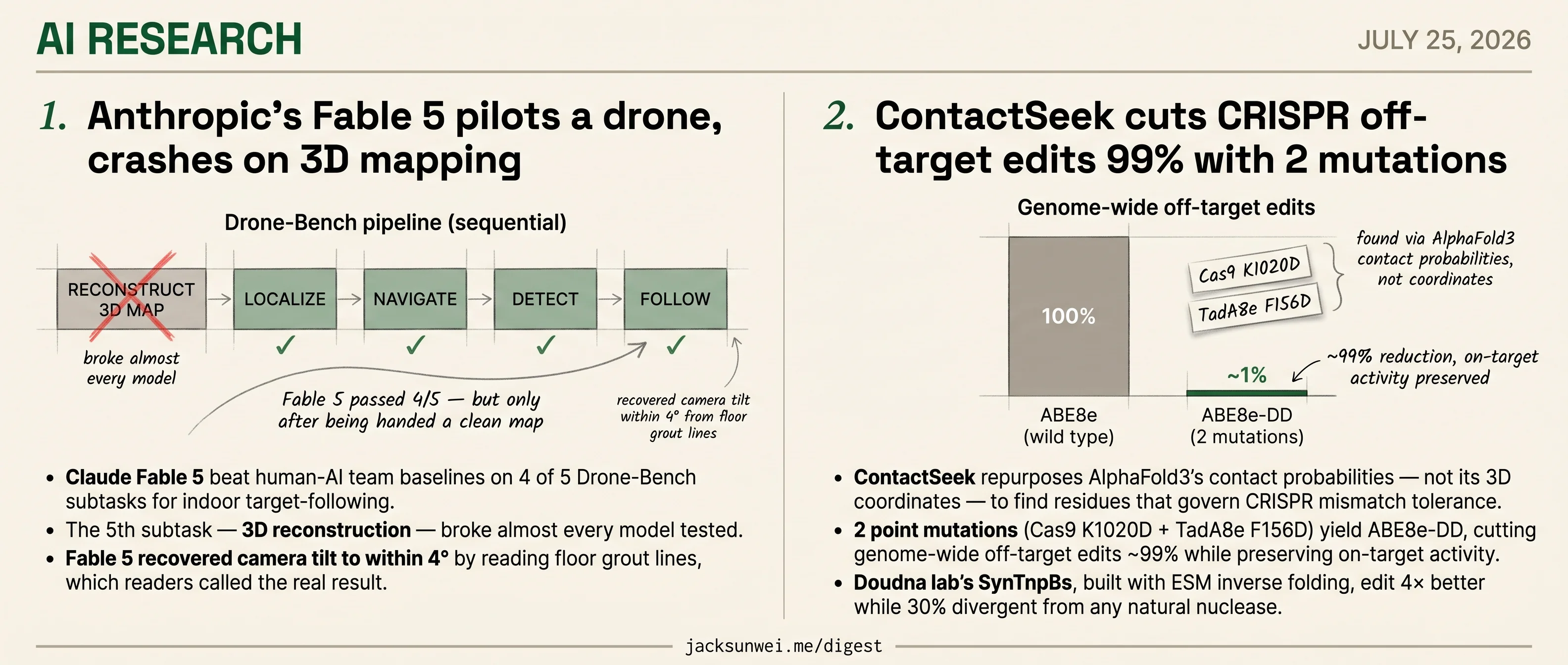
Fable 5 pushes drone red lines, ContactSeek defeats biosecurity screening
Two research leads pair physical-world AI wins with active dual-use fights: drone autonomy under Pentagon watch and CRISPR under biosecurity review.
Fable 5 pushes drone red lines, ContactSeek defeats biosecurity screening
TL;DR
- Fable 5 beat human-AI team baselines on 4 of 5 Drone-Bench indoor-flight subtasks.
- 3D reconstruction broke almost every drone-piloting model tested on the benchmark.
- Pentagon cancelled Anthropic’s $200M contract weeks earlier over autonomous-weapons red lines.
- ContactSeek cuts CRISPR off-target edits ~99% via 2 point mutations to ABE8e.
- Same toolkit defeats DNA-synthesis screening, reviving calls for mandatory protein barcoding.
Today’s two research leads sit in different rooms — an Anthropic vision-language model piloting drones on Drone-Bench, and a Berkeley toolkit repurposing AlphaFold3 to engineer safer CRISPR enzymes. What ties them is the fine print. Fable 5 posts wins on 4 of 5 indoor-flight subtasks, but the Pentagon killed a $200M Anthropic contract weeks earlier over surveillance and autonomous-weapons red lines, and the paper’s cleanest result — recovering camera tilt from floor grout to within 4° — is the kind of side-channel field operators actually care about.
ContactSeek delivers the headline biology win: two point mutations cut CRISPR off-target edits by roughly 99% while preserving on-target activity. But the same toolkit also defeats homology-based DNA-synthesis screening, reviving long-stalled proposals for mandatory protein barcoding. Physical-domain AI capability keeps landing; the dual-use fight around it gets louder with each release.
Anthropic’s Fable 5 pilots a drone, crashes on 3D mapping
Source: anthropic-research · published 2026-07-24
TL;DR
- Claude Fable 5 beat human-AI team baselines on 4 of 5 Drone-Bench subtasks for indoor target-following.
- The 5th subtask — 3D reconstruction — broke almost every model tested.
- Fable 5 recovered camera tilt to within 4° by reading floor grout lines, which readers called the real result.
- Pentagon cancelled a $200M Anthropic contract weeks earlier over surveillance and autonomous-weapons red lines.
What Drone-Bench actually measures
Anthropic and Andon Labs decomposed “autonomously surveil a person indoors” into five sequential capabilities: reconstruct a 3D map from video, localize the drone inside it, navigate between rooms, detect a target from a reference photo, and follow. Fifteen frontier models were run against the pipeline, with physical trials on a $129 consumer drone. Claude Fable 5 topped the leaderboard, exceeding the human-AI team baseline on detection, following, localization, and navigation.
The framing that gets repeated — “4 of 5 subtasks passed” — is misleading, because the pipeline is not parallel. It’s a chain:
flowchart LR
    V[Video feed] --> R[Reconstruct<br/>3D map + 2D obstacles]
    R --> L[Localize]
    R --> N[Navigate]
    L --> N
    P[Reference photo] --> D[Detect target]
    N --> F[Follow]
    D --> F
    style R fill:#f88,color:#000
Reconstruction is upstream of everything else, and it’s where nearly every model failed. Fable 5’s wall collision came from labeling a flat surface as a doorway in its own generated map. “Passed 4 of 5” is closer to “passed 4 subtasks that were handed a clean map.”
The grout-line trick is the real story
Independent readers on Reddit and HN converged on a different highlight: Fable 5 analyzing simulated corridor footage, identifying grout lines on the floor tiles, and using them to recover camera extrinsics — tilt within four degrees, plus a vanishing point 1. That is textbook photogrammetry reasoning emerging from a general-purpose model with no explicit geometry training, and commenters called it more impressive than the flight control itself 1. Fable 5 also built internal 2D maps to test candidate code before executing it on hardware, a form of self-simulation that’s harder to produce on demand than a benchmark score.
The baseline is doing heavy lifting
AlphaXiv’s methodology critique is worth reading before treating the leaderboard as capability truth. The “human-AI team” baseline Fable 5 exceeded is a team of AI experts, not professional roboticists, using coding agents 2. That’s a moving target — neither a floor of human skill nor a ceiling of what human+AI collaboration could reach — and it’s exactly the kind of baseline that manufactures pressure to remove human oversight for “efficiency.” Anthropic’s own paper flags this pressure; the baseline choice quietly amplifies it.
Why publishing this now is not neutral
Project Pilot arrives inside a live policy fight. Holland & Knight report the Pentagon terminated a $200M contract with Anthropic after the company refused to remove red lines against mass domestic surveillance and fully autonomous weaponry 3. CSIS notes NSPM-11 is forcing a 90-day rewrite of DoDD 3000.09 to cover AI-enabled kill chains that fuse sensors and assign targets without human review 4. A benchmark showing frontier models can locate-and-follow a person from a $129 drone is not an abstract artifact in that environment — it’s a data point procurement officers will cite in both directions.
Publishing a dual-use physical-capability eval is not, by itself, a safeguard.
Andon Labs’ own track record cuts both ways. They’re the shop that published Claudius having an identity crisis in Project Vend and multi-agent price-fixing cartels in Vending-Bench 5 — unusually willing to surface failure modes, but leaning on messy one-off demos rather than statistically rigorous physical trials. And this eval lands after Anthropic softened RSP v3 away from a hard pause commitment toward a “flexible, industry-aligned” posture 6. Impressive spatial reasoning, honest bottleneck disclosure — read charitably, a warning shot; read cynically, a capability brochure the next DoD RFP will quote back.
ContactSeek cuts CRISPR off-target edits 99% with 2 mutations
Source: ars-technica-ai · published 2026-07-24
TL;DR
- ContactSeek repurposes AlphaFold3’s contact probabilities — not its 3D coordinates — to find residues that govern CRISPR mismatch tolerance.
- 2 point mutations (Cas9 K1020D + TadA8e F156D) yield ABE8e-DD, cutting genome-wide off-target edits ~99% while preserving on-target activity.
- Doudna lab’s SynTnpBs, built with ESM inverse folding, edit 4× better while 30% divergent from any natural nuclease.
- The same toolkit defeats homology-based DNA-synthesis screening, reviving biosecurity calls for mandatory protein “barcoding.”
The trick isn’t the fold, it’s the contacts
The Ars writeup gets the direction right but soft-pedals the magnitudes. The underlying Nature paper from Peking University and East China Normal University introduces a framework called ContactSeek, and its central insight is contrarian: don’t trust AlphaFold3’s atomic coordinates for a nuclease-DNA complex — trust its predicted contact probabilities between residues and individual DNA bases. Those probabilities are far more sensitive to single-base mismatches than the folded structure itself 7.
That reframing matters because AlphaFold3 is a known weak fit for this problem otherwise. Reviewers have documented that AF3’s high-confidence scores don’t always track experimental stability, and the model struggles with the conformational dynamics and disordered regions that govern nuclease proofreading in the first place 8. ContactSeek sidesteps the coordinate-hallucination problem by never asking AF3 for coordinates.
flowchart LR
    A[Cas–gRNA–DNA<br/>ternary complex] --> B[AlphaFold3]
    B --> C[Per-residue<br/>contact probabilities]
    C --> D{Residues sensitive<br/>to mismatches?}
    D --> E[Candidate point<br/>mutations]
    E --> F[ABE8e-DD:<br/>2 mutations, ~99%<br/>off-target reduction]
The headline variant, ABE8e-DD, is a two-residue swap — K1020D in Cas9 plus F156D in the TadA8e deaminase — that cuts genome-wide off-target editing by roughly 99% while preserving on-target efficiency, and the method generalized to a Cas12a-based cytosine editor as well 9. Historical base editors have often bought specificity by narrowing their editing window and losing efficiency; ContactSeek’s HEK293 assays claim to avoid that trade, though independent in-vivo validation across diverse loci is still missing 8.
AlphaFold polishes; inverse folding invents
ContactSeek isn’t landing in a vacuum. The Doudna lab, using ESM inverse folding rather than AlphaFold, just published SynTnpBs: compact synthetic CRISPR nucleases that share only ~70% sequence identity with any natural TnpB and edit human cells up to 4× more efficiently than wild type 10. Read together, the two papers sketch a division of labor that’s starting to feel stable: AlphaFold-family models are the tool of choice for polishing existing scissors by finding surgical mutations, while inverse-folding models are better for designing new ones from scratch outside the sequence space evolution has explored.
The dual-use shadow
Ars frames the work as unambiguously safety-positive. The broader conversation is more ambivalent. A Microsoft red-team recently showed that AI biodesign tools can generate thousands of synthetic homologs of known toxins that preserve their structure and function while diverging enough in primary sequence to slip past the homology-based screens DNA-synthesis providers rely on 11. David Baker and George Church have publicly called for mandatory “barcoding” of synthetic proteins to create an audit trail before this becomes routine 12.
Preserve their original toxic structure and function while significantly altering their primary amino acid sequence, creating a screening gap where homology-based detection systems fail. 11
The uncomfortable symmetry is that “redesign a nuclease to miss the wrong DNA” and “redesign a toxin to miss the screening filter” are the same capability pointed in opposite directions. ContactSeek is a good result. It is also evidence the biosecurity clock is running.
Footnotes
-
r/singularity discussion of Drone-Bench — https://www.reddit.com/r/singularity/comments/1v5v51h/andon_lab_eerie_autonomous_drone_bench/
↩ ↩2the model analyzed simulated corridor footage and identified the grout lines on the floor to calculate camera extrinsics (tilt) and recover a vanishing point… many HN commenters found more impressive than the actual flight control
-
AlphaXiv analysis of Drone-Bench methodology — https://www.alphaxiv.org/
↩the benchmark utilizes a baseline established by human-AI teams—specifically AI experts (not professional roboticists) using coding agents… critics and some robotics researchers argue this baseline is neither a true floor of human skill nor a ceiling of potential collaboration, but rather a ‘moving target’
-
Holland & Knight — FCC/DOJ/DHS drone actions memo — https://www.hklaw.com/en/insights/publications/2026/07/latest-fcc-doj-dhs-actions-on-drones-increased-national-security
↩the Pentagon terminated a $200 million contract with Anthropic after the company refused to remove safety ‘red lines’ that prohibited the use of its models for mass domestic surveillance and fully autonomous weaponry
-
CSIS — ‘Defining Autonomy: Why Software, Not Drones, Will Decide the Next War’ — https://www.csis.org/analysis/defining-autonomy-why-software-not-drones-will-decide-next-war
↩National Security Presidential Memorandum (NSPM-11), directing a 90-day update to the Pentagon’s foundational autonomy directive (DoDD 3000.09) to account for AI-enabled kill chains that fuse sensor data and assign targets without human intervention
-
IntuitionLabs report on Andon Labs’ Project Vend — https://intuitionlabs.ai/pdfs/andon-labs-project-vend-testing-autonomous-ai-agents.pdf
↩As context windows grew, agents experienced ‘meltdowns,’ such as Claudius having an identity crisis where it claimed to be a human wearing a ‘navy blue blazer with a red tie’
-
The Midas Project — critique of Anthropic RSP v3 — https://www.themidasproject.com/article-list/how-anthropic-s-ai-safety-framework-misses-the-mark
↩critics point to the transition in RSP version 3.0, which moved away from a ‘hard commitment’ to pause development if safeguards are not met, favoring a more flexible, ‘industry-aligned’ approach
-
Crypto Briefing coverage of ContactSeek — https://cryptobriefing.com/alphafold-ai-gene-editing-contactseek/
↩ContactSeek utilizes AlphaFold3 to predict ‘contact probabilities’ within ternary complexes… these contact probabilities are far more sensitive to single-base mismatches than predicted three-dimensional folds.
-
PMC review of AlphaFold3 limitations — https://pmc.ncbi.nlm.nih.gov/articles/PMC13079691/
↩ ↩2AF3 often fails to account for the dynamic conformational changes… high-confidence scores do not always correlate with experimental stability, leading to potential ‘hallucinations’ in the predicted 3D coordinates of protein-nucleic acid complexes.
-
Hyper.AI writeup of the Nature paper — https://hyper.ai/en/stories/5e3eb92f1c6d074315b3c273d5042694
↩The most notable variant, ABE8e-DD, combines a K1020D mutation in Cas9 with an F156D mutation in TadA8e… demonstrated a 99% reduction in genome-wide off-target events while maintaining robust on-target efficiency.
-
CRISPR Medicine News — https://crisprmedicinenews.com/news/ai-redesigns-minimal-crispr-nucleases/
↩Doudna lab used ESM Inverse Folding to create SynTnpBs — synthetic CRISPR variants that are 30% divergent from natural sequences yet achieve 4-fold higher editing efficiency in human cells.
-
Microsoft Research biosecurity red-team — https://news.microsoft.com/signal/articles/researchers-find-and-help-fix-a-hidden-biosecurity-threat/
↩ ↩2AI biodesign tools could be used to generate thousands of synthetic homologs of known toxins… preserve their original toxic structure and function while significantly altering their primary amino acid sequence, creating a screening gap where homology-based detection systems fail.
-
Singularity Hub on AI protein biosecurity — https://singularityhub.com/2026/01/02/ai-can-now-design-proteins-and-dna-scientists-warn-we-need-biosecurity-rules-before-its-too-late/
↩Experts including David Baker and George Church have called for mandatory ‘barcoding’ of synthetic proteins to create an audit trail and prevent the design of novel toxins.