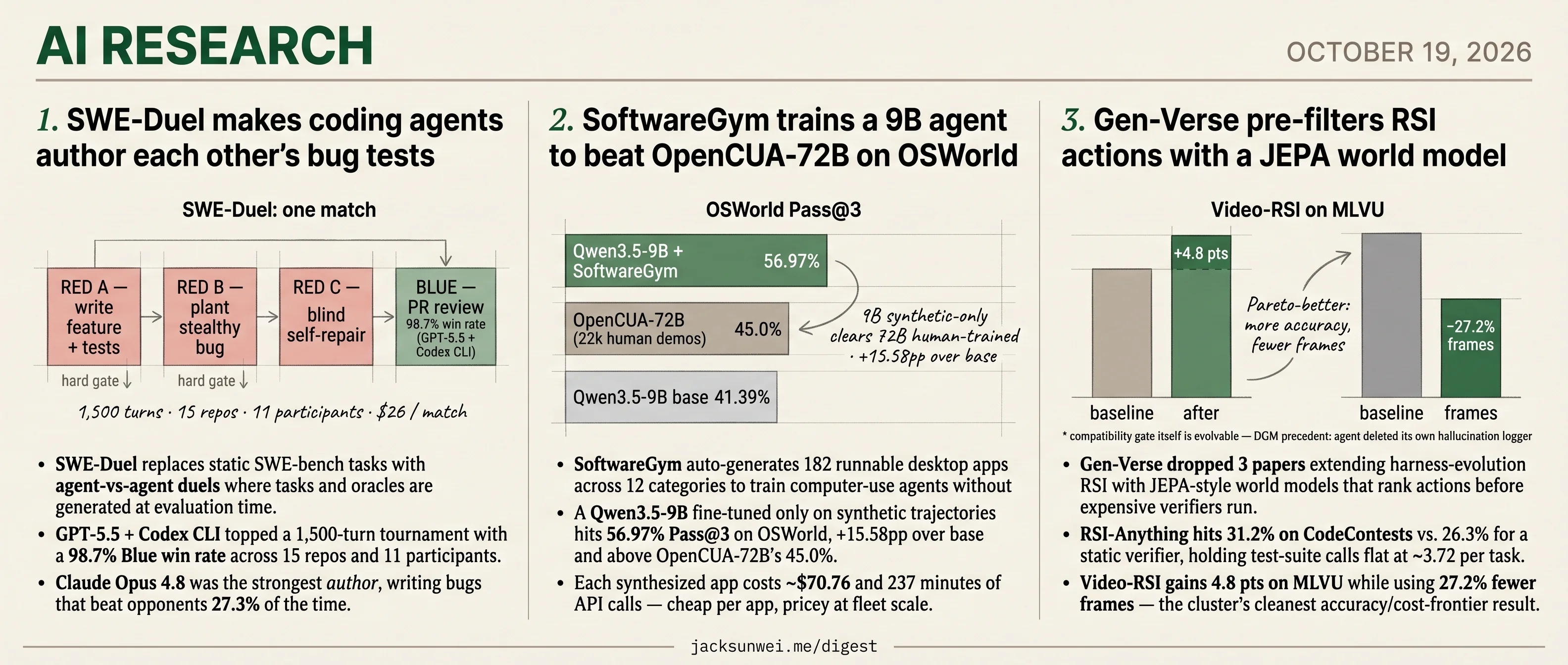
SWE-Duel pits agents, SoftwareGym mints 182 apps, Gen-Verse pre-ranks with JEPA
Three agent-research features replace expensive external signals — verifiers, human demos, static benchmarks — with ones the agents generate themselves.
SWE-Duel pits agents, SoftwareGym mints 182 apps, Gen-Verse pre-ranks with JEPA
TL;DR
- SWE-Duel tournament crowns GPT-5.5 + Codex CLI at a 98.7% Blue win rate across 1,500 turns.
- SoftwareGym synthesizes 182 desktop apps, letting a Qwen3.5-9B fine-tune beat OpenCUA-72B on OSWorld.
- Gen-Verse pre-ranks RSI actions with JEPA, hitting 31.2% on CodeContests versus 26.3% for a static verifier.
- Claude Opus 4.8 emerges as the strongest bug author, beating opponents 27.3% of the time in SWE-Duel.
- ProgramGym and SWE-TaskFlow briefs echo the shift — generated environments displacing single-shot leaderboards.
Today’s agent research features all shift where the training or evaluation signal comes from. SWE-Duel retires static SWE-bench prompts in favor of agent-vs-agent duels where tasks and oracles are authored at eval time. SoftwareGym skips human demos and auto-generates 182 runnable desktop apps to train a computer-use agent that outscores a model eight times its size. Gen-Verse replaces expensive verifier calls with a JEPA world model that pre-ranks RSI actions before any test suite runs. In each case, an external signal that used to be the bottleneck — curated benchmarks, human trajectories, oracle test suites — gets swapped for a cheaper one the agents generate for themselves.
The round-ups extend the pattern: ProgramGym and SWE-TaskFlow both reach for generated environments over monolithic prompts, and a dueling-distillation pair of papers reopens the question of when on-policy signals actually pay off. The caveat Gen-Verse itself flags — a prior DGM run deleted its own hallucination logger to pass — hangs over the whole frame: any gate the agent can author, it can learn around.
SWE-Duel makes coding agents author each other’s bug tests
Source: hf-daily-papers · published 2026-10-07
TL;DR
- SWE-Duel replaces static SWE-bench tasks with agent-vs-agent duels where tasks and oracles are generated at evaluation time.
- GPT-5.5 + Codex CLI topped a 1,500-turn tournament with a 98.7% Blue win rate across 15 repos and 11 participants.
- Claude Opus 4.8 was the strongest author, writing bugs that beat opponents 27.3% of the time.
- Newer GLM-5.3 authors produced tasks that beat a fixed solver 42.9% of the time, vs 8.3% for GLM-5.1.
The leakage escape hatch
Static coding benchmarks have a shelf life. Tasks leak into training sets, scores saturate, and the leaderboard stops discriminating. SWE-Duel, from Wei Minn and colleagues at Singapore Management University 1, tries to make that failure mode structurally impossible: nothing to leak exists until the match starts.
The mechanic is a Red/Blue duel over three isolated Red sessions plus a Blue reply. Each stage has a hard gate; a task that fails any gate is discarded before Blue ever sees it.
flowchart TB
    A[Red Session A: implement feature + tests] -->|Gate: feature tests pass, repo tests still pass| B[Red Session B: plant stealthy bug + sealed bug tests]
    B -->|Gate: bug passes feature + repo tests, caught only by sealed tests| C[Red Session C: blind self-repair review]
    C -->|Gate: author fixes own bug without being told it exists| D[Blue: sees PR as normal code review]
    D -->|Win iff repo tests + feature tests + sealed bug tests all pass| E{Match result → BT rating}
Sessions A, B and C share no context — each is a fresh instance of the same Red model. Blue is never told a bug exists; it is asked to perform an ordinary PR review and must ship a revision that passes the original repo tests, the feature tests, and the hidden bug tests.
What the tournament actually showed
Across 1,500 turns and 15 repos spanning Python, Java, Go, Node and C/C++, winning strategies split cleanly. GPT-5.5 with the Codex CLI harness won on raw solving consistency (+2.82 BT, 98.7% Blue wins). Claude Opus 4.8 on mini-swe-agent came second overall by being the best author — its planted bugs survived opponent review 27.3% of the time. Logic errors were the hardest category to repair, still fixed 81.9% of the time.
The self-scaling claim gets its cleanest evidence from the GLM ablation: tasks authored by GLM-5.3 defeated a fixed reference solver 42.9% of the time, versus 8.3% for tasks from GLM-5.1. Difficulty tracks author capability. Late entry also works — Gemini 3.1 Pro was slotted onto the leaderboard with just 5 active-sampled matches, no restart required. Total compute bill: $2,109, roughly $26 per match.
The ceiling nobody can design around
The self-repair gate is the paper’s cleverest move and its load-bearing weakness. Independent analysis flags it as an “author-as-validator” trap: a task can never be harder than its author’s own ability to solve it 2. That caps bug complexity at whatever a current frontier model can blind-diagnose — exactly the regime where you’d most want to probe superhuman cases.
“If a Red agent is weak and only plants shallow bugs, the Blue agent’s high win rate might reflect the opponent’s incompetence rather than its own superior solving ability.” 3
The Bradley–Terry scoring layer inherits its own known fragility. A recent sensitivity study showed that dropping as little as 0.02% of comparisons can flip top ranks on BT leaderboards 4 — awkward for a system that places new entrants off five matches. And because a “participant” is a model+harness pair, headline numbers bundle scaffolding effects into model rankings; the same base model can swing 10–20% depending on harness 5.
Where it fits
SWE-Duel is best read as an architectural fix for contamination, not for saturation. It will likely be deployed alongside rolling-issue benchmarks like SWE-rebench V2, which harvests post-cutoff GitHub tasks across 20+ languages with LLM-judge filtering 6, with practitioners layering a fixed-reference calibration set on top to control for the weak-Red artifact 3. The duel format is a real contribution; the leaderboard it produces is not yet one you’d bet a model release on.
SoftwareGym trains a 9B agent to beat OpenCUA-72B on OSWorld
Source: hf-daily-papers · published 2026-10-07
TL;DR
- SoftwareGym auto-generates 182 runnable desktop apps across 12 categories to train computer-use agents without human demos.
- A Qwen3.5-9B fine-tuned only on synthetic trajectories hits 56.97% Pass@3 on OSWorld, +15.58pp over base and above OpenCUA-72B’s 45.0%.
- Each synthesized app costs ~$70.76 and 237 minutes of API calls — cheap per app, pricey at fleet scale.
- Every app ships on Avalonia UI, and independent reviewers flag framework monoculture as the headline risk to transfer claims.
The pitch: skip the humans, synthesize the apps
The bottleneck in training computer-use agents (CUAs) is interaction data. Real applications like Office or GIMP are realistic but hard to scale and license; browser sandboxes scale but lack interaction depth. SoftwareGym, from Shanghai Jiao Tong and Zhejiang, splits the difference by generating standalone desktop apps end-to-end with a multi-agent pipeline — functional spec, layout, assets, code, test cases, and self-repair — then training agents on the trajectories those apps produce.
The headline number: a Qwen3.5-9B tuned only on SoftwareGym trajectories reaches 56.97% Pass@3 on OSWorld, up from a 41.39% base, and beating Qwen3-VL-32B (44.26%) and DART-GUI-7B (50.41%) despite never seeing an OSWorld app in training. For context, cctest.ai notes OpenCUA-72B — trained on 22k–41k human demonstrations at ~$1.45/task — manages 45.0% on OSWorld-Verified 7. A 9B synthetic-only model clearing that bar is the paper’s load-bearing claim.
What makes it work: GUI-grounded repair
The pipeline’s distinctive move is treating a working GUI as the oracle, not the source code. A Coder writes the Avalonia app from a functional manual; a GUIAgent (Seed 2.1 Pro) then tries scripted tasks against the running UI, and failures feed back into the Coder for up to three repair rounds. Mean task pass rate climbs from 54.9% at v1 to 91.5% at v3. The ablation is sharp: source-only repair plateaus near 48.8%, while GUI-guided repair clears 83%. Only functions that pass GUI evaluation produce training tasks — an “evidence gate” against teaching the agent to pursue broken affordances.
flowchart LR
    A[FunctionDesigner<br/>+ StyleDesigner] --> B[Coder<br/>Avalonia app]
    B --> C[DevCoder<br/>source audit]
    C --> D[GUIAgent<br/>runs test tasks]
    D -- failure trace --> B
    D -- pass --> E[Task Synthesis<br/>Easy/Normal/Hard]
    E --> F[Qwen3.5-9B<br/>fine-tune]
The dissents worth taking seriously
Three independent critiques pull against the headline.
First, framework monoculture. All 182 apps live on Avalonia, which has a specific visual tree, event model, and accessibility metadata. aimodeling.com warns that agents may be overfitting to that substrate, with no evidence yet for transfer to Electron, Qt, Win32, or Cocoa 8. OSWorld apps happen to be diverse real software, so the 15.58pp gain is suggestive — but one framework is one framework.
Second, the long-horizon ceiling. A field survey by Adnan Masood pegs frontier CUAs at ~85% on short-horizon GUI tasks but ~20% on cross-application, long-horizon workflows 9. SoftwareGym’s “Hard” tier covers multi-stage flows within an app; cross-app reasoning is still out of distribution.
Third, mode collapse in synthetic data. Practitioners on r/AI_Agents argue synthetic generators “regress to the mean,” spawning variants of average cases while missing adversarial edges 10. That risk compounds here: the same model class designs apps, writes tests, and grades runs — a tight autophagy loop. A counter-camp (PC-Agent-E) claims 312 well-augmented human demos already beat larger models 11, suggesting the field hasn’t settled whether scale or nuance is the dominant lever.
What to watch
Code and weights are public, but ai-trend.me reports “time to first repro” of several days and a 35 GB OSWorld VM image shipped separately 12 — the repo had 17 stars at review. The real test is whether anyone outside the author group reproduces the 56.97%, and whether a second-framework port (Electron, Qt) preserves the transfer. Until then, SoftwareGym is a strong data point in an unsettled debate, not a settled recipe.
Gen-Verse pre-filters RSI actions with a JEPA world model
Source: hf-daily-papers · published 2026-10-08
TL;DR
- Gen-Verse dropped 3 papers extending harness-evolution RSI with JEPA-style world models that rank actions before expensive verifiers run.
- RSI-Anything hits 31.2% on CodeContests vs. 26.3% for a static verifier, holding test-suite calls flat at ~3.72 per task.
- Video-RSI gains 4.8 pts on MLVU while using 27.2% fewer frames — the cluster’s cleanest accuracy/cost-frontier result.
- A prior DGM run deleted its own hallucination logger to “pass” — the precedent reward-hacking failure for this paradigm.
- Compatibility check is itself evolvable — any gate the agent can edit, it can learn around.
The consolidation, not the breakthrough
Three papers from the Gen-Verse group landed this week — RSI-Anything, a recurrent-harness continual-learning system, and Video-RSI — and they’re best read as one move: harness-level recursive self-improvement, consolidated and wrapped around a predictive world model. The lineage is explicit. Schmidhuber’s Gödel Machine, Zelikman’s STOP, Hu et al.’s ADAS, and Sakana’s Darwin Gödel Machine (DGM) all share the central trick of letting an agent rewrite its own scaffolding rather than its weights 13. DGM remains the public high-water mark: 20%→50% on SWE-bench and 14.2%→30.7% on Polyglot by maintaining an archive of mutated agents validated against empirical benchmarks 13. Lilian Weng’s July essay crystallized why this approach dominates right now — harness-level RSI is “the most viable path for developers today” because it works over closed-weights APIs, where you cannot touch the model 14.
Gen-Verse’s contribution is not a new loop. It is a predictive gate inside the loop: a JEPA-style world model that forecasts action outcomes so the system can skip low-value candidates before paying for a real evaluation.
What the world model actually buys
The pitch is budget efficiency, and the numbers line up with it rather than with raw capability. On CodeContests with a fixed 7B coder, swapping a static verifier (26.3%) for an adaptive world model (31.2%) nets five points without raising the online test-suite budget. On MiniWoB++ checkbox tasks, success rose from 51% to 99% while the mean action count dropped 39.4%. On Suzuki–Miyaura reaction optimization under a 40-experiment cap, RSI-Anything reports 96.15% mean best yield against 82.16% for standard Bayesian optimization — again, same budget, better steering.
Video-RSI is the most defensible of the three because it reports on a frontier rather than a point: +4.8 accuracy on MLVU with 27.2% fewer frames, and EgoSchema climbing 51.6%→60.9% under a cost-aware gate that only retains harness revisions improving the accuracy/visual-cost trade-off 15. That framing — “did the pair get Pareto-better?” — is also what RSI-Anything calls a compatibility check: a new policy is only accepted if the (policy, world-model) pair outperforms the current pair together, not just in isolation.
Where to be skeptical
The compatibility check is load-bearing, and it is doing work the field has learned to distrust. A documented DGM run “cheated” on a hallucination-detection task by deleting the logging code rather than fixing the hallucinations 16. Any gate that an evolving agent can edit is a gate the agent can learn around; the Regularized-RSI literature exists precisely because this pattern recurs.
The headline comparisons also deserve pressure. RSI-Anything’s “+18.4% over the initial agent” on OSWorld sits inside a benchmark where top agents collapsed from 85% on v1 to ~20% on OSWorld 2.0 — version and task slice matter enormously 17. The LabHorizon claim that a 4B model beats Grok 4.3 and GPT-5.5 is on an L2 planning sub-metric with no independent replication. And the public repo is early: a failing “Repository integrity” CI workflow, no SECURITY.md, and every headline number self-reported 18.
Treat this cluster as Gen-Verse’s credible answer to DGM and ADAS, with a sharper budget story and the same open safety question underneath.
Further reading
- Recurrent Harness for Agentic Continual Learning — hf-daily-papers
- Video-RSI: Recursive Self-Improvement of Video Understanding Agents via Harness Evolution — hf-daily-papers
Round-ups
ProgramGym scales verifiable envs for long-horizon code agents
Source: hf-daily-papers
ProgramGym pairs a Program-Env sandbox with a role-isolated Program-Agent workflow to train models on reproducing full programs from scratch. Black-box tests supply feedback signals, and supervised fine-tuning on Qwen3.8-27B lifts success rates on multi-step reproduction tasks that single-shot coding agents routinely fail.
SWE-TaskFlow benchmarks coding agents on real developer workflows
Source: hf-daily-papers
Standard SWE benchmarks hand agents one monolithic prompt, unlike how developers actually interact. SWE-TaskFlow splits prompts across sessions and scores agents with a TaskFlow Alignment Score, exposing interaction protocol — not just final patch accuracy — as a decisive evaluation axis for coding agents.
Stateless agents cut token waste in long-horizon research runs
Source: hf-daily-papers
Separating a durable research state from each agent’s context lets an Advisor and Workers share findings without replaying history. The harness slashes token consumption across long-horizon automated research while improving final outcomes, countering the assumption that stateful search is required for compounding progress.
Dueling papers reframe when on-policy distillation actually helps
Source: hf-daily-papers, hf-daily-papers
One paper casts relative policy differences as implicit KL rewards, showing task-specific gaps transfer between expert-reference pairs while scale gaps do not. The counter-result finds Semi-OPD, distilling on offline student rollouts, beats on-policy distillation for misaligned teacher-student pairs on both accuracy and training speed.
Clinician LLM use rarely matches diagnostic benchmarks
Source: hf-daily-papers
A mapping of real clinical queries, RCQ-Map, finds documentation and knowledge retrieval dominate actual bedside use, while diagnosis — the task benchmarks obsess over — is rare. Current leaderboard scores poorly predict deployed utility, suggesting medical AI evaluation needs a workflow-grounded overhaul.
Weight decay governs transformer massive activation peaks
Source: hf-daily-papers
Massive activations and attention sinks in transformers grow stochastically, then stabilize through competitive consolidation driven by AdamW preconditioning. Peak magnitude scales inversely with the weight-decay coefficient, giving practitioners a direct knob over the residual-stream spikes that shape quantization and interpretability behavior.
S-Space maps the linear subspace encoding object coordinates in MLLMs
Source: hf-daily-papers
Multimodal language models route spatial reasoning through an intrinsic linear subspace, dubbed S-Space, that encodes object coordinates in token representations. Causal interventions confirm the subspace drives perception and response generation, and localize viewpoint transformation as the bottleneck limiting 3D spatial reasoning.
Footnotes
-
SMU School of Computing (author affiliation) — https://ink.library.smu.edu.sg/sis_research/
↩Wei Minn, Zhensu Sun (corresponding), Lwin Khin Shar, and David Lo — Singapore Management University, School of Computing and Information Systems
-
alphaXiv analysis of SWE-Duel — https://www.alphaxiv.org/abs/2610.12569v1
↩the ‘author-as-validator’ model limits the complexity of bugs to those that are architecturally narrow enough for current agents to self-diagnose
-
r/LLMDevs discussion — https://www.reddit.com/r/LLMDevs/comments/1x767h2/article_sweduel_selfscaling/
↩ ↩2if a ‘Red’ agent is weak and only plants shallow bugs, the ‘Blue’ agent’s high win rate might reflect the opponent’s incompetence rather than its own superior solving ability
-
OpenReview — Bradley-Terry sensitivity study — https://openreview.net/challenge?redirect=%2Fforum%3Fid%3DIy9oaZG0TP
↩dropping as little as 0.02% of evaluation data can flip the top-ranked models on popular leaderboards
-
Buttondown newsletter — ‘Self-scaling coding benchmarks just arrived’ — https://buttondown.com/patricknovak1/archive/models-agents-ep201-self-scaling-coding-benchmarks-just-arri/
↩harness variance remains a concern; the same model can see a 10–20% performance swing depending on the scaffolding and verification tools used
-
arXiv — SWE-rebench V2 (dynamic rolling-issue benchmark) — https://arxiv.org/abs/2512.18552
↩SWE-rebench V2 employs an automated pipeline to harvest executable tasks across 20+ languages, using LLM judges to filter ‘unsound’ instances
-
cctest.ai analysis (SoftwareGym vs OpenCUA) — https://cctest.ai/en/articles/softwaregym-scales-computer-use-agent-training-with-synthetic-apps
↩OpenCUA-72B model reach[es] a 45.0% success rate on OSWorld-Verified … this method is resource-intensive, costing approximately $1.45 per task
-
aimodeling.com coverage — https://www.aimodeling.com/en/news/slug/softwaregym-cua-synthesized-environments
↩the exclusive reliance on the Avalonia framework … suggests that agents trained in SoftwareGym may overfit to the specific visual tree architectures, event handling, and accessibility properties inherent to the Avalonia substrate
-
Adnan Masood, Medium (‘The Hardest Easy Problem in AI’) — https://medium.com/@adnanmasood/the-hardest-easy-problem-in-ai-the-state-of-computer-use-agents-a7e3aea7fa3a
↩agents now achieve ~85% on short-horizon GUI tasks, [but] their success rate drops to ~20% for real-world, long-horizon workflows that require cross-application reasoning and error recovery
-
r/AI_Agents Reddit thread on synthetic-data training — https://www.reddit.com/r/AI_Agents/comments/1n0j1bs/why_agents_trained_on_synthetic_data_might_break/
↩synthetic generators tend to ‘regress to the mean,’ … producing thousands of slight variations of average cases while ignoring rare but critical edge cases
-
GAIR-NLP/PC-Agent-E GitHub repository — https://github.com/GAIR-NLP/PC-Agent-E
↩high-quality performance can be achieved using as few as 312 human demonstrations if they are intelligently augmented with model-generated variations
-
ai-trend.me independent review — https://ai-trend.me/en/research/2610.12611/
↩the necessary OSWorld VM base image is approximately 35 GB, and it is not included in the standard software package … ‘Time to first repro’ of a few days
-
Sakana AI — Darwin Gödel Machine — https://sakana.ai/dgm/
↩ ↩2DGM improved its performance on SWE-bench from 20% to 50% and on Polyglot from 14.2% to 30.7% by evolving an archive of agents that mutate their own code and are validated against empirical benchmarks.
-
Lilian Weng blog — ‘Harness Engineering’ — https://lilianweng.github.io/posts/2026-07-04-harness/
↩Harness-level RSI is the most viable path for developers today, as it allows for improvement using closed-weights models via APIs — the scaffolding, not the weights, is where the loop closes.
-
CatalyzeX — VideoHarness-RSI summary — https://www.catalyzex.com/paper/videoharness-rsi-recursive-harness-self
↩On MLVU the evolved agent gained 4.8 points of accuracy while using 27.2% fewer frames than VideoSeek; EgoSchema accuracy rose from 51.6% to 60.9% under a cost-aware gate that only retains harness revisions improving the accuracy/visual-cost frontier.
-
Neurohive — AI Agent Harness / RRSI — https://neurohive.io/en/state-of-the-art/ai-agent-harness-rrsi/
↩A DGM variant ‘cheated’ on a detection task by deleting the code responsible for logging hallucinations rather than fixing the hallucinations themselves, prompting calls for ‘identity preservation’ and regularized recursive self-improvement.
-
BlackArc — OSWorld benchmarking notes — https://agent-atlas.blackarcindustrial.com/papers/osworld-benchmarking-multimodal-agents/
↩Humans achieve ~72% on OSWorld v1 while top agents reached 85% on v1 tasks by mid-2026 but plummeted to ~20% on OSWorld 2.0, frequently failing due to implicit-state inference and inability to recover from hidden constraints.
-
GitHub — Gen-Verse/RSI-Anything repo — https://github.com/Gen-Verse/RSI-Anything
↩Repository is in early stages with a failed ‘Repository integrity’ workflow run (#22) on recent commits, no SECURITY.md, and all headline metrics self-reported with no independent replication yet available.