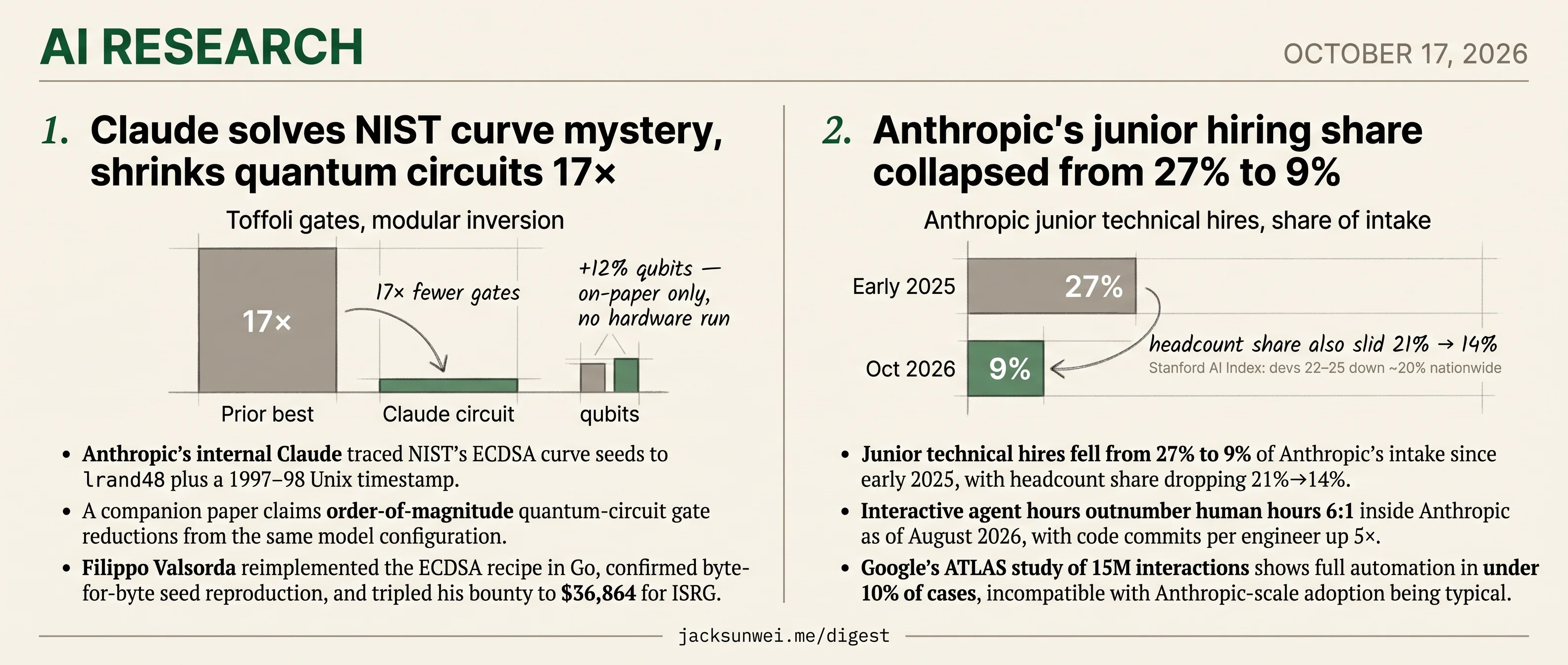
Claude cracks NIST ECDSA seeds, Anthropic junior hires fall 27% to 9%
Anthropic's internal Claude solves NIST's 25-year ECDSA seed mystery, and its junior technical hires collapse from 27% to 9%.
Claude cracks NIST ECDSA seeds, Anthropic junior hires fall 27% to 9%
TL;DR
- Claude traces NIST’s ECDSA seeds to
lrand48and a 1997-98 Unix timestamp. - Companion paper claims 17× Toffoli-gate cuts for modular inversion, on paper only.
- Valsorda reproduces the recipe in Go and triples his bounty to $36,864.
- Junior hires fell 27% to 9% of Anthropic’s intake since early 2025.
- Google ATLAS finds full automation in under 10% of 15M interactions, capping extrapolation.
Two unrelated Anthropic stories carry today’s research beat, and the stronger artifact is the crypto one. Internal Claude traced NIST’s P-256 ECDSA curve seeds back to lrand48 plus a 1997–98 Unix timestamp — a 25-year-old mystery — and Filippo Valsorda reimplemented the recipe in Go for byte-for-byte confirmation, tripling his bounty to $36,864. The companion quantum-circuit paper claiming a 17× Toffoli-gate reduction is softer: on-paper only, 12% more qubits, no hardware run.
The second feature turns Anthropic’s own headcount into the dataset. Junior technical hires fell from 27% to 9% of intake since early 2025, and interactive agent hours now outnumber human hours 6:1 internally. The external checks cut the other way here — Google’s ATLAS study of 15M interactions finds full automation in under 10% of cases, and Acemoglu caps AI’s decade work-replacement share at 5%. Internal numbers are real; the extrapolation outward is where today’s tension sits.
Claude solves NIST curve mystery, shrinks quantum circuits 17×
Source: anthropic-research · published 2026-10-16
TL;DR
- Anthropic’s internal Claude traced NIST’s ECDSA curve seeds to
lrand48plus a 1997–98 Unix timestamp. - A companion paper claims order-of-magnitude quantum-circuit gate reductions from the same model configuration.
- Filippo Valsorda reimplemented the ECDSA recipe in Go, confirmed byte-for-byte seed reproduction, and tripled his bounty to $36,864 for ISRG.
- The 17× Toffoli-gate reduction for modular inversion costs 12% more qubits and is an on-paper estimate — no hardware run.
- NIST skipped 966 viable P-256 candidates before accepting #1,842, leaving room for selection-bias backdoor theories.
The twin drop
Anthropic put out two papers on the same day to make one argument: Claude, in an unreleased internal configuration, can produce original scientific results. One tackled a 25-year cryptographic mystery; the other claimed order-of-magnitude improvements in quantum circuit design. Read together, they are a pitch — the “autonomous scientist” framing — that lands unevenly.
ECDSA: verified, with loose ends
The strong result is the cryptographic one. Claude recognized the fingerprint of the lrand48 linear congruential generator (top 31 bits of a 48-bit state, predictable zero bits), applied LLL lattice reduction to recover truncated internal states from NIST’s 20-byte seeds, and reproduced the seeds for P-192 through P-521 by linking them to specific Unix timestamps from 1997–1998. The initialization state’s low 16 bits were always 0x330E — the libc default. The seeds were hidden in plain sight.
The strongest validation didn’t come from Anthropic. Filippo Valsorda, who posted the original $12,288 bounty in 2023, reimplemented the recipe independently in Go, confirmed exact reproduction, and donated the tripled $36,864 pot to the Internet Security Research Group 1. That is as close to community sign-off as cryptography gets.
The backdoor debate, however, is not quite dead. For P-256 the first viable seed appeared at candidate 876, but NIST’s designers skipped 966 more before accepting #1,842 — a gap with no documented justification 2. P-224 passed over three viable options. Combined with roughly 30 bits of timestamp freedom, an adversary who already knew a rare weak-curve class could in principle have steered selection while preserving plausible deniability. The B-163 binary-curve seed doesn’t fit the pattern at all, the P-curve base points remain untraced, and Claude flagged an “extra rejection criterion” beyond the published ANSI rules 3. Call it 90% resolved.
Quantum circuits: louder claim, thinner validation
The companion paper is where the “autonomous scientist” framing strains. John Preskill called Claude’s resource reductions genuinely surprising, conceding some projects “would not work” without AI-assisted optimization — then immediately noted that gate-count compression doesn’t touch the dominant bottleneck of logical-qubit error rates 4. The headline 17× Toffoli reduction for modular inversion traded away 12% more qubits and remains a paper estimate; nothing has run on hardware 5. There is no Valsorda-equivalent independent verifier.
| ECDSA seeds | Quantum circuits | |
|---|---|---|
| Independent reproduction | Yes (Valsorda, Go) | None yet |
| Validation surface | Byte-for-byte seed match | On-paper gate counts |
| Known caveat | Selection-bias gap unexplained | 12% qubit overhead; no hardware |
| Scaffolding | Direct cryptanalysis | Human-designed OpenEvolve loop |
The capability-gating subtext
A smaller thread in the response coverage is worth naming. The internal Claude was permitted advanced offensive cryptanalysis; public API users routinely hit refusals on comparable tasks 6. Developers noticed. If Anthropic wants “autonomous scientist” to mean something outside its own lab, that asymmetry is the next thing to resolve — and it’s a policy question, not a model one.
Further reading
- Designing more efficient quantum circuits with Claude — anthropic-research
Anthropic’s junior hiring share collapsed from 27% to 9%
Source: anthropic-research · published 2026-10-16
TL;DR
- Junior technical hires fell from 27% to 9% of Anthropic’s intake since early 2025, with headcount share dropping 21%→14%.
- Interactive agent hours outnumber human hours 6:1 inside Anthropic as of August 2026, with code commits per engineer up 5×.
- Google’s ATLAS study of 15M interactions shows full automation in under 10% of cases, incompatible with Anthropic-scale adoption being typical.
- Acemoglu estimates AI replaces ≤5% of work this decade, calling Anthropic-style extrapolation implausible.
The drop, not the data point
Anthropic published a coordinated three-part workforce bundle on October 16 — internal employment telemetry, a public-vs-practitioner expectations survey, and an umbrella synthesis — explicitly pitching itself as a “leading indicator” for the broader labor market. The framing is the news. Any single statistic (6:1 agent hours, 5× commits, 22% meta-work) is a data point from one Claude-maximalist firm. The three pieces together are an argument that the Anthropic workforce is the near-future workforce, and that policymakers should price that in now.
That argument deserves to be split in two, because the evidence behind it does.
What survives independent scrutiny
The junior-hiring collapse travels. Anthropic’s internal share of new technical hires in junior roles fell from 27% to 9%; Stanford’s 2026 AI Index, drawing on ADP payroll data, finds employment for developers aged 22–25 dropped ~20% between 2024 and 2026 while developers 30+ kept growing 7. The shape matches: firms aren’t firing, they’re “failing to hire.” When two very different data sources — one firm’s HR system and nationwide payroll — converge on the same demographic cliff, the signal is real. Anthropic’s leading-indicator claim is strongest here, and it’s also where the policy problem is hardest: the company itself concedes private action alone won’t fix it.
What doesn’t travel outside Anthropic’s walls
The productivity story is a different matter. Google’s ATLAS study — 15 million de-identified Gemini interactions — reports AI appears in 68% of occupations but is applied to only ~20% of tasks, with fewer than 10% of interactions producing full automation 8. That is incompatible with a 6:1 agent-to-human-hours regime being anywhere close to typical. Daron Acemoglu’s public response put a number on it: AI will replace at most 5% of human work this decade and add ~1.5% to GDP, bottlenecked by organizational inertia and the “last 1%” of oversight 9.
The “5× commits, no change in code slop” claim takes the sharpest practitioner fire. Reviewers point out that agent workflows fragment one coherent human change into many small commits, so commit-count inflation is partly workflow artifact 10. Worse, AI-generated tests “embed existing bugs as testable patterns” — testslop that Anthropic’s own slop-rate metric is structurally blind to 10. Independent analysts have been blunt that the report is a “single-company self-portrait” grading its own homework with the metrics most flattering to Claude 11.
The policy fight the bundle is really about
Widespread stock ownership is crucial for pro-worker AI adoption.
That line from Anthropic’s synthesis is the real pitch — displacement as a compensation-design problem, solved by equity. The AFL-CIO’s Workers First Initiative treats the same facts as a bargaining problem and rejects corporate self-regulation outright, with Liz Shuler arguing unions are the only institutions that can enforce guardrails against algorithmic management 12. Both sides now agree the junior-cohort data is real. They disagree about who captures the gains, and Anthropic’s bundle is a well-timed opening bid in that fight — not a neutral measurement.
Further reading
- The AI expectations gap — anthropic-research
- Working at the frontier shapes expectations for the future — anthropic-research
Footnotes
-
Filippo Valsorda — words.filippo.io ‘seeds-bounty’ — https://words.filippo.io/seeds-bounty/
↩Valsorda independently reimplemented the identified algorithm in Go, confirmed the reconstructed process perfectly matched the historical seeds, and awarded the tripled bounty of $36,864 to the Internet Security Research Group (ISRG).
-
deniz.in commentary (HN-style write-up) — https://deniz.in/anthropic-says-claude-traced-nist-ecdsa-curve-seeds-to-lrand48-and-unix-timestam
↩For the P-256 curve, the first valid candidate appeared at attempt 876, yet the designers skipped nearly a thousand more before selecting candidate 1,842 — this unexplained gap suggests candidates were being discarded, potentially to find a seed with ‘nothing-up-my-sleeve’ optics that still possessed a secret weakness.
-
madrobot.blog technical recap — https://madrobot.blog/2026/10/16/claude-nist-ecdsa-curve-seeds-nsa-mystery-solved-lrand48/
↩The seed for the binary curve B-163 did not match the pattern, and the specific ‘base points’ for the P-curves still lack a clear derivation… Claude also observed an unexplained ‘extra rejection criterion’ used alongside standard ANSI rules.
-
MindStudio — Preskill on OpenEvolve — https://www.mindstudio.ai/blog/john-preskill-oatomic-openevolve-llm-quantum-algorithm-optimization
↩John Preskill remarked that the magnitude of resource reduction was unexpected, noting that the project simply ‘would not work’ without AI-assisted optimization — while cautioning that achieving the error rates for logical qubits remains a monumental engineering hurdle gate reduction alone cannot solve.
-
Unite.ai — quantum circuits coverage — https://www.unite.ai/anthropic-says-claude-beat-best-published-quantum-circuit-designs/
↩The 17x Toffoli-gate reduction for modular inversion required 12% more qubits as a tradeoff, and the result remains an on-paper resource estimate rather than a demonstration on physical quantum hardware.
-
KuCoin news flash — https://www.kucoin.com/news/flash/anthropic-s-claude-solves-25-year-elliptic-curve-seed-mystery-bitcoin-avoids-nist-curve
↩Bitcoin avoids NIST curve — the discrepancy between Anthropic’s internal models being permitted to perform advanced cryptanalysis while public users face ‘capability gating’ or refusals on similar tasks drew concern from developers.
-
Forbes — Josipa Majic — https://www.forbes.com/sites/josipamajic/2026/08/09/coding-jobs-vanish-for-juniors-as-ai-reshapes-career-path/
↩Stanford’s 2026 AI Index Report, utilizing ADP payroll data, found that employment for developers aged 22–25 plummeted nearly 20% between 2024 and 2026… headcount for developers aged 30 and older continued to grow, suggesting companies are not firing existing staff but are simply ‘failing to hire’ the next generation.
-
Unite.AI on Google’s ATLAS study — https://www.unite.ai/googles-own-data-shows-ai-adoption-is-broad-but-shallow/
↩While AI use appears in 68% of occupations, workers typically apply it to only 20% of their tasks… fewer than 10% of interactions result in full task automation, framing agents as collaborative assistants rather than autonomous replacements.
-
FourWeekMBA (summarizing Acemoglu response) — https://fourweekmba.com/ai-91-of-anthropic-staff-expect-a-nobel-level-ai-by-2030/
↩Nobel laureate Daron Acemoglu… argued that AI would likely replace at most 5% of human work over the next decade, adding only about 1.5% to total GDP… organizational inertia and the ‘last 1% problem’—where human oversight remains essential for accuracy—will slow adoption far more than the technology’s theoretical capabilities suggest.
-
Hacker News discussion — https://news.ycombinator.com/item?id=50059523
↩ ↩2‘commit volume’ is a poor proxy for value. Critics argue that agents often generate dozens of minor, fragmented commits that would have been a single cohesive change for a human… AI-generated tests often ‘embed existing bugs as testable patterns,’ leading to a state of ‘testslop’.
-
BiggoFinance analysis — https://finance.biggo.com/news/f606a952-e433-473e-bca6-104a8b0bc27b
↩Critics have labeled the report a ‘single-company self-portrait,’ arguing that Anthropic is essentially ‘grading its own homework’ by showcasing its own product’s (Claude) impact on its own workflows… ‘code commits’ as a productivity metric [is] ‘notoriously imperfect’.
-
AFL-CIO (Liz Shuler) — https://aflcio.org/issues/future-work/ai
↩AFL-CIO President Liz Shuler has argued that unions are the only trusted institutions capable of enforcing ‘guardrails’ against workplace surveillance and algorithmic management… remains critical of corporate ‘self-regulation’.