Qwen3.8-Next matches 397B, OPSA drops the teacher, CAST-8B beats 120B
Three research wins today where a smaller system beats a much heavier baseline by moving the real mechanism off the obvious axis.
Qwen3.8-Next matches 397B, OPSA drops the teacher, CAST-8B beats 120B
TL;DR
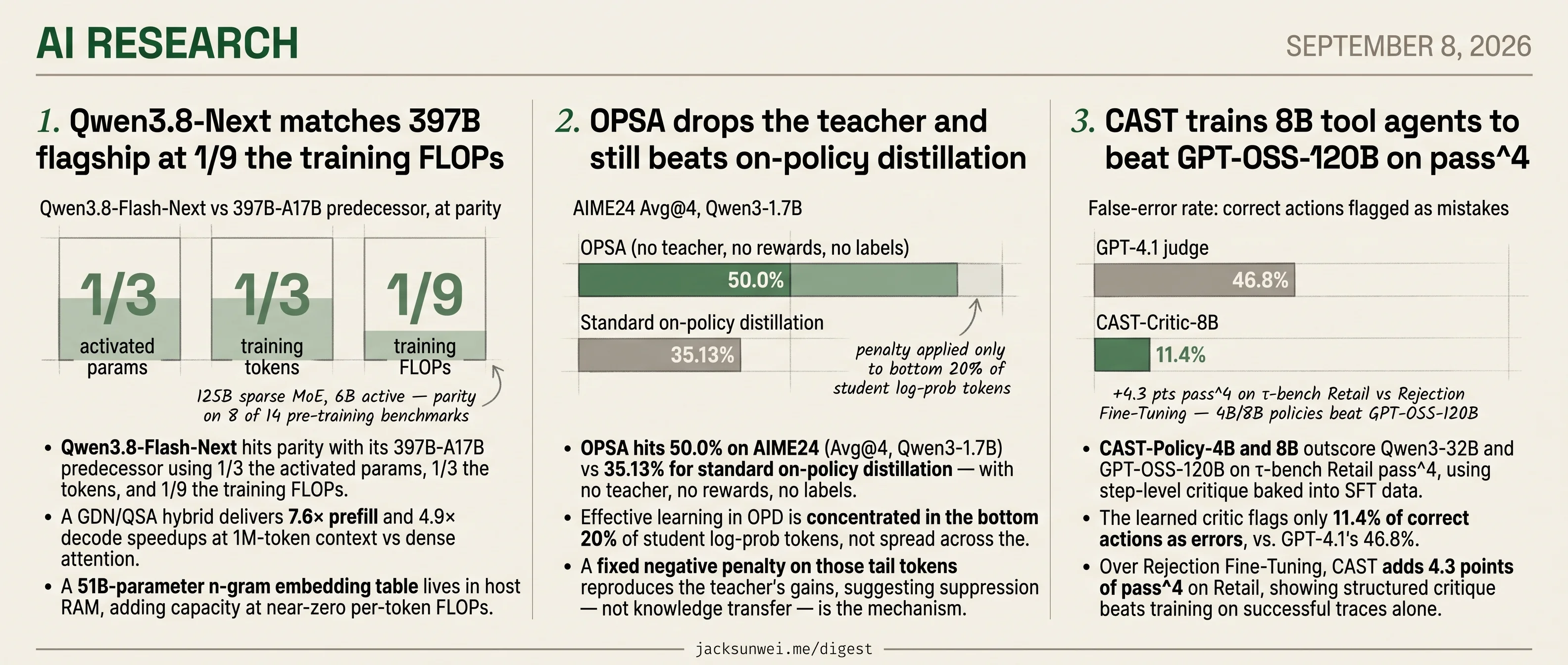
- Qwen3.8-Next matches its 397B predecessor at 1/9 the training FLOPs via hybrid attention and a 51B RAM n-gram table.
- OPSA reaches 50% on AIME24 with no teacher, rewards, or labels, beating on-policy distillation’s 35.13%.
- CAST-8B beats GPT-OSS-120B on τ-bench Retail pass^4 using step-level critique baked into SFT data.
- OPSA’s real gain comes from suppressing bottom-20% student tokens, contradicting the knowledge-transfer story for distillation.
Three research wins today, and none of them come from the axis the technique’s tradition would point at. Qwen3.8-Next matches a 397B predecessor at a ninth of the training FLOPs, but the capacity that keeps it competitive lives in a 51B n-gram table sitting in host RAM and a GDN/QSA hybrid attention stack — not in activated parameters. OPSA beats on-policy distillation without a teacher, without rewards, without labels, and its ablation says the standard method’s gain was tail-token suppression all along, not knowledge transfer. CAST-8B tops GPT-OSS-120B on τ-bench Retail pass^4 by baking step-level critique into SFT data, not by scaling the policy or filtering to successful traces.
The through-line for the day: when a small system beats a big one this cleanly, it’s worth asking whether the technique was ever named for what it actually does. A survey brief on scaling reasoning past human supervision and a FACE-Eval result on CoT faithfulness under tool-delivered cues sit downstream in the same spirit.
Qwen3.8-Next matches 397B flagship at 1/9 the training FLOPs
Source: hf-daily-papers · published 2026-08-30
TL;DR
- Qwen3.8-Flash-Next hits parity with its 397B-A17B predecessor using 1/3 the activated params, 1/3 the tokens, and 1/9 the training FLOPs.
- A GDN/QSA hybrid delivers 7.6× prefill and 4.9× decode speedups at 1M-token context vs dense attention.
- A 51B-parameter n-gram embedding table lives in host RAM, adding capacity at near-zero per-token FLOPs.
- Kimi Linear and NVIDIA’s GDN-2 already frame Flash-Next’s scalar memory gate as the design’s weakest link.
The efficiency headline is the story
Qwen’s Flash-Next is a 125B-parameter sparse MoE with 6B activated. The pitch is efficiency, not scale: it reaches the quality of the previous 397B-A17B flagship on 8 of 14 pre-training benchmarks and trails by ≤2.6 points elsewhere, at roughly a ninth of the training compute. Three of every four layers are Gated DeltaNet (a linear-attention variant that compresses context into a fixed-size state); every fourth is Qwen Sparse Attention, whose lightweight indexer scores context at micro-block granularity to drop indexing from O(n²) to O(n²/r).
Downstream, third-party aggregators back the efficiency claim with headroom to spare:
| Model | SWE-bench Pro | DeepSWE 1.1 |
|---|---|---|
| Qwen3.8-Flash-Next (6B active) | 62.5% | 58.7% |
| Qwen3.7-Plus (17B active, 397B total) | 55.8% | 16.5% |
| Claude 4.6 Max | 53.4% | — |
That’s a ~4× jump on DeepSWE against the previous generation from a model with a third of the activated parameters 1.
The systems bets hold up
Two claims that could have been vendor puffery survive independent write-up. FlashQLA — the fused GDN kernel Qwen open-sourced — reproduces its 2–3× forward and ~2× backward gains over the Flash Linear Attention Triton baseline on H200s, using gate-driven intra-card context parallelism and warp-specialized Hopper/Blackwell kernels 2. And the 51B off-accelerator n-gram table is not a Qwen quirk: DeepSeek’s Engram work frames the same trick as a distinct “conditional memory” scaling axis parallel to MoE conditional computation, with <3% throughput penalty from asynchronous prefetch 3. Two labs converging on host-memory embedding tables in the same quarter suggests this is becoming a standard design pattern.
flowchart LR
    T[Token stream] --> GDN[3× Gated DeltaNet layers<br/>linear, fixed-state]
    GDN --> QSA[1× QSA layer<br/>micro-block indexer]
    QSA --> GDN
    NG[(51B n-gram table<br/>host RAM)] -. prefetch .-> GDN
    NG -. prefetch .-> QSA
The gating design is already dated
Here’s the awkward part. Sebastian Raschka’s architecture gallery notes that linear-attention variants like GDN are “inherently weaker at exact recall than softmax attention,” and that QSA’s indexer still carries a residual quadratic term the paper itself flags as a future bottleneck at extreme sequence lengths 4. More pointedly, Kimi Linear’s authors argue that Flash-Next inherits vanilla GDN’s scalar memory gate — one decay knob per token — and that giving each channel its own gate (Kimi Delta Attention) yields materially better long-horizon RL and math convergence 5. NVIDIA’s Gated DeltaNet-2 pushes the same critique from a different angle, decoupling erase and write into separate channel-wise gates to fix what they call a “scalar tie” the original GDN leaves unresolved 6.
Flash-Next ships the exact GDN variant that two independent follow-ups are now positioning as strictly less expressive than their successors.
The paper’s own ablations hint at the tension: enlarging the n-gram vocabulary keeps lowering cross-entropy loss even after downstream accuracy saturates, and gating-branch restrictions look free early in training before collapsing late. Flash-Next is a strong efficiency and kernel-engineering play. The gating primitives it standardizes on look likely to be superseded before the next Qwen flagship ships.
OPSA drops the teacher and still beats on-policy distillation
Source: hf-daily-papers · published 2026-08-30
TL;DR
- OPSA hits 50.0% on AIME24 (Avg@4, Qwen3-1.7B) vs 35.13% for standard on-policy distillation — with no teacher, no rewards, no labels.
- Effective learning in OPD is concentrated in the bottom 20% of student log-prob tokens, not spread across the teacher’s signal.
- A fixed negative penalty on those tail tokens reproduces the teacher’s gains, suggesting suppression — not knowledge transfer — is the mechanism.
- A parallel research thread (Lp-Reg) argues the opposite intervention — protect low-probability “reasoning sparks,” don’t suppress them.
The claim: the teacher was mostly noise
Ding & Zhang’s paper takes a swing at the currently loudest story in efficient post-training. On-policy distillation (OPD) — where a student generates rollouts and a teacher grades them token-by-token via reverse-KL — has been marketed as a knowledge-transfer shortcut: Thinking Machines’ Tinker stack claims ~70% on AIME’24 at roughly 10% of the compute of full RL, with the teacher signal doing the heavy lifting 7.
The paper’s core empirical claim is that the teacher isn’t doing that lifting. Teachers routinely assign positive advantages to wrong student responses and negative advantages to correct ones, and the noise gets worse as the teacher scales. Students, meanwhile, learn at basically the same rate on cleanly-labeled and noisily-labeled trajectories. What actually drives improvement, the authors argue, is suppression of low-probability tokens the student sampled — regardless of what the teacher said about them 8.
OPSA: keep the suppression, drop everything else
If suppression is the mechanism, you don’t need a teacher to do it. On-Policy Self-Adaptation (OPSA) is the minimal recipe that falls out of that observation:
- Sample a student rollout.
- Take only the bottom 20% of tokens by log-probability.
- Assign each a negative advantage scaled by its entropy — strong penalties at high-entropy “fork” positions, near-zero at confident ones.
That’s the whole training objective. No teacher forward passes, no ground-truth answers (they train on DAPO-17k questions only), no reward model. On Qwen3-1.7B, OPSA lifts Avg@32 on AIME24 by 35.41 points — a 263% relative gain over the base model — and more than doubles Pass@32 on AIME24, MATH, and GSM8K. Independent write-ups have echoed the framing bluntly: OPD “works better without the teacher” and functions more as a self-improvement filter that prunes bad reasoning branches than as knowledge transfer 8.
The dissent: don’t kill the sparks
This is where the field visibly disagrees with itself. The Lp-Reg line of work diagnoses the same phenomenon — entropy collapse under RL-style training — and prescribes the opposite fix. Low-probability tokens like “wait” and “but” are “reasoning sparks” that GRPO-style methods wrongly extinguish; preserving them extends stable exploration from ~1,000 to ~3,000 training steps 9. OPSA drives negative advantage into that same tail. Both methods can’t be right about the same tokens.
“Regularization against unforced errors” more than genuine distillation.
That’s how one commentator characterized the finding, along with an unresolved worry: suppressing tails may not be a coherent objective outside verifiable-reward domains like math 10. One data point cuts the other way — applied to RealSafe-R1, the same entropy-adaptive suppression concentrated updates on early “compliance-decision” tokens and reportedly softened the usual safety-vs-reasoning tradeoff 11.
What to watch
The code and Qwen3.5-9B-OPSA checkpoints are public, with one reproduction gotcha: upstream DAPO-Math-17k parquet files contain ~1.79M duplicated rows, and the recipe wants exactly the bottom 20% of valid tokens with negative advantages in the [-0.5, -1.0] band 12. If OPSA replicates on creative or open-ended tasks — where there is no “correct path” to prune toward — the teacher-as-noise story becomes hard to dismiss. If it doesn’t, Lp-Reg’s spark-preservation camp gets the stronger claim.
CAST trains 8B tool agents to beat GPT-OSS-120B on pass^4
Source: hf-daily-papers · published 2026-08-30
TL;DR
- CAST-Policy-4B and 8B outscore Qwen3-32B and GPT-OSS-120B on τ-bench Retail pass^4, using step-level critique baked into SFT data.
- The learned critic flags only 11.4% of correct actions as errors, vs. GPT-4.1’s 46.8%.
- Over Rejection Fine-Tuning, CAST adds 4.3 points of pass^4 on Retail, showing structured critique beats training on successful traces alone.
- No code released, SFT-only training, and labels lean on privileged ground-truth info available only at training time.
Why pass^k changes what “reliable” means
CAST’s numbers only land if you accept the τ-bench community’s shift from pass@k (succeed on any of k tries) to pass^k (succeed on all k). The two diverge fast: top models like GPT-4o hit ~50% on a first attempt but fall below 25% at pass^8, because cascading failures compound across independent runs 13. The Sierra/Princeton τ-bench work traced most of that decay to a specific failure mode — agents that can’t refuse a user request that violates a corporate rule 14. CAST’s 10.4-point pass^4 lift on Retail is worth reading in that light: pass^k is exponentially unforgiving, so single-digit gains are load-bearing.
How the critic gets built
The pipeline has three stages. A teacher policy (Qwen3-32B) generates 2,500 trajectories across 500 Retail tasks. A multi-agent verification system then labels every step for hallucination, domain-rule violation, or wrong tool use, producing a structured rationale and a binary validity label — with access to privileged ground-truth information only available at training time. Two models are trained on that data: CAST-Critic, which predicts validity + rationale from local context, and CAST-Policy, an SFT model fine-tuned on successful traces enriched with critique signals.
flowchart LR
    A[Teacher policy<br/>Qwen3-32B] --> B[2,500 trajectories]
    B --> C{Multi-agent<br/>verifier}
    G[Privileged<br/>ground truth] --> C
    C --> D[Step-level<br/>rationales + labels]
    D --> E[CAST-Critic 8B]
    D --> F[CAST-Policy 4B/8B]
    E -. optional inference-time critic .-> F
The design choice worth noting: CAST trades training-time critique compute for cheap inference. IRMA, the closest competitor, keeps a retriever+verifier agent pair in the inference loop and leans on Qwen2.5-72B helpers 15. CAST beats it by 4.5 points on Retail pass^4 while running a single small model at serving time — the more attractive tradeoff for anyone actually deploying agents.
Where the result earns its keep — and where it doesn’t
The critic calibration is arguably the more portable win. GPT-4.1 as a judge flags 46.8% of correct actions as errors; CAST-Critic-8B drops that to 11.4%. That’s the kind of signal you’d want as a reward model for on-policy RL, which the authors flag as future work.
Two things temper the headline. First, the labels themselves rely on privileged ground-truth trajectories only available at training time — that’s what buys the calibration, but it also means the recipe doesn’t transfer to domains without a curated oracle to check against. And τ-bench has broader measurement problems: τ²-bench added dual-control scenarios where the user also holds tools, and τ³-bench corrected over 75 task errors across the suite 16, so the ceiling of what “reliable” even means here is still moving. Second, the paper is SFT-only, and there’s a growing body of evidence that heavy SFT induces “pseudo-reasoning paths” — rigid imitative behaviors that cap downstream RL gains 17. The authors acknowledge both limits and propose GRPO/PPO with CAST-Critic as the reward model next.
CAST bridges the gap between unreliable prompt-based critics and black-box optimization methods by making ‘thinking’ part of the supervision signal. 18
The “small models beat 120B” framing is real but narrow: it’s a claim about supervision quality on a specific benchmark, not about scaling. And with no GitHub link in the paper — correspondence goes to an ASU email address — independent replication is on hold.
Round-ups
Survey maps a ladder for scaling reasoning models past human supervision
Source: hf-daily-papers
The paper organizes post-RLHF training into a structured ladder built on reusable verifiers, self-generated curricula, and autonomous co-evolution, then names the failure modes that block progress: reward hacking, feedback drift, and curriculum collapse across policy capability, feedback fidelity, and experience quality.
WebWorld turns the browser into a world model for self-improving web agents
Source: hf-daily-papers
WebWorld treats a live browser as an executable world model, letting a vision-language model verify its own HTML fixes through interaction contracts before exporting them as supervised fine-tuning data. The loop is evaluated on HTMLBench-400 and MiniAppBench-Val, closing the certification gap for autonomous web code repair.
MNIST-PRO revives MNIST as a partial-observability test for multimodal agents
Source: hf-daily-papers
The benchmark forces agents to reconstruct digits from fragmented glimpses, isolating perceptual-state construction from reasoning. Frontier multimodal models stumble at integrating glimpses over time, deciding when to keep exploring, and revising wrong beliefs, exposing weak working memory rather than weak perception.
NoRA stabilizes LoRA fine-tuning by normalizing the down-projection
Source: hf-daily-papers
Normalized Low-Rank Adaptation applies a normalization step to LoRA’s down-projection matrix, accelerating convergence and lifting accuracy without adding parameters or inference cost. The authors also report reduced catastrophic forgetting and gains in reinforcement learning fine-tunes, with code released on GitHub.
Verification-aware training sharpens draft models for speculative decoding
Source: hf-daily-papers
The method simulates the sequential verification loop during draft-model training and reweights the loss toward tokens likely to be accepted. Applied on top of EAGLE-3 and DFlash, it raises acceptance rates and end-to-end speedups without changing the target LLM or inference stack.
FACE-Eval shows chain-of-thought faithfulness collapses when cues come from tools
Source: hf-daily-papers
Across open-weight reasoning models, preference cues delivered through tool returns or implicit artifacts produce lower verbalized commitment and higher unverbalized adoption than cues stated in the prompt. Transcript-based CoT monitors miss these hidden influences, weakening a key AI-safety assumption about reasoning models.
Paper argues LLM safeguard evals must be tied to deployment risk
Source: hf-daily-papers
Local scores like refusal rate, attack success rate, and policy violation rate can improve while residual real-world harm stays flat. The authors propose evaluating guardrails against deployment context and downstream risk, not in isolation, to avoid safety theater in production LLM systems.
Footnotes
-
MindStudio — Qwen3.8-Flash-Next benchmarks — https://www.mindstudio.ai/blog/qwen-3-8-flash-next-benchmarks
↩Flash-Next scores 62.5% on SWE-bench Pro (vs Claude 4.6 Max at 53.4% and predecessor 3.7-Plus at 55.8%) and 58.7% on DeepSWE 1.1—roughly 4× the 16.5% of Qwen3.7-Plus.
-
MarkTechPost — FlashQLA release coverage — https://www.marktechpost.com/2026/04/29/qwen-team-releases-flashqla-a-high-performance-linear-attention-kernel-library-that-achieves-up-to-3x-speedup-on-nvidia-hopper-gpus/
↩FlashQLA achieves 2–3× forward and ~2× backward speedups over the Flash Linear Attention Triton kernel on H200s via gate-driven intra-card context parallelism and warp-specialized kernels tuned for Hopper/Blackwell.
-
Introl — DeepSeek Engram conditional memory writeup — https://introl.com/blog/deepseek-engram-conditional-memory-architecture-january-2026
↩DeepSeek’s Engram and Qwen3.8-Flash-Next both offload >50B-parameter n-gram tables to host memory, treating ‘conditional memory’ as a distinct scaling axis from MoE ‘conditional computation’, with <3% throughput penalty from prefetching.
-
Sebastian Raschka — Qwen Sparse Attention gallery — https://sebastianraschka.com/llm-architecture-gallery/qwen-sparse-attention/
↩Linear-attention variants like GDN are fast but inherently weaker at exact recall than softmax attention; QSA’s micro-block indexer still carries a residual quadratic component that may bottleneck at very long sequences.
-
Vizuara Substack — Kimi Linear analysis — https://vizuara.substack.com/p/kimi-linear-an-expressive-efficient
↩Kimi Delta Attention upgrades Gated DeltaNet with channel-wise gating so every feature dimension has its own gate, avoiding the coarse scalar decay Qwen3-Next inherits from vanilla GDN.
-
NVIDIA Research — Gated DeltaNet-2 — https://research.nvidia.com/publication/2026-05_gated-deltanet-2-decoupling-erase-and-write-linear-attention
↩Gated DeltaNet-2 decouples the erase and write operations into separate channel-wise gates, addressing a ‘scalar tie’ that limits memory-editing precision in the original Gated DeltaNet used by Qwen3-Next.
-
data-pilot.com on Thinking Machines’ Tinker — https://data-pilot.com/blog/mira-muratis-thinking-machines-lab-unveils-tinker-a-new-era-of-ai-model-fine-tuning/
↩On-Policy Distillation… involves the student generating its own ‘rollouts’ which are then graded by a teacher model… using a reverse-KL divergence objective, providing dense, token-level supervision, helping student models like Inkling-Small achieve high-tier reasoning performance (reaching 70% on AIME’24) at roughly 10% of the compute required for traditional RL.
-
dev.to — ‘On-Policy Distillation Works Better Without the Teacher’ — https://dev.to/reidmarlow/on-policy-distillation-works-better-without-the-teacher-1ac1
↩ ↩2Replacing the teacher entirely with a fixed negative penalty on low-probability tokens achieved identical performance on mathematical reasoning benchmarks… OPD functions more as a self-improvement filter that ‘prunes’ bad reasoning branches than a knowledge transfer mechanism.
-
Lp-Reg paper (arXiv 2510.03222) — https://arxiv.org/abs/2510.03222
↩Lp-Reg specifically targets the preservation of ‘reasoning sparks’ — valuable low-probability tokens… Standard GRPO often suppresses these tokens as ‘bad actions’… while baseline entropy-control methods collapse after roughly 1,000 steps, Lp-Reg sustains stable exploration for over 3,000 training steps.
-
TheNeuron AI daily digest — https://www.theneuron.ai/digest/everything-that-happened-in-ai-today-wednesday-september-2-2026/
↩AI researcher Gurtej Gill interpreted the findings as evidence that many apparent distillation gains are actually just a form of ‘regularization against unforced errors’… some dissent remains regarding whether this ‘self-adaptation’ can truly substitute for a teacher in more creative or open-ended tasks.
-
RealSafe-R1 application note (ResearchGate) — https://www.researchgate.net/publication/390773392_RealSafe-R1_Safety-Aligned_DeepSeek-R1_without_Compromising_Reasoning_Capability
↩Applied to safety-aligned models like RealSafe-R1, [OPSA] achieved a superior safety-reasoning tradeoff by concentrating updates on early ‘compliance-decision’ tokens.
-
Project page — DripNowhy/On-Policy-Self-Adaptation — https://dripnowhy.github.io/On-Policy-Self-Adaptation/
↩Practitioners are advised to use ‘Slime-ready’ mirrors of the DAPO-Math-17k dataset to avoid the 1.79M-row duplicated parquet files found in upstream versions… targeting only the 20% of valid tokens with the lowest actor log probabilities, assigning negative advantages between -0.5 and -1.0.
-
Phil Schmid — ‘Agents: pass@k vs pass^k’ — https://www.philschmid.de/agents-pass-at-k-pass-power-k
↩pass^k requires an agent to succeed on all k independent trials… top-tier models like GPT-4o achieved roughly 50% success on a first attempt, [but] their pass^8 score dropped to below 25%
-
Sierra blog on τ-bench — https://sierra.ai/kr/blog/tau-bench-shaping-development-evaluation-agents
↩τ-bench evaluates an agent’s ability to maintain consistency across complex, multi-turn dialogues… even state-of-the-art function-calling agents struggle to ‘say no’ to users when a request violates a corporate rule
-
IRMA paper (arXiv 2504.11468) — https://arxiv.org/abs/2504.11468
↩IRMA… employs a multi-agent setup where a ‘retriever’ agent extracts relevant domain policy rules and a ‘verifier’ agent reformulates the original query with specific tool suggestions before the main agent attempts an action
-
τ²-bench / τ³-bench (arXiv 2506.09338) — https://arxiv.org/abs/2506.09338
↩τ²-bench addressed the limitation of ‘single-control’ environments… by introducing ‘dual-control’ scenarios where the user also uses tools; τ³-bench corrected over 75 task errors [and] identified numerous ‘incorrect expected actions’ in the original airline domain
-
OpenReview discussion on process reward models / SFT-vs-RL — https://openreview.net/challenge?redirect=%2Fforum%3Fid%3DLnBEASInVr
↩excessive SFT can actually degrade subsequent RL performance… SFT often induces ‘pseudo-reasoning paths’—rigid, imitative behaviors that look like reasoning but are fundamentally incorrect
-
Medium — Dutta Saswata, ‘Structuring Multi-Agent Systems around Irreversible Actions’ — https://medium.com/@duttasaswata7/structuring-multi-agent-systems-around-irreversible-actions-lessons-from-tau-bench-defe0f139eda
↩as projects scale, even advanced tool-calling agents struggle with ‘context pollution’… [CAST] bridges the gap between unreliable prompt-based critics and black-box optimization methods by making ‘thinking’ part of the supervision signal