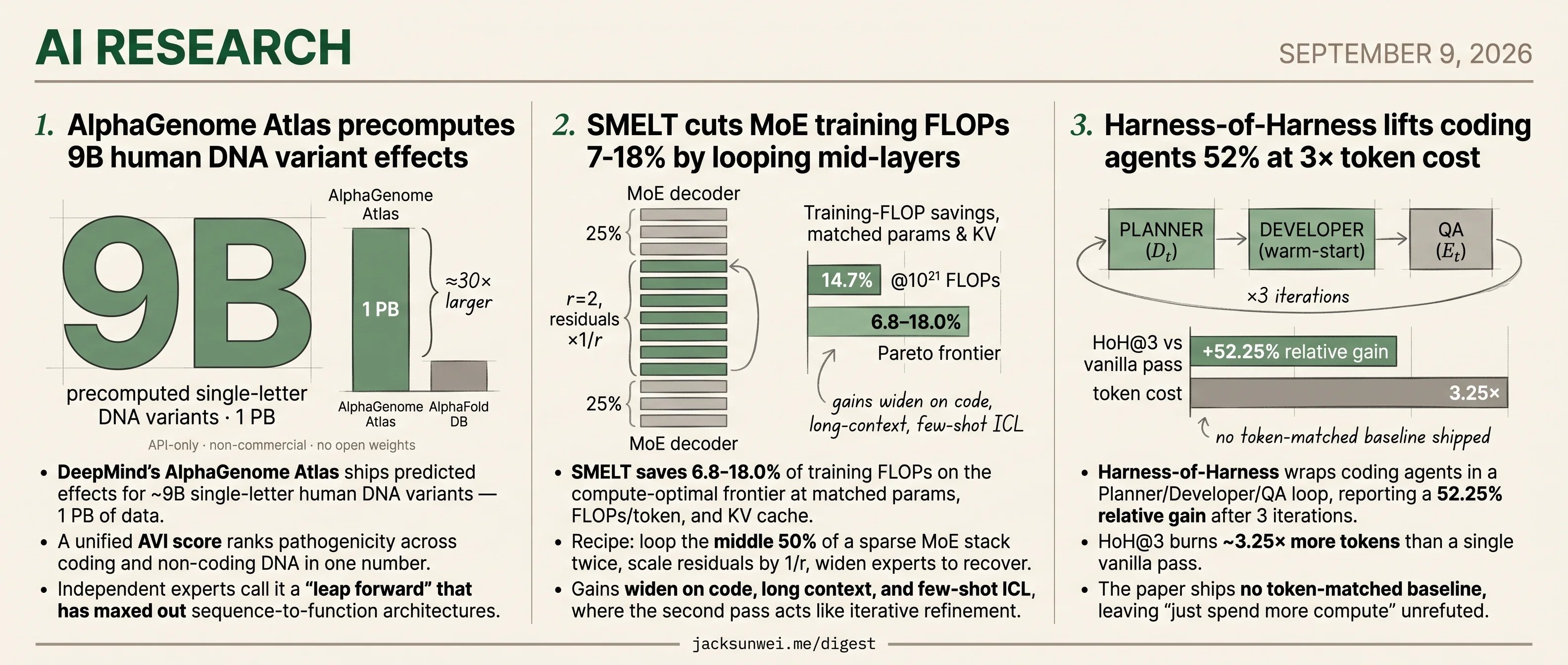
AlphaGenome precomputes 9B variants, SMELT loops MoE, Harness-of-Harness +52%
DeepMind precomputes 9B DNA variants, SMELT loops MoE mid-layers, and Harness-of-Harness wraps coding agents — three gains from restructuring compute, not new weights.
AlphaGenome precomputes 9B variants, SMELT loops MoE, Harness-of-Harness +52%
TL;DR
- DeepMind’s AlphaGenome Atlas precomputes ~9B human DNA variant effects into a 1 PB lookup table.
- SMELT cuts MoE training FLOPs 6.8-18% by looping the middle 50% of layers twice.
- Harness-of-Harness lifts coding agents 52.25% relative — at 3.25× the token cost of one vanilla pass.
- Qwen-Drive-1.0 unifies BEV perception, VQA and planning behind one vision-language backbone.
- Persistent agent memory launders unauthorized actions, per new EAL-Bench safeguards paper.
Today’s three research features share a lens: the headline gain doesn’t come from a better model. DeepMind’s AlphaGenome Atlas ships as a 1 PB precomputed table of ~9B human DNA variant effects — the lookup, not the network, is the artifact users touch. SMELT finds 6.8-18% of training FLOPs on the compute-optimal MoE frontier by looping the middle 50% of layers twice and widening experts to compensate. And Harness-of-Harness wraps a stock coding agent in a Planner/Developer/QA loop and reports a 52.25% relative lift — at roughly 3.25× the token cost, with no token-matched baseline in the paper.
The wrapping structure is doing the work in each case, which is also where the caveat lives: an API-only, non-commercial distribution for the Atlas; a wall-clock latency gap the compute-matched framing skips for SMELT; and an unrefuted is-this-just-more-compute? question for HoH.
AlphaGenome Atlas precomputes 9B human DNA variant effects
Source: deepmind-blog · published 2026-09-08
TL;DR
- DeepMind’s AlphaGenome Atlas ships predicted effects for ~9B single-letter human DNA variants — 1 PB of data.
- A unified AVI score ranks pathogenicity across coding and non-coding DNA in one number.
- Independent experts call it a “leap forward” that has maxed out sequence-to-function architectures.
- Unlike AlphaFold, the Atlas is API-only and non-commercial — no open weights, no clinical use.
The scale claim is genuine
The headline numbers hold up. AlphaGenome Atlas precomputes molecular effects — splicing, expression, chromatin accessibility — for roughly 9 billion single-nucleotide variants, packaged as a 1-petabyte dataset that is more than 30× the original AlphaFold Database. The design choice matters: rather than run the model per query, DeepMind materialized the full grid so a researcher can look up any point mutation instead of scheduling GPU time.
The most useful new primitive is the AlphaGenome Variant Impact (AVI) score, which fuses AlphaGenome’s regulatory predictions with AlphaMissense’s protein-coding calls into one pathogenicity ranking that spans coding and non-coding regions. Early academic results are concrete: with the GREGoR Consortium, AVI flagged a previously overlooked DNM1 splice-disrupting variant in epileptic encephalopathy; at Exeter, applying the Atlas to 54,000 UK Biobank whole genomes surfaced 22% more non-coding associations than standard methods, including rare variants in EGLN1 and PLA2G7.
Where the model still struggles
Independent voices are less breathless than the launch post. Stanford’s Anshul Kundaje, quoted in Science News, calls AlphaGenome a “leap forward” in utility but argues it has “essentially maxed out” what sequence-to-function architectures can do — and says unpublished benchmarks from his lab show it still fails to predict individual-specific gene expression, the exact regime personalized medicine needs 1. The ICR’s Kristian Helin flags the same gap for cell-type-specific regulation, which is where oncology lives 2.
A third-party CRISPRi benchmark is sharper still: AlphaGenome leads the field at ranking distal enhancer perturbations, but “systematically underpredicts the magnitude” of those effects 3. Ordering is state of the art; calibration is not.
Openness is not AlphaFold-grade
The AlphaFold comparison flatters the release in a way the license terms do not support. AlphaGenome ships without open weights, and the GitHub license explicitly forbids clinical decision-making, prohibits distillation of outputs into other models, caps free API usage, and forces derivatives to inherit the non-commercial terms 4. Labs that wire the Atlas into production pipelines are choosing a Vertex AI dependency, not an AlphaFold-style public good.
The competitive framing is also selective. The launch post benchmarks against Enformer, Borzoi, and AlphaMissense but omits Arc Institute’s Evo2, released earlier in 2026 — fully open-source with weights, code, and training data, and already used to design functional bacteriophages 5. Evo2 is generative where AlphaGenome is predictive; they occupy adjacent niches, and pretending only one exists distorts the field.
One orthogonal note for anyone using the Atlas as an Antigravity skill: security researchers have reported agent-manager vulnerabilities in Antigravity permitting sandbox escape and remote code execution 6. Piping genomic queries through the agent layer inherits that surface area.
Takeaway
The Atlas is the strongest general-purpose variant-effect lookup table anyone has shipped, and the AVI score genuinely simplifies triage across coding and non-coding DNA. Just don’t confuse “best-in-class” with “solved” — personalized prediction, cell-type specificity, and effect-size calibration are still open — and don’t confuse “available” with “open.”
SMELT cuts MoE training FLOPs 7-18% by looping mid-layers
Source: hf-daily-papers · published 2026-08-31
TL;DR
- SMELT saves 6.8-18.0% of training FLOPs on the compute-optimal frontier at matched params, FLOPs/token, and KV cache.
- Recipe: loop the middle 50% of a sparse MoE stack twice, scale residuals by 1/r, widen experts to recover capacity.
- Gains widen on code, long context, and few-shot ICL, where the second pass acts like iterative refinement.
- Second pass redistributes attention away from the sink token toward semantically relevant ones — a side effect, not a targeted fix.
- Wall-clock latency and CoT visibility are the two gaps the compute-matched framing skips.
The recipe, and what makes it fair
Prior looped-Transformer studies tended to conflate depth with compute. SMELT — from ByteDance Seed, Tsinghua, M-A-P and TokenWave.AI — is the first to hold three budgets fixed at once: per-token FLOPs, non-embedding parameters, and KV cache size. The recipe is narrow: take a decoder-only MoE with top-8 routing, execute the middle 50% of layers twice (r=2), scale each residual update inside the loop by 1/r to keep activations stable, then compensate by narrowing the hidden dimension H (to pay for the extra FLOPs), adding experts (to recover capacity), and tuning GQA ratios (to hold the cache flat).
Trained across a ladder from 100M to 1.6B active parameters (up to 54B total), SMELT matches a baseline’s validation loss using 14.7% less compute at 10²¹ FLOPs, with Pareto-frontier savings of 6.8-18.0%. Downstream gains exceed what validation loss predicts, and they scale with structure: code shows the largest lift, few-shot accuracy improves as demonstrations increase, and the gap widens on longer sequences. The authors argue this is because the second pass through shared weights lets the model refine — Q and K stay similar between passes, but V and the attention distribution shift materially.
A third scaling axis, with company
SMELT lands in a crowded conversation about recurrent depth as a “third axis” alongside width and depth. Google DeepMind/KAIST’s Mixture-of-Recursions makes the adaptive version of the argument: a 167M MoR model beat a 315M vanilla Transformer at few-shot accuracy with a claimed 2.06× throughput speedup and 50% memory reduction 7. UCSD/Together AI’s Parcae reframes the loop as a stable dynamical system and reports beating fixed-depth baselines at every scale — while warning that training-free retrofitting of recurrence degrades performance, so SMELT-style looping cannot be bolted onto existing checkpoints 8. Yang et al. supply the theory: looped stacks can emulate iterative algorithms like gradient descent that single-pass Transformers cannot, which lines up cleanly with SMELT’s outsized ICL and code gains 9.
| Approach | Recurrence policy | Headline claim |
|---|---|---|
| SMELT | Fixed: middle 50%, r=2 | 6.8-18% training-FLOP savings, matched budgets |
| MoR 7 | Per-token router | 2.06× throughput, 50% memory vs. 2× larger baseline |
| Parcae 8 | Loop as stable dynamical system | Matches a Transformer twice its size |
What the paper doesn’t answer
Two external critiques bite. First, wall-clock: serial execution of the shared block underutilizes GPU parallelism, so equal-FLOP does not mean equal tokens/sec — a “wall-clock penalty” the FLOP-savings headline elides 10. Second, interpretability: because the extra computation happens in latent space, reasoning that would otherwise surface in a chain-of-thought trace is absorbed into hidden-state recurrence, “bypass[ing] human-readable CoT monitoring” 11. That is the sharpest safety-adjacent objection to the whole recurrent-depth family, and it applies to SMELT by construction.
The attention-sink story is also less novel than framed. StreamingLLM keeps sinks deliberately and gets stable 4M-token streaming without retraining 12; SMELT shows sinks can be reduced as a side effect of recurrence, but never benchmarks against those targeted mitigations. The compute-matched frontier is real. The rest of the design space is still open.
Harness-of-Harness lifts coding agents 52% at 3× token cost
Source: hf-daily-papers · published 2026-08-31
TL;DR
- Harness-of-Harness wraps coding agents in a Planner/Developer/QA loop, reporting a 52.25% relative gain after 3 iterations.
- HoH@3 burns ~3.25× more tokens than a single vanilla pass.
- The paper ships no token-matched baseline, leaving “just spend more compute” unrefuted.
- Fusepoint, a playable 3D FPS with 18 enemy AIs, was built autonomously over 70+ loops.
The loop
HoH is an orchestration layer, not a new agent. It splits a long-horizon build across three roles: a Project Planner that emits a bounded Development Document $D_t$, a Developer that warm-starts from the previous artifact and does shift-left testing, and a QA Tester that runs white-box and black-box checks to produce an Evidence Bundle $E_t$. Two states persist across loops — the code artifact (version-controlled, revertable) and the evidence log — while a progressive-disclosure scheme keeps stale plans out of the context window.
flowchart LR
    R[Requirements] --> P[Planner: D_t]
    P --> D[Developer: warm-start from prior artifact]
    D --> Q[QA: white-box + black-box]
    Q --> E[Evidence bundle E_t]
    E -->|next iteration| P
    D --> A[(Version-controlled artifact)]
    A -->|revert on regression| D
The design directly targets two documented failure modes of long-horizon agents. A 2026 study on regression accumulation found 40–73% of multi-turn coding tasks lose previously correct behavior as agents add features 13, and AWS’s failure-mode writeup argues the coder and the grader must be different agents to avoid false-completion cycles 14 — exactly HoH’s Developer/QA split.
The numbers
Across three model-harness pairings (Codex/GPT-5.5, OpenCode/DeepSeek-V4-Pro, Pi/MiniMax-M3), HoH@3 posts a 52.25% average relative gain, peaking at 82.86%. On FrontierSWE with GPT-5.5, ten iterations lift the Dominance score from 22% to 72.67%. The qualitative headline is Fusepoint, a 3D FPS built over 70+ loops with combat, an 18-enemy AI roster, 3D assets, audio, and a working UI — genuinely further than prior meta-agent demos have gone.
Context matters for reading those wins. GameCraft-Bench is punishing: frontier agents land between 41% and 65% on their best runs and often sub-40%, typically failing at visual feedback and coherent project structure 15. HoH is climbing from a low floor.
The missing baseline
The sharpest independent critique is methodological. A walkthrough by CCTest.ai points out that HoH@3 consumes ~3.25× the tokens of a single vanilla pass, calling the 52% gain “a numerator that lacks a cost-normalized denominator” — a plain agent given the same token budget might close much of it 16. The paper’s own ablation reinforces the suspicion: killing warm-start drops scores 7.85 points and balloons tokens from 8.41M to 11.12M per task, suggesting artifact continuity — not the Planner/QA choreography — is doing the heavy lifting. A promised “HoH-lite” hasn’t shipped 17.
The meta-agent field has been here before. MetaGPT and ChatDev prototypes suffer “coordination bloat” where agent-to-agent chatter outweighs coding, and ~75% of autonomous coding agents still break working code in CI 18. HoH concedes regressions are “normal” and handled by reopening QA issues 17 — which validates the loop’s necessity but also concedes autonomy hasn’t fixed instability, only amortized it.
Takeaway
HoH is a strong engineering artifact and the FPS demo is the field’s most convincing multi-day autonomous build to date. As science, the claim is unresolved until someone runs vanilla harnesses at matched token budgets. Until then, the honest read is: spending 3× the compute buys ~50% better software, and most of that premium probably comes from not throwing the repo away between turns.
Round-ups
Qwen-Drive-1.0 unifies 3D perception, VQA and planning for driving
Source: hf-daily-papers
Alibaba’s first driving foundation model shares a vision-language backbone across a BEV perception head, visual question answering, and a Planning Expert, trained in stages so motion planning inherits scene understanding. The paper drew 377 upvotes on Hugging Face’s daily list.
H3-World turns 33B MiniMax video generator into controllable world model
Source: hf-daily-papers
Building on MiniMax-H3’s zero-shot language control of characters and cameras, H3-World adds temporally grounded instructions so users steer the 33B video generator as an interactive world model. Language replaces bespoke control interfaces as video generators scale in capability.
ZimaBlue pre-trains a world action model on egocentric video
Source: hf-daily-papers
A three-stage curriculum turns large-scale egocentric video into a generalizable world action model, paired with a slow-fast dual-system architecture and asynchronous inference. The approach substantially lifts zero-shot robotic manipulation without task-specific teleoperation data.
Switch Distillation gates teacher signal by confidence to protect facts
Source: hf-daily-papers
Applied during mid-training, Switch Distillation only borrows from a post-trained teacher when the teacher’s predictive entropy is low, preserving factual recall while lifting reasoning in smaller models. The selective gate avoids the recall collapse that uniform logit-based KL distillation tends to cause.
Adaptive structuring cuts data-agent token costs by orders of magnitude
Source: hf-daily-papers
Enterprise LLM agents answering questions over PDFs, contracts and filings often burn up to a million tokens per query re-reading documents. The paper proposes adaptively structuring unstructured sources up front so repeated queries reduce to cheap lookups over a shared schema.
Persistent agent memory becomes a channel for authorization laundering
Source: hf-daily-papers
Long-running LLM agents accumulate memory errors that quietly promote themselves into authority they were never granted, enabling unauthorized actions downstream. The authors release EAL-Bench and show bounded event-sourcing safeguards curb the attack but trade off legitimate memory use.
UI-Venus-2 closes GUI agent loop with trace-level verifiers
Source: hf-daily-papers
The multimodal GUI agent runs unified reasoning-action loops across an expanded set of desktop and mobile environments, with trace- and sample-level evaluators plus multi-model voting supplying RL signals. Safety-aware checks aim to make real-world digital automation reliable enough to deploy.
Footnotes
-
Science News (quoting Anshul Kundaje, Stanford) — https://www.sciencenews.org/article/ai-tool-alphagenome-predicts-genetics
↩AlphaGenome is a ‘leap forward’ in utility but has essentially maxed out current sequence-to-function architectures; unpublished lab data shows it still struggles to predict individual-specific gene expression.
-
Science Media Centre expert reaction (Prof. Kristian Helin, ICR) — https://www.sciencemediacentre.org/expert-reaction-to-paper-on-google-deepminds-alphagenome/
↩A major advance in sequence-to-function modeling, but capturing cell-type-specific regulation — critical for cancer and other diseases — remains a significant unsolved challenge.
-
GenomicsXAI benchmark blog — https://genomicsxai.github.io/blogs/2026-007/
↩In CRISPRi enhancer-knockdown screens AlphaGenome leads the field but systematically underpredicts the magnitude of effects for distal cis-regulatory elements.
-
AlphaGenome GitHub (license terms) — https://github.com/google-deepmind/alphagenome
↩Non-commercial license forbids clinical use, prohibits distillation of outputs into other models, and caps free API usage; derivatives must inherit the non-commercial terms.
-
r/genomics thread comparing 2025–2026 genomic foundation models — https://www.reddit.com/r/genomics/comments/1u2dkpt/comparing_the_20252026_genomic_foundation_models/
↩Evo2 (Arc Institute) is fully open-source with weights and training code; AlphaGenome remains API-only, and Evo2 already produced the first AI-designed functional bacteriophages — a generative capability AlphaGenome lacks.
-
Implicator.ai on Antigravity integration — https://www.implicator.ai/google-alphagenome-atlas-9-billion-dna-variants/
↩Security researchers have identified vulnerabilities in the Antigravity ‘agent manager’ that could allow an agent to escape its sandbox and execute remote code.
-
Turing Post — Mixture-of-Recursions explainer — https://www.turingpost.com/p/mixtureofrecursions
↩ ↩2a 167M MoR model achieved higher few-shot accuracy (43.1% vs 42.3%) than a 315M vanilla Transformer, despite using 50% fewer unique parameters … up to a 2.06x throughput speedup and a 50% reduction in memory usage
-
MarkTechPost — Parcae (UCSD/Together AI) — https://www.marktechpost.com/2026/04/16/ucsd-and-together-ai-research-introduces-parcae-a-stable-architecture-for-looped-language-models-that-achieves-the-quality-of-a-transformer-twice-the-size/
↩ ↩2Parcae … recasts the loop as a stable dynamical system … claims to beat fixed-depth baselines at every scale … training-free retrofitting of recurrence often degrades performance, suggesting that models must be trained from scratch with the loop to be effective
-
Yang et al., arXiv:2505.01855 (looped transformers for ICL) — https://arxiv.org/pdf/2505.01855
↩looped structures are significantly better at emulating iterative algorithms like gradient descent than standard transformers … looped models can perform multi-step refinement, achieving higher sample efficiency
-
crackingwalnuts.com — Recurrent-Depth Transformers — https://crackingwalnuts.com/post/recurrent-depth-transformers
↩serial execution prevents the model from fully utilizing the parallel throughput of modern GPUs, leading to a ‘wall-clock penalty’ even if the mathematical complexity (FLOP count) is identical to a baseline model
-
tosea.ai — Looped Transformer / Astra guide — https://tosea.ai/blog/looped-transformer-recurrent-depth-astra-guide
↩the looping happens within the hidden layers, [so] the model’s reasoning process becomes a ‘black box’ that bypasses human-readable Chain-of-Thought (CoT) monitoring
-
MIT HAN Lab — StreamingLLM — https://hanlab.mit.edu/blog/streamingllm
↩StreamingLLM … preserves the KV cache of the first 1–4 ‘sink’ tokens alongside a sliding window … enabling stable processing of over 4 million tokens without retraining
-
Techstrong.ai — ‘The Long-Horizon Agent Reliability Problem’ — https://techstrong.ai/contributed-content/the-long-horizon-agent-reliability-problem/
↩A 2026 study titled Regression Accumulation in Multi-Turn LLM Programming Conversations found that 40% to 73% of tasks lose previously correct behavior as an agent adds new features or input validation.
-
AWS Builder — ‘Agent Failure Modes in Long-Horizon Tasks’ — https://builder.aws.com/content/3HJsZwEzpYmgRLuRPNGZxmUtYey/agent-failure-modes-in-long-horizon-tasks
↩Agents are poor judges of their own work, often declaring ‘success’ on partial or unvalidated outcomes… the agent writing the code must be separate from the one grading it to avoid false completion cycles.
-
alphaXiv summary of GameCraft-Bench — https://www.alphaxiv.org/abs/2606.17861
↩On GameCraft-Bench, the strongest frontier agents initially achieved scores between 41% and 65%, with many falling below 40%. Agents often implement basic mechanics but frequently fail to deliver functional visual feedback or coherent project structures.
-
CCTest.ai analysis of HoH — https://cctest.ai/en/articles/harness-of-harness-turning-coding-agents-into-iterative-software-developers
↩A three-iteration run (HoH@3) consumes roughly 3.25 times more cumulative tokens than a single vanilla pass… the 52% gain is a ‘numerator’ that lacks a cost-normalized denominator, suggesting that simply spending the same token budget on a plain agent might yield comparable results.
-
unifiedharnessprotocol.dev writeup — https://unifiedharnessprotocol.dev/harness-of-harness/
↩ ↩2Regressions—where new code breaks previously verified features—are a normal part of the HoH trajectory, handled by the QA role ‘re-opening’ issues in the development log… a more efficient ‘HoH-lite’ implementation announced as ‘coming soon’.
-
SmythOS — MetaGPT vs ChatDev comparison — https://smythos.com/developers/agent-comparisons/metagpt-vs-chatdev/
↩MetaGPT and ChatDev are impressive for prototyping, they often suffer from ‘coordination bloat,’ where the time spent on agent-to-agent chatter exceeds the actual coding time… 75% of autonomous coding agents still broke working code during CI workflows.