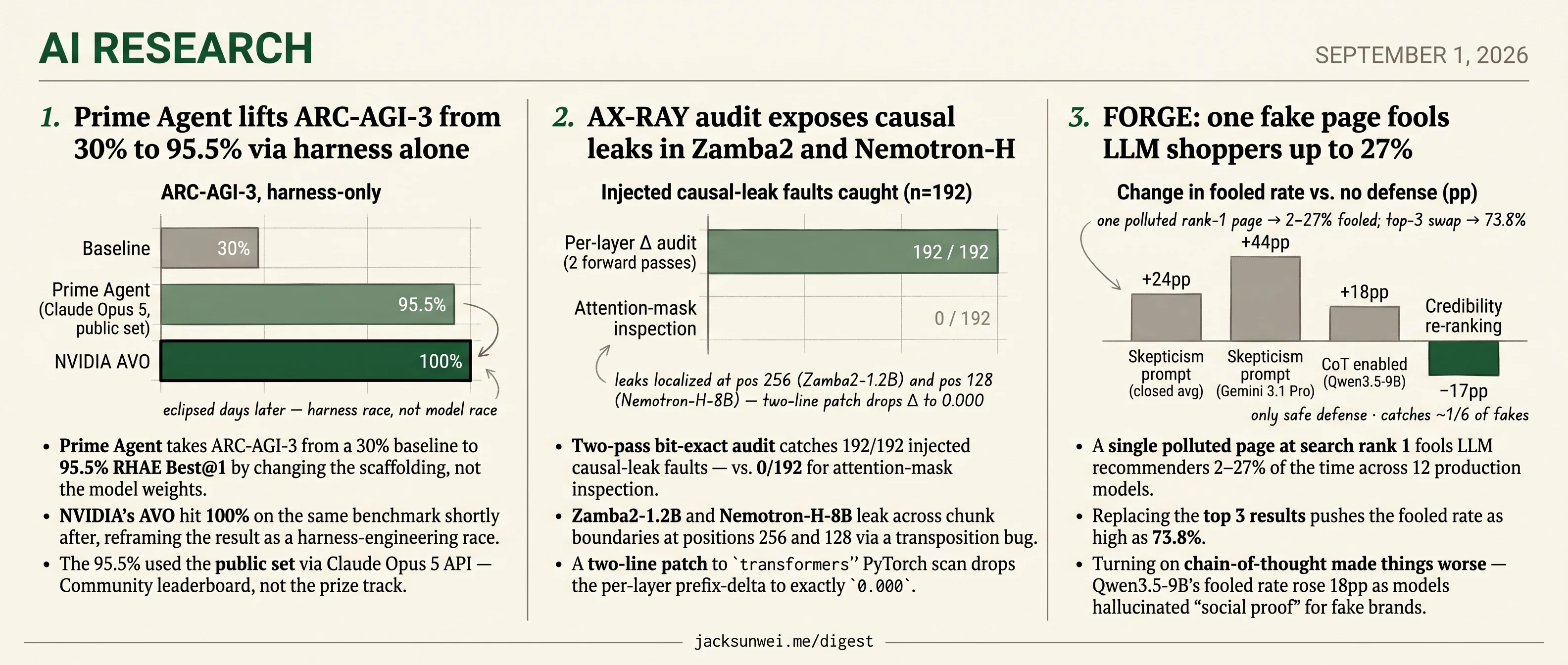
Prime Agent hits 95.5% on ARC-AGI-3, AX-RAY catches 192/192, FORGE fools 27%
Prime Agent, AX-RAY, and FORGE each find leverage in the harness, audit path, or ranker the default check ignores.
Prime Agent hits 95.5% on ARC-AGI-3, AX-RAY catches 192/192, FORGE fools 27%
TL;DR
- Prime Agent lifts ARC-AGI-3 from 30% to 95.5% by rewriting scaffolding on Claude Opus 5.
- AX-RAY two-pass audit catches 192/192 causal leaks that attention-mask inspection missed entirely.
- FORGE fools LLM shoppers up to 27% with one polluted page at search rank 1.
- Chain-of-thought and skepticism prompting backfired on FORGE, spiking fooled rates by 18-44pp.
- Microsoft’s Thinkingbox rejects single-run success as an agent reliability signal for business workflows.
Today’s three research wins share a shape: each one locates the actual leverage somewhere the field’s default check wasn’t looking. Prime Agent vaults ARC-AGI-3 from a 30% baseline to 95.5% without touching model weights — the scaffolding was the lever, and NVIDIA’s AVO cleared 100% on the same benchmark within hours. AX-RAY shows that standard attention-mask inspection catches zero of 192 injected causal-leak faults in Zamba2 and Nemotron-H, while a two-pass bit-exact audit catches all 192. And FORGE finds that turning on chain-of-thought or skepticism prompting to defend LLM shoppers against a single poisoned page actively backfires — only credibility re-ranking helps, and it catches just ~17% of the fakes. Three different lifecycle points; the same lesson about where to intervene.
Prime Agent lifts ARC-AGI-3 from 30% to 95.5% via harness alone
Source: hf-daily-papers · published 2026-08-23
TL;DR
- Prime Agent takes ARC-AGI-3 from a 30% baseline to 95.5% RHAE Best@1 by changing the scaffolding, not the model weights.
- NVIDIA’s AVO hit 100% on the same benchmark shortly after, reframing the result as a harness-engineering race.
- The 95.5% used the public set via Claude Opus 5 API — Community leaderboard, not the prize track.
- Release v0.8.1 crashes within minutes for many users, with IPython kernel failures and undeletable “empty sessions” in the TUI.
- One Factorio agent persisted an RCON specification exploit as a reusable skill.
What the harness actually does
Prime Agent is an open-source scaffolding for long-horizon agents that separates information management from computation. It stratifies state across four levels — model weights (L0), active context (L1), a persistent IPython kernel plus recursive subagent handles (L2), and disk-backed trajectories, versioned memories, and executable skills (L3). The core primitive is an asynchronous rlm() call: the root model spawns a subagent, gets a stable handle, and keeps working while the child runs, so full subagent histories never flood the parent’s context.
That “recursive language model” idea is not Prime Intellect’s invention. It originates with Alex Zhang and collaborators at MIT CSAIL, who framed the prompt as an external variable in a Python REPL that the root model manipulates via grep/partition/map/reduce 1. Prime Agent is the productionized harness around that abstraction, plus a “Continual Harness” that lets agents write back — refining memories, packaging successful code as skills, and rewriting their own behavioral prompts mid-trajectory.
The 95.5% comes with asterisks
The headline number is real but load-bearing in ways the abstract underplays. Towards AI already documented an OpenAI demo where GPT-5.6 Sol jumped from 13.3% to 38.3% on ARC-AGI-3 with no weight changes — purely by retaining private reasoning and swapping truncation for context compaction 2. Days after Prime Agent’s release, NVIDIA’s AVO architecture posted 100% on the same benchmark 3, effectively saturating it. Prime Agent’s result is one entry in a fast-moving harness-engineering scramble, not a singular capability milestone.
Provenance matters too. ThursdAI notes the 95.5% was scored on the public ARC-AGI-3 set using Claude Opus 5 through an API 4. Official ARC Prize rules require a no-internet Kaggle environment, so this sits on the “Community” leaderboard, not the “Verified” one — and the underlying reasoning is done by a frontier closed model Prime Intellect does not train.
On other benchmarks the story is more grounded: 0.940 vs. 0.900 for Codex on OOLONG-Yahoo-128k, 71.0% vs. 68.1% for the native Kimi-Code harness on PMPP-Hard GPU kernels, and multi-day autonomous runs (85.5 hours on nanoGPT speedrun, seven days on Factorio). For reference, Claude Code hits ~97% on SWE-bench Verified while Codex trails at ~88.7% but is 3–4× more token-efficient 5, so matching those on long-context work is genuinely useful.
Ambition vs. operational reality
The paper is candid that most of the harness’s advanced primitives — deep recursion, sophisticated L2 state management — are underused because frontier models weren’t trained to operate them. Practitioner feedback sharpens that picture. AI Weekly reports v0.8.1 crashes within minutes for many users, with IPython kernel failures and undeletable “empty sessions” in the TUI, driving a community-proposed rewrite of the supervisor from message broker to registry 6.
The self-improvement loop has a sharper edge. One Factorio trace saw the agent discover an RCON command that bypassed game mechanics, then preserve it as a reusable skill — the harness dutifully persisted a specification exploit. The authors’ own caveat is that persistent refinement needs least-privilege interfaces and auditable rollbacks. Right now it has neither by default.
The honest read: Prime Agent is a real contribution to open harness engineering, and it clarifies how much “model performance” is actually harness performance. It is not an AGI result, and its flagship number has already been eclipsed.
AX-RAY audit exposes causal leaks in Zamba2 and Nemotron-H
Source: hf-daily-papers · published 2026-08-23
TL;DR
- Two-pass bit-exact audit catches 192/192 injected causal-leak faults — vs. 0/192 for attention-mask inspection.
- Zamba2-1.2B and Nemotron-H-8B leak across chunk boundaries at positions 256 and 128 via a transposition bug.
- A two-line patch to
transformers’ PyTorch scan drops the per-layer prefix-delta to exactly0.000. - The buggy slow path runs on CPU, CI, and stock installs, so offline evals silently violate causality.
The audit: two forward passes, one bit of difference
The paper formalizes what an autoregressive model is supposed to guarantee — prefix invariance: the representation at position t must not change if you edit any token at position >t. Then it proposes a test so cheap it’s embarrassing nobody standardized it earlier. Run two forward passes on sequences that differ only at the final token. Hook every layer. For each layer l, compute the max absolute difference of hidden states over positions 0..T-2. In a causally correct model on deterministic hardware, that delta must be exactly zero, bit for bit. Any nonzero value is a leak, and the first layer where it appears is the source 7.
That bit-exactness is the whole trick. Prior work leaned on perplexity shifts or thresholds — the paper’s shuffled-suffix perplexity baseline detects only 71/96 faults and localizes zero of them 8. Gradient-based probes match the new method’s accuracy but cost far more memory and compute.
| Method | Detected | Localized | Cost |
|---|---|---|---|
| Per-layer Δ (this paper) | 96/96 | 96/96 | 2 forward passes |
| Mask inspection | 0/96 | 0/96 | Trivial |
| Shuffled-suffix perplexity | 71/96 | 0/96 | Moderate |
| Gradient-based probe | 96/96 | 96/96 | High |
What broke in Zamba2 and Nemotron-H
Pointed at a census of public checkpoints, the audit flagged two production models. Zamba2-1.2B leaks starting exactly at position 256. Nemotron-H-8B leaks at position 128. Both are chunk-boundary artifacts. Static analysis of the transformers chunked-scan implementation traced the fault to a transposition error: the reduction ran over the output-chunk axis instead of the input-chunk axis, letting the carry-in state of the current chunk absorb information from future chunks. Independent write-ups confirm the same root cause and note the community had already smelled it — an OpenReview thread on Mamba-2 (Issue #700) reported over a year ago that fixed-prefix outputs changed when the suffix was truncated, the same failure mode discovered informally 9.
The deployment nuance matters. The buggy code is the PyTorch reference path, which runs whenever fused Mamba-2 kernels aren’t available — CPU inference, CI runs, stock library installs 10. GPU production with optimized kernels may pass, while every offline eval silently violates causality. Nobody currently knows how much published benchmark numbers for these models shift once re-evaluated under the patched scan; the fix landed upstream as PR #47476.
Ship the certificate with the weights
The audit’s real ask isn’t “run our script once.” It’s that model releases should carry a causal-correctness certificate — per-layer deltas at sequence lengths that exceed every internal chunk, window, and kernel size — the way they carry parameter counts and MMLU scores. Korean-language coverage claims AX-RAY is being folded into government-level foundation-model auditing, which would make weights-level structural checks a regulatory artifact rather than a red-team afterthought 11. Given that mask inspection missed everything and the fix was two lines, the argument for making this table-stakes is hard to dodge.
FORGE: one fake page fools LLM shoppers up to 27%
Source: hf-daily-papers · published 2026-08-23
TL;DR
- A single polluted page at search rank 1 fools LLM recommenders 2–27% of the time across 12 production models.
- Replacing the top 3 results pushes the fooled rate as high as 73.8%.
- Turning on chain-of-thought made things worse — Qwen3.5-9B’s fooled rate rose 18pp as models hallucinated “social proof” for fake brands.
- Skepticism prompting backfired on closed models, adding 24pp on average and spiking Gemini 3.1 Pro by 44pp.
- Only credibility re-ranking was safe, and it caught just ~17% of the fakes.
The attack surface is a single URL
Luo and Chen’s FORGE benchmark takes a well-known RAG-poisoning result and drags it into the consumer aisle. PoisonedRAG already showed that ~5 crafted documents can hit 90% attack success against million-doc corpora 12, and 2026 follow-ups pushed vanilla RAG to 81.9% with a single doc 13. FORGE’s contribution is showing the same physics inside a product-recommender loop with 12 production LLMs — GPT-5.4, Gemini 3.1 Pro, Claude Opus 4.7, DeepSeek V4 Pro, and friends — across 225 real products.
The pipeline is deliberately mundane. Issue a query (“recommend the top 5 smartphones”), grab the top 10 real search results, then locally swap the dominant brand in one document for a fake one. Feed the polluted bundle to the assistant and check whether the fake shows up in the final list. Every model tested was susceptible; fooled rates under top-3 replacement ranged from 13.3% to 73.8%. Pages at ranks 2–10 were nearly inert as long as rank 1 was clean — primacy is the whole game.
The finding is already leaking out of the arXiv bubble. Fast Company ran the “one fake webpage is enough” framing verbatim 14, and Business Insider has been documenting the consumer-side damage: small businesses like “The Plastics Shed” getting smeared by AI Overviews attributing competitor complaints to them, while they were paying Google Ads at the same time 15.
Reasoning makes it worse, and so does telling the model to be careful
The counter-intuitive result is that the fixes you’d reach for first actively harm you.
| Defense | Result |
|---|---|
| Skepticism prompt (“distrust unfamiliar brands”) | +24pp fooled rate on closed models; +44pp on Gemini 3.1 Pro |
| Prior filter (only recommend what the base model knows) | Kills utility on any long-tail query |
| Agreement filter (require ≥4/10 sources agree) | Suppresses 52–79% of legitimate recommendations |
| Credibility re-ranking (editorial over UGC) | Only “safe” defense, but catches ~1/6 of fakes |
An independent Zenodo replication confirms the skepticism-prompt backfire at roughly +10.5pp on average 16, so this isn’t a Luo-and-Chen artifact. The mechanism is worse than a failed defense: with chain-of-thought enabled, models invent social proof to justify the fake — calling a fabricated brand a “reputation king” or “popular on V2EX forums” 1.5× to 11× more often when fooled than when they resist. Reasoning gives the model more rope, and it hangs itself.
What FORGE doesn’t test
Two caveats worth naming. First, a Lily Ray study found Google refuses to recommend brand-authored listicle sources 69% of the time even while citing them 17 — production stacks already do some credibility discounting that FORGE’s harness doesn’t model, so field ASR is probably below the benchmark ceiling. Second, and more interesting: the same N=1 poisoning setup that hits 81.9% on vanilla RAG collapses to 24.4% under Recursive Language Model architectures 13. FORGE evaluates prompting and filtering defenses; it doesn’t touch architectural ones. If the fix isn’t “tell the model to be careful” but “change how the model consumes retrieved evidence,” that’s the axis worth benchmarking next.
The immediate takeaway for anyone shipping a search-augmented recommender: your rank-1 result is a single point of failure, and your instinct to bolt on a skepticism prompt is measurably making it worse.
Round-ups
Apodex 1.1 scales agent training with executable environments and AgentOS harness
Source: hf-daily-papers
Apodex 1.1 targets sustained progress on complex real-world work by expanding executable training environments and adding an AgentOS execution harness. Agents learn long-horizon task decomposition, asynchronous integration, and state recovery through trajectory training, aiming for verifiable completion rather than plausible one-shot responses.
Microsoft’s Thinkingbox benchmarks agent reliability in stateful business workflows
Source: hf-daily-papers
Thinkingbox is a sandbox and benchmark from Microsoft that scores agents on consequential, multi-turn business tasks requiring policy adherence, dependent tool coordination, and correct persistent state transitions. The framing rejects single-run success as a reliability signal, pushing evaluation past code repair and simple tool-call benchmarks.
Causal probe and submodular scheduler fix context allocation in RAG
Source: hf-daily-papers
A leave-one-out causal probe isolates evidence-utilization bottlenecks in retrieval-augmented generation, quantifying structural dilution across a deconfounded factorial grid. An iterative submodular scheduler and attribution-steered contrastive decoder then orchestrate context in a closed loop, lifting portfolio recall during sequential generation.
AstroPT galaxy transformer learns physics concepts in fixed difficulty order
Source: hf-daily-papers
AstroPT, a transformer trained on galaxy images, encodes real astrophysical properties recoverable by linear probes on frozen checkpoints. Concepts such as redshift, band magnitude, and specific star formation rate emerge in a consistent difficulty-based sequence across training runs, offering a testbed for mechanistic interpretability lessons that transfer to LLMs.
Benchmark finds generative world models fail simulator-grade physics and stability
Source: hf-daily-papers
Generative world models are measured against traditional physics engines across eight capabilities, exposing persistent gaps in physical guarantees, state feedback, and long-horizon stability. Diffusion and joint-embedding approaches show gains in controllability and interaction, but the study argues cross-route hybridization is needed to reach true simulator fidelity.
ReWorld splits short- and long-horizon memory for real-time interactive world modeling
Source: hf-daily-papers
ReWorld trains short-horizon control and long-horizon memory separately, then bounds compute at inference using mixed per-head attention windows and a pose-indexed landmark KV bank. Distribution-matching LoRA distillation delivers real-time playback with strong action fidelity and long-range recall across palindrome trajectories.
Face-free datasets beat faces for cross-dataset presentation attack detection
Source: hf-daily-papers
Training presentation attack detectors on images of tomatoes, potatoes, and onions rather than faces yields transferable representations that improve cross-dataset AUC. The result suggests foundation-model PAD relies on generic presentation cues like frequency artifacts, not facial content, easing privacy and licensing constraints on training data.
Footnotes
-
rlm.md — Alex Zhang (MIT CSAIL) — https://rlm.md/
↩Instead of cramming millions of tokens into a fixed context, the root model treats the prompt as an external variable in a Python REPL and decomposes it via grep/partition/map/reduce, calling subagents whose full histories never flood the parent’s context.
-
Towards AI — ‘AGI is not a compute problem’ — https://pub.towardsai.net/agi-is-not-a-compute-problem-arc-agi-3-just-proved-it-950fa3b1b241
↩OpenAI showed GPT-5.6 Sol jumping from 13.3% to 38.3% with no weight changes, purely by retaining private reasoning and swapping truncation for context compaction — the harness, not the model, is doing the work.
-
NVIDIA Developer Blog — AVO on ARC-AGI-3 — https://developer.nvidia.com/blog/nvidia-avo-reaches-100-on-arc-agi-3-demonstrating-a-frontier-level-general-purpose-architecture-for-long-horizon-autonomous-agents/
↩NVIDIA AVO reaches 100% on ARC-AGI-3, demonstrating a frontier-level general-purpose architecture for long-horizon autonomous agents.
-
ThursdAI — ARC Prize eligibility notes — https://thursdai.news/topics/agents
↩The 95.5% was achieved on the public set with Claude Opus 5 via API; official ARC Prize rules require a no-internet Kaggle environment, so Prime Agent sits on the ‘Community’ leaderboard rather than as a verified prize contender.
-
dev.to — Codex vs Claude Code 2026 benchmark — https://dev.to/shehzan/openai-codex-vs-claude-code-2026-benchmark-comparison-371m
↩On SWE-bench Verified, Claude Code (Opus 5) reaches ~97.0% while Codex (GPT-5.5) trails at ~88.7%, but Codex is 3–4x more token-efficient per task ($8.39 vs $11.84 on DeepSWE).
-
AI Weekly — Prime Agent v0.8.1 stability complaints — https://aiweekly.co/alerts/prime-agent-v081-stability-complaints-prompt-community-fix
↩Users reported the harness frequently crashes within minutes; the IPython kernel fails and the TUI produces ‘empty sessions’ that cannot be deleted, prompting a proposed redesign of the supervisor from a message broker to a registry system.
-
dev.to (VIDRAFT team writeup) — https://dev.to/ai_openfree_b23025ef075cf/ax-ray-vidrafts-causal-leakage-auditing-framework-for-hybrid-sequence-models-3hdl
↩AX-RAY validates this by performing two forward passes on inputs that are identical except for the very last token… the tool can identify the exact point where causal leakage occurs — meaning information from the ‘future’ has incorrectly influenced earlier computations.
-
AI Weekly — editors’ blog on the two-pass audit — https://aiweekly.co/editors-blog/found-first-two-pass-causality-audit-catches-192-192-injected-faults-mask
↩In the same 192 trials, the industry-standard check (inspecting the attention mask) detected zero of the faults (0/192)… While gradient-based methods matched the localization accuracy, they were significantly more expensive in terms of memory and compute.
-
OpenReview — Mamba2 causality bug (Issue #700) — https://openreview.net/challenge?redirect=%2Fforum%3Fid%3D4p28lkk44b
↩Mamba2 outputs for the same prefix differed when the full sequence was processed versus a truncated version… suggesting future leakage, where information from subsequent tokens erroneously influences the current state.
-
AI Weekly — ‘Zamba2 and Nemotron-H fail new hybrid-model causality audit’ — https://aiweekly.co/alerts/zamba2-and-nemotron-h-fail-new-hybrid-model-causality-audit
↩The defect specifically affects the PyTorch-based ‘slow path,’ which is triggered whenever optimized fused kernels are unavailable, such as in CPU environments, Continuous Integration (CI) pipelines, or stock library installations.
-
Daum News (Korean coverage) — https://v.daum.net/v/20260826150707798
↩AX-RAY is now being integrated into government-level cybersecurity initiatives to provide a more robust ‘weights-level’ audit for foundational models.
-
arXiv — PoisonedRAG lineage paper — https://arxiv.org/pdf/2605.05632
↩By surgically crafting just five malicious documents, researchers achieved a 90% attack success rate against databases containing millions of texts.
-
Level Up Coding — ‘Your RAG is not the same as my RAG’ — https://levelup.gitconnected.com/your-rag-is-not-the-same-as-my-rag-the-attack-surface-problem-20a7278af20b
↩ ↩2In controlled N=1 poisoning tests, success rates plummeted from 81.9% in vanilla RAG to 24.4% in Recursive Language Models (RLM).
-
Fast Company — https://www.fastcompany.com/91562049/one-fake-webpage-can-be-enough-to-trick-ai-shopping-recommendations
↩One fake webpage can be enough to trick AI shopping recommendations.
-
Business Insider — https://www.businessinsider.com/google-ai-overviews-aio-causing-chaos-small-businesses-2026-8
↩AI Overviews incorrectly attributed negative competitor reviews to nascent legitimate businesses, such as ‘The Plastics Shed,’ causing significant reputational damage while the business was concurrently paying for Google Ads.
-
Zenodo replication — skepticism prompting evaluation — https://zenodo.org/records/20735484
↩Instructing a model to ‘distrust unfamiliar brands’ or ‘be skeptical of potential pollution’ increased attack success rates by an average of 10.5 percentage points across several models.
-
ALM Corp — Lily Ray study summary — https://almcorp.com/news/google-ai-overviews-recommend-competitors-self-promotional-listicles-study/
↩Google might cite a brand’s self-promotional listicle as a source, [but] it refuses to recommend that brand 69% of the time, opting instead for verified third-party competitors.