ParaTempo prunes 30%, same-origin teacher beats 14B, Hydra-0 cuts motion 90%
Today's research wins each swap a scaling bump for a smarter signal: inference scheduler, teacher-student origin match, or pixel-flow conditioning.
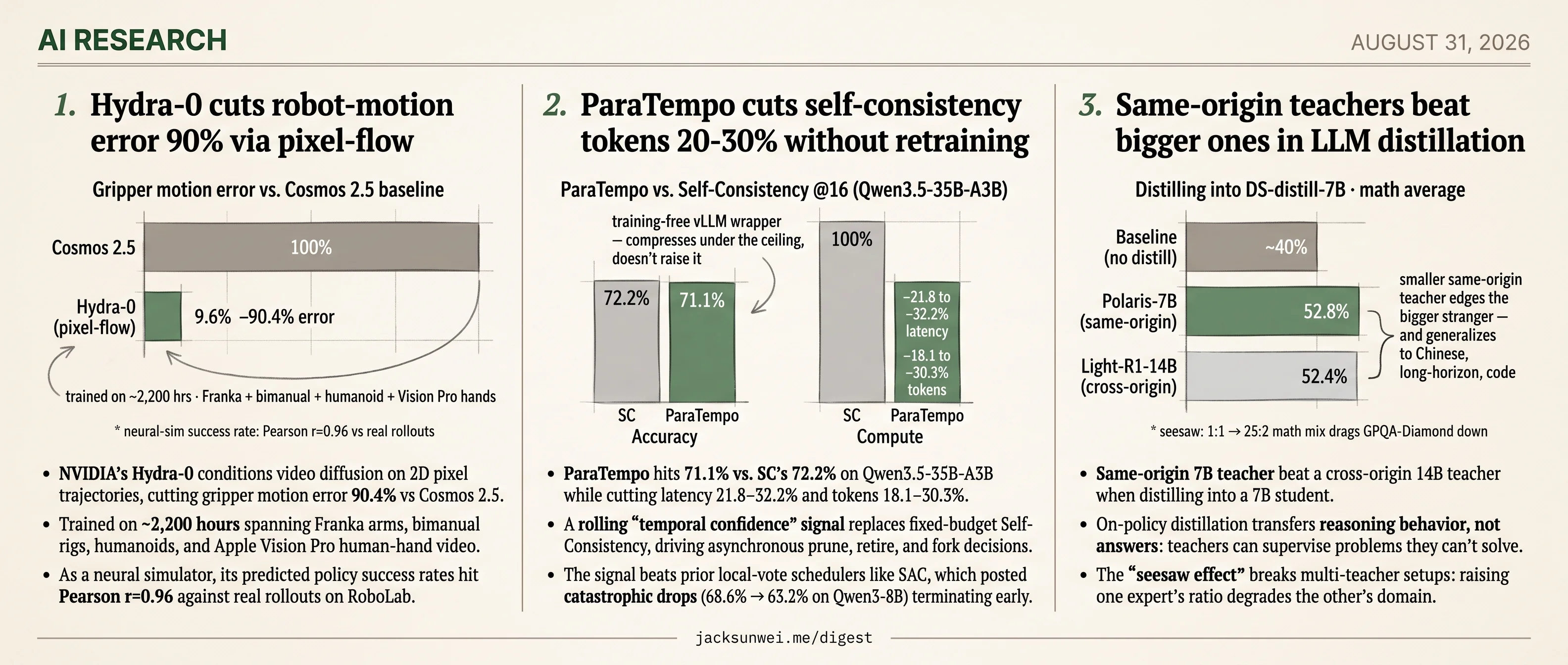
ParaTempo prunes 30%, same-origin teacher beats 14B, Hydra-0 cuts motion 90%
TL;DR
- NVIDIA’s Hydra-0 cuts gripper motion error 90.4% via 2D pixel-trajectory conditioning on Cosmos 2.5.
- ParaTempo matches Self-Consistency at 71.1% while cutting tokens 18-30% on Qwen3.5-35B.
- Same-origin 7B teacher beat a 14B cross-origin teacher when distilling into a 7B student.
- Prior scheduler SAC collapsed 68.6% to 63.2% on Qwen3-8B by terminating reasoning early.
- Hydra-0’s dataset and code remain unreleased weeks after the arXiv drop.
Three research features today, three headline numbers — 90.4%, 30%, 71.1% — and none of them come from a bigger backbone. NVIDIA’s Hydra-0 cuts robot gripper motion error 90.4% by conditioning video diffusion on 2D pixel trajectories rather than scaling the model. ParaTempo matches fixed-budget Self-Consistency accuracy while cutting tokens 20-30%, using a rolling temporal-confidence signal to prune, retire and fork branches in flight. And a distillation study finds a same-origin 7B teacher beats a cross-origin 14B teacher when training a 7B student — the origin match, not the parameter count, sets the ceiling.
The through-line: each win trades a scaling lever for a smarter signal — a conditioning input, a scheduling signal, or a teacher-student pairing. The room for gains today isn’t only in more parameters, and the briefs echo it: CLEAR routes a safety adapter via hidden-state gating, and a scaling-law recipe skips MoE hyperparameter sweeps entirely.
Hydra-0 cuts robot-motion error 90% via pixel-flow
Source: hf-daily-papers · published 2026-08-18
TL;DR
- NVIDIA’s Hydra-0 conditions video diffusion on 2D pixel trajectories, cutting gripper motion error 90.4% vs Cosmos 2.5.
- Trained on ~2,200 hours spanning Franka arms, bimanual rigs, humanoids, and Apple Vision Pro human-hand video.
- As a neural simulator, its predicted policy success rates hit Pearson r=0.96 against real rollouts on RoboLab.
- The dataset and code remain “coming soon” weeks after release, with no repo alongside the arXiv drop.
What “action flow” actually is
Hydra-0’s core trick is refusing to speak robot. Instead of conditioning on joint angles or 6D end-effector deltas, the model represents an action as a set of (u, v) pixel trajectories over an H-step horizon — where visible points on the robot and the manipulated object will move in the camera plane. SAM-2 masks split those tracks into “Embodiment” and “Object” channels, which is exactly the failure mode that sank earlier point-trajectory work: ATM’s Track Transformer beat video pre-training by ~80% across 130+ tasks but degraded under embodiment shift because it couldn’t decouple agent motion from object motion 1.
At deployment, candidate motor commands are rolled out in Isaac Lab, projected to 2D, and used as a C_motion condition concatenated with noisy video latents inside a Cosmos 2.5 or Wan2.2 DiT. LoRA (rank 32–64) does the adaptation; DMD2 distillation gets rollouts down to four denoising steps. An inverse mode inverts the whole thing: give it a desired object flow (e.g., a human folding a cloth), and a 2-layer MLP action head decodes DiT features into motor commands for a target robot.
The numbers that matter
Beyond the 90.4% gripper-error cut, Hydra-0 posts 60.16% lower object-motion error and reaches its performance plateau on six IWS tasks with only 20% of task-specific data — the multi-embodiment mid-training is doing real work. Visual fidelity from the Wan2.2 A14B 4-step variant lands at PSNR 21.84 / SSIM 0.830 / FVD 155.9. The r=0.96 correlation with reference success rates is the more consequential result: it means the model is usable as an open-loop evaluator, not just a pretty video generator.
Where it sits in the lineage
Two critiques loom. First, the backbone isn’t really the contribution — NVIDIA already ships Cosmos-Predict2.5-2B/robot/multiview post-trained on three-camera robot views with LoRA/DoRA recipes 2. Hydra-0 is the action-flow conditioning layer bolted on top. Second, 2D pixel flow inherits depth and contact ambiguity that a 3D representation avoids; 3DFlowAction argues object motion should be predicted in 3D space precisely for this reason 3. And in the broader world-model debate, V-JEPA 2 proponents call pixel generation a “compute-heavy luxury” versus latent prediction 4, while 1X’s 14B 1XWM takes ~11s per action — an order of magnitude slower than Hydra-0’s 4-step rollouts but a live competitor 4.
The asterisks
Data scaling is already moving past Hydra-0: Ego2Robot (also August 2026) synthesized 18,000+ hours across 15 morphologies from egocentric human video 5, dwarfing Hydra-0’s 2,200. And despite the “breaking embodiment silos” framing, community observers noted the multi-embodiment dataset was still marked “coming soon” weeks after release, with no code repo accompanying the arXiv drop 6. Until those artifacts land, Hydra-0 reads as a strong engineering synthesis — pixel-flow conditioning + Cosmos/Wan priors + PEFT — whose reference-vs-footnote fate depends on shipping.
ParaTempo cuts self-consistency tokens 20-30% without retraining
Source: hf-daily-papers · published 2026-08-17
TL;DR
- ParaTempo hits 71.1% vs. SC’s 72.2% on Qwen3.5-35B-A3B while cutting latency 21.8–32.2% and tokens 18.1–30.3%.
- A rolling “temporal confidence” signal replaces fixed-budget Self-Consistency, driving asynchronous prune, retire, and fork decisions.
- The signal beats prior local-vote schedulers like SAC, which posted catastrophic drops (68.6% → 63.2% on Qwen3-8B) terminating early.
- It’s a training-free vLLM wrapper, not a capability lift — a scheduler that compresses inference under the model’s ceiling, not one that raises it.
The signal: temporal confidence
The paper’s real contribution is a stability trick. Instead of trusting a single answer-forcing probe (“what would you answer right now?”) or token-level entropy, ParaTempo appends </think> Final answer: every 500 tokens, collects the top-$L$ answer distribution, and aggregates across a sliding window. Confidence is the exponentiated negative entropy of that aggregate — high only when recent probes have consistently and sharply agreed.
That averaging is what makes early termination safe. The authors show temporal confidence has meaningfully lower volatility than instantaneous probes, and that a high value at time $t$ statistically predicts the branch will hold the same answer to completion. Prior schedulers didn’t have this property, which is why SAC-style local convergence has been unreliable 7.
Around the signal sits a four-state controller (Active / Retired / Pruned / Forked). Branches that converge early stop decoding but keep voting; branches that flatline get killed; freed slots fork from a high-confidence “donor” prefix with a new seed to preserve diversity. Everything runs asynchronously — no width-wise barriers waiting for the slowest branch.
The numbers in context
The headline claim — within ~1 accuracy point of SC@16 at 20–30% less compute — only reads as a win against the right baseline. Against Parallel-Probe, ParaTempo is 3.8–3.9 points more accurate at comparable latency. Against SAC, it wins because forking reinvests the saved budget rather than just stopping.
But the adaptive-SC landscape has more aggressive options. SeerSC front-loads a “System 1” entropy probe before committing to a reasoning chain and reports 47% token and 43% latency reductions by skipping self-consistency entirely on easy queries 8 — roughly double ParaTempo’s savings, with a different accuracy profile. And ParaThinker takes the opposite approach: train the model for native parallel thought with control tokens, get +12.3% accuracy on 1.5B and +7.5% on 7B models at 7.1% latency overhead 9. ParaThinker raises the ceiling; ParaTempo compresses inference under it.
Reviewers have noted the framing directly: ParaTempo is “an inference-time scheduler [that] does not raise the underlying model’s capability ceiling,” and its accuracy is “competitive rather than lossless” 10.
Where it breaks down
The efficiency story leans on vLLM primitives that aren’t fully there. NVIDIA’s own analysis of tree-based branch pruning shows 1.4–1.6× speedups when things go well, but a net performance loss below ~50–60% acceptance rate 11 — plausibly the regime ParaTempo’s early-warmup branches occupy before its quantile threshold stabilizes. vLLM contributors are still openly requesting dynamic tree-topology support for related methods like EAGLE-3 12, which suggests the ragged-batch async scheduling ParaTempo requires isn’t a solved engine problem.
Add the paper’s own caveats — warmup calibration eats the first ~1,500 tokens, and pruning a “confused but recoverable” branch is a real failure mode adaptive forking only partially mitigates — and the honest read is: a well-designed signal, a middle-of-the-pack savings envelope, and a deployment story that depends on inference-engine work still in flight.
Same-origin teachers beat bigger ones in LLM distillation
Source: hf-daily-papers · published 2026-08-16
TL;DR
- Same-origin 7B teacher beat a cross-origin 14B teacher when distilling into a 7B student.
- On-policy distillation transfers reasoning behavior, not answers: teachers can supervise problems they can’t solve.
- The “seesaw effect” breaks multi-teacher setups: raising one expert’s ratio degrades the other’s domain.
- Independent work: distilled students lose self-correction tokens and pass@K versus the base model.
Behavior, not answers
“Every Coin Has Two Sides” makes an unusually mechanistic claim for a distillation paper: on-policy distillation (OPD) transfers a teacher’s policy — its reasoning shape — rather than solutions to specific problems. The evidence is that filtering training data by teacher difficulty (only-solved, only-unsolved, random) all converge to nearly identical final accuracies on English math. The teacher’s job is to shape how the student reasons on its own rollouts, not to hand it worked examples.
That framing fits the broader consensus forming around reverse-KL-on-student-rollouts as the default post-training primitive. Thinking Machines’ recipe — roughly ten lines of PyTorch — reportedly lets a 0.5B student match a 1.5B teacher at 9–30× less compute than RL 13. The mode-seeking property of reverse KL is why students “commit” to a teacher’s path instead of smearing probability mass, and it is why lineage matters so much.
Lineage beats size
The paper’s headline result is that when teacher and student share a base model (“same-origin”), gains generalize across languages (English→Chinese), reasoning horizons (short→long), and domains (math→code, math→science). When they don’t, transfer stays local.
| Student: DS-distill-7B | Baseline | Polaris-7B (same-origin) | Light-R1-14B (cross-origin) |
|---|---|---|---|
| Math average | ~40% | ~52.8% | ~52.4% |
The 14B cross-origin teacher has higher standalone accuracy but loses to the smaller same-origin teacher on the harder transfer axes — the authors report the same-origin pair brought the student “significantly closer to its own level” on Chinese and long-horizon math, though they don’t surface a headline number. For a 1.5B student, same-origin math-only training nearly matched code-specific training on LiveCodeBench — a strong cross-domain lift that vanishes when the teacher’s lineage doesn’t match 14.
The seesaw, and the blind spots
Same-origin’s reach is also its liability. Mixing a math expert (JustRL-1.5B) with a science/IF expert (Nemotron-1.5B) and routing prompts to the “correct” teacher does not isolate their effects: pushing math data from 1:1 to 25:2 dragged GPQA-Diamond down. The student’s policy shifts as a whole, so prompt-level routing cannot contain a teacher whose influence is policy-level 14.
Two independent critiques sharpen the “curse” side of the coin. Work summarized by bdtechtalks finds privileged-teacher supervision suppresses epistemic markers like “Wait” and “Let me recheck,” costing up to 40% on out-of-distribution problems 15 — precisely the self-correction habit long-horizon reasoning depends on. And an “illusory distillation” analysis reports that OPD students improve avg@K while their pass@K at large K falls below the base model: previously solvable hard problems become unsolvable as the student trades exploration for teacher-style shortcuts 16.
The paper’s insensitivity-to-difficulty claim also needs a footnote. PACED argues informative signal follows a p(1-p) bell curve around student competence, so both trivial and unreachable problems should be filtered — not that curriculum doesn’t matter, but that it matters symmetrically 17. And concurrent work shows scaled OPD data makes latent teacher traits more recoverable in the student, a subliminal inheritance that survives content filtering 18.
Takeaway
Lineage-first is a real, cheap heuristic: pick the same-family teacher over the bigger stranger. But the same mechanism that makes same-origin OPD broadly effective also propagates the teacher’s biases, refusal patterns, and shortcut habits as a policy-level shift — one the practitioner cannot localize by routing or filtering.
Round-ups
CLEAR routes a LoRA safety adapter via hidden-state gating
Source: hf-daily-papers
CLEAR tackles the safety-utility tradeoff in aligned LLMs by continuously modulating a low-rank safety adapter through a hidden-state gate. The conditional routing raises HarmBench safety scores on harmful prompts while leaving benign-input utility largely intact, unlike static LoRA merges that degrade helpfulness.
Two-step hyperparameter transfer skips sweeps for large MoE pretraining
Source: hf-daily-papers
A scaling-law framework predicts optimal learning rates for large Mixture-of-Experts models by extrapolating first across width using Maximal Update Parameterization, then across token budgets. The recipe covers Multi-head Latent Attention and the Muon optimizer, cutting pretraining compute otherwise spent on hyperparameter sweeps.
SparsePR speeds up video transformers with training-free sparse attention
Source: hf-daily-papers
SparsePR accelerates video generation and world-model transformers without retraining by pairing response-coupled partitioning with probe-fitted residual reconstruction. The method cuts attention-reconstruction error at low executed-pair densities, delivering substantial speedups over dense attention while keeping block-sparse execution friendly to existing video transformer stacks.
UniSpace unifies understanding, reconstruction and generation without a VAE
Source: hf-daily-papers
UniSpace reparameterizes a pretrained semantic ViT so a single visual space handles understanding, high-fidelity reconstruction and image generation, removing the usual separate VAE tokenizer. A reconstruction-aware patch embedding plus Mixture-of-Transformer-Experts lets one interface scale across multimodal tasks.
Daedalus-150M hybrid beats larger LMs on CPU with sparse attention
Source: hf-daily-papers
Daedalus-150M combines sparse attention blocks with short convolutions and 4-bit weights to target CPU inference. The 150M-parameter hybrid outperforms larger conventional transformers on bits-per-byte and downstream benchmarks despite training on far less data, while sustaining longer context under tight memory bandwidth.
Llama-Mobile squeezes 11B vision-language model to 3.7 GB at 2.7 bits
Source: hf-daily-papers
Llama-Mobile quantizes vision-language models for on-device use with a 2.7-bit-per-parameter format trained on self-generated data. Applied to Llama 3.2 11B Vision Instruct, it shrinks the model to 3.7 GB for Arm CPUs while preserving visual question answering accuracy.
LLM-agent social feeds converge in wording but not opinions
Source: hf-daily-papers
Stress tests of peer-voted feeds populated by synthetic LLM agents show rising TF-IDF lexical similarity across posts, but no reliable opinion capture or matched-exposure advantage for distributed sources. Block-bootstrap analysis held across model families, topics, and adversarial impression injections.
Footnotes
-
ATM: Any-point Trajectory Modeling (arXiv 2605.23856) — https://arxiv.org/html/2605.23856v1
↩ATM pre-trains a Track Transformer on unlabeled video to predict future paths of arbitrary points, outperforming video pre-training baselines by 80% on average across 130+ language-conditioned tasks; however, side-by-side comparisons show ATM degrades when training and testing embodiments differ significantly, as it struggles to decouple object motion from agent movement.
-
NVIDIA Cosmos-Predict/Transfer 2.5 blog (HuggingFace) — https://huggingface.co/blog/nvidia/cosmos-predict-and-transfer2-5
↩NVIDIA provides specialized robotic variants such as Cosmos-Predict2.5-2B/robot/multiview post-trained on three-camera robotic views; fine-tuning employs LoRA and DoRA adapters for viewpoint- or task-specific adaptation.
-
3DFlowAction GitHub (Hoyyyaard) — https://github.com/Hoyyyaard/3DFlowAction/
↩3DFlowAction uses a 3D flow world model that predicts the movement of objects rather than robot-specific joint angles… a universal language applicable to humans and diverse robot types alike.
-
Alignify world-model comparison — https://alignify.co/tools/world-model
↩ ↩21X’s proprietary 1XWM uses a 14B-parameter video diffusion backbone to ‘imagine’ a task before executing it, though inference can take roughly 11 seconds per action… V-JEPA 2 predicts outcomes in an abstract latent space rather than generating pixels, favored for efficiency because it ignores irrelevant visual details.
-
Ego2Robot summary (opentrain.ai) — https://www.opentrain.ai/papers/ego2robot-scalable-robot-data-synthesis-from-egocentric-human-data—arxiv-2608.02580/
↩Ego2Robot (August 2026) transforms egocentric human videos into robot training data across 15 different morphologies, producing over 18,000 hours of synthetic demonstrations.
-
Twitter/X — lead authors Hongyu Li & Soha Pouya (via twstalker) — https://ww.twstalker.com/YXWangBot
↩Lead researchers emphasized that breaking ‘embodiment silos’ is the critical unlock for scaling Physical AI… community observers noted a gap between the ‘open-source’ announcement and actual data availability; as of late August 2026, the full multi-embodiment dataset was still marked as ‘coming soon’.
-
ACL SRW 2026 paper (SCOUT benchmarking of adaptive SC) — https://aclanthology.org/2026.acl-srw.1.pdf
↩SAC … terminates paths upon local answer convergence before the final vote. While it reduces token counts, researchers have observed ‘catastrophic drops’ in accuracy (e.g., from 68.6% to 63.2% on Qwen3-8B) because local convergence doesn’t always align with global correctness.
-
OpenReview — SeerSC (advance budget estimation) — https://openreview.net/pdf/101680ffd9cbf0b6cabab20dc7ade1124eaeba60.pdf
↩SeerSC … uses a rapid ‘System 1’ pass to calculate answer entropy before committing to a full reasoning chain … reduces token consumption by up to 47% and latency by 43% by only applying heavy self-consistency checks to complex queries.
-
EmergentMind — ParaThinker framework overview — https://www.emergentmind.com/topics/parathinker-framework
↩ParaThinker reports accuracy gains of up to 12.3% on 1.5B models and 7.5% on 7B models across mathematical benchmarks like AIME and MATH-500 … with a modest 7.1% latency overhead by leveraging KV-cache reuse.
-
aimodeling.com technical review — https://www.aimodeling.com/en/news/slug/paratempo-temporal-confidence-parallel-reasoning
↩ParaTempo’s accuracy is described as ‘competitive’ rather than ‘lossless’ … it is an inference-time scheduler; it improves the efficiency of finding a solution but does not raise the underlying model’s capability ceiling.
-
NVIDIA Developer Blog — speculative decoding / tree attention — https://developer.nvidia.com/blog/an-introduction-to-speculative-decoding-for-reducing-latency-in-ai-inference/
↩Tree-based branch pruning in vLLM can yield a 1.4x to 1.6x speedup on models like Llama-3 … however, if the draft model’s acceptance rate falls below approximately 50-60%, the overhead of managing the speculative branches can actually lead to a net performance loss.
-
vLLM GitHub issue #18327 (dynamic tree topology) — https://github.com/vllm-project/vllm/issues/18327
↩Developers have pushed for more dynamic pruning capabilities, specifically requesting support for dynamic tree topology in methods like EAGLE-3 to adapt to varying prompt complexities.
-
Thinking Machines Lab blog (Kevin Lu) — https://thinkingmachines.ai/blog/on-policy-distillation/
↩A 0.5B parameter student matches a 1.5B teacher on math reasoning tasks while using 9–30x less compute than traditional RL, with the loss expressible in roughly ten lines of PyTorch as reverse-KL between student and teacher logits on student rollouts.
-
alphaXiv discussion of ‘Every Coin Has Two Sides’ (2608.16647) — https://www.alphaxiv.org/abs/2608.16647
↩ ↩2Origin compatibility gives developers a practical ‘lineage-first’ heuristic; the seesaw effect shows teacher influence in same-origin MOPD cannot be confined by prompt routing because the student’s policy is altered as a whole.
-
bdtechtalks — LLM self-distillation tradeoffs — https://bdtechtalks.com/2026/04/13/llm-self-distillation-tradeoffs/
↩Teachers using ‘privileged information’ to supervise students discourage the expression of uncertainty; suppression of epistemic markers like ‘Wait’ or ‘Let me recheck’ can cause performance drops of up to 40% on out-of-distribution problems.
-
arXiv 2607.15161 — ‘Illusory’ distillation analysis — https://arxiv.org/html/2607.15161v1
↩OPD-trained models show superior avg@K but their pass@K for large K often lags their pre-distillation base versions; previously solvable difficult problems become unsolvable, suggesting capability collapse in favor of teacher-style shortcuts.
-
PACED (ACL Findings 2026) — https://aclanthology.org/2026.findings-acl.335/
↩Signal-to-noise ratio follows a bell curve p(1-p) relative to student pass-rate and collapses at both 0% and 100% extremes — both easiest and hardest data should be filtered simultaneously, contradicting classical easy-to-hard curriculum learning.
-
alphaXiv commentary on 2608.19408 (concurrent work) — https://www.alphaxiv.org/abs/2608.19408
↩Scaling model-generated distillation data can make latent teacher traits more recoverable — subliminal inheritance of behaviors that survive explicit data filtering.