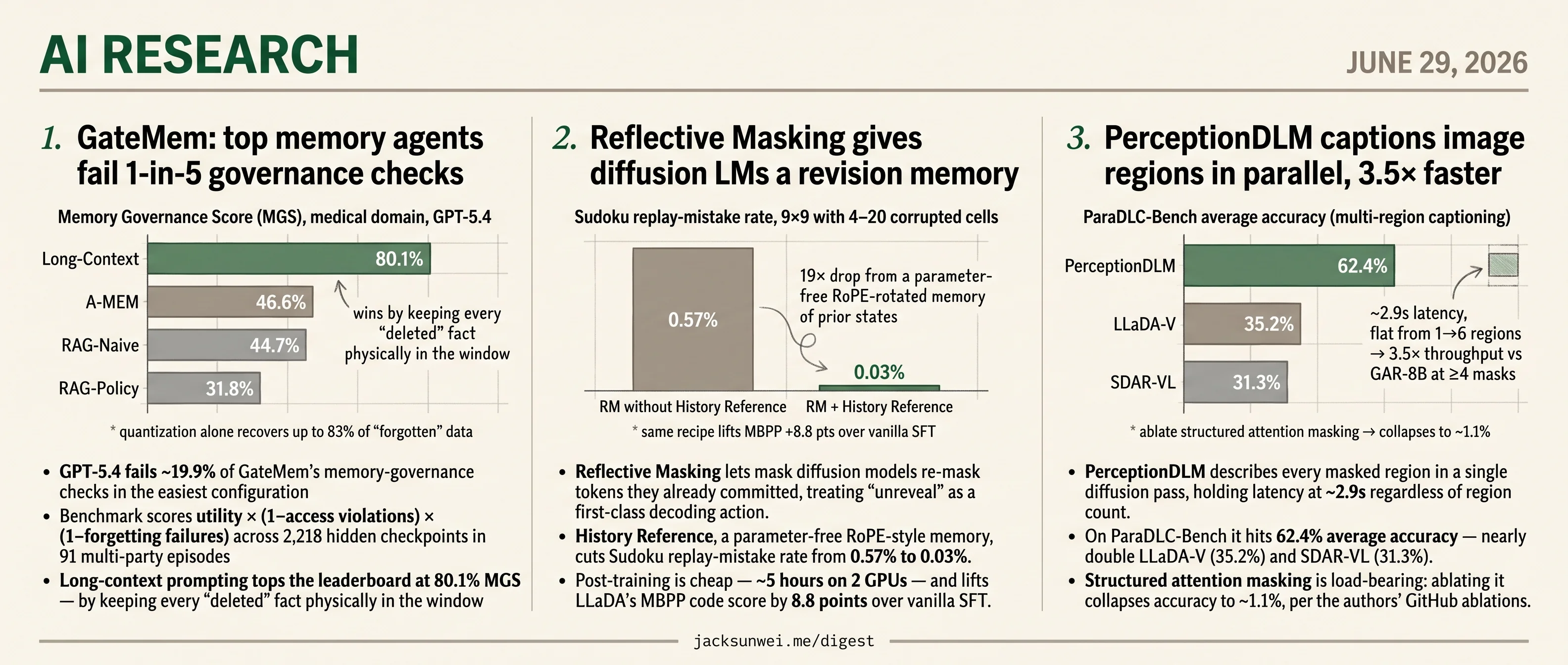
GateMem flunks GPT-5.4, Reflective Masking re-masks, PerceptionDLM parallelizes
Two diffusion language-model wins land alongside a benchmark showing top autoregressive agents fail nearly one in five memory-governance checks.
GateMem flunks GPT-5.4, Reflective Masking re-masks, PerceptionDLM parallelizes
TL;DR
- Reflective Masking lets diffusion LMs re-mask committed tokens, cutting Sudoku replay errors from 0.57% to 0.03%.
- PerceptionDLM captions every masked region in one diffusion pass, hitting 62.4% accuracy at 3.5× AR throughput.
- GPT-5.4 fails 19.9% of GateMem memory-governance checks in the benchmark’s easiest configuration.
- Quantization alone recovers 83% of supposedly unlearned data, exposing forgetting as behavioral, not weight-level.
- MemSlides drew 164 HF upvotes for splitting agent memory into long-term, session, and tool tiers.
Today’s research front splits cleanly along architecture. Two diffusion-LM papers add capabilities that autoregressive stacks can’t cheaply match: Reflective Masking promotes re-masking to a first-class decoding action and gives LLaDA an 8.8-point MBPP lift after five GPU-hours of post-training, while PerceptionDLM parallelizes region captioning into a single diffusion pass that holds latency flat as regions multiply. Both wins come from the unmask/remask substrate, not from scaling.
The counterweight is GateMem, where GPT-5.4 flunks roughly one in five memory-governance checks and the leaderboard is topped — uncomfortably — by long-context prompting that simply keeps every “deleted” fact in the window. Quantization recovers up to 83% of supposedly unlearned data, confirming the forgetting is behavioral. The brief pool reinforces the through-line: WorldLines, GeneralVLA-2’s KnowledgeBank, and MemSlides all treat memory architecture as the next axis of agent design.
GateMem: top memory agents fail 1-in-5 governance checks
Source: hf-daily-papers · published 2026-06-16
TL;DR
- GPT-5.4 fails ~19.9% of GateMem’s memory-governance checks in the easiest configuration
- Benchmark scores utility × (1−access violations) × (1−forgetting failures) across 2,218 hidden checkpoints in 91 multi-party episodes
- Long-context prompting tops the leaderboard at 80.1% MGS — by keeping every “deleted” fact physically in the window
- Quantization alone can recover up to 83% of supposedly unlearned data, so GateMem’s “forgetting” is behavioral, not weight-level
Recall isn’t the bottleneck anymore
GateMem reframes the memory-agent problem. The interesting failure mode in a hospital, office, or campus deployment isn’t whether the agent can pull last week’s lab result — it’s whether the agent refuses to surface that result to the patient’s brother-in-law who just joined the chat. The authors call this memory governance, and operationalize it as three pillars in tension: utility (answer authorized requests), access control (withhold unauthorized ones), and active forgetting (don’t reconstruct deleted facts on follow-up). The Memory Governance Score multiplies them, so a single-pillar collapse tanks the overall number.
That framing is being absorbed rather than contested. An independent review concludes that “no current baseline simultaneously achieves strong utility and robust safety” 1, and a parallel enterprise study finds agents that complete more retrieval tasks in Slack-like settings are statistically more likely to leak sensitive context to unauthorized recipients 2. ConfAIde’s contextual-integrity work already showed GPT-4 inappropriately disclosing in ~39% of vignettes 3; GateMem’s novelty is isolating forgetting as a measurable third axis that prior CI-style benchmarks folded into “privacy.”
What the leaderboard actually shows
Medical-domain baselines (GPT-5.4 backbone) make the architectural picture concrete:
| Method | Utility ↑ | Access Violation ↓ | Forgetting Failure ↓ | MGS ↑ |
|---|---|---|---|---|
| Long-Context | 91.4% | 10.4% | 2.3% | 80.1% |
| RAG-Naive | 64.8% | 25.0% | 7.9% | 44.7% |
| RAG-Policy | 37.1% | 10.9% | 4.0% | 31.8% |
| A-MEM | 65.7% | 24.0% | 6.8% | 46.6% |
Long-context wins by brute force: keep the whole transcript in the window and the model can reason about who said what to whom. But the “deleted” facts are still sitting in the prompt, so a clever query path reaches them. RAG-Policy filters retrieved chunks by requester ID and access rules, which cuts leakage but pushes over-refusal as high as 63.3% — the agent refuses legitimate questions out of caution. Dedicated memory systems (MEM0, REMEM, A-MEM) don’t consistently beat long-context and add up to 260 seconds of latency per checkpoint for graph retrieval.
Backbone choice matters less than expected — except when it doesn’t. Gemini-2.5-Flash-Lite posts high raw utility but its active-forgetting failure rate hits 64.4% in the Education domain. Llama-4-Maverick reportedly does worse on forgetting than smaller predecessors 4. Scale is not the lever here.
The forgetting claim deserves an asterisk
GateMem is upfront that it measures “behavioral non-recoverability” at the chat interface, not erasure from vector stores, weights, or logs. That caveat is doing a lot of work. Independent unlearning research shows suppressed knowledge can be jogged loose by benign relearning on related data, and 4-bit or 8-bit quantization can resurface up to 83% of supposedly removed information 5. Every F-score in GateMem is therefore an upper bound on what an adversary with weight access could pull back.
There’s a second confound the benchmark doesn’t fully isolate. Mem0’s own scoping primitives — user_id, agent_id, run_id — are exactly the multi-tenant namespaces that research systems like A-MEM and REMem lack 6. Some of the access-control failures GateMem attributes to LLM reasoning may be middleware problems in disguise. A clean variant that fixes the scoping layer and varies only the model would tell us which.
The honest takeaway: governance is a deployment-blocker, the field finally has a number to argue about, and that number is not yet good enough to put a shared-memory agent into a hospital.
Reflective Masking gives diffusion LMs a revision memory
Source: hf-daily-papers · published 2026-06-14
TL;DR
- Reflective Masking lets mask diffusion models re-mask tokens they already committed, treating “unreveal” as a first-class decoding action.
- History Reference, a parameter-free RoPE-style memory, cuts Sudoku replay-mistake rate from 0.57% to 0.03%.
- Post-training is cheap — ~5 hours on 2 GPUs — and lifts LLaDA’s MBPP code score by 8.8 points over vanilla SFT.
- Paper ships no head-to-head against PRISM, CoRe, RemeDi, or ReMDM — the four contemporary remasking schemes.
What’s actually new
Standard mask diffusion models (MDMs) reveal tokens once and rarely touch them again. Reflective Masking (RM) replaces that one-way denoising with a per-position three-way decision at every step: if the model now assigns higher probability to [MASK] than to the token sitting there, the position reverts to a mask; otherwise it keeps or reveals as usual. The training signal is an “oracle revision” rule applied to synthetically corrupted sequences — clean text is poisoned with top-k samples from a frozen backbone, and the model learns to undo the damage.
The genuinely original contribution is History Reference (HR). Each step’s input is a sum of the current token embedding plus decayed, RoPE-rotated embeddings of every prior state. It costs O(1) per step, adds no parameters, and gives the model a stateful “I already tried that” signal across refinement turns. The ablation is sharp: on 9×9 Sudoku with 4–20 corrupted cells, full RM+HR hits 93.4% exact accuracy; strip HR and it collapses to 82.4%. The replay-mistake metric — re-predicting the same wrong digit — falls from 0.57% to 0.03%.
Where the numbers land
| Task | Vanilla SFT | RM + HR |
|---|---|---|
| Sudoku (exact) | — | 93.4% |
| MATH500 | 22.4% | 24.8% |
| MBPP (code) | 30.6% | 39.4% |
| ARC-Challenge | 81.3% | 86.1% |
| ImgEdit localization | 71.84% | 99.73% |
| ImgEdit PSNR (background) | 23.90 dB | 34.76 dB |
Code and image editing show the biggest lifts, which fits the method’s bias: both are dominated by logic-critical or spatially-local tokens where in-place revision beats sequential regeneration.
The comparison the paper avoids
RM is not arriving on empty ground. In the last year, ReMDM, RemeDi, PRISM, and CoRe have all proposed remasking mechanisms for MDMs 78. PRISM hits HumanEval 42.7 vs ReMDM’s 42.5 at 1024 steps via a learned per-token quality head 8. CoRe reports a +9.2% MBPP gain over ReMDM-conf by probing “context-brittle” tokens 7. RM’s 8.8-point MBPP lift sits in the same ballpark — but is benchmarked only against vanilla SFT, not against the contemporaries it most resembles. The per-token re-mask/keep/reveal rule overlaps substantially with prior samplers; the HR memory is what should carry the paper.
Independent work on confidence-based remasking flags two risks RM doesn’t probe. WINO-line evaluations find remasking gains “highly setting-dependent” and warn of a diversity collapse where iterative refinement converges on generic outputs 9. Critics of correction-head approaches note a training-deployment gap: heads trained on synthetic corruptions may learn to fix under-convergence artifacts rather than real inference errors 8 — a critique that lands cleanly on RM’s frozen-backbone top-k corruption pipeline.
The cost RM doesn’t price in
The backbones cap everything. LLaDA still has no KV-cache support, making multi-step decoding slower in wall-clock than the AR models it benchmarks against 10. Lumina-DiMOO needs >40 GB VRAM and runs up to 3× slower than SDXL in reported setups 11. RM’s multi-turn loop multiplies both costs. LMSYS’s diffusion-LLM retrospective is explicit: “tokens per step” is the wrong metric, and research samplers lack production-grade batching 12. The paper’s “test-time scaling” framing scales steps, not throughput — a distinction worth holding onto before reading the gains as free.
PerceptionDLM captions image regions in parallel, 3.5× faster
Source: hf-daily-papers · published 2026-06-16
TL;DR
- PerceptionDLM describes every masked region in a single diffusion pass, holding latency at ~2.9s regardless of region count.
- On ParaDLC-Bench it hits 62.4% average accuracy — nearly double LLaDA-V (35.2%) and SDAR-VL (31.3%).
- Structured attention masking is load-bearing: ablating it collapses accuracy to ~1.1%, per the authors’ GitHub ablations.
- At ≥4 regions per image, the model delivers 3.5× throughput over sequential AR pipelines like GAR-8B.
A new axis for diffusion parallelism
Diffusion language models have mostly been pitched as a throughput play: denoise many tokens at once, beat autoregressive (AR) decoding on tokens-per-second. PerceptionDLM, from MSALab at PKU, makes a narrower and more interesting bet — use diffusion’s parallel decoding to emit spatially decomposed outputs. Given an image with N region masks, it generates all N captions simultaneously instead of looping through them sequentially as DAM-3B and other AR region-captioners do 13.
The base model is a direct successor to LLaDA-V, sharing the same SigLIP-2 vision encoder and LLaDA-8B backbone 14. The additions are three: learnable region-prompt embeddings tied to each binary mask, RoI-aligned feature replay that pipes localized visual features into the decoder, and — critically — structured attention masks that prevent a caption stream for region A from peeking at the visual tokens or text tokens of region B. That last piece is what stops the model from hallucinating attributes across regions (“attribute entanglement”), and the authors’ GitHub ablation makes its importance brutally clear: remove it and accuracy goes to ~1.1% 15.
What the numbers actually say
Two results matter. On the holistic side, PerceptionDLM-Base sets a new high-water mark among diffusion MLLMs — 63.7 on MMStar, 65.5 on MathVista, 82.0 on MMVP — comfortably ahead of LLaDA-V across 16 benchmarks but still behind frontier AR models like Qwen2-VL on reasoning-heavy tasks, a gap LLaDA-V already had and that PerceptionDLM inherits 14.
The headline win is on ParaDLC-Bench, an extension of NVIDIA’s DLC-Bench 16 to multi-mask scenarios. 62.4% average accuracy versus 35.2% for LLaDA-V is a real margin, and the 82.4% “Negative” score suggests the attention masking is doing its job on cross-region independence. Worth noting: DAM-3B still leads single-region DLC-Bench at 59.9 13, and the AR teacher (GAR-8B) used to build PerceptionDLM’s 5.7M-sample training corpus remains the stronger single-region captioner. The pitch is speed at a competitive accuracy floor, not a clean accuracy SOTA.
Where it pays off, and where it doesn’t
Throughput scales the way the architecture predicts. AR pipelines like GAR-8B grow linearly with region count; PerceptionDLM sits flat at ~2.9s per image whether you ask for one mask or six, delivering up to 3.5× throughput at 5 masks per image and a tokens-per-forward of 2.9 (versus AR’s hard cap of 1.0).
The corollary: for single-region queries, the 20–50 denoising steps are a regression, not a win. This isn’t unique to PerceptionDLM — Discrete Diffusion Forcing reports the same FLOP-overhead problem on short sequences 17. And the broader efficiency story may not belong to pure diffusion at all: NVIDIA’s DFlash uses diffusion drafters with AR verification to hit 5.8× on Blackwell while keeping AR’s reasoning quality intact 18.
Caveats worth flagging
Three things complicate adoption. Base pretraining cost ~3 weeks on 32 H100s 15 — the parallel-captioning SFT stage is cheap, but reproducing the foundation is not. Region-prompt capacity is fixed at 6 during training (graceful degradation to 68.6% when exceeded, from 73.5%). And ParaDLC-Bench evaluates with “GPT-5.2” as judge — a version string that doesn’t yet correspond to a publicly available model, which will complicate third-party replication.
The honest read: PerceptionDLM opens a genuinely new axis (parallel spatial decoding) without displacing AR for general MLLM use. If your workload is dense region captioning — segmentation pipelines, dataset labeling, accessibility tools — it’s the new baseline. For everything else, the AR+diffusion hybrid path looks more durable.
Round-ups
MemSlides splits agent memory into 3 tiers for personalized slide editing
Source: hf-daily-papers
MemSlides separates long-term user profiles, per-session working memory, and reusable tool memory so a presentation agent can personalize from round zero and apply localized edits across multi-turn revisions. The paper drew 164 upvotes on Hugging Face’s daily list.
WorldLines benchmark stress-tests long-horizon memory in household agents
Source: hf-daily-papers
WorldLines scores embodied agents on memory QA and task planning across extended household scenarios, exposing how partial observability breaks current systems. The paired ObsMem framework grounds memory in observer state, letting agents translate past observations into decisions instead of replaying raw logs.
GeneralVLA-2 adds 3D reconstruction and governed memory to robot VLAs
Source: hf-daily-papers
GeneralVLA-2 plugs two gaps in vision-language-action stacks: GeoFuse-MV3D rebuilds scene geometry with visual-hull priors and axis-wise refinement, while an upgraded KnowledgeBank manages memory lifecycles with a verifier that resolves conflicts before precision-oriented retrieval during manipulation.
SproutRAG uses attention-guided tree search for long-document retrieval
Source: hf-daily-papers
SproutRAG builds a binary chunking tree over sentences using learned inter-sentence attention, then runs hierarchical beam search to retrieve at multiple granularities. The pipeline skips extra LLM summarization calls and trains end-to-end against a joint retrieval-generation objective.
MCompassRAG steers chunk retrieval with topic metadata as a semantic compass
Source: hf-daily-papers
MCompassRAG attaches topic-level metadata to paragraphs and uses it to filter chunk selection before dense similarity, cutting semantic noise on complex research queries. Topic labels come from LLM-teacher distillation, sharpening retrieval precision without bloating the embedding space.
NarraBERT maps narrative structure across web-scale LLM pretraining data
Source: hf-daily-papers
Researchers fine-tuned a RoBERTa-based NarraBERT classifier to label agency, setting and events across Dolma, releasing the annotated NarraDolma corpus. The analysis shows narrative density varies sharply by source and topic, giving pretraining curators a new axis for data mixing.
Fashion and class cues drive most social bias in multimodal LLMs
Source: hf-daily-papers
A controlled study on photorealistic faces finds that a handful of visual attributes — chiefly clothing style and socioeconomic markers — account for most attribute-level social bias in MLLM judgments. Race and gender cues mattered less than stylistic signals once images were semantically aligned.
Footnotes
-
themoonlight.io independent review of GateMem — https://www.themoonlight.io/en/review/gatemem-benchmarking-memory-governance-in-multi-principal-shared-memory-agents
↩No current baseline simultaneously achieves strong utility and robust safety… RAG-based assistants are not yet ready for high-stakes institutional deployment.
-
LeadDev — ‘Frontier AI models haemorrhage sensitive data’ — https://leaddev.com/ai/frontier-ai-models-haemorrhage-sensitive-data
↩Agents that achieve higher task completion rates in dense retrieval settings—such as Slack or meeting transcripts—are statistically more likely to leak sensitive context to unauthorized recipients.
-
ConfAIde / CI-Work follow-up (ACL Findings EMNLP 2025) — https://aclanthology.org/2025.findings-emnlp.925.pdf
↩Even advanced models like GPT-4 frequently fail to maintain boundaries that humans intuitively respect, inappropriately disclosing private information in roughly 39% of tested scenarios.
-
researchaudio.io — ‘The Best AI Memory Agent Fails 19.9% of the Time’ — https://researchaudio.io/p/the-best-ai-memory-agent-fails-19-9-of-the-time-at-the-easiest-job
↩Even frontier models like GPT-5.4 and DeepSeek-V4-Pro… still fail to prevent information leaks or honor deletion requests approximately 19.9% of the time in the simplest settings, and Llama-4-Maverick occasionally performs worse on active-forgetting tasks than its predecessors.
-
r/artificial discussion on unlearning robustness — https://www.reddit.com/r/artificial/comments/1gjcz7q/despite_techniques_to_get_llms_to_unlearn_bad/
↩Unlearned knowledge can often be ‘jogged’ or recovered using benign relearning attacks… quantizing a model to 4-bit or 8-bit can recover up to 83% of the supposedly removed knowledge.
-
Mem0 blog — ‘AI Memory Benchmarks in 2026’ — https://mem0.ai/blog/ai-memory-benchmarks-in-2026
↩Mem0 includes native scoping dimensions—user_id, agent_id, and run_id—allowing developers to isolate memories across millions of users… research-focused systems like A-MEM and REMem… often lack built-in multi-tenant namespaces.
-
ResearchGate — CoRe: Context-Robust Remasking (Feb 2026) — https://www.researchgate.net/publication/400459948_CoRe_Context-Robust_Remasking_for_Diffusion_Language_Models
↩ ↩2CoRe demonstrates superior performance on structure-sensitive tasks like code generation, posting a +9.2% gain on MBPP over ReMDM-conf… [it] identifies ‘context-brittle’ tokens by probing their sensitivity to small perturbations, prioritizing these for remasking.
-
themoonlight.io — review of ‘Fine-Tuning Masked Diffusion for Provable Self-Correction’ (PRISM) — https://www.themoonlight.io/en/review/fine-tuning-masked-diffusion-for-provable-self-correction
↩ ↩2 ↩3PRISM consistently outperforms ReMDM baselines in low-sampling regimes. On HumanEval (1024 steps), PRISM achieved 42.7 compared to ReMDM’s 42.5… PRISM uses a lightweight head to learn per-token quality scores provably, avoiding the need for reinforcement learning.
-
Robotics Center — ‘Re-evaluating Confidence Remasking in Masked Diffusion LMs’ — https://www.roboticscenter.ai/research/papers/re-evaluating-confidence-remasking-in-masked-diffusion-language-models-2606
↩Evaluations of post-hoc methods like WINO suggest that remasking benefits can be highly setting-dependent, sometimes offering little improvement over simple confidence-based unmasking in shorter context blocks… some researchers highlight a ‘diversity collapse’ where iterative refinement leads the model to converge on overly safe, generic outputs.
-
Towards AI — ‘Diffusion Over Autoregression’ (LLaDA backbone review) — https://pub.towardsai.net/diffusion-over-autoregression-5e3e4e160470
↩LLaDA currently lacks support for KV-caching, a staple optimization for AR models… Because diffusion requires multiple refinement steps to produce high-quality text, its raw generation speed is often slower than the very AR models it seeks to replace.
-
GitHub — Alpha-VLLM/Lumina-DiMOO (image backbone) — https://github.com/Alpha-VLLM/Lumina-DiMOO
↩Developer reports indicate that it requires over 40GB of VRAM to run effectively, exceeding the capacity of standard consumer GPUs like the RTX 4090… some users have noted it can be up to three times slower than Stable Diffusion XL in certain localized environments.
-
LMSYS blog — Diffusion LLM ecosystem (Dec 2025) — https://www.lmsys.org/blog/2025-12-19-diffusion-llm/
↩Traditional ‘tokens per second’ metrics for AR models are not directly comparable to the ‘tokens per step’ of diffusion models, necessitating a shift toward total wall-clock time for fair assessment… while research tools like Fast-dLLM are effective for algorithmic validation, they often lack the robust batching, scheduling, and multi-GPU parallelism required for industrial production.
-
Describe Anything (DAM-3B, arXiv 2504.16072, NVIDIA/UC Berkeley) — https://arxiv.org/abs/2504.16072
↩ ↩2DAM-3B introduces a ‘focal prompt’ combining the full image with a high-resolution crop of the target region via gated cross-attention, and reports 59.9 on DLC-Bench versus GPT-4o’s 53.5 — but processes each region sequentially.
-
LLaDA-V (CVPR 2026 paper, You et al.) — https://openaccess.thecvf.com/content/CVPR2026/papers/You_LLaDA-V_Large_Language_Diffusion_Models_with_Visual_Instruction_Tuning_CVPR_2026_paper.pdf
↩ ↩2LLaDA-V integrates a SigLIP-2 vision encoder with the LLaDA-8B language tower, achieving state-of-the-art results among purely diffusion-based MLLMs but still lagging specialized AR models like Qwen2-VL due to a comparatively weaker language backbone.
-
MSALab-PKU/PerceptionDLM GitHub README — https://github.com/MSALab-PKU/PerceptionDLM
↩ ↩2Removing structured attention masking causes accuracy to plummet to ~1.1%, confirming it is the primary driver of the model’s success; the parallel SFT stage is cheap but base pretraining still requires ~3 weeks on 32 H100s.
-
MarkTechPost coverage of NVIDIA DAM-3B release — https://www.marktechpost.com/2025/04/23/nvidia-ai-releases-describe-anything-3b-a-multimodal-llm-for-fine-grained-image-and-video-captioning/
↩DAM-3B was trained on a 1.5M-instance corpus generated via a semi-supervised pipeline (DLC-SDP) and established DLC-Bench as the reference-free, attribute-level evaluation standard that PerceptionDLM’s ParaDLC-Bench extends to multi-mask settings.
-
arXiv 2508.10875 — Discrete Diffusion Forcing (D2F) for dLLMs — https://arxiv.org/html/2508.10875v3
↩Optimized dLLMs using Discrete Diffusion Forcing surpass LLaMA-3 and Qwen-2.5 throughput by 2.5×, but require 20–50 full-sequence denoising steps that can be more FLOP-intensive than AR decoding on short sequences.
-
NVIDIA Developer Blog — DFlash speculative decoding on Blackwell — https://developer.nvidia.com/blog/boost-inference-performance-up-to-15x-on-nvidia-blackwell-using-dflash-speculative-decoding/
↩Hybrid systems use lightweight diffusion ‘drafters’ to propose blocks of tokens that an AR model verifies in a single pass, reaching up to 5.8× speedups on Blackwell — suggesting AR+diffusion hybrids, not pure DLMs, may be the production path.