Anthropic's June AEI reads as a Claude product report, not a labor study
Anthropic's June AEI headlines workforce effects, but each load-bearing number tracks Claude quotas, mirroring, and interface autonomy instead.
Anthropic’s June AEI reads as a Claude product report, not a labor study
TL;DR
- Anthropic’s June AEI headlines a labor-market read on Claude usage patterns.
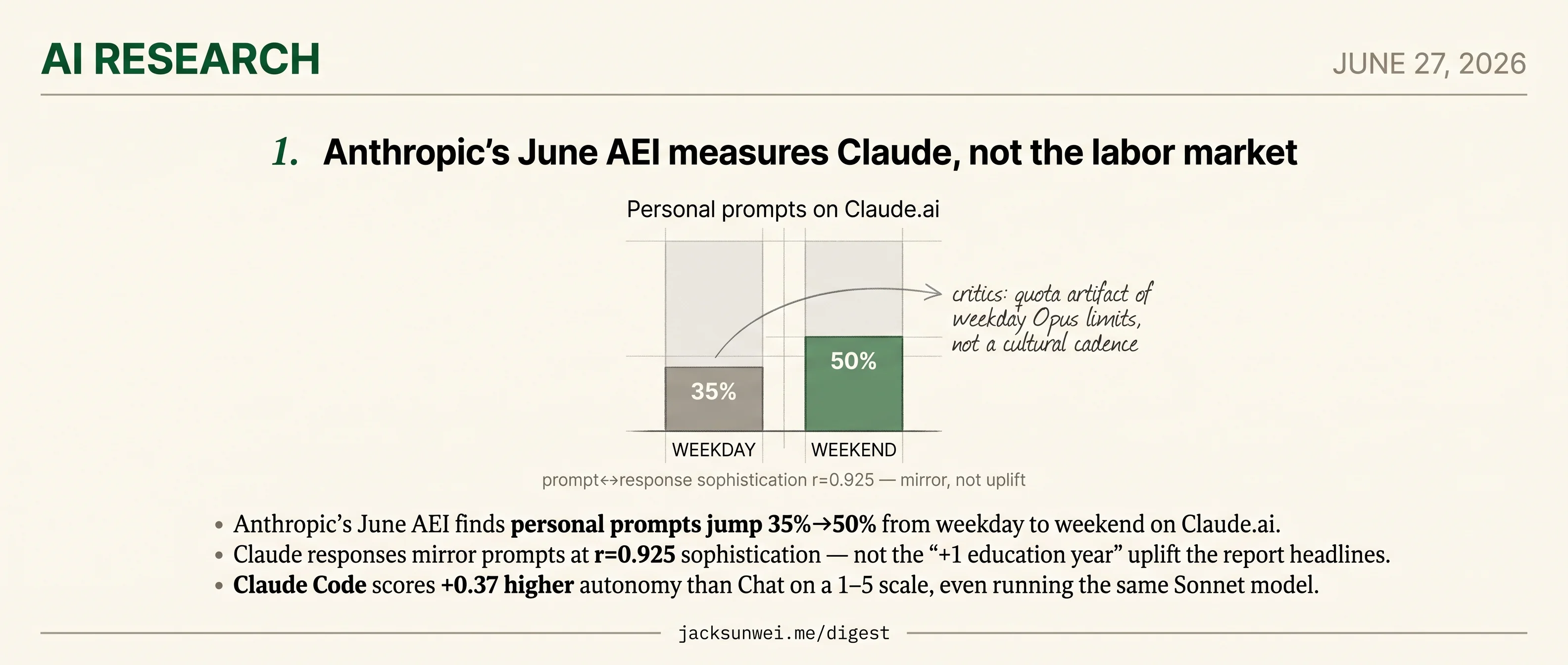
- Personal prompts jump from 35% on weekdays to 50% on weekends.
- Claude responses mirror prompt sophistication at r=0.925, not adding an education year.
- Claude Code scores +0.37 higher autonomy than Chat running identical Sonnet weights.
- Critics read the weekend spike as an Opus quota artifact, not cultural cadence.
Today’s lone research lead is Anthropic’s June Anthropic Economic Index, and the gap between what it claims to measure and what its numbers actually track is the whole story. The report frames itself as a window onto how AI is reshaping work — education uplift, personal-vs-professional cadence, agent autonomy in the wild. But each headline figure, on inspection, is a measurement of Claude: how its weekly quotas shape weekend behavior, how its outputs mirror the prompts they’re given, how the Code interface scores differently from Chat even when both run the same Sonnet weights.
That’s not a small caveat. The r=0.925 mirroring correlation undercuts the “+1 year of education” framing the report leads with, and the quota-artifact reading of the weekend spike turns a “cultural cadence” claim into a billing-page observation. Read as a labor study, the AEI overreaches. Read as a Claude product report — surface behavior, interface effects, quota-driven usage shifts — it’s a useful internal document the rest of us happen to get to see.
Anthropic’s June AEI measures Claude, not the labor market
Source: anthropic-research · published 2026-06-26
TL;DR
- Anthropic’s June AEI finds personal prompts jump 35%→50% from weekday to weekend on Claude.ai.
- Claude responses mirror prompts at r=0.925 sophistication — not the “+1 education year” uplift the report headlines.
- Claude Code scores +0.37 higher autonomy than Chat on a 1–5 scale, even running the same Sonnet model.
- Critics read the weekend spike as a quota artifact of weekday Opus limits, not a cultural cadence.
What the “Cadences” report actually measures
The June 2026 Anthropic Economic Index uses hourly telemetry to argue that AI usage has acquired a workweek rhythm: business correspondence clusters at 10–11am, recipe queries spike at 6pm, US tax requests run 8× normal around April 15. Anthropic classifies 93% of conversations as producing an “artifact” — most often an explanation (17%), document (15%), or piece of guidance (11%) — and finds that tasks mapped to higher-wage occupations consume roughly 2.07× more tokens than bottom-tercile tasks, which the report frames as compute-as-value-proxy.
The product story is sharper than the labor story. Claude Code sessions are 54% Opus vs. 10% on Chat/Cowork, and users delegate noticeably more autonomy to Code than to Chat. Crucially, that autonomy gap persists when the underlying model is held constant: Sonnet-in-Code beats Sonnet-in-Chat. Adnan Masood’s “loop engineering” essay reads this as evidence that the meaningful variable is the harness — when an agent stops, verifies, or escalates — rather than the model or the delegation appetite of users 1.
The headline numbers are endogenous to the product
Three of the report’s quotable findings look weaker once you read them against the prior cut and outside commentary.
First, the sophistication gap. Anthropic says Claude’s responses sit roughly one education-year above user prompts. The underlying study, written up by Towards Data Science, gives the load-bearing statistic: a 0.925 correlation between prompt and response sophistication 2. That is near-perfect mirroring with a small constant offset, not Claude pulling users up a rung. The gap widens to +1.7–2.6 years in technical fields because the prompts there are already at the ceiling of what Claude will match.
Second, the weekend personal-use spike. The March 2026 AEI already showed serious technical work migrating off Claude.ai onto the API — computer/math tasks up 14% on API, down 18% on chat, with the top-10 task share thinning from 24% to 19% 3. Cadences is sampling a chat surface that is steadily shedding its technical workload, which mechanically inflates the personal-use share. Practitioners on r/artificial add a simpler explanation: weekday Opus quotas push token-heavy hobby projects into Saturday 4.
Third, the automation optimism paradox. Users who delegate most to Claude are most bullish about their pay and job security. Kulkarni’s econforeverybody reframes this as a “Broken Ladder”: senior workers thrive by delegating away the entry-level tasks that juniors needed to become seniors in the first place 5. Built In notes the macro check on the displacement narrative — federal labor data still shows no statistically significant AI-attributable unemployment signal 6.
What survives
The longitudinal series itself is the durable contribution; nobody else publishes hourly first-party usage telemetry at this scale 3. The artifact taxonomy and the Claude Code autonomy gap are genuinely new. But “AI lifts users a year” and “delegators are optimists” are the wrong shapes to lift out of this dataset — the first is a mirror, the second is a survivorship story told by the 12%-women, Claude-paying slice of the workforce that opted into the survey.
Footnotes
-
Adnan Masood, Medium — ‘Loop Engineering’ essay — https://medium.com/@adnanmasood/loop-engineering-a-guide-for-engineers-and-practitioners-893bb65ea943
↩the real bottleneck has moved from ‘prompt engineering’ to ‘loop engineering’ — the design of control systems that decide when an agent should quit or seek human verification
-
Towards Data Science — analysis of the sophistication study — https://towardsdatascience.com/the-sophistication-of-your-prompt-correlates-almost-perfectly-with-the-sophistication-of-the-response-anthropic-study-found/
↩a near-perfect correlation (r = 0.925) between the estimated years of education required to understand a user’s prompt and those required to understand Claude’s response
-
Anthropic Economic Index — March 2026 report (prior cadence) — https://www.anthropic.com/research/economic-index-march-2026-report
↩ ↩2Between August 2025 and February 2026, computer and mathematical tasks on the API rose by 14%, while dropping by 18% on the consumer interface; the top-10 task share fell from 24% to 19%.
-
r/artificial discussion of the 35% personal-use finding — https://www.reddit.com/r/artificial/comments/1ugaq5b/anthropic_just_published_data_showing_35_of_their/
↩commenters argue the ‘50% personal use’ figure is partly a result of strict weekday usage quotas that force users to save more complex, token-heavy personal tasks for the weekend
-
Econforeverybody (Ashish Kulkarni) — ‘Learning to Learn with AI’ — https://www.econforeverybody.com/p/learning-to-learn-with-ai-notes-on
↩AI is creating a ‘Broken Ladder’ effect, where the automation of entry-level tasks prevents junior staff from gaining the experience necessary to become the ‘superpowered seniors’ the reports celebrate.
-
Built In — coverage of the AEI 2026 jobs data — https://builtin.com/articles/anthropic-economic-index-2026-ai-jobs-report
↩federal and independent data have yet to show statistically significant unemployment spikes attributable to AI, despite Anthropic’s strong narrative of labor disruption