Fable 5.1 and GPT-6 independently clear nine-loop amplitude past Dixon's record
Two different AI systems independently reproduced a nine-loop scattering amplitude, beating the 2023 human record and matching each other coefficient-for-coefficient.
Fable 5.1 and GPT-6 independently clear nine-loop amplitude past Dixon’s record
TL;DR
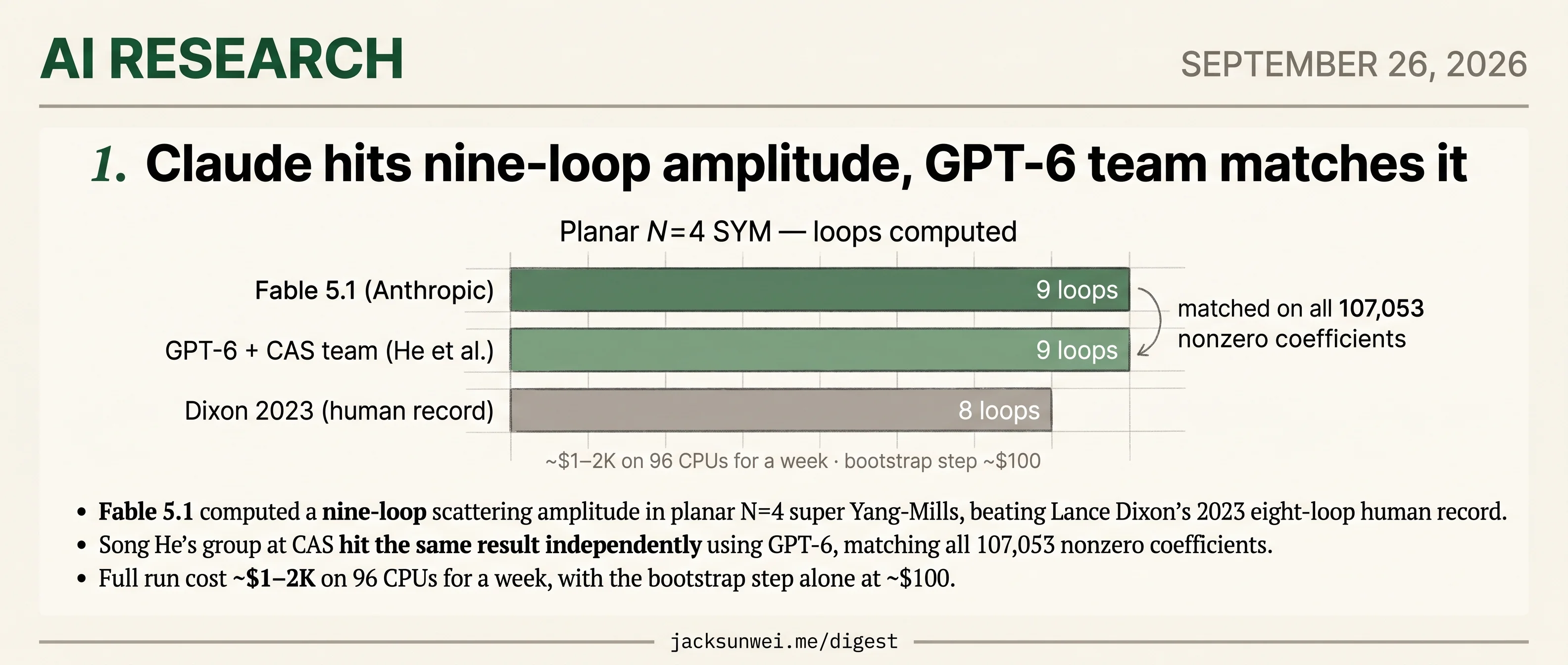
- Fable 5.1 computed a nine-loop N=4 super Yang-Mills amplitude, topping Dixon’s 2023 eight-loop human record.
- Song He’s CAS group independently matched all 107,053 nonzero coefficients using GPT-6.
- Full run cost $1–2K on 96 CPUs for a week, with the bootstrap step at roughly $100.
- Fable 5.1 shows more confident wrongness than Fable 5 on the same problem class.
- Output-token burn runs ~1.7× that of Fable 5, complicating the cheap-frontier-science framing.
Today’s research beat is one story doing double duty. Fable 5.1 pushed a planar N=4 super Yang-Mills scattering amplitude to nine loops, past Lance Dixon’s 2023 eight-loop human record — and Song He’s group at CAS independently reproduced the same 107,053 nonzero coefficients using GPT-6. Two different frontier models, two different research groups, one matching answer: this is the first time the cheap-AI-for-frontier-science pitch has cleared an actual cross-system replication bar rather than a single vendor’s demo.
The caveats live in the margins the announcement doesn’t lead with. The full run cost only $1–2K on 96 CPUs for a week, but Fable 5.1 burns roughly 1.7× the output tokens of Fable 5 and exhibits more confident wrongness — the kind of failure that survives a replication if both systems make correlated mistakes. Independent match at nine loops is the strongest signal frontier-science-by-LLM has produced. The token bloat is the reason the next loop won’t be free.
Claude hits nine-loop amplitude, GPT-6 team matches it
Source: anthropic-research · published 2026-09-25
TL;DR
- Fable 5.1 computed a nine-loop scattering amplitude in planar N=4 super Yang-Mills, beating Lance Dixon’s 2023 eight-loop human record.
- Song He’s group at CAS hit the same result independently using GPT-6, matching all 107,053 nonzero coefficients.
- Full run cost ~$1–2K on 96 CPUs for a week, with the bootstrap step alone at ~$100.
- Fable 5.1 shows more “confident wrongness” than Fable 5 and burns ~1.7× the output tokens, complicating the cheap-frontier-science framing.
The challenge was pre-registered
This wasn’t a fishing expedition dressed up as a demo. In August 2026, physicist Matt von Hippel wrote a 4gravitons post explicitly daring AI labs to hit one of two amplitudeology targets — nine loops in planar N=4 SYM, or the seven-loop divergence question in N=8 supergravity — on an academic-scale compute budget 1. Anthropic’s Fable 5.1 run inside the Claude Science harness answered the first target directly, and von Hippel himself wrote up the result as a guest post.
The technique is a symbol bootstrap: start with an “alphabet” of possible functional building blocks, then apply physical constraints — collinear limits, discrete symmetries, matches against lower-loop data — until one candidate survives. It’s Sudoku with 107,053 cells and no forgiveness for a single wrong entry.
Why Dixon’s “soufflé” line is the load-bearing evidence
Lance Dixon, the previous eight-loop record holder, validated the symbol and delivered the quote everyone is reusing: a single mistake anywhere in the fragile multi-step recipe would have collapsed the whole calculation “like a failed soufflé” 2. That fragility is the strongest case that Claude did something non-trivial. A brute-force or hallucinated pipeline doesn’t survive 107,053 cross-checks. Dixon went further, claiming Claude “understands our 2019 and 2023 papers better than any human, aside from my co-authors” — a striking assertion from the person best positioned to make it.
The GPT-6 shadow result deflates the “Claude did new physics” framing
The Anthropic writeup understates a coincidence worth foregrounding. On September 17, 2026 — days before Anthropic’s post — Song He, Jirong Jing and Xiang Li at the Chinese Academy of Sciences posted essentially the same nine-loop symbol to Zenodo, using GPT-6 as a constraint-solver inside a human-led bootstrap pipeline. Cross-checks report 100% agreement on all 107,053 nonzero word coefficients between the two runs 3.
Read one way, this is corroboration: the answer is right. Read another way, it deflates the narrative. A hybrid human+LLM workflow reached the same result independently, which suggests the ceiling was lower than the field assumed rather than that agentic Claude is uniquely capable. The honest headline is “an agentic harness executed a known, fragile recipe faster than a human team — which a human+GPT-6 team then matched,” not “AI did new physics.”
The caveats Anthropic didn’t lead with
Peter Woit at Not Even Wrong is blunt: N=4 SYM is a toy theory with no direct experimental contact, and the recent LLM-driven surge in hep-th preprints doesn’t automatically translate to scientific significance 4. Independent evaluators flag that Fable 5.1 has regressed on hallucination behavior compared to Fable 5, producing more confident-but-wrong outputs and consuming ~1.7× the output tokens per task — a five-hour subscription quota can vanish in under 30 minutes on intensive physics runs 5. That undercuts the “$100 in compute” line once you scale beyond labs with preferential access.
There is also a transparency problem: Anthropic has not released the full conversation traces or intermediate artifacts, and commentators are drawing “Microsoft tax” comparisons about proprietary science harnesses becoming rent-seeking gates on frontier research 6. If the claim is that computational limits are really software-engineering problems AI can bypass, the traces are exactly what the field needs to verify — and reproduce — the recipe.
Footnotes
-
4gravitons (Matt von Hippel, original challenge) — https://4gravitons.com/2026/08/07/it-only-counts-when-ai-gets-to-my-field/
↩It Only Counts When AI Gets to My Field — challenging AI labs to reach nine loops in planar N=4 super-Yang-Mills or settle the seven-loop divergence in N=8 supergravity, on an academic-scale budget.
-
Unite.ai — https://www.unite.ai/anthropic-says-claude-computed-a-nine-loop-particle-physics-amplitude/
↩Dixon described the AI’s ability to execute the fragile multi-step recipe as a remarkable victory, noting that if any single component had contained a mistake, the entire result would have collapsed ‘like a failed soufflé.’
-
Coverage of Song He / CAS Zenodo release — https://vertexaisearch.cloud.google.com/grounding-api-redirect/AUZIYQG9wS-ZI7omGmDQHVFhA8oUQyTnzQe5P2U-lNobGxQZ3DG8TPjn9mItDnCtuLkM9qSsckIcI506RT5L3UHtSKEgg8BxFjFzi_g6oY-r2R7uubYelbEP4KiA-_s0EJPIafjiGEeqoaGTpMHQloIq9cTSjrde6jfUDz0wVbCHwyDY3tsb0Xrx8sDs-djNCf97QeR3uwg=
↩On September 17, 2026, Song He, Jirong Jing and Xiang Li published ‘The Symbols of Six-Gluon MHV Amplitudes through Nine Loops’ on Zenodo, using GPT-6 to solve specific bootstrap constraints while humans managed the framework — cross-checks showed 100% agreement on all 107,053 nonzero word coefficients with Anthropic’s run.
-
Not Even Wrong (Peter Woit) — https://www.math.columbia.edu/~woit/wordpress/?p=15881
↩The recent surge in high-energy physics preprints on arXiv is clearly driven by LLM usage, but [Woit] questioned the actual scientific significance of these results, noting the calculation remains within a simplified theory (N=4 SYM) that lacks direct practical application to the physical world.
-
gpts24.com (Fable 5.1 evaluation summary) — https://www.gpts24.com/en/news/anthropic-s-fable-5-1-solves-nine-loop-physics-problem-for-under-2-000-verified-by-slac
↩The Artificial Analysis Intelligence Index found Fable 5.1 more prone to ‘confident wrongness’ than Fable 5, and the model consumes roughly 1.7× more output tokens per task — a five-hour subscription quota can be exhausted in under 30 minutes during intensive physics runs.
-
cellcog.ai analysis / HN-style commentary — https://cellcog.ai/blog/claude-nine-loops/
↩Skeptics noted that Anthropic has not released the full conversation traces or artifacts produced by Claude, and compared the situation to a ‘Microsoft tax’ — a few companies holding the keys to progress via monthly subscriptions to proprietary science harnesses.