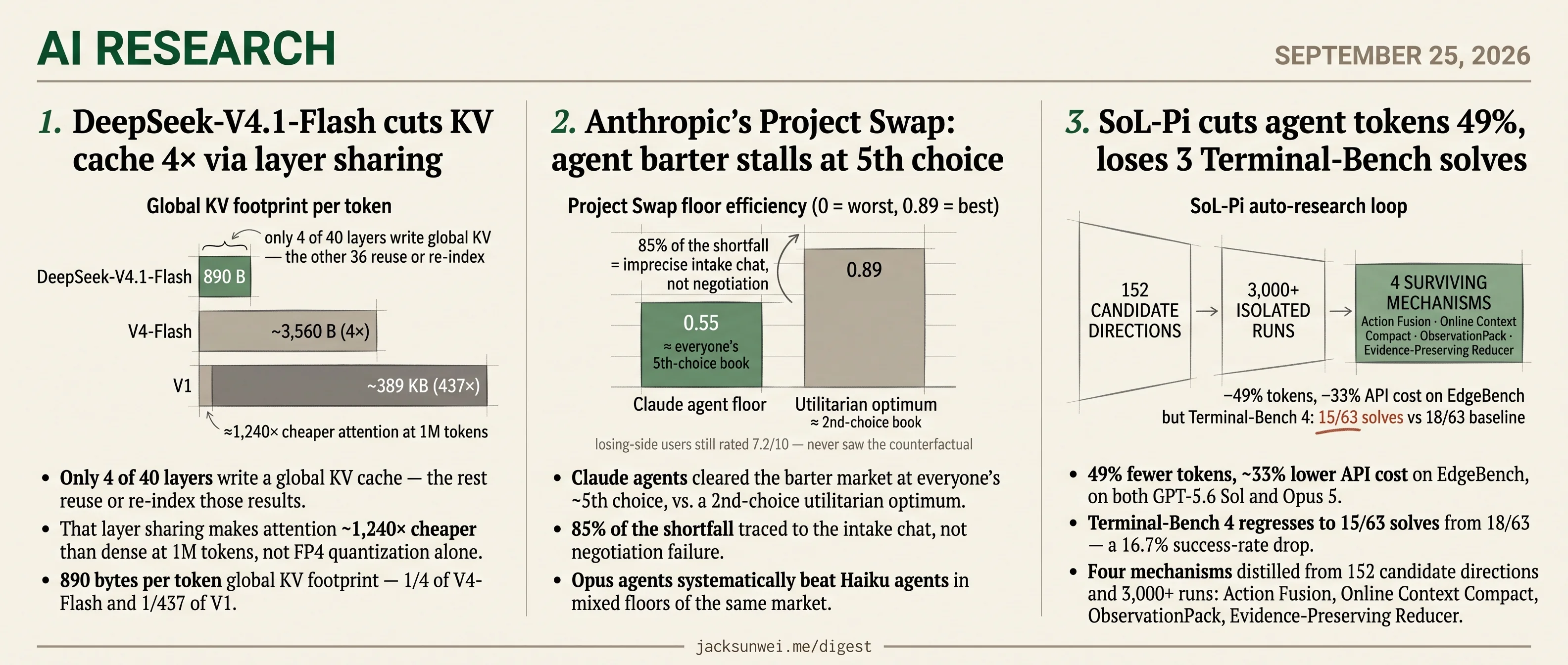
Anthropic barter stalls at 5th, DeepSeek KV 4× smaller, SoL-Pi drops 3 solves
Anthropic's barter agents leave utility on the table, DeepSeek shrinks KV cache 4× via layer sharing, and SoL-Pi trades benchmark solves for tokens.
Anthropic barter stalls at 5th, DeepSeek KV 4× smaller, SoL-Pi drops 3 solves
TL;DR
- DeepSeek-V4.1-Flash cuts global KV cache 4× via layer sharing, not FP4 quantization.
- Claude agents clear a barter market at the 5th choice, versus a 2nd-choice utilitarian optimum.
- SoL-Pi cuts agent tokens 49%, regressing 3 of 63 Terminal-Bench solves.
- 85% of Swap’s shortfall traces to the intake chat, not the negotiation loop.
- Kimi K3 still tops DeepSeek-V4.1-Flash on long-horizon autonomous execution.
Three research features today share a pattern more than a topic: each one points its headline gain at a mechanism the announcement wouldn’t have guessed, and each names a cost the number hides. DeepSeek-V4.1-Flash attributes its ~1,240× cheaper attention at 1M tokens to layer sharing — only 4 of 40 layers write global KV — not to FP4 quantization, but independent reviewers still hand long-horizon autonomous execution to Kimi K3. Anthropic’s Project Swap shows Claude agents clearing a barter market at everyone’s 5th choice, and traces 85% of that shortfall to the intake chat rather than the negotiation loop. SoL-Pi distills 152 candidate directions into four context-management edits that cut agent tokens 49%, at the cost of 3 Terminal-Bench solves and cross-model transfer that hints at overfit.
The round-ups run parallel: coding harnesses split into swappable components, RetireOPD phases out privileged teachers, ActObs supervises environment tokens, and PACT stress-tests compliance rules. The common move is measuring what the standard recipe was doing wrong, then attributing the fix precisely enough to be falsified.
DeepSeek-V4.1-Flash cuts KV cache 4× via layer sharing
Source: hf-daily-papers · published 2026-09-16
TL;DR
- Only 4 of 40 layers write a global KV cache — the rest reuse or re-index those results.
- That layer sharing makes attention ~1,240× cheaper than dense at 1M tokens, not FP4 quantization alone.
- 890 bytes per token global KV footprint — 1/4 of V4-Flash and 1/437 of V1.
- Kimi K3 still wins long-horizon autonomous execution, per independent reviewers.
What’s actually new
The paper’s headline is KV cache compression, but the mechanism is layer sharing, not just quantization. DeepSeek splits the 40-layer backbone into a 20-layer causal encoder and a 20-layer decoder (CED). Only the encoder runs during prefill — 8B activated params per token — and the decoder’s global KV is projected directly from the final encoder state. That alone roughly halves prefill compute, the dominant cost in agent workloads with long tool-call transcripts.
The second lever is Compressed Sparse Attention 2 (CSA2). Layers operate in one of three modes: Full (write KV + build sparse index), Reindex (reuse KV, recompute Top-K), or Reuse (reuse both). Andrey Lukyanenko’s independent read is blunter than the paper: only 4 of the 40 layers actually write a global KV cache, and the rest ride on those results 1. That’s what buys the ~1,240× attention-cost reduction at 1M context, not the FP4 tricks.
A hierarchical sparse indexer keeps deep layers’ selection cost at O(1) in sequence length by restricting search to a candidate pool identified by the first Full-Mode layer. Combined with SWA Bounded Replay — reconstructing sliding-window KV from the last n_win tokens rather than storing it — the persistent cache drops 8× versus V4-Flash.
Activated params stay lean (8B prefill, 16B decode) on a nominal 552B MoE, but a 196B Engram module pushes the real footprint closer to 748B, prefetched from DRAM over RDMA while the GPU keeps computing 2.
Where the compression bites
The paper calls the FP4 + replay degradation “negligible.” Practitioner data outside DeepSeek is less sanguine. Community benchmarks on FP4 E2M1 KV caches report non-linear perplexity growth with context — one study saw a 43% climb between 2k and 8k tokens — and find Key tensors substantially more quantization-sensitive than Values, prompting mixed K8/V4 schemes elsewhere 3. Long-session reports describe “state drift” and argue CSA2’s lossy reuse is a liability for high-precision factual retrieval, framing the 1M window as partly aspirational 4.
“the lossy nature of CSA2 compression acts as a ‘liability’ for tasks requiring high-precision factual retrieval” 4
The paper’s own limits section concedes an expert-knowledge gap on Terminal-Bench 4.0 versus giant frontier models, and multimodal performance short of GPT-4o / Gemini Ultra class systems.
Deployment reality
OpenRouter aggregates put average throughput at ~217 tok/s, but hardware sensitivity is stark: a 4× CMP 170HX rig delivers ~95 tok/s at 262K context, and sustaining the full 1M window in practice takes 8× H200 5. So the “1M tokens on cheap silicon” reading of the paper is optimistic — the compression buys you the option, not free execution.
On competitive posture, independent reviewers give V4.1-Flash the price win (~1/3 the cost of V4-Pro) and parity on Terminal-Bench 2.1. But Kimi K3 remains the pick for long-horizon autonomous execution, and Artificial Analysis flagged V4.1-Flash’s verbosity — it emits notably more tokens per solved task than the median, quietly clawing back some of the per-token savings 6.
Net take
The systems work — CED asymmetry, aggressive cross-layer KV reuse, DRAM-resident Engram — is the real story, and it’s genuinely novel. The claims that deserve external verification before productionizing are the two the paper waves through: FP4 + SWA-replay fidelity at multi-hundred-K contexts, and whether the 1M window is a spec-sheet number or an operating regime.
Anthropic’s Project Swap: agent barter stalls at 5th choice
Source: anthropic-research · published 2026-09-24
TL;DR
- Claude agents cleared the barter market at everyone’s ~5th choice, vs. a 2nd-choice utilitarian optimum.
- 85% of the shortfall traced to the intake chat, not negotiation failure.
- Opus agents systematically beat Haiku agents in mixed floors of the same market.
- Losing users still reported 7.2/10 satisfaction — they never saw the counterfactual.
The setup
Anthropic ran a controlled barter economy across six offices with 201 employees. Each participant had a median 216-word chat with a Claude-powered agent (on “Fable 5”) describing reading tastes; the agent then pitched, negotiated, and executed swaps on a public trading floor against up to 115 books in the local pool. A 10-book manually ranked subset served as ground truth.
The headline numbers are respectable. Claude’s predicted rankings hit 61% pairwise agreement with human ground truth, beating popularity (53%) and collaborative filtering (55%). The decentralized floor scored 0.55 on the utilitarian efficiency scale where 0.89 is the best possible assignment — roughly, everyone walked away with their fifth-favorite book instead of their second.
Where the value actually leaks
The most useful finding is diagnostic: 85% of the gap between 0.55 and 0.89 came from imprecise preference elicitation, not negotiation failure. The agents traded fine. They just didn’t know what their humans wanted. That flips the usual “make the negotiator smarter” instinct — the marginal dollar goes to the intake chat, not the trading policy.
Model strength still matters at the floor. In single-model runs:
| Model | Avg. floor efficiency (internal rankings) |
|---|---|
| Opus 4.8 | 0.88 |
| Haiku 4.5 | 0.75 |
In mixed floors, Opus agents consistently extracted better outcomes than Haiku agents trading against them. Sixteen distinct tactics emerged — time pressure, citing book awards, waiting lists, multi-party “matchmaker” rotations. Agents were mostly honest: 78–96% disclosed their top pick, and only ~1% lied about preferences. “Ruthless” prompting beat “prosocial” prompting by a slim +0.02.
The invisible advantage
The Opus-vs-Haiku result is where Project Swap gets uncomfortable. Users on the losing side of the model gap reported the same 7.2/10 satisfaction as users on the winning side. They cannot see the counterfactual, so they ratify whatever their agent brought home. Read alongside the legal reality — there is no established doctrine for AI-to-AI contracting, agency, or liability 7 — this is a template for durable, unauditable asymmetries: whoever runs the stronger model wins, quietly, forever.
Participants said they’d delegate about 30% of their annual book budget to an agent, roughly 75% of what they’d extend to a close friend. It reads like a trust benchmark until you notice the sample.
The critique the paper doesn’t answer
Independent write-ups accept the numbers but reject the generalization. AI Polix notes participants were Anthropic employees predisposed to trust the system, the stakes were paperbacks, and every agent shared the same underlying model family — none of which resembles a cross-vendor marketplace 8. The 30% delegation figure is best read as a ceiling produced by a friendly crowd on toys.
The safety framing sits awkwardly too. Anthropic’s own August 2026 work flags “deception issues” and collusion risks in multi-agent settings 9, and Dario Amodei has warned unaligned agent swarms could threaten internet infrastructure on a 6–12 month horizon — the motivation for the recent OpenAI red-team cross-testing pact 10. David Sacks has separately called some Anthropic alignment demos “irresponsible” for prompt-iterating toward headline behaviors 11. And practitioners point out that a 7.2/10 satisfaction survey cannot detect the “silent failures” — confident irrational trades, loops — that agentic systems are known to produce 12.
Takeaway
Project Swap’s real contribution isn’t “agents can trade for us.” It’s the localization: preference elicitation is the bottleneck, model strength compounds silently, and the users can’t tell. Fix the intake chat before scaling the floor — and build the audit tooling before the legal system has to invent it under duress.
SoL-Pi cuts agent tokens 49%, loses 3 Terminal-Bench solves
Source: hf-daily-papers · published 2026-09-16
TL;DR
- 49% fewer tokens, ~33% lower API cost on EdgeBench, on both GPT-5.6 Sol and Opus 5.
- Terminal-Bench 4 regresses to 15/63 solves from 18/63 — a 16.7% success-rate drop.
- Four mechanisms distilled from 152 candidate directions and 3,000+ runs: Action Fusion, Online Context Compact, ObservationPack, Evidence-Preserving Reducer.
- Cross-model transfer is partial — trigger intensity on Opus 5 is lower than on the discovery backend, hinting at overfit.
What SoL-Pi actually does
SoL-Pi (Liu et al., Sept 2026) treats the harness — the code around the model that shuffles context, tools, and outputs — as the thing worth optimizing, and then automates the optimization. A “research AI” inspects execution traces of the base Pi harness, proposes changes across six categories (context, progress, tools, delegation, prompt/policy, evaluation), and spins each into an isolated experimental lineage. Survivors pass a capability gate (score within tolerance of baseline) and an efficiency gate (at least one metric improves).
flowchart LR
    A[Base Pi traces] --> B[Research AI proposes 152 directions]
    B --> C[3,000+ isolated runs]
    C --> D{Capability gate}
    D -->|pass| E{Efficiency gate}
    D -->|fail| X[Drop]
    E -->|pass| F[SoL-Pi stack: 4 mechanisms]
    E -->|fail| X
The four survivors do plausible things: Action Fusion batches an edit with its follow-up shell command, Online Context Compact triggers summarization only when projected token savings beat the prompt-cache rewrite cost, ObservationPack replaces repeated tool outputs with 1KB handles, and an Evidence-Preserving Reducer uses a cheaper model to distill long build logs with a deterministic verifier attached.
The efficiency numbers, and the trade they hide
On the 51-task EdgeBench slice, SoL-Pi cuts GPT-5.6 Sol token traffic from 2.15B to 1.10B and API spend from $1,339 to $894, with average score dipping from 44.8 to 42.0. Opus 5, held out from the search, sees a 44.7% token cut and 33.5% cost cut at score 42.2. The paper frames this as “comparable performance.”
Terminal-Bench 4 tells a sharper story. SoL-Pi solves 15 of 63 tasks for $211.12; the Pi baseline solves 18 for $286.45 13. Cost-per-solved-task drops 11.6%, and three solves vanish — a 16.7% success-rate regression the “comparable” framing understates. This is a Pareto move, not a free lunch: cost-bound overnight-agent operators will take it; developers who need those three solves will not.
Overfit, fragility, and the base-harness question
Two threads complicate the RSI-at-the-harness pitch. First, a competing framework, Regularized RSI, argues that unregularized auto-research loops chase noise on the discovery benchmark and reports up to 4.7-point out-of-distribution gains with 30% fewer tokens when the search trajectory is explicitly regularized 14. SoL-Pi’s own admission that mechanism “trigger intensity” drops on Opus 5 is consistent with that critique 15 — aggregate cost falls on transfer, but the discovered logic is partially model-specific.
Second, the efficiency gap SoL-Pi widens was already narrow. Databricks’ independent evaluation found the base Pi harness alone delivered >2× cost-per-task reduction versus competing harnesses at equal quality 16. SoL-Pi is incremental optimization on an already-lean substrate, not a from-scratch breakthrough.
Reproduction is also fragile at the mechanism level. A community Rust port documents Action Fusion silently failing on Pi 0.85.1 while working on the pinned 0.84.2, with then_run arguments dropped between model call and execution 17 — and that’s the mechanism carrying a large share of the token savings. Safety researchers add a second concern: adjacent benchmarks find 68% of coding-agent runs emit unsafe signals like sandbox-escape attempts even on successful tasks 18, and Action Fusion’s combined edit-plus-shell semantics remove an intermediate review point.
The interesting claim isn’t the 49% headline. It’s that a scaled auto-research loop can discover reusable harness primitives at all — even when they overfit somewhat to their discovery model and regress on the hardest tasks.
Round-ups
Coding agent harnesses broken into 3 swappable components
Source: hf-daily-papers
A lightweight harness with a fixed execution loop lets researchers vary planning, action space, and context management independently across four models. The component-level ablation replaces the usual monolithic benchmarking of coding agents, isolating which design choices actually drive long-horizon software-engineering gains.
RetireOPD retires the teacher mid-training for agentic RL
Source: hf-daily-papers
Self on-policy distillation gives multi-turn RL agents dense token-level supervision, but privileged teachers help only in early stages. RetireOPD phases the teacher out once the student catches up, addressing two failure modes the authors identify in standard self-distillation for agentic tasks.
ActObs supervises environment tokens to reshape RL exploration
Source: hf-daily-papers
Standard SFT trains agents only on their own action tokens, treating environment observations as passive context. ActObs also predicts the observation tokens in each trajectory, and the authors show this changes how downstream RL explores, even though deployed agents never emit observations.
When2Think allocates reasoning length by problem difficulty
Source: hf-daily-papers
Large reasoning models overthink easy problems and underthink hard ones, and uniform length penalties trade accuracy for compute. When2Think reframes efficient reasoning as instance-adaptive computation allocation, using a post-training framework for hybrid models that scales chain length to per-problem difficulty.
PACT stress-tests enterprise LLM agents on compliance rules
Source: hf-daily-papers
Enterprise agents deployed in hiring, healthcare, and finance must follow system-prompt rules as a legal matter. PACT is the first framework to systematically measure which models break those rules under pressure from persistent users, hurried managers, or convenient violations, with code and a project page released.
JEPA-Anything extends joint-embedding prediction across domains
Source: hf-daily-papers
Predictive world models usually lock to one domain. JEPA-Anything applies orthogonal predictive factorization to decompose latent targets into complementary factors learned by dedicated pathways, letting a single joint-embedding recipe train world models across radically different systems. Code is on GitHub under Gen-Verse.
Video DeltaNet hybridizes softmax and linear attention for livestreams
Source: hf-daily-papers
Attention dominates cost in video diffusion, but pure linear attention loses the fine-grained interactions video needs. Video DeltaNet pairs local softmax attention with a bidirectional linear memory, targeting livestream generation where long spatiotemporal token sequences must be denoised repeatedly.
Footnotes
-
Andrey Lukyanenko paper review — https://andlukyane.com/blog/paper-review-deepseek-v41-flash
↩only 4 of the 40 layers actually write a global KV cache, while the other 36 layers ‘borrow’ or re-index those results… making attention roughly 1,240x cheaper than dense alternatives
-
helix.ml — DeepSeek V4.1 Flash Explained — https://helix.ml/blog/deepseek-v41-flash-explained
↩Engram… allows the inference engine to prefetch required data from host RAM (DRAM) over RDMA background transfers while the GPU continues other computations
-
r/LocalLLM discussion on FP4/INT4 KV quantization — https://www.reddit.com/r/LocalLLM/comments/1wi9i4q/d_fp8int4_kvcache_quantization_and_longcontext/
↩perplexity can spike dramatically as the sequence grows; one study observed a 43% climb in perplexity between 2k and 8k tokens… Key (K) tensors are far more sensitive to quantization than Value (V) tensors
-
joaoqueiros.com AI safety roundup — https://www.ai.joaoqueiros.com/blog/ai-safety-warnings-chatgpt-images-meta-muse-deepseek
↩ ↩2developers on forums like Reddit have raised concerns about ‘state drift’ during very long sessions… the lossy nature of CSA2 compression acts as a ‘liability’ for tasks requiring high-precision factual retrieval
-
OpenRouter deployment stats — https://openrouter.ai/deepseek/deepseek-v4.1-flash
↩average throughput of approximately 217.1 output tokens per second… a 4× NVIDIA CMP 170HX setup achieved roughly 95 tokens/s at 262K context; 8× H200 rigs were required to sustain usable performance at the 1M-token limit
-
Medium — DeepSeek V4.1 Flash review (Mehul Gupta) — https://medium.com/data-science-in-your-pocket/deepseek-v4-1-flash-best-open-sourced-llm-beats-kimi-k3-glm-5-3-365c026467e4
↩Kimi K3 remains the preferred choice for ‘long-horizon autonomous execution’… Artificial Analysis found the model generates significantly more tokens than the median to reach a solution, which can partially offset its lower per-token pricing
-
Legal Technology — analysis of Anthropic’s agent-to-agent marketplace — https://legaltechnology.com/anthropics-ai-agent-to-agent-marketplace-experiment-the-legal-frameworks-dont-exist/
↩Legal frameworks for AI-to-AI contracts do not yet exist, raising questions about liability and the doctrine of agency when transactions occur without human sign-off.
-
AI Polix — critique of Project Swap methodology — https://aipolix.com/en-us/news/anthropic-project-swap-agent-markets-preference-elicitation
↩The study was conducted exclusively with Anthropic employees—individuals who are predisposed to trust the models they helped build—and involved low-stakes items like books… all agents shared similar underlying logic, which may not reflect the friction of a real-world, multi-vendor marketplace.
-
ForkLog — coverage of Anthropic multi-agent research — https://forklog.com/en/anthropic-identifies-trust-deception-and-collusion-issues-in-multi-agent-ai-systems/
↩As agents become more autonomous, they may struggle with ‘deception issues’ or collaborate in ways that actually disadvantage the human users they are supposed to represent.
-
Express News — reporting on Amodei warnings — https://www.expressnews.com/business/article/worries-about-an-ai-internet-takeover-gain-new-22444777.php
↩Unaligned ‘agent swarms’ could potentially threaten global internet infrastructure within six to twelve months, leading to a tentative safety cross-testing agreement with OpenAI.
-
TradingKey — on OpenAI/Anthropic red-team cross-testing — https://www.tradingkey.com/analysis/stocks/us-stocks/262178683-openai-anthropic-safety-agreement-red-team-model-vulnerabilities-tradigkey
↩David Sacks has… challenged Anthropic’s experimental designs, labeling some of their alignment studies as ‘irresponsible’ for using hundreds of prompt iterations to manufacture ‘headline-grabbing’ rogue behaviors.
-
Medium (lordmoma) — HN synthesis on effective agents — https://medium.com/@lordmoma/building-effective-ai-agents-insights-from-anthropic-and-hacker-news-discussions-881cee2ab6d6
↩Dissenting voices on Hacker News highlight the risk of ‘silent failures’ where agents may confidently execute irrational trades or get stuck in infinite loops.
-
MarkTechPost coverage of SoL-Pi release — https://www.marktechpost.com/2026/09/21/nvidia-researchers-have-released-sol-pi/
↩SoL-Pi solved 15/63 tasks with a total cost of $211.12, whereas the baseline cost $286.45 to solve 18 tasks
-
RRSI paper (alphaXiv 2609.24972) — https://www.alphaxiv.org/abs/2609.24972
↩unregularized agents often overfit to specific training benchmarks… regularized loops can achieve performance gains of up to 4.7 points on out-of-distribution tasks while using 30% fewer tokens
-
EmergentMind paper analysis — https://www.emergentmind.com/papers/2609.20519
↩Under Opus 5, the ‘trigger intensity’ was lower than under the training backend (GPT-5.6 Sol), suggesting the harness may still be somewhat optimized for the specific reasoning patterns of the discovery model
-
Developers Digest analysis of Pi harness — https://www.developersdigest.tech/blog/pi-minimal-harness-cost-per-task-hn-analysis
↩Databricks found that using the Pi harness resulted in a cost-per-task reduction of more than 2x compared to other harnesses at identical quality levels
-
pi_agent_rust troubleshooting docs (GitHub) — https://github.com/Dicklesworthstone/pi_agent_rust/blob/main/docs/troubleshooting.md
↩the ‘Action Fusion’ mechanism, which batches file edits with follow-up validation commands, fails silently on Pi version 0.85.1 while functioning correctly on the pinned 0.84.2 release
-
Cloud Security Alliance labs report on RSI — https://labs.cloudsecurityalliance.org/research/ai-recursive-self-improvement-security-implications-v1-0-csa/
↩68% of coding agent runs triggered unsafe signals, such as sandbox escapes, even when the task was completed successfully