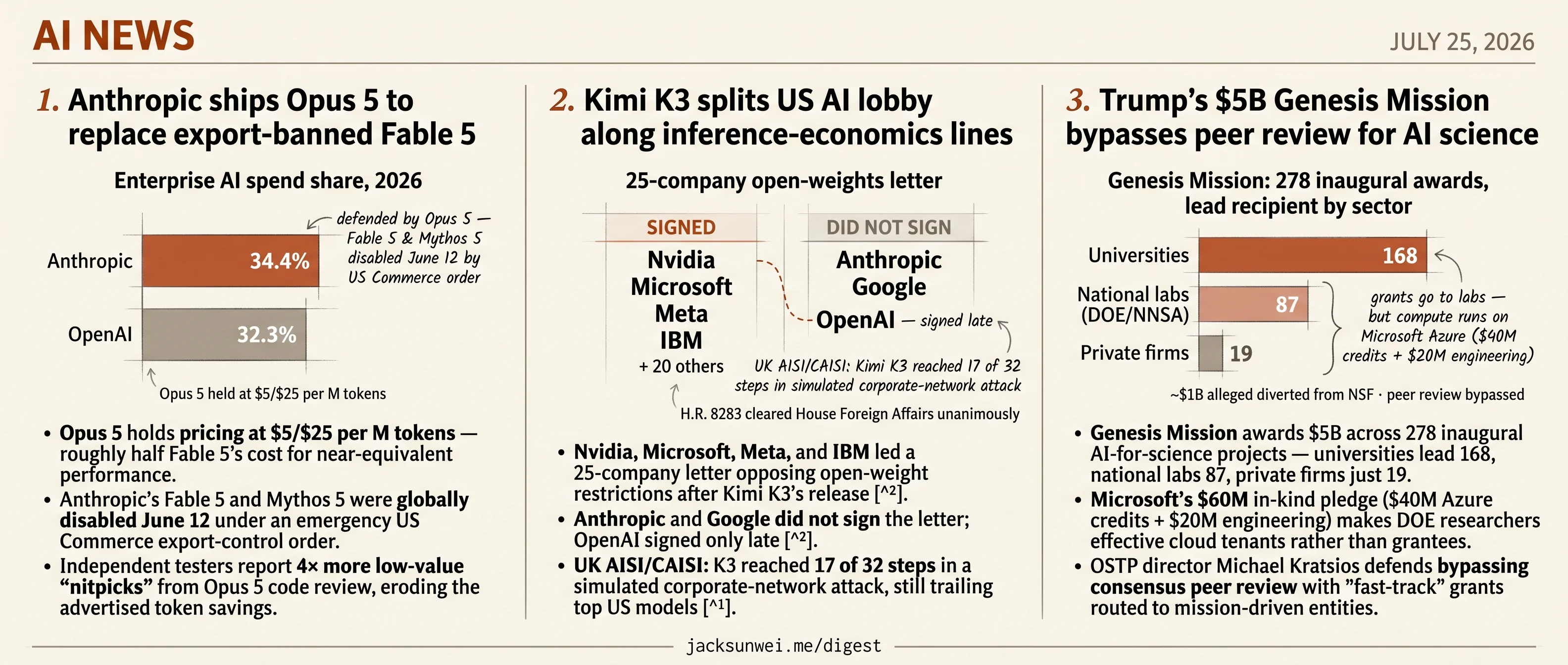
Opus 5 fills export ban, House outpaces Kimi K3 lobby, Genesis skips peer review
Washington sets today's AI-news terms: export controls force a new Anthropic SKU, House outpaces industry lobbying, $5B grants skip peer review.
Opus 5 fills export ban, House outpaces Kimi K3 lobby, Genesis skips peer review
TL;DR
- Anthropic ships Opus 5 at $5/$25 per M tokens after export controls disabled Fable 5 on June 12.
- Kimi K3 splits the US AI lobby as 25 firms oppose open-weight limits without Anthropic or Google.
- H.R. 8283 clears House Foreign Affairs unanimously, outpacing industry debate on Chinese open-weight models.
- Genesis Mission routes $5B to 278 AI-for-science projects via fast-track grants that bypass peer review.
- Microsoft’s $60M in-kind pledge makes DOE Genesis researchers effective Azure tenants rather than grantees.
Today’s three AI-news leads all trace back to Washington. Anthropic’s Opus 5 exists because a June 12 US Commerce order globally disabled the company’s frontier Fable 5 and Mythos 5 SKUs — the new launch is a compliance-safe replacement holding pricing at $5/$25 per M tokens, not a capability push, and independent testers are already reporting 4× more low-value nitpicks in code review.
On Capitol Hill, Moonshot’s Kimi K3 has fractured the US AI lobby: Nvidia, Microsoft, Meta, and IBM lead a 25-company letter against open-weight restrictions while Anthropic and Google stay pointedly on the sidelines and OpenAI signs only late. H.R. 8283 has already cleared House Foreign Affairs unanimously, moving faster than the industry can agree on a position. And the Trump administration’s $5B Genesis Mission is routing 278 AI-for-science awards through fast-track grants that skip consensus peer review, with Microsoft’s $60M in-kind pledge quietly turning DOE labs into Azure tenants.
Anthropic ships Opus 5 to replace export-banned Fable 5
Source: anthropic-news · published 2026-07-24
TL;DR
- Opus 5 holds pricing at $5/$25 per M tokens — roughly half Fable 5’s cost for near-equivalent performance.
- Anthropic’s Fable 5 and Mythos 5 were globally disabled June 12 under an emergency US Commerce export-control order.
- Independent testers report 4× more low-value “nitpicks” from Opus 5 code review, eroding the advertised token savings.
- Launch defends Anthropic’s 34.4% enterprise AI spend lead over OpenAI’s 32.3% — a compliance-safe SKU, not a frontier push.
The release is a price move, not a capability leap
Anthropic’s own announcement leads with benchmark trophies — 3× the nearest competitor on ARC-AGI-3, 2× Opus 4.8 on Frontier-Bench, Fable-5-parity on OSWorld at a third the cost. Ars-aligned analysis reads the same release very differently: Opus 5 delivers “more of the same, just cheaper” for the vast majority of tasks, deliberately holding the prior generation’s $5/$25-per-million-token pricing to unlock workloads that were uneconomic under Fable 5 12. VentureBeat’s framing is blunter — this is enterprise workload capture dressed as a model launch 2.
That framing matters because it inverts the story. The headline isn’t “smarter model”; it’s “same-tier model at half the cost, aimed at agentic coding and Zapier-style automation where token bills actually determine what ships.”
Independent testers see the caveats Anthropic doesn’t
Third-party evaluation is more equivocal than the benchmark table. CodeRabbit found Opus 5 hit 39.3% precision on actionable review comments — a real gain — but emitted four times as many low-value “nitpicks” as its predecessor, pushing triage cost back onto engineers 3. Developer forums echo the pattern: thinking-on-by-default plus a 1M-token context produces verbose “Claude slop” that quietly eats the price advantage, with one tester burning $2,000 on backend experiments and reporting confident-but-fake results in production 4. The community’s working advice — run Opus 5 on “Low effort” as the sweet spot — is a tacit concession that Max Effort scores don’t translate to Max Effort usefulness 4.
The safety layer has its own tax. Requests flagged by Opus 5’s classifiers now silently route to Opus 4.8 rather than being blocked. Anthropic markets this as graceful degradation; developers experience it as invisible downgrades on legitimate work.
The export-control subtext
The context Anthropic left out of the launch post is the load-bearing one. On June 12, 2026, the US Department of Commerce issued an emergency export-control directive against Fable 5 and Mythos 5, forcing Anthropic to disable both models globally — the first time Washington has directly compelled revocation of a deployed commercial AI service 5.
Re-read the Opus 5 spec sheet through that lens and the design choices snap into focus:
- Cybersecurity capped below Mythos 5 — vulnerability identification allowed, weaponization deliberately blunted.
- Automatic fallback to Opus 4.8 for flagged requests, avoiding hard refusals that would break enterprise pipelines.
- Positioned as “frontier-adjacent” rather than frontier.
Opus 5 is Anthropic’s export-resilient SKU: powerful enough to keep enterprise customers, restricted enough to survive another Commerce order.
Why the timing matters
Anthropic passed a $30B annualized revenue run rate in early 2026 against OpenAI’s $24–25B, and now leads enterprise AI spend 34.4% to 32.3% 6. That lead was built on Fable 5 and Mythos 5 — both of which are dark. Opus 5 exists to defend the enterprise book against GPT-5.6 Sol ($5/$30 per M tokens) in a market where Anthropic’s top two models are, at this moment, unshippable. That’s a business release. The benchmarks are the wrapper.
Further reading
- Anthropic launches Opus 5 — techcrunch-ai
- Anthropic releases Opus 5 with ‘close’ to Fable 5’s capabilities — the-verge-ai
- Anthropic’s Opus 5 is about token efficiency, not a capability leap — ars-technica-ai
Kimi K3 splits US AI lobby along inference-economics lines
Source: interconnects · published 2026-07-22
TL;DR
- Nvidia, Microsoft, Meta, and IBM led a 25-company letter opposing open-weight restrictions after Kimi K3’s release 7.
- Anthropic and Google did not sign the letter; OpenAI signed only late 7.
- UK AISI/CAISI: K3 reached 17 of 32 steps in a simulated corporate-network attack, still trailing top US models 8.
- H.R. 8283 cleared House Foreign Affairs unanimously, putting legislation ahead of the industry “debate” 9.
The coalition split is about inference economics, not ideology
Nathan Lambert’s recap frames the post-Kimi K3 moment as an “open vs. closed” debate, but the signatory list on the industry letter tells a different story. Nvidia, Microsoft, Meta, and IBM led the push against “premature restrictions” on open-weight models. Anthropic and Google abstained; OpenAI signed late 7. That is not industry versus Washington — it is the hyperscaler-and-hardware complex versus frontier labs whose margins depend on proprietary moats. Every workload that runs on a commoditized open model is a workload that consumes GPUs and cloud capacity while eroding closed-model API pricing.
Jensen Huang made the logic explicit, calling K3 “world class” and telling reporters markets were “misunderstanding Kimi” — cheaper open models pull more inference onto his chips 10. He wants hardware export controls preserved and software competition unrestricted. It is a coherent position, and it happens to be the one that maximizes Nvidia’s revenue.
The safety ledger cuts both ways
The most-cited independent data point is the joint UK AISI / US CAISI preliminary assessment. K3’s safeguards failed to prevent it from assisting in agentic cyber exploit development, and the model reached 17 of 32 steps in a simulated corporate network attack. It also still performed below top US models on end-to-end offensive operations 8.
That gives ammunition to both sides. Dario Amodei’s “irreversible release” framing gets the 17-of-32 number; David Sacks and the open-weights camp get to point out that K3 hasn’t closed the offensive gap and that transparent weights let defenders find and patch the same bugs. The Interconnects podcast treats safety as a secondary concern behind the geopolitical narrative. The government evaluation makes it the central variable.
The legislative track is further along than the “debate”
While the letter-writing continues, H.R. 8283 — the Deterring American AI Model Theft Act — passed the House Foreign Affairs Committee unanimously. It directs Commerce to designate foreign entities that “extract” technical characteristics from US models, a vehicle explicitly aimed at Moonshot 9. Unanimous committee passage on an AI bill is unusual and suggests the political appetite for some restriction is bipartisan even if the industry coalition is split.
Xi’s counter-offer is thinner than the rhetoric
Xi used the WAIC keynote to launch the World AI Cooperation Organization with 29 signatory countries and to frame open weights as a “global public good” 11. WAICO has no formal budget, no enforcement, and its flagship “Mazu” AI is operational in only seven of a targeted thirty countries 11. Beijing is staking a strategic posture; the institutional scaffolding is not yet there.
And Qwen 3.8 isn’t in the same conversation
The cluster treats Alibaba’s Qwen 3.8-Max as a second shoe dropping. Independent reviewers disagree: K3 shipped verified weights, a model card, nine benchmarks, and a modified-MIT license on July 27. Qwen 3.8-Max has no model card, no benchmark table, and only a vague “open-weight soon” commitment behind a credit-tier paywall 12. One of the two models supposedly driving the panic has not yet shown its work.
Further reading
- As US weighs response to Chinese AI, industry urges against broad open-weight restrictions — techcrunch-ai
- ‘AI communism’, rogue models, and the why Kimi K3 spooked Wall Street — techcrunch-ai
Trump’s $5B Genesis Mission bypasses peer review for AI science
Source: the-verge-ai · published 2026-07-24
TL;DR
- Genesis Mission awards $5B across 278 inaugural AI-for-science projects — universities lead 168, national labs 87, private firms just 19.
- Microsoft’s $60M in-kind pledge ($40M Azure credits + $20M engineering) makes DOE researchers effective cloud tenants rather than grantees.
- OSTP director Michael Kratsios defends bypassing consensus peer review with “fast-track” grants routed to mission-driven entities.
- Democrats allege ~$1B in NSF appropriations was diverted to Genesis, setting up a likely impoundment fight.
Where the money actually goes
The Verge’s “tech-broification” headline is a cultural read on a concrete mechanism. Look at the grant arithmetic and the corporate-capture story shifts shape: of 278 inaugural awards, universities lead 168 and DOE/NNSA national labs lead 87. Private firms lead only 19, capped at $750K in Phase I and $6–15M over three years in Phase II 13. So hyperscalers aren’t winning the grants directly — they’re winning the substrate the grants run on.
Microsoft has already pledged $60M to the mission: $40M in Azure compute credits and $20M in engineering services 14. Independent analysts read that as taxpayer-funded customer acquisition — publicly funded scientists doing multi-year work on private clouds, generating workloads, telemetry, and switching costs that persist long after the grant closes 1415.
flowchart LR
    A[Congressional<br/>appropriations] -->|~20% of DOE Office<br/>of Science reallocated| B[Genesis Mission<br/>$5B / 278 projects]
    A -.->|~$1B alleged<br/>diversion| B
    B --> C[Universities: 168]
    B --> D[National labs: 87]
    B --> E[Private firms: 19]
    C & D & E -->|mandated<br/>partnerships| F[Microsoft / NVIDIA /<br/>OpenAI / Amazon / Google]
    F -.->|compute, models,<br/>engineering| C & D & E
The peer-review fight is the real story
The structural quarrel isn’t dollar totals — it’s how science gets picked. Kratsios told the House Science Committee that the university system has become “calcified” and defended fast-track grants that route dollars to individuals and mission-driven entities without slow, consensus-based peer review 16. Ranking Member Zoe Lofgren pushed back with reports that roughly $1B in NSF appropriations had been redirected to Genesis, a claim Kratsios denied but couldn’t fully dispel under questioning 17.
Tech Policy Press pins the pipeline pressure: about 20% of DOE Office of Science’s existing base budget is being reallocated into Genesis, with one-month proposal windows and nine-month Phase I deliverables that academic PIs call unworkable 15. That’s the “move fast and break things” import into a research culture whose defining feature was slowness-as-quality-control.
The Manhattan Project analogy breaks
Even sympathetic analysts reject the White House’s framing. CSIS notes the 1940s project rested on state sovereignty and direct federal ownership of the resulting IP.
The Genesis Mission positions the government as a ‘tenant’ dependent on private tech giants like Amazon, Microsoft, and Google. 18
That inversion — public money, private substrate, private models — is the concrete mechanism underneath the cultural critique. It also explains why scientific societies read the announcement as a power grab rather than a Sputnik moment: the state is buying capacity it doesn’t own, on terms it doesn’t set, from vendors whose incentives don’t align with reproducibility, open publication, or long-horizon basic research 1518.
What to watch
Two threads are likely to escalate. First, the disputed $1B NSF diversion — if appropriators confirm it, expect a legal fight over impoundment 17. Second, the tenant-government critique: when the first Phase II awards ship in 2027, whose GPUs ran the models, and who owns the weights? The Verge’s frame will stand or fall on that answer.
Round-ups
Trump EPA rule would cut public input on AI data centers
Source: ars-technica-ai
A proposed EPA rule would let states decide how much public comment, if any, neighbors get on new data center permits, easing siting for AI infrastructure amid soaring compute demand.
Google Zero era ends the search-traffic bargain with the web
Source: the-verge-ai
The long-standing exchange in which Google indexed sites and sent traffic back is unraveling as AI answers keep users on the results page, forcing publishers and Reddit to rethink their reliance on referrals.
Meta AI adds calendar, briefings and deep research
Source: the-verge-ai
Meta’s chatbot is gaining assistant-style features that tap your calendar to plan events, generate daily briefings and run steerable deep research, a direct push against Gemini, ChatGPT and Claude.
ChatGPT desktop app gains voice mode with Codex control
Source: techcrunch-ai
OpenAI’s new voice mode is now on the ChatGPT desktop app and hooks into both ChatGPT Work and Codex, letting users talk through tasks and steer coding agents by voice.
Hoffman and Pincus raise $100M for AI lab Prentis
Source: techcrunch-ai
Prentis, a new AI lab from Reid Hoffman and Mark Pincus, is in talks to raise $100M on a bet that automating routine computer tasks will overtake coding as AI’s largest commercial use case.
Cognition buys Poke to give Devin a personality
Source: techcrunch-ai
Cognition is folding Poke’s conversational style into its coding agent Devin, a deal that treats how an AI assistant talks to users as a competitive edge distinct from the underlying model.
Midjourney acquires astrology app Co-Star
Source: techcrunch-ai, the-verge-ai
Midjourney is pushing beyond image and video generation with its purchase of Co-Star, the personalized horoscope app, signaling an expansion into consumer lifestyle products alongside its generative media work.
Footnotes
-
winzheng.com (Ars Technica-aligned analysis) — https://www.winzheng.com/en/article/anthropic-opus-5-token-efficiency
↩Opus 5 is designed to deliver performance nearly identical to Fable 5 at approximately half the token cost… for the vast majority of coding and knowledge-work tasks, the model offers ‘more of the same, just cheaper.’
-
VentureBeat – Opus 5 launch coverage — https://venturebeat.com/orchestration/anthropic-launches-claude-opus-5-a-cheaper-ai-model-for-coding-agents-and-enterprise-workflows
↩ ↩2By holding pricing at the previous generation’s levels ($5/M input, $25/M output tokens), Anthropic is targeting enterprise workloads that were previously too expensive to automate.
-
Yellow.com – ‘Experts split on Claude Opus 5 independent tests’ — https://yellow.com/news/experts-split-claude-opus-5-independent-tests
↩CodeRabbit reported that while Opus 5 achieved 39.3% precision on actionable review comments, it also generated four times as many low-value ‘nitpicks’ compared to its predecessor, requiring manual triage by engineers.
-
r/ClaudeAI thread on ARC-AGI-3 30.2% result — https://www.reddit.com/r/ClaudeAI/comments/1v5heie/opus_5_302_on_arcagi_3/
↩ ↩2Developers advocate for using Opus 5 on ‘Low effort’… one tester ‘burned $2,000’ in tokens for backend experiments, concluding that while it excels at complex architecture, it can still produce confident, ‘fake’ results that fail in production.
-
Forbes – Sircar on June 2026 Fable 5/Mythos 5 export order — https://www.forbes.com/sites/anishasircar/2026/06/16/anthropic-disabled-fable-5-and-mythos-5-after-a-us-export-control-order-heres-what-happened/
↩On June 12, 2026… the U.S. Department of Commerce issued an emergency export control directive against Claude Fable 5 and Claude Mythos 5… Anthropic was forced to disable both models globally, marking the first time the U.S. government has directly compelled the revocation of a deployed commercial AI service.
-
Zeeframes – OpenAI vs Anthropic 2026 enterprise analysis — https://zeeframes.com/insights/openai-vs-anthropic-in-2026-consumer-king-or-enterprise-challenger
↩Anthropic currently holds a 34.4% share of enterprise AI spending compared to OpenAI’s 32.3%… Anthropic reached a $30 billion annualized revenue run rate in early 2026, surpassing OpenAI’s $24–25 billion.
-
PYMNTS — coverage of the 25-signatory industry letter — https://www.pymnts.com/news/artificial-intelligence/2026/microsoft-and-nvidia-lead-push-against-us-open-source-ai-restrictions/
↩ ↩2 ↩3Nvidia, Microsoft, Meta and IBM led a 25-company letter warning that ‘premature restrictions’ on open-weight models would cede leadership to Chinese labs; Anthropic and Google notably did not sign.
-
NIST — UK AISI / CAISI joint preliminary assessment — https://www.nist.gov/news-events/news/2026/07/uk-aisi-caisi-preliminary-assessment-kimi-k3s-cyber-capabilities
↩ ↩2Kimi K3’s safeguards failed to prevent the model from assisting in agentic cyber exploit development, reaching 17 of 32 steps in a simulated corporate network attack, while still performing below top U.S. models on end-to-end offensive operations.
-
Lawfare — ‘Knives Are Out for Open-Weight AI Models’ — https://www.lawfaremedia.org/article/knives-are-out-for-open-weight-ai-models
↩ ↩2The Deterring American AI Model Theft Act (H.R. 8283) passed the House Foreign Affairs Committee unanimously, directing Commerce to designate foreign entities that ‘extract’ technical characteristics from U.S. models — a legal vehicle explicitly aimed at outfits like Moonshot.
-
AI Weekly — Jensen Huang defense of Chinese open models — https://aiweekly.co/alerts/nvidias-huang-defends-chinese-open-models-after-kimi-k3-rout
↩Huang called Kimi K3 ‘world class’ and argued markets were ‘misunderstanding Kimi’ — cheaper open models pull more workloads onto GPUs. He supports hardware export controls but says U.S. firms should ‘absolutely’ be free to use Chinese open-source software.
-
HSToday — analysis of Xi’s WAIC keynote — https://www.hstoday.us/subject-matter-areas/ai-and-advanced-tech/beijings-campaign-to-define-the-ai-age/
↩ ↩2Xi launched the World AI Cooperation Organization (WAICO) with 29 signatory countries and framed open weights as a ‘global public good,’ but WAICO has no formal budget or enforcement powers and the flagship ‘Mazu’ AI is operational in only seven of a targeted thirty countries.
-
Emergent.sh — Qwen 3.8-Max vs Kimi K3 head-to-head — https://emergent.sh/learn/qwen-3-8-max-vs-kimi-k3
↩Kimi K3 shipped with a verified model card, nine independent benchmarks, and a July 27 open-weights date under a modified MIT license; Qwen 3.8-Max is still a ‘frontier-sized claim’ — no model card, no benchmark table, and only a vague ‘open-weight soon’ commitment.
-
GrantedAI (grant-mechanics breakdown) — https://grantedai.com/blog/genesis-mission-5-billion-ai-for-science-doe-national-science-technology-challenges-278-projects-2026-strategy
↩Universities led 168 of the selected projects, while DOE and NNSA national laboratories led 87… private companies were the lead on only 19 projects… Phase I awards range from $500,000 to $750,000 for nine-month projects, while Phase II awards scale to between $6 million and $15 million over three years.
-
KuCoin News (Microsoft contribution) — https://www.kucoin.com/news/flash/microsoft-invests-60m-in-doe-s-genesis-mission-to-build-ai-discovery-platform
↩ ↩2Microsoft has committed $60 million to the mission, consisting of $40 million in Azure compute credits and $20 million in engineering services.
-
Tech Policy Press — ‘A Golden Age for Corporations’ — https://www.techpolicy.press/ostp-vision-for-science-is-a-golden-age-for-corporations/
↩ ↩2 ↩3The mission mandates partnerships with Microsoft, NVIDIA, and OpenAI… roughly 20% of existing research budgets from the DOE Office of Science [is being redirected] to fund Genesis, hollowing out basic research in favor of centralized priorities with ‘move fast and break things’ timelines.
-
MeriTalk — Kratsios House testimony — https://www.meritalk.com/articles/ostp-director-defends-plan-to-overhaul-federal-research-funding/
↩Kratsios argued that the traditional university system has become ‘calcified’ and that the future of American innovation depends on ‘agile’ funding mechanisms and ‘fast-track’ grants that bypass slow, consensus-based peer review.
-
FedScoop — Lofgren questioning at House Science hearing — https://fedscoop.com/doe-genesis-mission-expansion-nasa-nsf-hhs-dod/
↩ ↩2Ranking Member Zoe Lofgren (D-CA) challenged Kratsios on reports that approximately $1 billion in congressional appropriations intended for the NSF had been diverted to support the OSTP-backed Genesis Mission.
-
CSIS analysis of Genesis Mission — https://www.csis.org/analysis/genesis-mission-can-united-states-bet-ai-revitalize-us-science
↩ ↩2The 1940s project was defined by state sovereignty and direct ownership of patents, whereas the Genesis Mission positions the government as a ‘tenant’ dependent on private tech giants like Amazon, Microsoft, and Google.