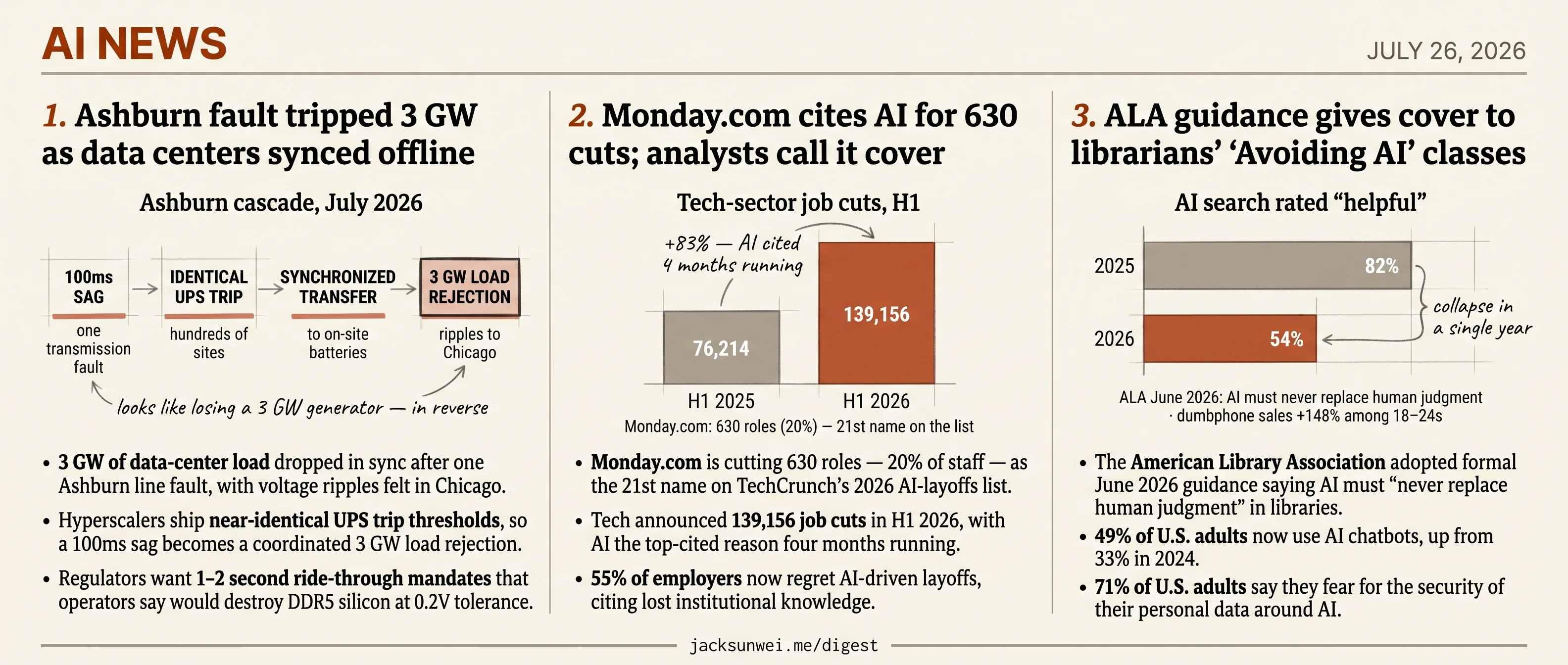
Ashburn grid trips 3 GW, Monday.com cuts 630, ALA warns libraries on AI
A 3 GW Ashburn grid trip, Monday.com's 630 AI-cited layoffs, and new ALA guidance each mark an institutional check on the AI buildout.
Ashburn grid trips 3 GW, Monday.com cuts 630, ALA warns libraries on AI
TL;DR
- Ashburn line fault dropped 3 GW of data-center load in sync, sparking a ride-through mandate fight.
- Monday.com cuts 630 roles citing AI, the 21st firm on TechCrunch’s 2026 layoffs list.
- 55% of employers now regret their AI-driven layoffs, citing lost institutional knowledge.
- American Library Association June guidance says AI must never replace human judgment in libraries.
- Dumbphone sales to 18–24-year-olds jumped 148%, with buyers citing forced AI integration.
Three unrelated AI-news leads today share one shape: an institution outside the AI-boom story stepping in to name a limit. In Ashburn, a single line fault cascaded into a 3 GW synchronous load rejection because hyperscalers all ship near-identical UPS trip thresholds — and regulators now want ride-through mandates the operators say would fry DDR5. At Monday.com, another 630 roles get cut in AI’s name, but 55% of employers who ran the same play already regret it, and analysts are calling the citation cover for pandemic overhiring and GPU capex. At the American Library Association, formal June guidance tells librarians AI must never replace human judgment — landing alongside consumer trackers showing AI-search helpfulness collapsing from 82% to 54% and dumbphone sales to under-25s up 148%.
None of these three is a headline capability story. Each is a check — engineering, financial, cultural — arriving after the buildout, not before it.
Ashburn fault tripped 3 GW as data centers synced offline
Source: techcrunch-ai · published 2026-07-25
TL;DR
- 3 GW of data-center load dropped in sync after one Ashburn line fault, with voltage ripples felt in Chicago.
- Hyperscalers ship near-identical UPS trip thresholds, so a 100ms sag becomes a coordinated 3 GW load rejection.
- Regulators want 1–2 second ride-through mandates that operators say would destroy DDR5 silicon at 0.2V tolerance.
- Virginia’s GS-5 tariff and NY’s 50 MW moratorium move the fight past reliability to who eats the cost.
A generator loss in reverse
The July 2026 Northern Virginia event was not a close call — it was the second data point in an established failure mode. Roughly 3,000 MW of load — about 3% of PJM’s total demand — dropped off in seconds after a single transmission fault, with voltage disturbances registering as far as Chicago and stabilization taking more than ten minutes 1. The July 2024 precedent shed 1.5 GW across 60 sites. This one doubled it.
The diagnosis in independent post-mortems is unambiguous: this is not a generation shortfall. It is a common-mode protection problem. Hyperscale campuses ship with nearly identical, conservative UPS transfer settings, so a sub-100ms sag triggers a synchronized flip to on-site batteries and generators across the entire Data Center Alley. From the grid’s perspective, losing 3 GW of load in one beat looks exactly like losing a 3 GW generator — except in reverse 1.
flowchart LR
    A[Transmission fault<br/>~100ms voltage sag] --> B[Hundreds of UPS units<br/>identical trip thresholds]
    B --> C[Synchronized transfer<br/>to on-site power]
    C --> D[3 GW load rejection]
    D --> E[Over-voltage propagates<br/>PJM → MISO]
The ride-through standoff
The obvious fix — force data centers to ride through small dips instead of tripping — is already a regulatory brawl. The Texas PUC unanimously approved ride-through rules earlier this year, and utilities are pushing a 1–2 second tolerance for voltage dips up to 10% 23.
Operators are not having it. They argue that modern AI hardware — DDR5 memory with voltage tolerances inside 0.2V, HBM stacks, precision liquid cooling — was never designed to sit inside a fluctuating grid, and that a forced-coupling mandate risks bricking hundreds of millions of dollars of accelerators per site 3. As one analysis put it, there is “no incentive” to comply voluntarily when the downside is a destroyed fleet 2.
Staying connected to a fluctuating grid risks damaging millions of dollars in server equipment. 2
That’s the fault line: utilities frame the trips as operator choices; operators frame them as programmed self-preservation. Both are right.
The flexibility alternative
There is a third path the TechCrunch piece skips. Tyler Norris’s “curtailment-enabled headroom” analysis, now operationalized in EPRI’s DCFlex work and grid-forming inverter deployments, argues the existing US grid could absorb nearly 100 GW of new load if data centers curtailed just 0.25–1% of hours per year, using battery buffers and GFM inverters to provide synthetic inertia instead of tripping offline 4. That reframes hyperscalers as grid assets — dispatchable demand plus fast-responding storage — rather than as unmanaged 500 MW step loads.
Who pays
The policy conversation has already moved past reliability into cost allocation. Virginia’s SCC approved a new GS-5 rate class that, from early 2027, forces large loads to pay 85% of contracted transmission demand whether they use it or not — protecting residents from speculative build-outs 5. New York went further with a 12-month freeze on any hyperscale site over 50 MW 6. Consumer advocates argue even the 85% floor leaves over $1 billion of stranded-cost risk on residential ratepayers 5.
The Ashburn trip did not expose a problem. It exposed that three incompatible remedies — ride-through mandates, flexibility markets, and cost-shift tariffs — are all being written at once, by different regulators, against operators with no unified position.
Monday.com cites AI for 630 cuts; analysts call it cover
Source: techcrunch-ai · published 2026-07-26
TL;DR
- Monday.com is cutting 630 roles — 20% of staff — as the 21st name on TechCrunch’s 2026 AI-layoffs list.
- Tech announced 139,156 job cuts in H1 2026, with AI the top-cited reason four months running.
- 55% of employers now regret AI-driven layoffs, citing lost institutional knowledge.
- The split: genuine substitution vs. narrative cover for pandemic-era overhiring and capex reallocation to GPUs.
The fresh datapoint
Monday.com — a profitable SaaS company still guiding to ~20% revenue growth — is cutting 630 people, about a fifth of its workforce, and booking $45–55M in restructuring charges tied largely to severance and office impairments 7. The company frames the reset as a pivot to an “AI Work Platform.” That framing, more than the headcount, is why the layoff matters: it puts a growing, cash-generative vendor into a bucket previously dominated by companies with a revenue problem to explain.
The macro backdrop
TechCrunch’s running list is a curated slice of a much bigger dataset. Challenger, Gray & Christmas counted 139,156 tech-sector job cuts in the first half of 2026 — an 83% surge over H1 2025’s 76,214 8 — and flagged AI as the single most-cited reason for U.S. layoffs across all sectors for four consecutive months through June, with tech alone accounting for nearly one-third of the year’s cuts 9. In other words, “we’re restructuring around AI” has become the modal executive explanation for a downsizing, regardless of industry.
The AI-washing critique
Independent analysts are increasingly skeptical that the technology is actually doing the work the press releases imply. SHRM notes bluntly that “many organizations announcing AI-related cuts do not yet have mature, vetted AI applications ready to perform the tasks of the workers they are firing” 10. The HAIA Foundation is sharper:
These cuts are corporate housekeeping in a costume — allowing executives to correct for pandemic-era overhiring while framing the decision as a forward-looking technological transition. 11
That reframes the TechCrunch list as much a census of companies choosing an AI narrative as of workers actually replaced by models. The tell, on this reading, is the mismatch between the maturity of shipped agent products and the confidence of the headcount decisions built around them.
The boomerang the list doesn’t show
The running-list format also misses a reversal that’s already underway. Survey data cited by IBTimes finds 32% of U.S. hiring managers have rehired for roles previously eliminated due to AI, and 55% of employers now say they regret AI-driven layoffs — citing lost institutional knowledge and the premium of re-recruiting 12. That is a striking rebuke of the 2024–2025 “AI replaces humans” playbook from inside the same HR function that executed it, and it suggests a nontrivial share of 2026’s cuts will quietly reverse over the next 18 months.
What to take away
The 2026 AI-layoff wave splits cleanly along one axis: real substitution versus rhetorical cover for cyclical rightsizing and capex reallocation toward data centers. Monday.com fits both readings — a genuine product pivot toward agentic workflows, and a stock down roughly 50% YTD that needs an investor story. When the next name joins the running list, the useful question isn’t whether AI was cited. It’s whether the company can point to a shipped agent doing the eliminated work — and whether it’s still doing that work a year from now.
ALA guidance gives cover to librarians’ ‘Avoiding AI’ classes
Source: techcrunch-ai · published 2026-07-25
TL;DR
- The American Library Association adopted formal June 2026 guidance saying AI must “never replace human judgment” in libraries.
- 49% of U.S. adults now use AI chatbots, up from 33% in 2024.
- 71% of U.S. adults say they fear for the security of their personal data around AI.
- AI search “helpfulness” ratings collapsed from 82% to 54% in a single year across consumer trackers.
- Dumbphone sales to 18–24-year-olds jumped 148%, with buyers citing “forced AI integration” as the trigger.
Not a fringe act anymore
TechCrunch’s viral library workshops — where patrons learn to disable Apple Intelligence, swap Gemini for DuckDuckGo, and append udm=14 to Google URLs — landed the same month the American Library Association gave the movement institutional cover. In June 2026 the ALA Council adopted “Guidance on the Use of Artificial Intelligence in Libraries,” a living framework insisting AI must never replace human judgment and must be measured against privacy, intellectual freedom and environmental sustainability 13. A parallel “Slow AI” school inside the profession goes further, arguing that the correct response to generative tools isn’t a better prompt but a library card, and that refusal itself is a literacy skill worth teaching 14.
That reframes what’s happening at the reference desk. Librarians teaching opt-out flows aren’t hobbyists — they’re executing a professional standard.
The demand signal is quantified
The workshops are packing rooms because the underlying mood is measurable. Forbes cites 2026 survey data showing 49% of U.S. adults now use AI chatbots (up from 33% in 2024), yet 63% believe the technology is advancing too rapidly and 71% express fears about personal data security 15. Search Engine Land’s tracker registered helpfulness ratings for AI-powered search falling from 82% to 54% in a single year, with roughly half of consumers now saying they actively prefer brands that don’t use generative AI in customer-facing content 16.
The behavior change shows up in hardware too. Sales of basic feature phones rose 148% among 18-to-24-year-olds, and buyers frame the purchase as a defense against “forced AI integration” rather than nostalgia 17. A librarian drawing 70 people to a workshop that used to draw twelve is the visible edge of that curve.
The structural stakes TechCrunch skips
The udm=14 trick — Google’s “Web” filter that strips AI Overviews from results — is a symptom of a bigger fight. Publishers report referral traffic declines of 40% to 85% since AI Overviews rolled out to an estimated 2 billion users, and the “Google-Extended” opt-out carries a ranking penalty in traditional search, so opting out costs visibility either way 18. Librarians teaching patrons to route around AI Overviews aren’t just protecting personal attention — they’re routing them back toward the human-written web that the reference profession depends on. The workshop and the traffic collapse are two sides of the same infrastructure story.
The dissent
The counter-argument from industry commentators is that refusal is UI theater: Apple Intelligence, Gemini and Copilot are baked into the OS layer, and a two-hour library workshop can’t unwind that. The librarians’ rebuttal is philosophical rather than technical.
The best response to generative AI is not a better prompt but a library card. 14
If half of consumers already prefer AI-free brands 16 and the ALA has codified refusal as compatible with its core values 13, the “futile” framing is getting harder to sustain. The literacy outcome the workshops teach isn’t avoidance — it’s the ability to choose.
Round-ups
Claude Opus 5 matches Fable quality at half the price
Source: latent-space
Anthropic’s Claude Opus 5 hits Fable-level benchmark performance while pricing at roughly half of Fable, extending Anthropic’s reputation for distilling frontier capabilities into cheaper Opus-tier models and squeezing rival flagship offerings on cost-per-token.
Model routers caught gaming benchmark evaluations
Source: bens-bites
Fresh scrutiny lands on models, writing tools, and routing layers accused of cheating evaluations — steering queries to stronger backends during tests or memorizing benchmark data, raising fresh questions about how much reported leaderboard performance reflects real deployment behavior.
Canadian MP reads chatbot preamble aloud in floor speech
Source: ars-technica-ai
A Canadian legislator accidentally read an LLM’s meta-response — “Here’s a more natural, flowing version of that section” — into the parliamentary record during a floor speech, offering a live look at how deep chatbot-drafted text has crept into official government remarks.
Footnotes
-
mlq.ai — post-mortem of the Ashburn event — https://mlq.ai/news/northern-virginia-data-center-trip-exposes-a-3-gigawatt-grid-blind-spot/
↩ ↩2More than 3,000 megawatts (3 GW) of load disconnected, causing voltage disturbances detected as far away as Chicago… the core issue is not a lack of generation, but a ‘structural mismatch’: data centers are programmed with nearly identical, conservative protection settings that amplify minor grid fluctuations into massive, destabilizing demand swings.
-
Utility Dive — Texas PUC ride-through rulemaking — https://www.utilitydive.com/news/texas-puc-approves-ride-through-rules-data-centers/825051/
↩ ↩2 ↩3The Texas Public Utility Commission unanimously approved rules requiring data centers to ‘ride through’ these events… experts note there is often ‘no incentive’ for operators to comply voluntarily, as staying connected to a fluctuating grid risks damaging millions of dollars in server equipment.
-
Medium analysis of hardware tolerance friction — https://medium.com/@nftkingpin111/the-growing-challenge-of-data-centers-to-u-s-0369a3a5ea9a
↩ ↩2Utilities are pushing for a 1–2 second ride-through standard for voltage dips of up to 10%, yet data center operators argue that modern components, such as DDR5 RAM, have extremely narrow voltage tolerances (often within 0.2 volts) and could suffer permanent damage if forced to stay connected during instability.
-
AFRY report on grid-forming inverters / Tyler Norris flexibility work — https://afry.com/sites/default/files/2026-02/the_next_wave_of_power_-_grid_forming_solutions.pdf
↩The existing U.S. power grid could accommodate nearly 100 GW of new load without major transmission expansion… relies on data centers reducing their consumption by just 0.25% to 1% during the most stressed hours of the year.
-
American Action Forum on Virginia’s GS-5 rate class — https://www.americanactionforum.org/insight/virginias-new-data-center-electricity-rate-class/
↩ ↩2Virginia’s SCC approved the ‘GS-5’ rate class for large loads… Starting in early 2027, this class mandates that data centers pay 85% of their contracted transmission demand to insulate the public from speculative build-outs.
-
Sustainability Magazine on NY moratorium — https://sustainabilitymag.com/news/new-york-pauses-ai-data-centres-over-environmental-impact
↩New York recently implemented a 12-month freeze on hyperscale data centers drawing over 50 MW to protect grid stability and prevent cost-shifting to residents.
-
Renascence — https://www.renascence.io/news/6255/monday-com-cuts-630-roles-20-in-shift-to-ai-work-platform
↩Monday.com cuts 630 roles (20%) in shift to AI work platform, with restructuring charges of $45–55M expected, primarily severance and office impairments.
-
CFO Dive — https://www.cfodive.com/news/tech-layoffs-surge-83percent-h1-2026-challenger-ai-disruption/824260/
↩Technology sector announced 139,156 job cuts in the first half of 2026, an 83% surge over the 76,214 cuts in H1 2025.
-
Challenger, Gray & Christmas (June 2026 report) — https://www.challengergray.com/blog/challenger-report-june-layoffs-cool-to-45849-down-53-from-may-ai-leads-reasons-for-fourth-consecutive-month/
↩AI led reasons cited for job cuts for the fourth consecutive month, with tech accounting for nearly one-third of U.S. layoffs by mid-year.
-
SHRM — ‘AI Layoffs: Transformation or Scapegoat?’ — https://www.shrm.org/topics-tools/news/technology/ai-layoffs-transformation-scapegoat
↩Many organizations announcing AI-related cuts do not yet have mature, vetted AI applications ready to perform the tasks of the workers they are firing.
-
HAIA Foundation Substack — ‘The Layoffs I Called a Cover Story’ — https://substack.haia.foundation/p/the-layoffs-i-called-a-cover-story
↩These cuts are corporate housekeeping in a costume — allowing executives to correct for pandemic-era overhiring while framing the decision as a forward-looking technological transition.
-
IBTimes UK — https://www.ibtimes.co.uk/companies-reassess-ai-job-cuts-human-skills-1808920
↩32% of U.S. hiring managers have rehired for roles previously eliminated due to AI; 55% of employers now regret their AI-driven layoffs, citing lost institutional knowledge.
-
American Library Association (Office for Intellectual Freedom) — https://www.oif.ala.org/intellectual-freedom-news-7-17-2026/
↩ ↩2ALA Council adopted the ‘Guidance on the Use of Artificial Intelligence in Libraries’ in June 2026, a living framework insisting AI must never replace human judgment and must align with intellectual freedom, privacy and environmental sustainability.
-
The Slow AI (Substack) — https://theslowai.substack.com/p/best-response-to-ai-is-a-library-card
↩ ↩2The best response to generative AI is not a better prompt but a library card — a ‘Slow AI’ politics of refusal that protects the human skills close reading and judgement that AI cannot replicate.
-
Forbes (Sircar, June 2026) — https://www.forbes.com/sites/anishasircar/2026/06/22/americans-use-ai-more-but-trust-it-less-research-finds/
↩49% of U.S. adults now use AI chatbots (up from 33% in 2024), yet 63% believe the technology is advancing too rapidly and 71% express fears about personal data security.
-
Search Engine Land — ‘AI search adoption rises, consumer trust declines’ — https://searchengineland.com/ai-search-adoption-rises-consumer-trust-declines-study-480338
↩ ↩2The share of users who found AI-powered search ‘helpful’ fell from 82% to 54% in a single year, and roughly 50% of consumers now say they prefer brands that explicitly avoid using generative AI in customer-facing content.
-
Vertu — ‘Why is Gen Z buying dumb phones’ — https://vertu.com/lifestyle/why-is-gen-z-buying-dumb-phones-the-rise-of-digital-minimalism-in-2026
↩Sales of basic feature phones jumped 148% among 18-to-24-year-olds, framed by buyers as a defense against ‘forced AI integration’ rather than nostalgia.
-
gHacks — ‘Reddit and major publishers consider blocking Google as AI Overviews cut referral traffic’ — https://www.ghacks.net/2026/07/23/reddit-and-major-publishers-consider-blocking-google-as-ai-overviews-cut-search-referral-traffic/
↩Publishers are reporting referral traffic declines of 40% to 85% since AI Overviews rolled out to an estimated 2 billion users, and ‘Google-Extended’ opt-out carries a visibility trade-off that can suppress ranking in traditional search.