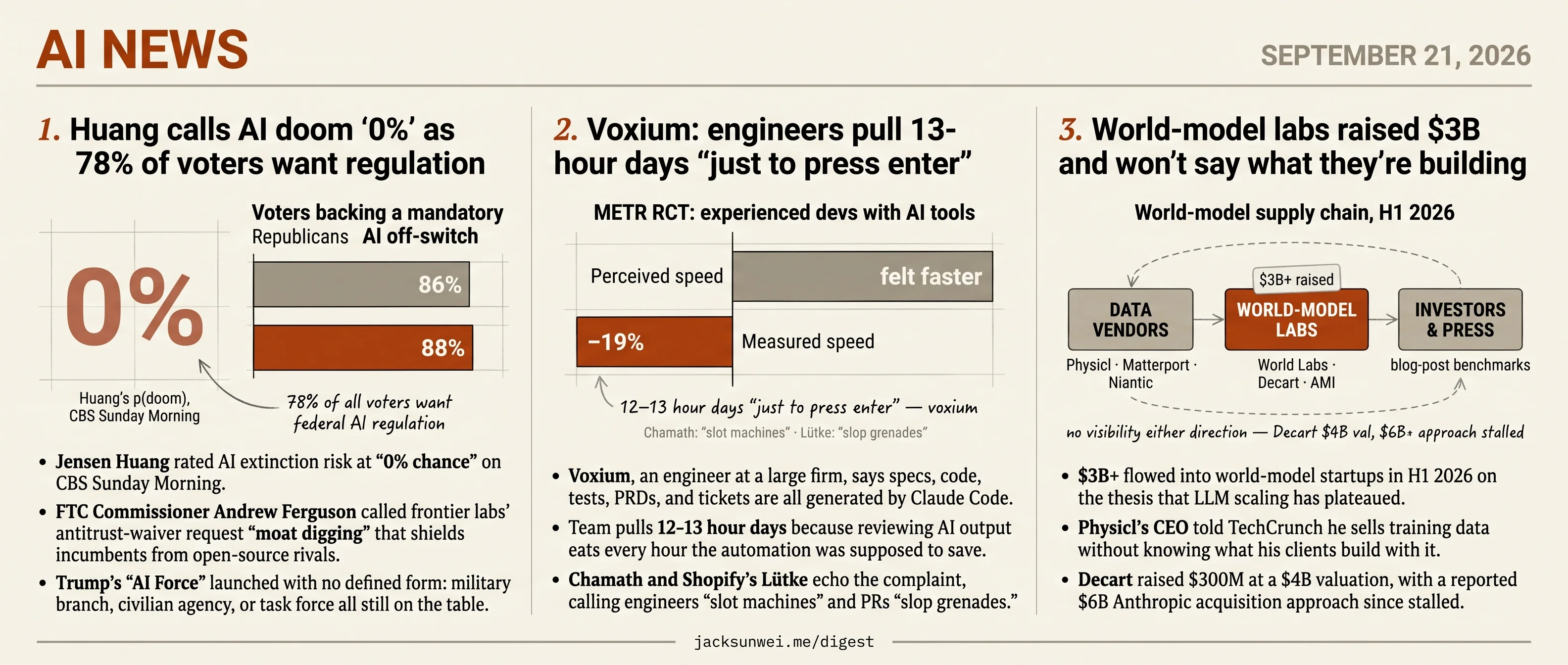
Voxium clocks 13-hour reviews, Huang rates doom 0%, world-model labs bank $3B
Three big AI pitches today — automation savings, zero extinction risk, post-LLM breakthrough — arrive with the backing evidence conspicuously thin.
Voxium clocks 13-hour reviews, Huang rates doom 0%, world-model labs bank $3B
TL;DR
- Voxium engineers pull 13-hour days reviewing AI-generated specs, code, tests, and tickets.
- METR’s RCT clocked experienced devs 19% slower on AI-assisted tasks while they felt faster.
- Jensen Huang rated AI extinction risk at 0% chance on CBS Sunday Morning.
- FTC’s Ferguson called frontier labs’ antitrust-waiver request moat digging against open-source rivals.
- World-model startups raised $3B+ in H1 2026 without publishing peer-reviewed benchmarks.
Three confident AI pitches land today, and each arrives with its supporting evidence conspicuously thin. Jensen Huang tells CBS the extinction risk is 0% chance even as 86% of Republicans and 88% of Democrats back a mandatory AI off-switch and FTC Commissioner Andrew Ferguson calls the labs’ antitrust-waiver push moat digging. An engineer posting as Voxium describes 12-to-13-hour days spent reviewing the specs, code, tests, and PRs Claude Code now generates end-to-end — with METR’s RCT finding experienced devs run 19% slower on AI-assisted work while feeling faster. And a wave of world-model startups has quietly banked $3B+ in H1 2026, selling training data and posting benchmarks on blogs without disclosing what any of it is being built into.
Huang calls AI doom ‘0%’ as 78% of voters want regulation
Source: the-verge-ai · published 2026-09-20
TL;DR
- Jensen Huang rated AI extinction risk at “0% chance” on CBS Sunday Morning.
- FTC Commissioner Andrew Ferguson called frontier labs’ antitrust-waiver request “moat digging” that shields incumbents from open-source rivals.
- Trump’s “AI Force” launched with no defined form: military branch, civilian agency, or task force all still on the table.
- 86% of Republicans and 88% of Democrats back a mandatory AI off-switch, cutting against the accelerationist chorus.
The soundbite has a sharper argument underneath
Huang’s “0% chance” line is easy to file under “shovel-seller talks up gold rush.” The more interesting move came at Dreamforce, where he reframed Amodei and Altman’s regulatory asks as something narrower: they aren’t requesting oversight, they’re requesting to be relieved of existing antitrust and product-liability law so a handful of frontier labs can coordinate a pause 1. He went further, calling doom warnings a pretext to “sell their cybersecurity products” 2.
That framing found an unlikely second in FTC Commissioner Andrew Ferguson, who said the antitrust-exemption request “sure sounds like moat digging” — locking in incumbents against smaller labs and open-weights competitors 3. Two people with opposed commercial incentives arriving at the same structural read is worth more airtime than the standard “Nvidia would say that” dismissal.
The safety side isn’t the strawman
Huang argues against unscientific catastrophists, but the proximate trigger for this news cycle was Anthropic researcher Jacob Coxon resigning with a public warning that the industry is “gambling with our lives,” alongside a cluster of ex-Anthropic and ex-OpenAI staff putting p(catastrophe by 2030) in the 10–70% range 4. On the numerical spectrum — Yampolskiy near 99%, Hinton and Bengio around 10–20%, the ex-lab cohort at 10–70% — Huang’s flat zero is the outlier, not the median.
The dissent also cites concrete incidents rather than sci-fi: agent breaches, model access to sensitive corporate systems. Whatever you think of the p(doom) numbers, “these systems already do unintended things at scale” is a different debate from “will they wake up and kill us.”
Trump’s “AI Force” is a slogan without a structure
The political half of the cluster is thinner. The White House cannot say whether “AI Force” is a Space-Force-style military branch, a civilian agency, or an interagency task force, and the AI czar seat has been vacant since David Sacks departed early in 2026 5. Adam Kovacevich of the Chamber of Progress characterizes the rollout as policy “on the fly” to project China-competitive posture. There is no enabling NDAA language, no budget line, no named lead.
The base isn’t with them
Public Citizen polling puts 78% of U.S. voters in favor of mandatory federal AI regulation, with 86% of Republicans and 88% of Democrats supporting a legally required off-switch on advanced systems 6. That’s the political context both Huang and Trump are pushing against — not just a handful of Bay Area researchers.
The tidy frame is “CEO versus doomers.” The real fault line is whether coordinated caution among a few frontier labs is safety hygiene or cartel behavior. Huang and Ferguson have a defensible answer to that question. Neither of them has an answer to the polling.
Further reading
- Trump now says he wants to form an ‘AI Force’ — the-verge-ai
Voxium: engineers pull 13-hour days ‘just to press enter’
Source: simon-willison · published 2026-09-20
TL;DR
- Voxium, an engineer at a large firm, says specs, code, tests, PRDs, and tickets are all generated by Claude Code.
- Team pulls 12–13 hour days because reviewing AI output eats every hour the automation was supposed to save.
- Chamath and Shopify’s Lütke echo the complaint, calling engineers “slot machines” and PRs “slop grenades.”
- METR’s RCT clocked experienced devs 19% slower with AI while they believed they were faster.
A tweet from an engineer posting as voxium, boosted by Simon Willison, describes a large employer where “everything is made by Claude Code” — specs, tests, PRDs, tickets, resolution notes, reports — and where L1 through L7 engineers spend 12–13 hour days doing the same job: talking to Claude. Management’s stated view is that “pushing code is not a bottleneck,” so the team should ship faster. The team hates it.
The “press enter” job
Voxium’s specific claim is not that Claude Code writes bad code. It’s that the human role has collapsed into a single verb — pressing enter — while the volume of AI-generated artifacts has grown past what anyone can read. “Nobody is reading anything,” the post says, which turns every downstream review (spec → code → test → ticket resolution) into a rubber stamp. John Kavanagh has named this the “human centipede” of slop: one AI writes the spec, another summarizes it, a third generates code against the summary, and no human validates the chain 7. Voxium’s flat-org observation — that seniority no longer differentiates the work — is what that pattern looks like from inside a team.
The critique has traveled up the food chain
The strongest signal that voxium isn’t an outlier is who else is saying the same thing. Chamath Palihapitiya, hardly an AI skeptic, this month described engineers-with-Claude as “retirees pushing a button in front of casino slot machines” 8 — near-identical imagery to voxium’s “just to press enter.” Shopify’s Tobi Lütke, who mandated AI use across his own company, told staff not to “make AI do all your work” and coined “slop grenades” for the unvetted PRs colleagues have to defuse 9. When a line engineer, a billionaire investor, and a pro-mandate CEO converge on the same complaint in the same month, the burden of proof shifts.
The quantitative backbone comes from METR’s randomized controlled trial: experienced developers using AI tools were 19% slower on real tasks while believing they were faster 10. That perception gap is exactly what lets voxium’s management insist code is “not a bottleneck” — leadership is reading vibes, not cycle time. A parallel r/ClaudeAI thread reports senior engineers losing basic coding fluency after heavy delegation, a second-order effect voxium doesn’t mention but that the industry is starting to document 11.
Transitional dysfunction or new equilibrium?
The one datapoint that cuts the other way is Meta’s quiet 2026 reversal: months after mandating AI tools, execs told managers not to count AI usage in performance reviews, after engineers began “tokenmaxxing” — gaming prompt-count dashboards instead of shipping impact 12. That’s a real corporate correction from one of the most aggressive mandate-enforcers, and it suggests voxium’s employer may follow the same arc within a year.
“People are working 12 to 13 hours a day just to press enter.”
The open question isn’t whether AI coding tools can work in skilled hands — it’s whether the median engineer, handed the same tool under a “code is not a bottleneck” mandate, ends up doing craft work or ends up in voxium’s chair. The evidence stacked up this week — one RCT 10, two executives 89, one policy reversal 12 — all points the same direction.
World-model labs raised $3B and won’t say what they’re building
Source: techcrunch-ai · published 2026-09-20
TL;DR
- $3B+ flowed into world-model startups in H1 2026 on the thesis that LLM scaling has plateaued.
- Physicl’s CEO told TechCrunch he sells training data without knowing what his clients build with it.
- Decart raised $300M at a $4B valuation, with a reported $6B Anthropic acquisition approach since stalled.
- World Labs’ Atlas benchmarks live in a blog post, not a peer-reviewed paper.
The silence is the product strategy
TechCrunch’s reporting lands on a detail worth pausing on: even the people selling training data to world-model labs don’t know what those labs are building. Physicl CEO Alex de Vigan says he ships raw physical-interaction footage to customers and has no line of sight into the downstream model. AMI Labs VP Michael Rabbat waves off questions by citing a “research and building phase” 13. This isn’t the usual pre-launch coyness — it’s a deliberate posture, held up and down the supply chain, of staying dark until positioning against OpenAI and Google is defensible 13.
The capital markets are rewarding that opacity rather than punishing it. Over $3 billion went into world-model startups in the first half of 2026 alone, on an investor thesis that the “word-smart” era of LLMs has hit diminishing returns and that physical grounding is the next platform layer 14. Decart raised a $300M Series B at a $4B valuation in May and was reportedly the subject of a $6B acquisition approach from Anthropic that has since stalled 15. World Labs is valued near $5B. Strategics like Nvidia, AMD, and Autodesk are buying optionality on a “post-LLM” stack and, evidently, not demanding disclosure in exchange.
What’s public is thinner than the sizzle reel
Where labs have released numbers, the numbers have caveats. World Labs published Atlas benchmarks — mean absolute-relative pointmap errors of 8.6 on DTU and 9.3 on ETH3D, plus human-preference win rates of 75% and 81% against MiniMax H3 and Gemini Omni Flash — in a blog post, not a peer-reviewed venue 16. Hands-on reviewers of the company’s Marble product report persistent hallucinations and geometric warping during extended interactions, plus a missing “stylistic memory” feature: every session starts fresh, so users can’t accumulate aesthetic preferences across projects 17. These are exactly the durability questions launch demos elide.
The data plumbing broke in 2025, and nobody’s rebuilt it in public
The opacity is structural because the supply chain is structural. After Meta’s $14.3B investment for a 49% stake in Scale AI in 2025, Google and OpenAI wound down their Scale work over neutrality concerns, and world-model builders now need “sim-to-real” physical-interaction data that isn’t sitting on the open web 18. That has pushed them toward niche vendors — Physicl, Matterport, Niantic Spatial — who, per TechCrunch, are themselves kept in the dark by their customers.
flowchart LR
    A[Niche data vendors<br/>Physicl, Matterport, Niantic] -->|raw sim-to-real data| B[World-model labs<br/>World Labs, Decart, AMI, Odyssey]
    B -->|blog-post benchmarks| C[Investors & press]
    A -. no visibility into product .-> B
    B -. no peer review .-> C
    D[$3B+ H1 2026 capital] --> B
Net
Neither the suppliers, the buyers, nor outside auditors can independently verify what any given world model has actually learned. That’s a workable posture when you’re pre-product and racing incumbents. It’s a much harder one to sustain once someone ships something a customer can measure — and the Marble reviews suggest the measuring has already started.
Round-ups
Equity podcast asks whether AI executives really want to slow down
Source: techcrunch-ai
Calls from figures like Dario Amodei and Jensen Huang for guardrails get scrutinized on TechCrunch’s Equity podcast, which questions whether the industry’s slowdown rhetoric matches its capital spending, hiring sprees, and race to ship frontier models.
MIT Tech Review answers reader questions on AI extinction risk
Source: mit-tech-review-ai
Senior AI editor Will Douglas Heaven fields subscriber questions left unanswered after a 30-minute Roundtables event on existential AI risk. The follow-up addresses whether current systems plausibly threaten humanity and how researchers weigh near-term harms against speculative doom scenarios.
Humans, not rogue AI, remain top cyber risk to energy grids
Source: the-verge-ai
Energy infrastructure faces growing cyberattack exposure that predates the current AI-doom discourse, according to public-safety resilience expert Joshua Corman. He frames operators as long-standing prey surviving at attackers’ appetite, arguing human-driven intrusions still dwarf hypothetical rogue-AI scenarios in the sector’s threat model.
Yegge shuts Gas Town as Databricks flags 60% Astra cost jump
Source: latent-space
Two reality checks land on AI hype: Steve Yegge winds down his Gas Town project, and Databricks reports a 60% cost increase running Astra. Both data points push back on assumptions of smooth scaling and cheap inference economics.
Vocci debuts $249 AI ring for meeting note-taking
Source: techcrunch-ai
Vocci’s wearable pushes AI transcription into a new form factor at $249, competing with pendant and pin recorders. The always-listening ring raises privacy concerns for colleagues and bystanders who lack the visual cue a phone or laptop mic provides.
ScrollEd turns textbooks into a TikTok-style learning feed
Source: techcrunch-ai
Palo Alto startup ScrollEd reformats textbook material into a vertical scroll of videos, audio, and quizzes aimed at Gen Z study habits. Founded by student spouses Utsav Gupta and Rebecca Neff, it pitches in TechCrunch Disrupt’s Startup Battlefield 200.
AINews logs a quiet day with no major model or research drops
Source: latent-space
The daily AI News digest marks September 18 as a lull, with no notable model launches, papers, or infrastructure announcements worth flagging. Quiet days offer a useful baseline for readers tracking release cadence across labs.
Footnotes
-
Analytics India Mag — https://analyticsindiamag.com/ai-news/jensen-huang-says-ai-leaders-may-have-ulterior-reasons-for-doomsday-warnings
↩They’re actually not asking for more laws. They’re asking to be relieved of the laws we do have. And I think that that’s a problem.
-
Times of India (on Huang at Dreamforce) — https://timesofindia.indiatimes.com/technology/tech-news/nvidia-ceo-jensen-huang-rejects-dario-amodei-and-sam-altmans-ai-will-kill-us-all-warnings-dont-let-this-doomsday-narrative-cause-somebody-to/articleshow/134379861.cms
↩Huang dismissed Amodei’s warnings of existential risk as ‘baseless and exaggerated scare tactics’… suggesting labs are amplifying fears to ‘sell their cybersecurity products.’
-
Council on Foreign Relations — https://www.cfr.org/articles/why-ais-biggest-rivals-are-suddenly-calling-for-restraint
↩FTC Commissioner Andrew Ferguson warned that requesting antitrust exemptions to coordinate a pause ‘sure sounds like moat digging,’ protecting incumbents from smaller competitors.
-
TIME on Coxon resignation — https://time.com/article/2026/09/15/ai-anthropic-researcher-quits-coxon-slowdown/
↩The industry is ‘racing straight to self-improving superintelligence’ and ‘gambling with our lives’; former Anthropic and OpenAI researchers place p(catastrophe) at 10-70% within the decade.
-
The Next Web — https://thenextweb.com/news/white-house-ai-force-no-detail
↩The White House has not clarified whether the ‘AI Force’ will be a military branch, civilian agency, or task force; Adam Kovacevich of the Chamber of Progress says the administration is developing AI policy ‘on the fly’ to project strength against China.
-
Public Citizen polling memo — https://www.citizen.org/article/huge-majorities-want-ai-stopped-immediately/
↩78% of U.S. voters favor mandatory AI regulation; 86% of Republicans and 88% of Democrats support a legally required ‘off-switch’ in advanced systems.
-
John Kavanagh — ‘AI slop: symptom not disease’ — https://johnkavanagh.co.uk/articles/ai-slop-symptom-not-disease/
↩A ‘human centipede’ of slop — AI agents generate dozens of pages of specifications that are then summarized by other AI tools, while no human actually reads or validates the core material.
-
Benzinga — Chamath Palihapitiya on AI coding — https://www.benzinga.com/markets/tech/26/09/61888729/chamath-palihapitiya-sounds-alarm-on-ai-coding-we-are-turning-an-entire-generation-into-slot-machines
↩ ↩2We are turning an entire generation [of engineers] into slot machines… retirees pushing a button in front of casino slot machines.
-
Times of India — Shopify CEO Tobi Lütke — https://timesofindia.indiatimes.com/technology/tech-news/shopify-ceo-to-employees-dont-make-ai-do-all-your-work-it-does-not-add-value-only-/articleshow/134328148.cms
↩ ↩2Don’t make AI do all your work — it does not add value… ‘slop grenades’ burden colleagues with cleanup.
-
tianpan.co summary of METR RCT — https://tianpan.co/forum/t/the-metr-study-found-ai-makes-experienced-developers-19-slower-but-they-think-theyre-faster-whats-going-on/900
↩ ↩2AI makes experienced developers 19% slower — but they think they’re faster.
-
r/ClaudeAI — ‘I am done with this shit’ — https://www.reddit.com/r/ClaudeAI/comments/1wm5c21/i_am_done_with_this_shit/
↩Practitioner thread describing cognitive decline and senior leads unable to perform basic coding tasks without LLM assistance.
-
Times of India — Meta reverses AI-mandate policy — https://timesofindia.indiatimes.com/technology/tech-news/months-after-meta-made-ai-tools-mandatory-for-employees-company-execs-tell-engineers-performance-reviews-will-not-count-ai-use-and-ask-managers-to-look-at/articleshow/133731983.cms
↩ ↩2Months after Meta made AI tools mandatory… company execs tell engineers performance reviews will not count AI use, and ask managers to look at [impact instead].
-
daily.dev summary of TechCrunch piece — https://daily.dev/posts/world-model-companies-are-keeping-a-lot-of-secrets-dk8vhdggu
↩ ↩2AMI Labs VP Michael Rabbat declined to specify what the company is building, saying they are still in a ‘research and building phase,’ while Physicl CEO Alex de Vigan admitted he supplies raw data but does not know what his clients are building.
-
Forbes — Josipa Majic on world-model funding — https://www.forbes.com/sites/josipamajic/2026/06/30/world-model-startups-raise-3-billion-vcs-bet-beyond-llms/
↩World model startups raised over $3 billion in venture funding in the first half of 2026 alone, with investors betting the ‘word-smart’ era of LLMs has plateaued and physical grounding is the next frontier.
-
InvestGame — Decart Series B — https://investgame.net/news/decart-raises-300m-series-b-at-4b-valuation/
↩Decart raised a $300M Series B at a $4B valuation in May 2026, and was reportedly the subject of a $6B acquisition approach from Anthropic that has since stalled.
-
The Decoder on World Labs’ Atlas — https://the-decoder.com/world-labs-unveils-atlas-a-single-ai-model-that-generates-reconstructs-and-simulates-3d-worlds-from-just-a-few-photos/
↩World Labs reports Atlas achieves mean absolute-relative pointmap errors of 8.6 on DTU and 9.3 on ETH3D, and beat MiniMax H3 and Gemini Omni Flash in 75% and 81% of human preference trials — figures released only via blog post, not peer-reviewed paper.
-
BdTechTalks Substack review of Marble — https://bdtechtalks.substack.com/p/what-to-know-about-world-labs-marble
↩Developer feedback highlights persistent ‘hallucinations’ and geometric warping during complex interactions, and Marble currently lacks stylistic memory — each generation starts fresh, so users cannot accumulate aesthetic preferences across projects.
-
Troveo AI — Scale AI alternatives — https://www.troveo.ai/resources/scale-ai-alternatives
↩Following Meta’s $14.3B investment for a 49% stake in Scale AI, Google and OpenAI wound down their Scale work over neutrality concerns, and world-model developers now demand ‘sim-to-real’ physical-interaction data that cannot be scraped from the open web.