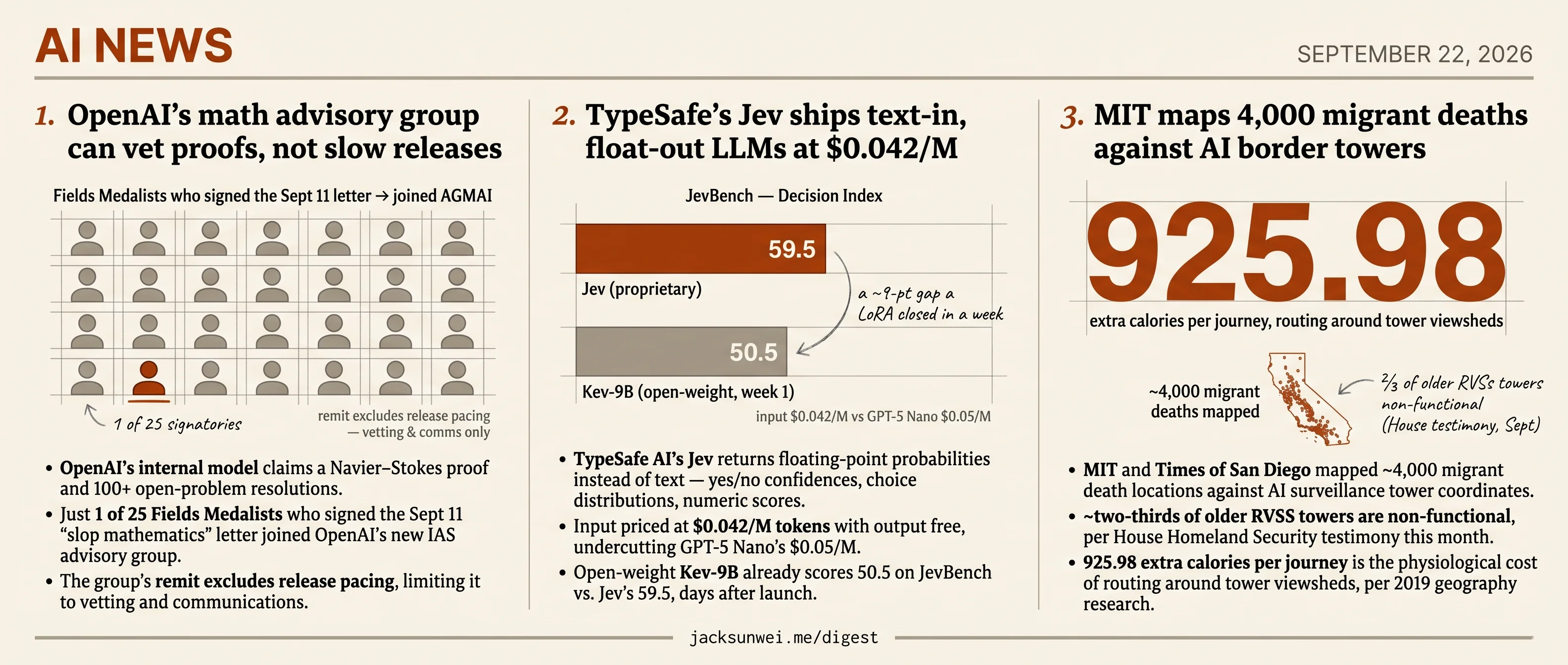
OpenAI limits math advisers, TypeSafe ships typed LLM, MIT maps border deaths
OpenAI narrows its new math advisory group, TypeSafe launches typed-probability LLMs, and MIT maps migrant deaths against Anduril's AI border towers.
OpenAI limits math advisers, TypeSafe ships typed LLM, MIT maps border deaths
TL;DR
- OpenAI’s IAS advisory vets proofs but has no say on release pacing.
- TypeSafe’s Jev returns typed probabilities at $0.042/M input tokens.
- MIT maps ~4,000 migrant deaths against Anduril’s AI border towers.
- California signs 7 bills creating a separate utility rate class for AI data centers.
- UN panel urges precautionary constraints on increasingly capable AI agents.
Three unconnected frontier stories anchor today’s news. OpenAI stands up an IAS math advisory group whose remit stops short of release pacing, even as an internal model claims a Navier–Stokes proof and 100+ open-problem resolutions. TypeSafe launches Jev, a text-in, float-out LLM priced under GPT-5 Nano — with open-weight Kev-9B already 9 points behind on JevBench days after launch. And MIT, with Times of San Diego, maps roughly 4,000 migrant death locations against the AI surveillance towers CBP has built along the border, with Anduril conceding the coverage gap in its formal response.
Around the edges, agent-safety pressure keeps building. Meta’s Muse ships with a ClickFix hijack and gets blocked from Amazon within days. A UN panel urges precautionary limits on capable AI agents. California signs a 7-bill package so residential ratepayers stop subsidizing AI data-center power. Xiaomi’s MiMo-V2.6-Pro claims the open-weights crown for a reported $3M. The frontier keeps shipping; the guardrails keep catching up.
OpenAI’s math advisory group can vet proofs, not slow releases
Source: openai-blog · published 2026-09-21
TL;DR
- OpenAI’s internal model claims a Navier–Stokes proof and 100+ open-problem resolutions.
- Just 1 of 25 Fields Medalists who signed the Sept 11 “slop mathematics” letter joined OpenAI’s new IAS advisory group.
- The group’s remit excludes release pacing, limiting it to vetting and communications.
- OpenAI concedes it “cannot rule out” that de-identified Codex telemetry from outside mathematicians improved the model.
A concession, not a governance structure
The Advisory Group on Mathematics and Artificial Intelligence (AGMAI) is being pitched as an independent bridge to the math community. It is more precisely a concession. Ten days before its launch, 25 Fields Medalists — including Terence Tao, Peter Scholze, Maryna Viazovska and Cédric Villani — signed “A Severe Misalignment of AI in Mathematics,” warning that treating open problems as benchmarks produces “slop mathematics” and reduces human mathematicians to unpaid verifiers of machine output 1. AGMAI is the answer.
The answer is thinner than the IAS letterhead suggests. Only one of the 25 signatories joined the group. Timothy Gowers, an inaugural member, publicly declined to sign the letter, calling the “misalignment” framing potentially counterproductive. The roster — Witten, Hairer, Vakil, De Lellis, Matchett Wood and others — is impressive; the consensus it represents is not.
What the group cannot do
Tao’s own blog post confirms the structural limit: OpenAI carved pacing of internal research out of AGMAI’s remit from the start 2. Members are unpaid, can publicly critique OpenAI, can quit, can leak — and cannot slow a release. This makes AGMAI a vetting-and-communications board, not oversight. It is closest in shape to a journal editorial board that has no power over what the authors do next.
That matters because the immediate trigger for the letter was velocity, not accuracy. If the group can only advise on how results are announced after the model has produced them, the “misalignment” the medalists named is untouched.
The priority dispute nobody wants to litigate
The Navier–Stokes announcement arrived tangled in a scooping allegation. Tristan Buckmaster (NYU) and Levent Alpöge (then at Anthropic) had spent roughly a year on finite-time blowup for 3D Euler using Codex and Claude. Business Insider reports Buckmaster’s claim that OpenAI’s Sébastien Bubeck pressured him to publish jointly without Alpöge, citing the Anthropic affiliation — and that OpenAI conceded it “cannot rule out” that de-identified Codex telemetry from that work improved the model that then produced its own proof 3. OpenAI’s rebuttal, that it solved the unforced case while Buckmaster and Alpöge worked the forced case, is a real technical distinction that most coverage flattens.
Two methodologies, one unverified claim
The verification story is genuinely strong on the artifact and genuinely weak on the semantics. OpenAI released 616,000+ lines of Lean 4 across 2,400 files, with independent kernel runs confirming zero sorry placeholders in the two main breakdown theorems 4. Lean cannot certify that the formal statement matches the Clay Institute’s official problem, and Clay itself requires a two-year acceptance window.
The methodological contrast with DeepMind is sharper still. AlphaProof Nexus solved 9 open Erdős problems and 44 OEIS conjectures earlier this year using Lean-based formalization at hundreds of dollars per problem 5; OpenAI’s swarm reportedly cost $15M and 10,000 parallel agents. And a dissenting flank led by Lior Pachter argues the medalists’ letter is itself elite gatekeeping — the community’s self-image as careful nurturer of ideas is, he says, historically false 6.
AGMAI arrives into that crossfire with a mandate to describe the weather, not change it.
Further reading
TypeSafe’s Jev ships text-in, float-out LLMs at $0.042/M
Source: simon-willison · published 2026-09-21
TL;DR
- TypeSafe AI’s Jev returns floating-point probabilities instead of text — yes/no confidences, choice distributions, numeric scores.
- Input priced at $0.042/M tokens with output free, undercutting GPT-5 Nano’s $0.05/M.
- Open-weight Kev-9B already scores 50.5 on JevBench vs. Jev’s 59.5, days after launch.
- The “typed = safe” pitch cracks under prompt injection: a planted input field moved one block-probability from 0.76 to 0.48.
A new output shape, not necessarily a new model
Jev keeps the LLM front end — text goes in — and rips off the back. Instead of decoding tokens, it emits typed probabilistic values: a Bernoulli score for yes/no (“Noul”) questions, a distribution over enumerated choices, or a float on a described numeric scale. You bundle a “state” object (string, list, or name-value pairs) with as many questions as fit in the context window, and Jev answers them in parallel. TypeSafe’s own framing — “frontier-intelligence function call: unstructured state in, typed probabilistic decisions out” — is the cleanest one-liner, and it’s the reason the launch has developer-experience momentum well beyond what a normal classifier release would earn.
That momentum is also the strongest evidence against the “new category” claim. Within days of launch, Jared Palmer’s Kev family shipped 0.8B/4B/9B open-weight recreations built on Qwen 3.5 with LoRA adapters, and Kev-9B lands at a Decision Index of 50.5 against Jev’s 59.5 on the community-built JevBench 7. Tom’s Hardware reports further clones — Laya, Nimble — built with off-the-shelf RL and LoRA, with critics invoking “getting Schmidhuber’d” to argue the novelty is packaging over architecture 8. A ~9-point gap that a LoRA closes in a week is not a moat.
Where it actually earns its keep
The reranker use case is where independent numbers hold up. MindStudio benchmarked BM25 alone against BM25 followed by a Jev relevance score across 100 candidates and saw top-1 retrieval jump from 21% to 54%, at lower latency than Gemini Flash-Lite 9. That mirrors Simon Willison’s own reranking experiment in the primary, and it’s a much more defensible pitch than “replace your chat model”: Jev slots between retrieval and generation as a cheap, steerable scorer.
flowchart LR
    Q[User query] --> BM25[BM25 retrieval<br/>top 100]
    BM25 --> Jev[Jev score<br/>relevance question]
    Jev --> Top[Top-k rerank]
    Top --> LLM[Generator LLM]
The typed-output safety story is oversold
“No text output” is being marketed as “no hallucination,” and that framing does not survive contact with the security literature. VentureBeat documented an adversarial input pattern that dropped a model’s block probability from 0.76 to 0.48 — enough to flip an automated approval gate — by planting a specific field in the state object 10. Pydantic’s own harness warns that even benign schema choices leak: reordering an enum from [ALLOW, BLOCK] to [BLOCK, ALLOW] can shift the returned probability 11. Willison’s Bay Area anecdote — Cupertino top, East Palo Alto bottom on a “Good city?” query — is a mild version of the same failure mode: a single float hides every signal the model actually used.
Net
Jev is a real DX win and a genuinely strong reranker at a shocking price point. The “System One” branding is doing a lot of work the architecture can’t fully back up — clones are cheap, pricing may be subsidized by the $40M seed on TypeSafe’s own admission 12, and the typed-output veneer doesn’t make the underlying model any less of a black box. Use it for classification and reranking; don’t put it in charge of anything that needs to be audited.
Further reading
MIT maps 4,000 migrant deaths against AI border towers
Source: mit-tech-review-ai · published 2026-09-21
TL;DR
- MIT and Times of San Diego mapped ~4,000 migrant death locations against AI surveillance tower coordinates.
- ~two-thirds of older RVSS towers are non-functional, per House Homeland Security testimony this month.
- 925.98 extra calories per journey is the physiological cost of routing around tower viewsheds, per 2019 geography research.
- Anduril’s formal response concedes the coverage gap: CBP sets “virtual boundaries” that blind the AI to certain zones.
The investigation, in one sentence
MIT Technology Review’s four-part package, built over 15 months with Times of San Diego, is the first attempt to empirically test the “virtual wall’s” central promise — that AI-equipped surveillance towers from Anduril and others help CBP find migrants in distress. The team geolocated nearly 4,000 migrant deaths and overlaid them on tower coordinates, using Anthropic’s Claude API to extract locations from thousands of pages of police and medical-examiner records before manual verification 13. The meta-story is worth pausing on: reporters used the same class of computer-vision-adjacent AI that CBP claims can spot bodies in the desert, and used it successfully to find the ones the towers missed.
The mechanism was in the literature a decade ago
The MIT investigation’s headline causal claim — that surveillance infrastructure kills by redirecting migrants into lethal terrain — is not new. Geographers Samuel Chambers and Geoffrey Boyce modeled the “tertiary funnel effect” as early as 2019, showing that migrants avoiding tower viewsheds expend on average 925.98 additional calories per journey and end up in more rugged, low-visibility corridors where hyperthermia and dehydration risk climbs sharply 14. Chambers put it plainly to GIJN: “Out here, surveillance equals death” 15. Independent reporting from Thomson Reuters Foundation’s Context News reached the same conclusion via separate fieldwork, documenting bodies recovered within camera line-of-sight 16.
flowchart LR
    A[Migrant crossing] --> B{In tower viewshed?}
    B -- Yes --> C[Reroute around]
    B -- No --> D[Continue]
    C --> E[+925 kcal, harsher terrain]
    D --> F[Dehydration / hyperthermia risk]
    E --> F
    F --> G[Death — often within<br/>camera line-of-sight]
What MIT’s dataset adds is empirical corroboration at scale. The academic model predicted where the bodies should fall; the investigation shows they fell there.
Vendor and oversight concede the coverage gap
Anduril’s formal response, preserved in a republication of the investigation, is narrower than its usual “we save lives” pitch. The company argued that proximity of a death to a tower does not equate to system failure, because CBP configures “virtual boundaries” that intentionally exclude certain zones, and because topography can obstruct autonomous detection 17. That defense concedes the marketed coverage overstates real-world capability — and shifts liability entirely to CBP.
CBP has its own problem. House Homeland Security Committee testimony this September flagged that roughly two-thirds of the older Remote Video Surveillance System towers are non-functional, with FAA-managed maintenance blocked by obsolete software and contractors lacking required background checks 18. The “digital wall” is a Potemkin structure even on its own procurement terms.
What’s actually contested
Not the death toll. Not the funnel mechanism. Not the towers’ patchy uptime. The remaining fault-line is accountability: Anduril points at CBP’s virtual boundaries 17, CBP points at FAA maintenance backlogs 18, and the academic literature has been pointing at the whole architecture for the better part of a decade 1415. The MIT package’s political weight comes from closing the last empirical gap — that the bodies are, in fact, where the deterrence model said they would be — and daring anyone in the chain to keep passing the buck.
Further reading
- How we made the first comprehensive map of deaths along the US border’s “virtual wall” — mit-tech-review-ai
- 4 ways to address the failures we found along the US border’s “virtual wall” — mit-tech-review-ai
- She died at the San Diego border. A surveillance camera was in plain sight — mit-tech-review-ai
Round-ups
UN panel urges AI agent safeguards before risks are proven
Source: the-verge-ai
The United Nations’ first major scientific assessment, prompted by OpenAI’s Hugging Face breach earlier this year, calls on governments to constrain increasingly capable AI agents under a precautionary principle. The report lands as world leaders convene in New York, elevating AI onto the core diplomatic agenda.
California signs 7 bills capping AI data center utility costs
Source: the-verge-ai
Governor Gavin Newsom signed a seven-bill package requiring the state utilities commission to create a separate rate class for AI data centers and forcing operators to pay for grid upgrades. The laws aim to stop residential customers from subsidizing surging compute-driven power and water demand.
Xiaomi’s MiMo-V2.6-Pro tops open weights, trained for just $3M
Source: latent-space
Xiaomi’s new 1T-parameter, 42B-active MoE claims the open-weights crown at a reported $3M training cost. The release positions Xiaomi as a serious Chinese frontier lab alongside DeepSeek and Qwen, and sharpens the cost gap versus Western closed-model training runs.
Open-model balance of power laid out in Congressional testimony
Source: interconnects
Interconnects expands its prepared Congressional testimony into a full read on where open-weight AI stands today. The piece maps the shifting balance between US labs and Chinese frontier releases, framing policy stakes for lawmakers weighing export controls and open-source rules.
Meta’s Muse assistant carries a critical zero-day hijack flaw
Source: ars-technica-ai
Muse, Meta’s newly launched agent with deep account privileges, can be fully hijacked through a simple ClickFix attack, Ars Technica reports. The vulnerability is one of several paths to takeover, raising alarms about shipping high-privilege AI agents before their prompt-injection surface is hardened.
Amazon blocks Meta’s Muse agent from shopping on its site
Source: the-verge-ai, techcrunch-ai
Amazon began showing popups Sunday telling Muse users that unauthorized AI agents violate its terms of use, cutting off Meta’s assistant without prior notice. The block underscores platforms’ growing willingness to fence out rival agents, especially when they compete with in-house models and inference services.
Google’s $899 Googlebook bets buyers will upgrade for Gemini
Source: techcrunch-ai
Google’s new AI-native laptop wires Gemini directly into the cursor, dictation, and desktop widgets at an $899 price point. The Googlebook is a wager that on-device AI integration, rather than raw hardware specs, is enough to pull shoppers into a fresh Chromebook upgrade cycle.
Footnotes
-
Leiter Reports (open letter text) — https://leiterreports.com/2026/09/12/a-severe-misalignment-of-ai-in-mathematics/
↩A Severe Misalignment of AI in Mathematics — signed by 25 Fields Medalists warning that AI labs treat unsolved problems as benchmarks and risk overwhelming the human ecosystem with ‘slop mathematics.’
-
Terence Tao, personal blog — https://terrytao.wordpress.com/2026/09/21/advisory-group-on-mathematics-and-artificial-intelligence/
↩Mathematicians must ‘sit at the table’ to shape communication of AI results; the group explicitly cannot influence the pace of OpenAI’s internal research.
-
Business Insider — https://www.businessinsider.com/openai-navier-stokes-math-breakthrough-drama-2026-9
↩Buckmaster alleged OpenAI researcher Sébastien Bubeck pressured him to publish a joint result excluding his collaborator Levent Alpöge due to Alpöge’s Anthropic affiliation; OpenAI admitted it ‘cannot rule out’ that de-identified Codex usage data improved its underlying models.
-
OpenAI Navier–Stokes page (Lean artifact) — https://openai.com/index/navier-stokes-solution/
↩Formalization spans over 616,000 lines of Lean 4 across 2,400 files; independent kernel runs confirm zero
sorryplaceholders in the two main breakdown theorems, but semantic alignment with the Clay problem statement remains unverified. -
GlitchWire (on DeepMind AlphaProof Nexus) — https://glitchwire.com/news/google-deepminds-ai-cracks-9-long-open-math-problems-for-hundreds-of-dollars-eac/
↩In May 2026 AlphaProof Nexus autonomously solved 9 open Erdős problems and 44 OEIS conjectures using Lean-based formalization at a cost of hundreds of dollars each — a contrasting methodology to OpenAI’s 10,000-agent, $15M compute swarm.
-
Lior Pachter, ‘Align AI and Mathematics — to Something Else’ — https://liorpachter.wordpress.com/2026/09/12/align-ai-and-mathematics-to-something-else/
↩The math community’s claim to ‘nurture students and ideas with great care’ is historically inaccurate; aligning AI only to current community standards would automate a system that already prioritizes prestige over mentorship.
-
AI-TLDR on Kev / JevBench — https://ai-tldr.dev/releases/jaredpalmer-kev-family/
↩Kev-9B currently serves as one of the leading open-weight contenders with a Decision Index score of 50.5, though it still trails the proprietary Jev reference model, which scores 59.5. Kev-4B scores 47.4, while the tiny Kev-0.8B reaches approximately 31.3.
-
↩Independent developers have already released ‘clones’ like Laya and Nimble, demonstrating that standard off-the-shelf RL and LoRA adapters on existing models can replicate Jev’s behavior — critics reference ‘getting Schmidhuber’d’, arguing Jev’s novelty lies in DX rather than fundamental architecture.
-
MindStudio reranking benchmark — https://www.mindstudio.ai/blog/jev-reranker-rag
↩Adding Jev as a reranking layer on a BM25 baseline lifted top-1 retrieval accuracy from 21% to 54% while maintaining significantly lower latency than Gemini Flash-Lite.
-
VentureBeat (security desk) — https://venturebeat.com/security/companies-are-putting-jev-in-charge-of-ai-agent-decisions-and-prompt-injection-can-influence-the-verdict
↩Adversarial text could drop a model’s ‘block probability’ for a malicious command from 0.76 to 0.48 by simply planting a specific field in the input data.
-
Medium / GaoDalie AI deep-dive — https://medium.com/@GaoDalie_AI/jev-the-ultimate-evolution-of-ai-non-autoregressive-system-1-model-c1d32cce83da
↩Pydantic warns that the internal order of options in a Literal or Enum can fundamentally change the model’s output; reordering categories from [ALLOW, BLOCK] to [BLOCK, ALLOW] may move the final probability score.
-
Towards Data Science analysis — https://towardsdatascience.com/a-new-kind-of-model-for-ai-decision-making/
↩TypeSafe’s leadership has acknowledged they cannot yet prove the current pricing isn’t heavily subsidized, raising questions about its long-term economic sustainability once the initial $40 million seed funding is exhausted.
-
Times of San Diego — investigation partner brief — https://timesofsandiego.com/immigration/2026/09/21/mit-technology-review-border-towers-surveillance-investigation/
↩The 15-month collaboration cross-referenced nearly 4,000 migrant death locations with tower coordinates, using Anthropic’s Claude API to extract geographic data from over 4,000 pages of police and medical examiner records before manual verification.
-
Chambers & Boyce, ‘Mortality, Surveillance and the Tertiary Funnel Effect’ (Academia.edu) — https://www.academia.edu/38269705/Mortality_Surveillance_and_the_Tertiary_Funnel_Effect_on_the_U_S_Mexico_Border_A_Geospatial_Modeling_of_the_Geography_of_Deterrence
↩ ↩2Geospatial modeling shows migrants avoiding viewsheds of surveillance towers must expend an average of 925.98 additional calories per journey, corralling them into more rugged, low-visibility terrain where the physiological risk of death from dehydration and hyperthermia rises sharply.
-
GIJN — ‘Mapping Migration Deaths with GIS Modeling’ — https://gijn.org/stories/mapping-migration-deaths-with-gis-modeling/
↩ ↩2‘Out here, surveillance equals death,’ Chambers said, explaining that as cameras proliferate, migrants take longer, riskier routes that maximize physiological stress.
-
Context News (Thomson Reuters Foundation) — ‘Surveillance tech makes US-Mexico border even deadlier’ — https://www.context.news/surveillance/surveillance-tech-makes-us-mexico-border-even-deadlier
↩Independent reporting corroborates that the ‘smart wall’ functions less as a rescue tool than as a deterrent that weaponizes terrain, with humanitarian groups documenting bodies recovered directly within camera line-of-sight.
-
Uma Incerta Antropologia (republication with Anduril statement) — https://umaincertaantropologia.org/2026/09/21/the-us-spent-billions-on-border-surveillance-why-cant-it-catch-people-before-they-die-mit-technology-review/
↩ ↩2Anduril told investigators that once towers are delivered, they are operated exclusively by CBP, and that proximity of a death to a tower does not equate to a system failure because CBP configures ‘virtual boundaries’ and topography can obstruct autonomous detection.
-
KuCoin news summary of House Homeland Security oversight — https://www.kucoin.com/news/flash/mit-technology-review-reveals-systemic-failures-in-us-border-virtual-wall-surveillance
↩ ↩2House Homeland Security Committee testimony in September 2026 flagged that roughly two-thirds of Remote Video Surveillance System towers are non-functional, with FAA maintenance stalled by obsolete software and contractors lacking required background checks.