Slok caps AI payoff at Big Tech, r/opensource bans AI, Kimi 3D calls Tripo
A macro analyst, open-source maintainers, and benchmark watchers each publicly audit an AI vendor claim the vendors themselves left standing.
Slok caps AI payoff at Big Tech, r/opensource bans AI, Kimi 3D calls Tripo
TL;DR
- Apollo’s Slok pins AI revenue gains on the Magnificent Seven, with S&P 493 productivity flat since 2022.
- r/opensource bans AI projects outright, calling them incongruent with open source.
- Kimi K3.1 Pro’s 3D demos route to Tripo’s external API, exposed in Moonshot’s own tool-call manifests.
- Google’s AI answers are collapsing publisher referral traffic, per The Verge’s Stepback column.
- xAI released 7 minutes of Grok’s AI-generated Odyssey, panned as hollow despite passable visuals.
Three stories today, three different kinds of outsider doing the auditing. Apollo’s Torsten Slok publishes the math on why AI’s revenue-per-employee lift stops at the Magnificent Seven and never reaches the S&P 493. r/opensource — a volunteer mod team, not a vendor — votes AI projects off the subreddit entirely, with its ‘incongruent with open source’ language costing BookStack co-mod Dan Brown on the way out. And benchmark observers caught Kimi K3.1 Pro’s flagship 3D demos routing through Tripo’s external API, visible in Moonshot’s own tool-call manifests.
The common move: the vendor’s framing stays unchallenged until someone outside the pitch deck checks the receipts. Today those someones are a macro analyst, a volunteer mod team, and a benchmark watcher — not regulators, not competitors, and not the labs themselves.
Apollo’s Slok says AI payoff stops at Big Tech’s border
Source: techcrunch-ai · published 2026-10-25
TL;DR
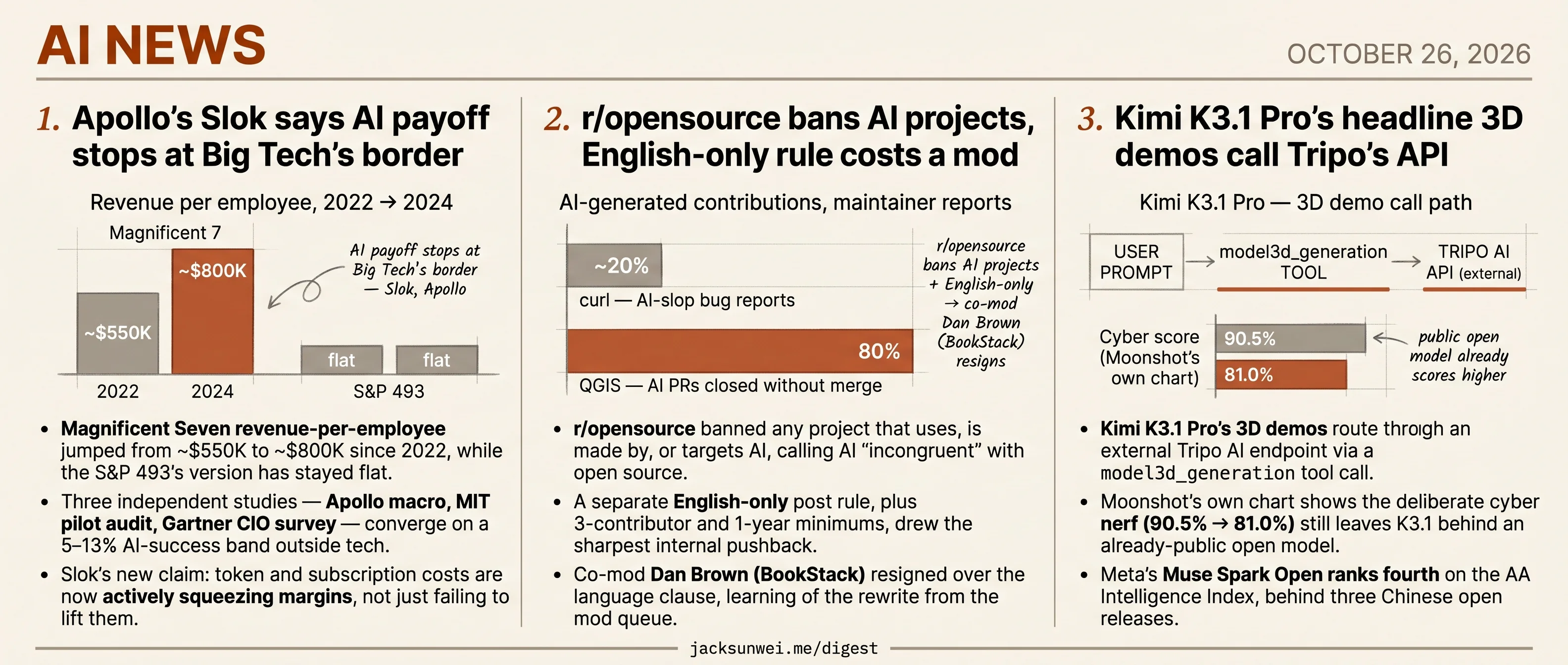
- Magnificent Seven revenue-per-employee jumped from ~$550K to ~$800K since 2022, while the S&P 493’s version has stayed flat.
- Three independent studies — Apollo macro, MIT pilot audit, Gartner CIO survey — converge on a 5–13% AI-success band outside tech.
- Slok’s new claim: token and subscription costs are now actively squeezing margins, not just failing to lift them.
- Brynjolfsson dissents, citing 2.7% U.S. productivity growth in 2025 as the J-curve’s harvest phase.
The split inside the S&P 500
Apollo chief economist Torsten Slok’s “zero payoff” line is not a vibe — it’s a specific decomposition. Revenue per employee at the Magnificent Seven climbed from roughly $550,000 in 2022 to nearly $800,000 in 2024. The same metric for the S&P 493 is flat across the ChatGPT era 1. His high-frequency input is the Census BTOS biweekly survey of 1.2M firms, where most AI adopters still report no change in headcount or required skill level.
The newer, sharper claim is that token and subscription spend has crossed from “not helping” to “actively squeezing” operating margins outside tech 1. That reframes AI from a growth lever that hasn’t fired yet into a cost center that’s already landed on the P&L.
Three methodologies, one number
What makes Slok hard to dismiss is that two more independent studies land in the same neighborhood from entirely different angles:
| Source | Method | ”AI is working” cohort |
|---|---|---|
| Apollo / Slok 1 | Macro revenue-per-employee | Magnificent Seven only |
| MIT Project NANDA 2 | Audit of enterprise GenAI pilots | 5% of integrated pilots |
| Gartner CIO survey (Oct 2026) 3 | CIO self-report survey | 13% of CIOs |
MIT’s “GenAI Divide” finds 95% of enterprise pilots deliver zero measurable P&L impact despite $30–40B in collective spend, with wins concentrated in a 5% cohort that redesigned workflows rather than bolting chatbots onto existing ones 2. Gartner’s October survey puts the “significant or transformational value” number at 13%, and notes its high-performing “Vanguard” kills failing pilots at 2.3× the rate of peers 3. Macro accounting, qualitative pilot audit, and CIO self-report all converging on a single-digit-to-low-teens success band is the strongest signal in this debate.
The J-curve rebuttal
Erik Brynjolfsson is the loudest dissenter. U.S. labor productivity grew 2.7% in 2025, nearly double the prior decade’s trend, which he reads as the “harvest phase” of a general-purpose-technology J-curve: intangible reorganization costs suppress measured output early, then flip 4. On his reading, Slok’s flat revenue-per-worker is a measurement lag.
The weakness is temporal. Brynjolfsson needs 2.7% productivity to persist and broaden; Slok has two years of Census data saying the breadth hasn’t arrived yet.
Why “zero payoff” is now a solvency question
Sequoia’s David Cahn reframes the gap as financing, not adoption: the industry needs roughly $3T in annual revenue to clear current chip and data-center capex, and that shortfall is widening even as frontier-lab ARR scales 5. If Slok is right that payoff stops at Big Tech’s border, the hyperscaler build-out has to be funded by Big Tech’s own balance sheets indefinitely.
Practitioners on Slashdot describe the ground-level mechanic as a “Cisco moment”: swap a $100K engineer for $99K of tokens, get 5× the output, then spend the savings on hyper-vigilant verification 6. Activity without progress — exactly the pattern that leaves aggregate margins flat while compute bills keep rising.
Slok is no longer a contrarian. He’s the macro voice of a consensus the earnings-call narrative has been talking past.
r/opensource bans AI projects, English-only rule costs a mod
Source: the-verge-ai · published 2026-10-25
TL;DR
- r/opensource banned any project that uses, is made by, or targets AI, calling AI “incongruent” with open source.
- A separate English-only post rule, plus 3-contributor and 1-year minimums, drew the sharpest internal pushback.
- Co-mod Dan Brown (BookStack) resigned over the language clause, learning of the rewrite from the mod queue.
- The maintainer revolt is real — curl at ~20% AI-slop bug reports, QGIS at 80% rejected AI PRs.
A unilateral rewrite, not a team call
Saturday night, r/opensource’s submission rules got a hard rewrite: no projects that use AI, are made by AI, or are built for AI; English-only posts; a three-contributor minimum; a one-year project age minimum. The opening line declares AI “incongruent” with open source.
Within hours, moderator ssddanbrown — Dan Brown, lead developer of BookStack — publicly disavowed the English-only clause and resigned, declining Reddit admins’ offer of the top-mod slot. His account reframes the story: this wasn’t a team consensus but a unilateral push by u/Wolvereness that co-moderators learned about from the mod queue, not from a discussion 7. Brown specifically called out the language rule as wrong in both substance and phrasing. That’s the clause that cost r/opensource one of its own.
The Linux paradox
The sharpest technical objection is the one critics keep returning to: the Linux kernel now officially accepts AI-assisted contributions. Under a strict reading of r/opensource’s own rule, Linux doesn’t qualify 8. Mods reportedly waved it through anyway — a “subjective pass” that makes the policy look less like a principle and more like a vibe check.
The three-contributor and one-year minimums draw the same complaint from the other direction: they’re a “dead loop” for solo developers, the demographic that produced SQLite, Python, and curl itself 8. A rule that would have excluded curl in 1996 is a rule with a calibration problem.
The maintainer revolt is real — this just isn’t a great flag for it
The AI-ban portion isn’t fringe. Daniel Stenberg says AI is “DDoSing” open source: by mid-2025 roughly 20% of curl’s incoming bug reports were AI-generated garbage, forcing an instant-ban policy and ultimately the shuttering of its HackerOne bounty program 9. QGIS flipped from permissive to “strict NOT ALLOWED” after finding nearly 80% of AI-tagged contributions were closed without merging 10. Debian went the other way, keeping AI contributions legal but holding humans personally accountable 10. The governance space is genuinely contested.
Behind that sits an unresolved definitional fight: without training data, can an “open-weights” model be studied or modified in any meaningful sense? The FSF calls OSI’s Open Source AI Definition 1.0 “openwashing” 11. r/opensource’s “incongruent” framing is downstream of that argument, not invented for the occasion.
What actually broke
Migration to r/TrueOpenSource started the same evening, and — predictably — the splinter promptly re-litigated the same fights and spawned further forks into r/ActuallyOpenSource and r/OpenSourceAIAllowed 12. The community is now fragmented across four subreddits debating the same question.
The AI clause is defensible, contested, and part of a real maintainer-burnout crisis. The English-only clause isn’t any of those things, and it’s the one that lost the mod team a member before the week was out. Bundling them was the mistake.
Kimi K3.1 Pro’s headline 3D demos call Tripo’s API
Source: interconnects · published 2026-10-25
TL;DR
- Kimi K3.1 Pro’s 3D demos route through an external Tripo AI endpoint via a
model3d_generationtool call. - Moonshot’s own chart shows the deliberate cyber nerf (90.5% → 81.0%) still leaves K3.1 behind an already-public open model.
- Meta’s Muse Spark Open ranks fourth on the AA Intelligence Index, behind three Chinese open releases.
- Microsoft’s Muse Quake II demo rendered at 300×180 pixels in Copilot Labs.
The podcast’s three threads, with the receipts
Episode 20 of Interconnects covers Kimi K3.1 Pro, open-weights cyber-risk discourse, and the two unrelated things called “Muse.” The through-line is Nathan Lambert’s argument that the open-weights conversation keeps mistaking narrative for capability. The independent reporting since release mostly backs that thesis — but it also sharpens each thread in ways the podcast only glances at.
Kimi K3.1 Pro: strong model, soft launch
Moonshot’s claim that K3.1 Pro is the top open-weight model holds up on Terminal-Bench 4.0 and the AA Intelligence Index. The launch collateral does not. Reddit teardowns found the viral 3D-generation demos were routed through an external Tripo AI service via an internal model3d_generation tool call; when the tool is disabled, output quality drops significantly 13. That is not a benchmark problem — it is a demo-reel problem, and it matters because 3D was the headline capability.
The second soft spot is the cyber “nerf.” Moonshot published a chart showing they filtered cyber data from mid-training and RL environments, dropping K3.1’s internal vulnerability score from 90.5% to 81.0% 14. The intent — reduce offensive uplift — is defensible. The execution is awkward: a public open-weight model already scores higher on the same axis, so withholding capability from Kimi doesn’t move the frontier of what an attacker can download today.
Cyber discourse: Lambert’s strongest leg
This is where independent evidence most clearly backs the podcast. Anthropic flagged GLM-5.3 as matching “Mythos-class” offensive capability (12% on ExploitBench) weeks ago. GLM-5.3 is public. The predicted wave of AI-assisted attacks has not materialized, and the documented high-impact incidents remain concentrated in closed-API models 15. If restricting open weights were the binding constraint on offensive cyber, that gap should be closing. It isn’t.
Muse Spark Open: a lag, not a catch-up
Lambert frames Meta’s Muse Spark Open as a US turnaround. The numbers describe something closer to a narrowing gap. The 816B-total / 42B-active MoE lands at 39 on the AA Intelligence Index, behind MiMo-V2.6-Pro (46), GLM-5.3 (45) and Kimi K3 (44), and local inference requires two paired M5 Ultra Mac Studios with 512GB RAM 16. Lambert called the Muse Model License “trash” on-air, but in his own Harvard lecture he conceded the $20M revenue gate that triggers a separate agreement is “reasonable” as a defense against competitor free-riding 17. The dissent is narrower than the soundbite.
Microsoft’s Muse: harsher reception than “musings” suggests
The naming collision is unfortunate because Microsoft’s Muse is in a different conversation entirely. Eurogamer’s reporting on the Copilot Labs Quake II demo documents developer backlash the podcast’s “ideation tool” framing softens: 300×180 output, object-permanence failures, and critics explicitly rejecting Microsoft’s pitch that an AI hallucination of an old game counts as preservation 18. With a reported one-million-updates-per-title training cost, it is nowhere near an engine substitute.
The net: the podcast’s structure is right, and three of the four threads deserve to be read a notch more skeptically than Lambert reads them.
Round-ups
Google’s AI search overhaul reshapes digital publishing economics
Source: the-verge-ai
Digital publishers face a referral collapse as Google’s AI-generated answers keep readers on the results page. The Verge’s weekly Stepback column traces the shift from a search-traffic-dependent web to one where summarization engines absorb the clicks that once funded editorial operations.
xAI’s Grok drops first 7 minutes of AI-generated ‘Odyssey’
Source: techcrunch-ai
xAI released the opening 7 minutes of Grok’s AI-generated adaptation of The Odyssey, pitched as a showcase for its video model. The footage is technically passable but hollow on artistry, inspiration, or human interest, per TechCrunch’s early review.
AI wearables roundup tracks Muse Charm, Bee, Friend, Plaud
Source: techcrunch-ai
The AI wearables field now spans always-listening pendants, meeting recorders, and ambient companions, with Muse Charm, Bee, Friend, and Plaud among the devices profiled. TechCrunch’s evergreen guide catalogs form factors, pricing, and use cases across the fast-crowding category.
Footnotes
-
↩ ↩2 ↩3Revenue per employee at the Magnificent Seven jumped from roughly $550,000 in 2022 to nearly $800,000, while the same metric has stayed flat for the S&P 493, with Slok warning that rising token costs are now ‘squeezing corporate profit margins’ outside tech.
-
MIT Project NANDA — State of AI in Business 2025 — https://mlq.ai/media/quarterly_decks/v0.1_State_of_AI_in_Business_2025_Report.pdf
↩ ↩2Despite $30–40 billion in enterprise GenAI investment, 95% of organizations are getting zero return; only 5% of integrated AI pilots are extracting millions in value, while the vast majority stall with no measurable P&L impact.
-
Gartner (Oct 2026 CIO survey) — https://www.gartner.com/en/newsroom/press-releases/2026-10-19-gartner-survey-finds-only-13-percent-of-cios-say-their-enterprise-has-realized-significant-or-transformational-value-from-ai
↩ ↩2Only 13% of CIOs say their enterprise has realized significant or transformational value from AI; a ‘Vanguard’ cohort is 2.3x more likely to kill pilots that miss pre-defined ROI thresholds.
-
Seeking Alpha / Brynjolfsson rebuttal thread — https://seekingalpha.com/news/4657029-apollos-slok-says-ai-has-delivered-zero-payoff-outside-tech
↩U.S. labor productivity grew 2.7% in 2025, nearly double the prior decade’s average — Brynjolfsson argues this signals the ‘harvest phase’ of the J-curve, with intangible reorganization costs finally paying off even as headline revenue-per-worker metrics lag.
-
AI Weekly — Sequoia’s David Cahn — https://aiweekly.co/alerts/sequoias-cahn-pegs-ais-2026-revenue-gap-at-roughly-3t
↩Sequoia’s updated ‘AI revenue gap’ now pegs the industry’s 2026 shortfall at roughly $3 trillion needed annually to justify current chip and data-center spend — reframing Slok’s ‘zero payoff’ as a systemic financing problem, not just an enterprise ROI one.
-
Slashdot discussion — https://slashdot.org/story/26/10/25/2040212/ai-delivers-zero-financial-payoff-to-most-companies-economist-says
↩Commenters describe a ‘Cisco moment’ where firms replace a $100k engineer with $99k in compute tokens producing 5x output that still requires hyper-vigilance to verify — ‘activity without progress’ that explains why aggregate margins stay flat.
-
danb.me (ssddanbrown, resigning r/opensource mod) — https://danb.me/blog/opensource-sub-rules/
↩I don’t agree with that rule. Especially so with how it was said… I learned of these sweeping changes only after moderation notifications began appearing.
-
↩ ↩2Commenters pointed out that even the Linux kernel now incorporates AI-assisted contributions, technically making it ineligible for the subreddit under a strict reading of the rules.
-
The New Stack — Daniel Stenberg (curl) — https://thenewstack.io/curls-daniel-stenberg-ai-is-ddosing-open-source-and-fixing-its-bugs/
↩AI is DDoSing open source… by mid-2025 slop submissions accounted for roughly 20% of all incoming reports, forcing the curl team to implement an instant-ban policy.
-
Medium — Can Artuc (QGIS maintainer context) — https://canartuc.medium.com/59-000-packages-1-400-developers-zero-ai-policy-95a00cfb92b2
↩ ↩2QGIS moved from a permissive policy to a ‘strict NOT ALLOWED’ stance after maintainers reported that nearly 80% of AI-tagged contributions were closed without merging.
-
ZDNet — on OSI’s Open Source AI Definition — https://www.zdnet.com/article/we-have-an-official-open-source-ai-definition-now-but-the-fight-is-far-from-over/
↩Without access to the exact training data, a user cannot truly ‘study’ or ‘modify’ a model… critics call it ‘openwashing’.
-
r/SubredditDrama thread — https://www.reddit.com/r/SubredditDrama/comments/1xfakev/ropensource_announces_a_hardline_ban_on_ai/
↩Frustrated users quickly launched r/TrueOpenSource… some early reports suggest it initially adopted similar restrictive language, leading to further fragmentation into r/ActuallyOpenSource and r/OpenSourceAIAllowed.
-
r/kimi (Reddit) — https://www.reddit.com/r/kimi/comments/1xe7cbr/moonshot_fooled_everyone_with_kimi_k31_pros_3d/
↩Moonshot fooled everyone with Kimi K3.1 Pro’s 3D [demos] — the model uses an internal ‘model3d_generation’ tool that appears to call an external Tripo AI API rather than generating natively; forced to generate without the tool, performance dropped significantly.
-
Chinmay Shringi (Medium) — https://medium.com/@chinmayshringi4/kimi-k3-1-pro-was-made-worse-at-hacking-moonshots-own-chart-shows-an-open-model-already-beats-it-d9d5d082418b
↩Kimi K3.1 Pro was made worse at hacking — Moonshot’s own chart shows an open model already beats it: cyber-vulnerability score dropped from 90.5% to 81.0% after filtering cyber data from mid-training and RL environments.
-
AI Weekly summary of Lambert — https://aiweekly.co/alerts/lambert-open-weights-cyber-risk-debate-misses-tradeoffs
↩Despite GLM-5.3 being public for weeks and Anthropic claiming it matches ‘Mythos-class’ cyber capabilities (12% on ExploitBench), the predicted wave of attacks has not materialized; the most significant AI-assisted incidents still involve closed-API models.
-
↩Muse Spark Open (816B total, 42B active) scored 39 on the Artificial Analysis Intelligence Index — behind Xiaomi MiMo-V2.6-Pro (46), GLM-5.3 (45) and Kimi K3 (44) — and runs locally only on two paired M5 Ultra Mac Studios with 512GB RAM.
-
Nathan Lambert — Harvard lecture slides — https://natolambert.com/slides/2026/harvard/lecture
↩The Muse Model License is ‘trash’ due to restrictive clauses including a $20M revenue gate requiring a separate agreement for large-scale inference providers — though the gate itself is ‘reasonable’ as a defense against competitor free-riding.
-
↩Muse’s playable Quake II demo in Copilot Labs was ‘slammed’ as a 300x180-pixel, blurry experience likened to ‘Nyquil-induced sleep paralysis’; critics rejected Microsoft’s game-preservation framing — an AI hallucination of an old game is not a substitute for source code.