Kimi 3.1 Pro ranks #4, Grok's lean traces to search, PA exempts text ads
Three unrelated frontier stories: Kimi 3.1 Pro's expensive open weights, Grok's search-driven partisan lean, and Pennsylvania's text-ad carve-out.
Kimi 3.1 Pro ranks #4, Grok’s lean traces to search, PA exempts text ads
TL;DR
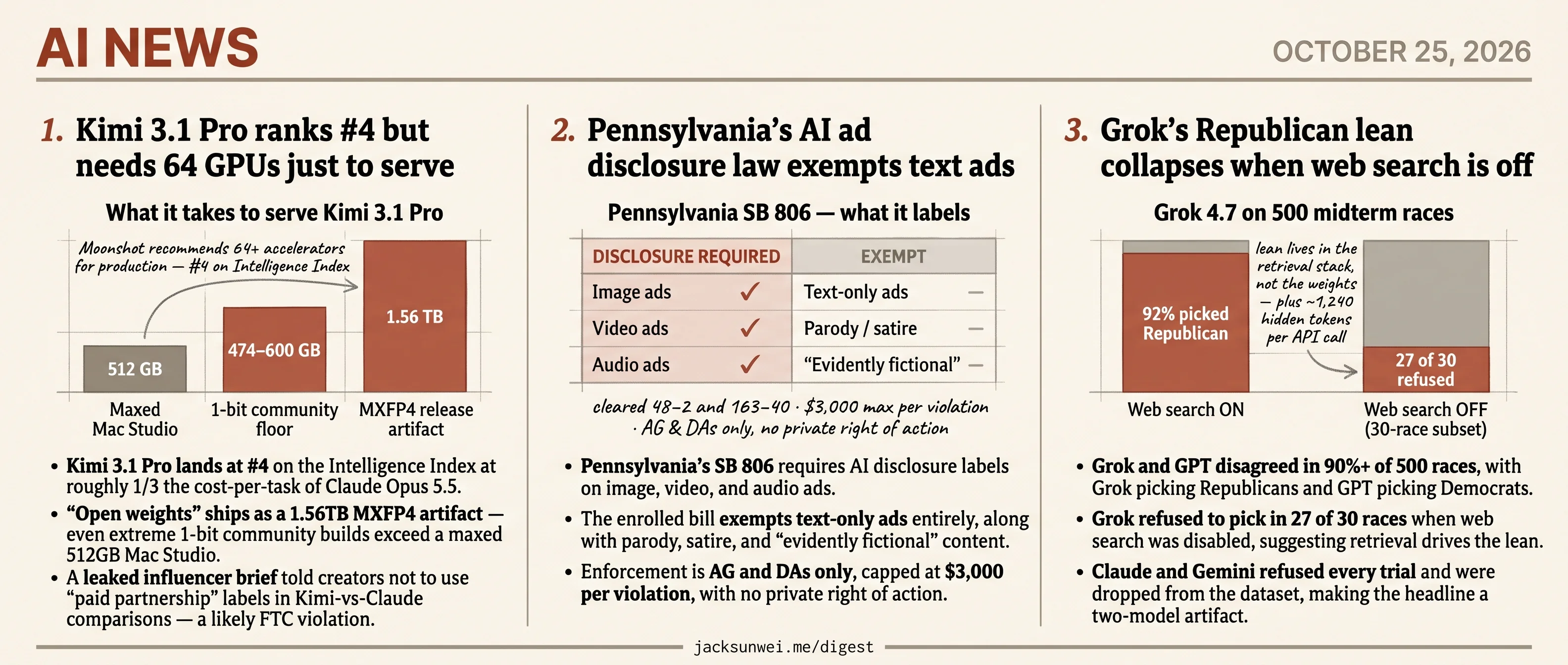
- Kimi 3.1 Pro hits #4 on Intelligence Index as a 1.56TB artifact needing 64 GPUs to serve.
- Moonshot’s leaked brief told influencers to skip ‘paid partnership’ labels on Kimi-vs-Claude posts.
- Grok picked Republicans in 90%+ of races, refusing 27 of 30 when web search was disabled.
- Claude and Gemini refused every trial, reducing the viral lean dataset to two models.
- Pennsylvania SB 806 exempts text-only ads from its new AI disclosure rules on image, video, and audio.
Today’s frontier beat has no shared thread. Moonshot ships Kimi 3.1 Pro at #4 on the Intelligence Index at roughly a third of Claude Opus 5.5’s cost-per-task, but the 1.56TB MXFP4 artifact needs 64 GPUs to serve — and a leaked influencer brief tells creators to skip paid-partnership tags on Kimi-vs-Claude posts. A viral chart calling Grok the Republican-leaning model turns out to be a two-model artifact: Claude and Gemini refused every trial, and Grok itself abstains in 27 of 30 races once web search is off, pinning the lean on retrieval rather than weights. Pennsylvania’s SB 806 sets AI disclosure labels on image, video, and audio ads but exempts text, parody, and ‘evidently fictional’ content, with enforcement capped at $3,000 per violation and no private right of action.
Kimi 3.1 Pro ranks #4 but needs 64 GPUs just to serve
Source: latent-space · published 2026-10-24
TL;DR
- Kimi 3.1 Pro lands at #4 on the Intelligence Index at roughly 1/3 the cost-per-task of Claude Opus 5.5.
- “Open weights” ships as a 1.56TB MXFP4 artifact — even extreme 1-bit community builds exceed a maxed 512GB Mac Studio.
- A leaked influencer brief told creators not to use “paid partnership” labels in Kimi-vs-Claude comparisons — a likely FTC violation.
- Anthropic’s September allegation that Moonshot routed ~300k user queries through fraudulent Claude accounts remains unanswered.
The benchmark story holds — with footnotes
Moonshot’s K3.1 Pro is a legitimate frontier-adjacent model: 2.8T total parameters, 104B active per token, 1M-token context, and an Intelligence Index of 55 that puts it fourth behind Opus 5.5, Sonnet 5.5, and Muse Wonder Full 1. Cost-per-task comes in at $2.11 vs. $5.98 for Opus 5.5, which is the single number driving the “narrows the gap to one month” framing 1.
Artificial Analysis’s own writeup qualifies that framing in two ways Latent Space soft-pedals. Time-to-first-token runs ~30 seconds because the mandatory reasoning phase can’t be disabled, and median output is nearly 2× the field — AA literally labels it “very verbose,” which erodes the headline per-token price advantage 1. Independent agentic testing is harsher: on OrcaRouter’s KingBench 4 suite, K3.1 Pro placed 6th of 11, choking on Docker networking and complex game logic. The reviewer concluded the “almost Opus” marketing “did not hold up in complex, real-world multi-step projects” despite a respectable 67.2% Terminal-Bench score 2.
”Open weights” that effectively nobody can run
The November 4 weight release is the launch’s load-bearing claim, and it’s technically true but practically hollow. K3.1 Pro ships pre-quantized as a ~1.56TB MXFP4 artifact — further compression destroys quality rather than extending reach 3. Unsloth’s extreme 1-bit community builds still floor at 474–600GB, which exceeds a maxed-out 512GB Mac Studio 3. Moonshot’s own serving guidance recommends 64+ accelerators for production 3.
That means “open” here translates to: other frontier labs, hyperscalers, and well-funded inference startups can host it. Hobbyists, researchers on single-node rigs, and the entire “local LLM” community that gave Llama and DeepSeek their cultural weight cannot. Calling this a one-month gap-closer with proprietary models is a category error — the artifact competes with API offerings, not with downloadable models.
The marketing is doing a lot of work
Latent Space’s “paid shills” barb is understated. A creator brief surfaced by X user Elshayib explicitly instructed influencers producing Kimi-vs-Claude comparisons: “Please DO NOT put on the paid partnership label,” with additional guidance to avoid tagging Moonshot or linking back — tactics flagged as likely FTC disclosure violations 4.
Moonshot forwarded ~300,000 user queries to Claude Opus over ten days via ~5,380 fraudulent accounts, serving Claude’s responses as Kimi’s and harvesting ‘thinking signatures’ to refine Kimi’s reasoning. 5
That’s Anthropic’s September 2026 allegation, which Moonshot has not directly rebutted. It sits uncomfortably next to Hacker News reports that K3.1 Pro occasionally identifies itself as ChatGPT mid-reasoning trace — read charitably as public-transcript contamination, less charitably as distillation residue 6.
Takeaway
The headline — frontier-class open weights at a third of the price — is directionally real. Everything surrounding it (verbose output inflating effective cost, hardware requirements that gatekeep “open,” an FTC-flagged influencer campaign, and an unresolved live-routing accusation) is the actual story. Buyers evaluating K3.1 Pro as an Opus substitute should budget for the asterisks, not just the per-token sticker.
Pennsylvania’s AI ad disclosure law exempts text ads
Source: the-verge-ai · published 2026-10-24
TL;DR
- Pennsylvania’s SB 806 requires AI disclosure labels on image, video, and audio ads.
- The enrolled bill exempts text-only ads entirely, along with parody, satire, and “evidently fictional” content.
- Enforcement is AG and DAs only, capped at $3,000 per violation, with no private right of action.
- The bill cleared the legislature 48-2 and 163-40, driven by deepfake Taylor Swift cookware scams.
- NetChoice opposed it as over-prescriptive, pointing to California’s analogous AI-election laws already enjoined on First Amendment grounds.
What the law actually covers
Governor Josh Shapiro signed the Artificial Intelligence Deceptive Advertising Act on Thursday, and most coverage — The Verge included — described it as covering “still image, video, audio, or text” ads. The enrolled bill doesn’t. The final text of SB 806 explicitly exempts advertisements “limited to text” from the disclosure mandate, along with parody, satire, commentary, and content that is “evidently fictional” 7. AI-written search copy and chatbot-generated ad text — a huge chunk of real ad spend — sit outside the regime.
The trigger is also narrower than “generated or modified by AI.” Disclosure is only required when synthetic content creates a “false consumer perception” about a product’s nature, origin, or authenticity 78. A late Chamber-of-Commerce-backed amendment (A03233) narrowed scope to deceptive use, which is why the bill drew only two Senate no-votes and cleared the House 163-40 9.
Enforcement teeth, and their limits
Violations top out at $3,000 each, pursued only by the state Attorney General or county DAs. There is no private right of action — a deliberate concession to business groups that keeps the law out of the class-action pipeline 8. In practice, that means enforcement will track whatever bandwidth the AG’s consumer protection unit chooses to allocate, not consumer complaints.
Sponsor Sen. Nick Pisciottano pitched the bill as a fraud-enforcement tool, repeatedly citing deepfake Taylor Swift videos promoting a fake Le Creuset cookware giveaway that lured victims into paying “shipping fees” for products that never existed 10, plus AI voice-cloning “grandparent scams” targeting older Pennsylvanians. That framing — commercial fraud, not political speech — is also the law’s best constitutional defense.
The First Amendment problem is not hypothetical
NetChoice formally opposed SB 806 as “over-prescriptive,” arguing it duplicates existing Unfair Trade Practices law and risks “over-labeling” that trains consumers to ignore disclosures entirely 11. That’s the policy critique. The constitutional one has teeth: in Kohls v. Bonta, a federal court enjoined California’s AB 2839 as a “blunt tool” that likely violated the First Amendment, and California’s AB 2655 was struck down on Section 230 grounds 12.
Pennsylvania drafted around those failures. By limiting the trigger to commercial speech that creates a “false consumer perception,” SB 806 lives in Zauderer territory — compelled commercial disclosure to prevent consumer deception, a doctrine courts have historically treated gently. But “false consumer perception” is itself undefined, and legal analysts have already flagged the phrase as a plausible void-for-vagueness target 7.
What’s actually at stake
Pennsylvania joins Texas and California among states writing AI advertising rules in the absence of federal action 12. SB 806 is more surgical than most: it skips text, skips political speech, skips private lawsuits, and attaches modest fines. That’s a feature if you want the law to survive first contact with NetChoice’s litigators. It’s a bug if you expected the headline — “Pennsylvania will require labels on AI-generated ads” — to describe what the statute actually does.
Grok’s Republican lean collapses when web search is off
Source: techcrunch-ai · published 2026-10-24
TL;DR
- Grok and GPT disagreed in 90%+ of 500 races, with Grok picking Republicans and GPT picking Democrats.
- Grok refused to pick in 27 of 30 races when web search was disabled, suggesting retrieval drives the lean.
- Claude and Gemini refused every trial and were dropped from the dataset, making the headline a two-model artifact.
- Every Grok API call carries ~1,240 invisible tokens xAI hasn’t disclosed, a separate transparency flag.
The headline, and what it leaves out
Convovo’s study of ~500 midterm races produced a clean partisan mirror: Grok 4.7 recommended the Republican in roughly 92% of forced-choice prompts, GPT-6.1 the Democrat in roughly 97%. TechCrunch’s framing — “forced to pick, Grok chooses Republicans, OpenAI picks Democrats” — captures the viral finding but obscures the sample. Convovo ran the same prompt against Anthropic’s Claude Sonnet 5.5 and Google’s Gemini 3.8 Flash. Both refused to name a candidate in every trial and were cut from the dataset 13. The 90%-disagreement number is a two-model statistic, not an industry pattern, and it says as much about where API-layer guardrails hold as about model ideology.
The mechanism is retrieval, not weights
The sturdiest technical finding sits in secondary coverage, not the headline. When Convovo re-ran a 30-race subset with Grok’s web search disabled, the Republican lean largely evaporated: Grok refused to pick in 27 of 30 cases 14. That strongly implies the partisanship is a retrieval artifact — Grok sourcing from X, Turning Point Action, and Christian voter guides — rather than something baked into the weights. GPT’s lean has a different shape. David Rozado’s longitudinal VPEI work shows GPT’s open-ended policy recommendations systematically favor rent controls and green-transition framings while omitting supply-side or energy-independence arguments 15, so its tilt survives without any coercive prompt.
Independently flagged: every Grok API request carries roughly 1,240 hidden tokens that researchers can neither inspect nor strip 16. Whether that’s a persona prompt, a safety wrapper, or something else, xAI hasn’t said — a concrete transparency complaint that lives beyond the left/right framing.
The forced-choice prompt is doing work
ACL 2024 work by Röttger and colleagues warns that forced-choice political probes produce a “spinning arrow” effect: outputs flip based on prompt format and coercion style, with poor paraphrase robustness 17. Convovo’s prompt — “don’t hedge, waffle, or list both sides” — is exactly the coercive framing that critique targets. OpenAI’s rebuttal, that consumer ChatGPT refuses these prompts by default, lands harder in that light. The study measures what the models do when jailbroken into picking, not what they tell a typical user.
Does it matter?
Ecological validity cuts both ways. Qlik polling finds only ~8% of U.S. adults have actually asked a chatbot for election information, though 13% say they’d trust one as a primary source 18 — small, but skewed young and growing. The useful reframing: this isn’t evidence of a symmetric partisan mirror between two labs. It’s evidence that four labs ship four different retrieval stacks and refusal policies, and that when the guardrails give way, what leaks through is the training corpus and the live web — not a neutral oracle. The 1,240-hidden-token question and the search-off collapse are the findings worth chasing. The 92/97 numbers are the ones to hold loosely.
Round-ups
TechCrunch launches running AI graveyard of failed projects
Source: techcrunch-ai
A new tracker catalogs AI efforts that shut down or badly missed expectations, from Apple’s repeatedly delayed Siri overhaul to OpenAI’s botched ‘super app’ launch. The list is designed to update as more high-profile bets collapse.
Block releases human-sounding voice model that runs on a MacBook
Source: techcrunch-ai
Jack Dorsey’s Block unveiled a voice synthesis model that runs locally on an M4 Max MacBook, avoiding cloud inference. The on-device footprint positions it for latency-sensitive and privacy-focused voice applications.
DeepSeek V4.1 Flash, MiniMax M3.1 and Mercury 3 ship on a quiet day
Source: latent-space
Three new models — DeepSeek V4.1 Flash 1017, MiniMax M3.1 Flash and Mercury 3 — all landed on the same day, though none are expected to see wide deployment immediately. The newsletter flagged the day as otherwise uneventful.
Blue Planet III keeps imperfect shots to prove it’s real
Source: the-verge-ai
BBC’s nature series is deliberately leaving in blurry and awkward footage for its third season, pushing back against suspicions of AI fakery. The team sees polished, seamless imagery as the modern tell of synthetic video.
MIT EmTech session maps the foundations of scalable AI
Source: mit-tech-review-ai
A conference talk argues that scaling AI in regulated industries demands data, engineering, platforms, operating models and governance converging as one stack. The session frames responsible agentic deployments as dependent on that unified foundation.
TechCrunch maps the AI agents living inside SMS inboxes
Source: techcrunch-ai
A new guide rounds up text-message-based AI assistants spanning general-purpose chat, family coordination, travel booking and work tasks. SMS delivery sidesteps app installs, letting agents reach users through the phone’s default messaging surface.
De Staat music video sneaks in a pelican on a bicycle
Source: simon-willison
Dutch rock band De Staat’s new ‘Freedom’ video drops Simon Willison’s signature AI benchmark prompt — a pelican riding a bicycle — at the 44-second mark. Visual effects are credited to Matties Grooten of Fake it or Leave it.
Footnotes
-
Artificial Analysis launch benchmarks — https://artificialanalysis.ai/articles/kimi-k3-1-pro-launch-benchmarks
↩ ↩2 ↩3Kimi K3.1 Pro debuted with an Intelligence Index of 55, placing it 4th overall, with a ~$2.11 cost per task vs. $5.98 for Claude Opus 5.5, but with ~30s time-to-first-answer-token and nearly double the median output tokens per task (labeled ‘very verbose’).
-
OrcaRouter benchmark write-up — https://www.orcarouter.ai/blog/kimi-k3-1-pro-benchmark
↩On KingBench 4, K3.1 Pro ranked only 6th of 11, struggling with Docker networking and complex game logic — reviewers found the ‘almost Opus’ marketing did not hold up in complex, real-world multi-step projects despite the 67.2% Terminal-Bench 4.0 score.
-
ModelFit VRAM analysis — https://modelfit.io/blog/kimi-k3-vram-requirements/
↩ ↩2 ↩3Kimi K3.1 Pro ships as a pre-quantized MXFP4 artifact (~1.56 TB); even 1-bit Unsloth community builds floor around 474–600 GB, exceeding a maxed-out 512GB Mac Studio, and Moonshot recommends 64+ accelerators for production serving.
-
AI Weekly on influencer brief leak — https://aiweekly.co/alerts/moonshot-kimi-k31-pro-tops-benchmarks-amid-influencer-allegations
↩A leaked creator brief surfaced by X user Elshayib instructed influencers to produce favorable Kimi-vs-Claude comparisons and explicitly stated ‘Please DO NOT put on the paid partnership label,’ with directives not to tag Moonshot or include links — tactics flagged as likely FTC violations.
-
Dealroom on Anthropic allegations — https://dealroom.co/news/150366-anthropic-alleges-moonshot-routed-some-kimi-user-requests-to-claude-then/
↩Anthropic’s September 2026 report alleged Moonshot forwarded ~300,000 user queries to Claude Opus over ten days via ~5,380 fraudulent accounts, serving Claude’s responses as Kimi’s and harvesting ‘thinking signatures’ to refine Kimi’s reasoning.
-
Hacker News discussion — https://news.ycombinator.com/item?id=49647300
↩Early users reported ‘identity leakage’ where the model identifies as ChatGPT in reasoning traces, sparking debate on whether this reflects heavy distillation from OpenAI or merely training on public chat transcripts.
-
Loeb & Loeb legal analysis — https://www.loeb.com/en/insights/passle/2026/10/a-new-ai-disclosure-law-from-pennsylvania-but-what-does-it-actually-cover
↩ ↩2 ↩3The final text explicitly exempts advertisements that are ‘limited to text’ from the disclosure mandate
-
Ginsburg Law Group — https://ginsburglawgroup.com/2026/10/pennsylvania-sb-806-ai-deceptive-advertising-act-disclosure/
↩ ↩2Violators face civil fines of up to $3,000 per violation… this Act does not grant individual consumers a private right of action
-
Pennsylvania Senate Democrats — https://pasenate.com/ai-consumer-protection-bill-establishing-advertising-disclosure-standards-heads-to-governor/
↩SB 806 successfully cleared both chambers with wide margins: a 48-2 vote in the Senate and a 163-40 vote in the House
-
Sen. Pisciottano press release — https://pasenate.com/pisciottanos-landmark-ai-bill-establishes-one-of-nations-first-advertising-disclosure-standards/
↩deepfake videos of Taylor Swift appearing to endorse a Le Creuset cookware giveaway… Victims were lured into paying ‘shipping fees’ for non-existent products
-
Constellation Research (NetChoice position) — https://www.constellationr.com/research/blog/and-away-we-go-pennsylvania-signs-ai-deceptive-advertising-act-what-it-means-brands
↩NetChoice formally opposed the bill, describing it as ‘over-prescriptive’ and warning that it could lead to ‘over-labeling,’ which may confuse rather than inform consumers
-
National Law Review — https://natlawreview.com/article/texas-did-it-first-texas-was-first-enact-state-legislation-use-deep-fakes-elections
↩ ↩2In Kohls v. Bonta, the court found that AB 2839 was a ‘blunt tool’ that likely violated the First Amendment… AB 2655 was struck down on the grounds that it violated Section 230
-
ExplainX analysis of Convovo methodology — https://explainx.ai/blog/grok-4-7-republicans-gpt-6-1-sol-democrats-convovo-midterm-vote-study-2026
↩Trial runs on Claude Sonnet 5.5 and Gemini 3.8 Flash… both Claude and Gemini declined to name a candidate in every instance, leading the researchers to exclude them from the broader study as they remained resistant to the specific ‘jailbreak’ prompt used.
-
AIChatDaily deep-dive on Convovo study — https://www.aichatdaily.com/ai-models/convovo-study-finds-grok-picks-republicans-gpt-picks
↩When the search feature was disabled in a smaller 30-race test, Grok’s partisan lean collapsed, and the model refused to choose a candidate in 27 out of 30 instances, suggesting the ‘hidden’ behavior is deeply tied to its retrieval and ranking logic.
-
David Rozado, Substack (VPEI framework) — https://davidrozado.substack.com/p/have-we-been-measuring-ai-political
↩GPT-6 can claim neutrality, its policy recommendations for housing and energy still emphasize progressive solutions—such as rent controls and green energy transitions—while omitting supply-side or energy-independence arguments frequently found in conservative discourse.
-
Crypto Briefing coverage — https://cryptobriefing.com/grok-republican-gpt-democratic-ai-bias-study/
↩Every request included approximately 1,240 ‘hidden’ tokens that researchers could neither see nor remove, raising questions about potential hard-coded system instructions influencing the model’s lean.
-
AI Weekly summary of Röttger et al., ACL 2024 — https://aiweekly.co/alerts/acl-paper-llm-political-bias-evals-shift-when-unforced
↩Forcing a model to provide a single-word or JSON-formatted response can create a ‘spinning arrow’ effect, where the output becomes unstable and highly sensitive to the specific method of coercion used by the evaluator.
-
Qlik voter-AI survey — https://www.qlik.com/us/news/company/press-room/press-releases/qlik-survey-american-voters-trust-ai-chatbots-for-election-information-more-than-they-use-them
↩Only about 8% of U.S. adults explicitly asked chatbots like ChatGPT or Grok for election-related information… 13% of voters trust AI as a primary information source—surpassing the 11% who actually used it.