OpenAI omits 1,000 pages, Qwen ships no model card, EU delays high-risk to 2028
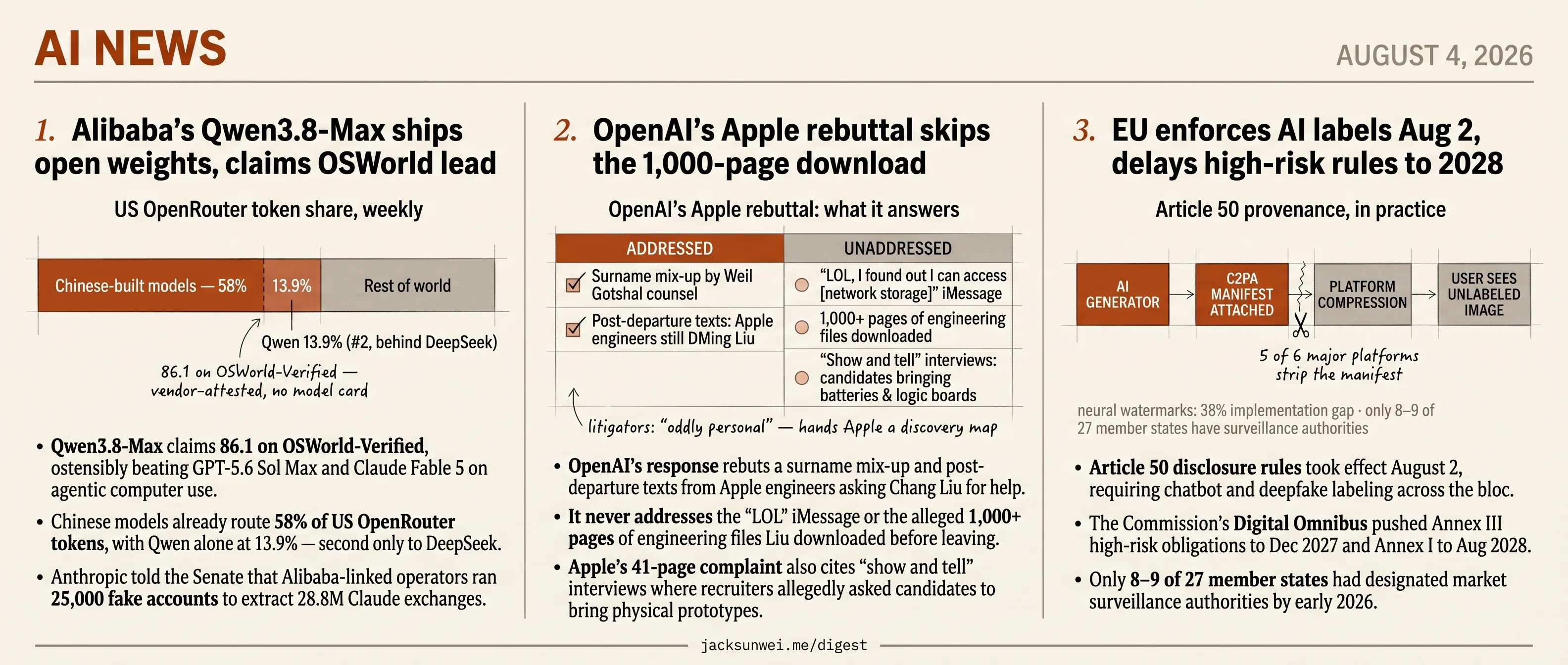
OpenAI answers Apple's trade-secret suit, Alibaba's Qwen3.8-Max claims OSWorld's top score, and the EU AI Act's disclosure rules take effect.
OpenAI omits 1,000 pages, Qwen ships no model card, EU delays high-risk to 2028
TL;DR
- Qwen3.8-Max claims 86.1 on OSWorld-Verified with no technical report or model card released.
- Anthropic told the Senate Alibaba-linked operators ran 25,000 fake accounts to extract 28.8M Claude exchanges.
- OpenAI’s response never addresses the 1,000+ engineering pages Apple says Chang Liu downloaded before leaving.
- EU Article 50 disclosure rules took effect August 2, requiring chatbot and deepfake labeling bloc-wide.
- Digital Omnibus pushed EU high-risk obligations to December 2027 and August 2028.
Three unrelated news beats today, and no single frame that holds across all of them without stretching. Alibaba’s Qwen3.8-Max ships open weights and claims 86.1 on OSWorld-Verified — ostensibly beating GPT-5.6 Sol Max and Claude Fable 5 on agentic computer use — but arrives without a technical report or model card, so every number is vendor-attested. OpenAI’s response to Apple’s 41-page trade-secret suit rebuts a surname mix-up and reframes post-departure texts, while stepping around the 1,000+ engineering pages and the LOL iMessage that anchor the complaint. And the EU AI Act’s Article 50 disclosure regime went live August 2, even as the Digital Omnibus punted Annex III to Dec 2027 and Annex I to Aug 2028 — with most member states still short of the market-surveillance authorities meant to enforce any of it.
Alibaba’s Qwen3.8-Max ships open weights, claims OSWorld lead
Source: the-verge-ai · published 2026-08-03
TL;DR
- Qwen3.8-Max claims 86.1 on OSWorld-Verified, ostensibly beating GPT-5.6 Sol Max and Claude Fable 5 on agentic computer use.
- Chinese models already route 58% of US OpenRouter tokens, with Qwen alone at 13.9% — second only to DeepSeek.
- Anthropic told the Senate that Alibaba-linked operators ran 25,000 fake accounts to extract 28.8M Claude exchanges.
- Alibaba shipped no technical report or model card, leaving every vendor benchmark unaudited.
The benchmark claim, half-audited
Alibaba’s pitch for Qwen3.8-Max is “second only to Fable 5” — and on the one number independent reporting has repeated, that holds up. VentureBeat confirms the 86.1 score on OSWorld-Verified for agentic computer use, above the numbers publicly reported for GPT-5.6 Sol Max and Anthropic’s Fable 5 1. Everywhere else the story softens. The model shipped without a technical report or model card, so training corpus, distillation lineage, and eval methodology are all vendor-attested.
Independent aggregators are less generous than the launch deck:
| Source | Qwen3.8-Max position | Note |
|---|---|---|
| Alibaba (self-report) | #2 globally | 86.1 OSWorld-Verified 1 |
| BenchLM composite | #6 (78.16/100) | Tied with Moonshot’s Kimi K3 |
| Chatbot Arena Elo | ~tied with Kimi K3 | Within 1 Elo point |
Aggregator rows are drawn from BenchLM and Chatbot Arena public leaderboards, cited in the research synthesis but not in the formal source bundle. The gap between “beats Fable 5 on one agentic benchmark” and “second-best model in the world” is the entire marketing surface of this release.
Adoption is already the story
The more interesting number isn’t on Alibaba’s slides. OpenRouter’s traffic data shows Chinese-built models now handle 58% of US token volume, with Qwen at 13.9% of weekly routed tokens — behind only DeepSeek 2. At $2 in / $6 out per million tokens, Qwen3.8-Max lands at roughly a tenth of frontier US pricing, which is why the companion 27B coding/cowork release matters: it slots directly into the developer pipelines that are already habituated to Chinese open weights.
The Verge frames this drop as a “swipe” at US supremacy. The routing data says the swipe landed months ago; Qwen3.8-Max is an incumbent shipping a new SKU, not a challenger arriving at the gate.
The distillation and policy overhang
The launch cannot be read cleanly because of what Anthropic disclosed in June: 25,000 fraudulent Anthropic accounts, allegedly operated by parties affiliated with the Qwen lab, generating 28.8 million Claude exchanges between April and June 2026 — characterized as the largest known distillation attack 3. Alibaba denies it. Defenders point to an awkward symmetry: Alibaba’s own Qwen outputs contributed more tokens to NVIDIA’s public Llama-Nemotron distillation dataset than Alibaba is accused of siphoning from Claude 4. Whichever side you take, “open-weights frontier contender” now travels with an unresolved IP dispute that Western legal teams have to price in.
Policy is moving in parallel. A Booz Allen audit found earlier Qwen-Coder variants emitted 130% more security vulnerabilities when the prompt persona was a US government developer versus a neutral one 5 — untested on 3.8-Max, but exactly the kind of finding that fuels the House’s AI Security and Innovation Act markup and proposed kill-switch mandates. Pushing back, a 200+ firm coalition led by Jensen Huang and Mark Zuckerberg warned that restrictions on Chinese open weights could cost US businesses $12B annually and hand the market to closed labs 6.
Takeaway
Treating this as another China-vs-US benchmark race misses the actual news: an open-weights model that is already load-bearing in US developer traffic just got a capability bump, shipped without documentation, under an active distillation lawsuit, while Congress debates whether US developers should be allowed to keep using it. The capability question is closer to settled than the legal and policy questions are.
Further reading
OpenAI’s Apple rebuttal skips the 1,000-page download
Source: openai-blog · published 2026-08-03
TL;DR
- OpenAI’s response rebuts a surname mix-up and post-departure texts from Apple engineers asking Chang Liu for help.
- It never addresses the “LOL” iMessage or the alleged 1,000+ pages of engineering files Liu downloaded before leaving.
- Apple’s 41-page complaint also cites “show and tell” interviews where recruiters allegedly asked candidates to bring physical prototypes.
- Legal analysts called the iMessage release “oddly personal” and warned it hands Apple more discovery leverage.
The PR win OpenAI actually got
OpenAI’s Sunday post lands two clean punches. Apple’s outside counsel at Weil Gotshal emailed the wrong person after mixing up two people with similar Asian surnames, then filed a declaration claiming a conversation with General Counsel Che Chang that had actually happened with a former employee. That’s embarrassing procedural theater and OpenAI is right to flag it.
The stronger piece of evidence is the chat log. OpenAI published iMessages showing Apple engineers texting Chang Liu weeks after his January 22, 2026 departure, asking him to help locate files and calling him “the best” for a technical assessment 7. That genuinely complicates Apple’s “rogue actor” framing — you can’t simultaneously claim someone exfiltrated your crown jewels and keep DMing them for help finding your own files.
What the blog post doesn’t answer
The problem is that neither of those points touches the substantive core of Apple’s complaint. Apple’s filing quotes Liu writing “LOL, I found out I can access the [network storage], so funny,” then allegedly downloading over 1,000 pages of confidential engineering material 89. Under the Defend Trade Secrets Act, active downloading by someone about to join a competitor plausibly clears the misappropriation bar regardless of whether Apple’s offboarding was sloppy 9. OpenAI’s “residual access” framing addresses the mechanism — credentials that weren’t revoked across cloud services — but not the volume or the intent Apple put in the record.
The complaint also alleges “show and tell” recruiting: candidates asked to bring physical parts — batteries, logic boards, prototypes — to interviews 8. That’s the kind of specific factual allegation that either happened or didn’t. OpenAI’s post says nothing about it.
The doctrinal backdrop
John Gruber reads the suit as fundamentally about hardware miniaturization expertise — Apple’s “secret sauce” for cramming components into small enclosures — and calls the alleged recruiting tactics “rotten to its core” 10. On the preliminary injunction, though, Apple faces a real headwind: IPWatchdog’s survey of recent DTSA doctrine finds federal courts increasingly reluctant to restrict employment absent proof of “actual or threatened” misappropriation, and California has largely rejected the “inevitable disclosure” theory as a de facto non-compete 11. That doctrinal shift doesn’t help OpenAI on the underlying trade-secret claim, but it does make the injunction OpenAI is publicly opposing a heavier lift for Apple than the complaint’s tone suggests.
The gamble on going public
Business Insider gathered reactions from litigators who called the release “oddly personal” and “non-lawyerly,” warning that publishing internal iMessages to exonerate one employee hands Apple a broader map of what to subpoena next 12.
Publishing iMessages to exonerate one employee may inadvertently hand Apple more ammunition during discovery. 12
That’s the trade OpenAI made: win the news cycle on the surname mix-up and the post-departure texts, and hope the “LOL” message doesn’t define the case when it reaches a judge. On the current record, it probably will.
EU enforces AI labels Aug 2, delays high-risk rules to 2028
Source: the-verge-ai · published 2026-08-03
TL;DR
- Article 50 disclosure rules took effect August 2, requiring chatbot and deepfake labeling across the bloc.
- The Commission’s Digital Omnibus pushed Annex III high-risk obligations to Dec 2027 and Annex I to Aug 2028.
- Only 8–9 of 27 member states had designated market surveillance authorities by early 2026.
- 5 of 6 major social platforms strip C2PA provenance manifests during normal compression, gutting the tech the rules rely on.
The one deadline that held
The Verge is right that August 2 was a real milestone: EU users interacting with chatbots or viewing synthetic media now have a legal right to be told. What the framing misses is why that particular obligation went live alone. The Commission’s Digital Omnibus, finalized in July, pushed compliance for stand-alone high-risk systems under Annex III to December 2, 2027, and AI embedded in regulated products under Annex I to August 2, 2028 13. Transparency isn’t leading the AI Act rollout — it’s the only part that didn’t get postponed.
The reason is institutional, not political. As of early 2026, only 8 to 9 of 27 member states had fully designated the national market surveillance authorities the Act depends on for enforcement 14. France split duties across 14 separate regulators; Poland stood up a single new entity called KRiBSI. Without those bodies, high-risk conformity assessments have nobody to file with — so Brussels bought itself two more years.
The tech underneath doesn’t survive contact with distribution
Article 50 requires that AI-generated content be marked in a machine-readable way, which in practice means C2PA manifests or neural watermarks. Independent testing keeps finding the same failure mode: the marks don’t survive the platforms where deepfakes actually spread. The Alliance for Forensic Integrity & Provenance found that five out of six major social networks strip C2PA manifests during standard compression and resizing 15. Compliance vendors themselves concede a 38% implementation gap for advanced neural watermarks like PawPrint across top-tier generators 16.
flowchart LR
    A[AI generator] -->|C2PA manifest attached| B[Upload to platform]
    B -->|compression/resize| C[Manifest stripped]
    C --> D[User sees unlabeled image]
    A -.->|neural watermark| E[Adversarial removal ~93%]
The law now obliges providers to embed provenance signals into a pipeline that reliably destroys them. Enforcement will have to decide whether “we attached the manifest at generation” satisfies Article 50 when the manifest is gone by the time a citizen sees the content.
Attacked from both flanks
The political coalition around the transparency rules is fragile. Consumer groups think they’re cosmetic: BEUC and EDRi argue “a label is not the same as protection,” and disclosure does nothing for victims of non-consensual intimate deepfakes, whose remedies sit under the DSA instead 17. From the other direction, Meta became the only major US developer to refuse the accompanying GPAI Code of Practice, with policy chief Joel Kaplan calling it a source of “legal uncertainties” that could “throttle the development of frontier models in Europe” 18. OpenAI, Google, Anthropic, Microsoft and Mistral all signed.
What actually changed
Strip out the ceremony and August 2 delivered a narrow, transparency-only foothold: enforced by regulators that mostly don’t exist yet, resting on watermarking tech that leaks at the distribution layer, and squeezed between advocates who call it too little and one hyperscaler who calls it too much. The AI Act is now in force. Most of the AI Act is not.
Round-ups
Palantir’s Karp brands AI frontier labs ‘Marxist’ after $1B quarter
Source: techcrunch-ai
Palantir CEO Alex Karp used a blockbuster earnings call — $1 billion in quarterly profit — to renew attacks on frontier AI labs, calling the industry ‘Marxist’ and too untrustworthy for enterprise customers. The framing positions Palantir as the grown-up alternative for regulated buyers.
ChatGPT dominates paid AI spending across Capitol Hill offices
Source: techcrunch-ai
House spending records show OpenAI’s ChatGPT is the AI tool congressional offices pay for most, TechCrunch found. Staffers lean on it to draft memos, summarize legislation, and handle constituent correspondence — cementing OpenAI’s foothold in federal workflows ahead of rivals.
Auterion’s $100M deal puts AI targeting on 50,000 Ukrainian drones
Source: ars-technica-ai
A US firm’s autonomy software will let Ukraine’s low-cost kamikaze drones lock onto targets without a human operator, under a $100 million contract covering 50,000 units. The upgrade lays groundwork for future swarm attacks resistant to Russian jamming.
AI-proctored exam voided as 58,000 students ordered to retake
Source: ars-technica-ai
An AI-supervised remote exam failed so badly that 58,000 students must sit it again, after top scores jumped 5x versus prior years. The spike suggested widespread cheating the automated proctor missed, forcing officials to throw out results entirely.
Trump’s AI protectionism extends to humanoid robotics sector
Source: mit-tech-review-ai
Humanoid robotics is the latest target of Trump-era industrial policy, MIT Technology Review reports in The Algorithm. The nascent field — still clumsy enough that machines stumble and mishandle objects — now faces trade curbs meant to blunt Chinese competitors before US firms mature.
Interconnects launches Artifacts Hub to track open-model adoption
Source: interconnects
Interconnects rolled out an Artifacts Hub and Adoption Dashboard to curate and measure the open-source AI ecosystem. The tools aim to scale visibility into which open models and datasets researchers actually pick up, giving the community a shared reference point beyond leaderboard chatter.
Import AI 467 covers self-sustaining AI viruses and progress pacing
Source: import-ai
Jack Clark’s latest issue weighs self-propagating AI malware, how to pace frontier progress, and persistent confusion over AI and creativity. The newsletter closes with a speculative riff on when humanity gets around to building a moon arcology.
Footnotes
-
↩ ↩2Qwen3.8-Max arrives with a bold claim: it outperforms GPT-5.6 Sol Max and Fable 5 on agentic computer use, scoring 86.1 on the OSWorld-Verified benchmark
-
AI Weekly / OpenRouter data — https://aiweekly.co/alerts/chinese-ai-models-hit-record-58-of-us-openrouter-traffic
↩Chinese-built models captured a record 58% of total US tokens processed through OpenRouter… Qwen has secured a 13.9% share of weekly routed tokens, trailing only DeepSeek
-
Business Insider — https://www.businessinsider.com/anthropic-china-alibaba-exploiting-ai-models-distillation-attack-2026-6
↩operators affiliated with Alibaba’s Qwen AI lab used approximately 25,000 fraudulent accounts to generate 28.8 million exchanges with its Claude model family between April 22 and June 5, 2026
-
Voronoi (dataset audit) — https://www.voronoiapp.com/technology/Alibabas-own-models-built-more-of-the-biggest-legal-AI-dataset-than-it-allegedly-took-from-Claude-8691
↩Alibaba’s own Qwen models have contributed more to public distillation datasets — such as NVIDIA’s Llama-Nemotron — than the volume Alibaba is accused of taking from Claude
-
Help Net Security (Booz Allen report) — https://www.helpnetsecurity.com/2026/06/09/chinese-ai-coding-models-security/
↩Qwen3-Coder introduced 130% more security vulnerabilities when the prompt persona was a U.S. government developer compared to a neutral persona
-
Export Compliance Daily — https://exportcompliancedaily.com/article/2026/07/28/us-tech-startups-china-caution-us-against-controls-on-open-weight-models-2607270012?BC=bc_6a688c45331ed
↩a coalition of over 200 tech entities, led by Nvidia’s Jensen Huang and Meta’s Mark Zuckerberg… warn that ‘premature restrictions’ would destroy competition… a ban on Chinese models could cost U.S. businesses up to $12 billion annually
-
↩OpenAI published chat logs showing Apple employees kept texting their former colleague Liu weeks after his departure, asking him to locate files and provide technical assessments — one Apple staffer said Liu was ‘the best’ for the task despite no longer being employed there.
-
MBHB IP law firm analysis — https://www.mbhb.com/intelligence/snippets/apple-v-openai-a-new-frontier-in-ai-hardware-trade-secret-litigation/
↩ ↩2The complaint alleges a ‘coordinated pattern of misconduct’ — including ‘show and tell’ interview requests for actual parts (batteries, logic boards, prototypes) and exploitation of a ‘previously unknown authentication bug’ by Chang Liu to access Apple’s network storage after his January 22, 2026 departure.
-
Medium: ‘What the LOL message actually tells us’ — https://medium.com/the-programmer/apple-vs-openai-what-the-lol-message-actually-tells-us-23b51e400632
↩ ↩2‘LOL, I found out I can access the [network storage], so funny’ — Apple alleges Liu then downloaded over 1,000 pages of confidential engineering files, which under the Defend Trade Secrets Act likely constitutes misappropriation regardless of Apple’s offboarding failures.
-
John Gruber, Daring Fireball — https://daringfireball.net/linked/2026/07/16/apple-lawyer-name-mixup
↩By hiring these specific product designers — essentially mechanical and electrical engineers who specialize in miniaturization — OpenAI is attempting to replicate Apple’s ‘secret sauce’ for fitting advanced tech into small enclosures, a move ‘rotten to its core.’ The suit is also useful anecdata against Musk’s claim that Apple favors OpenAI.
-
IPWatchdog: ‘When Trade Secret Claims Become Non-Competes’ — https://ipwatchdog.com/2026/06/22/when-trade-secret-claims-become-non-competes-by-another-name/
↩Under DTSA, federal courts are increasingly reluctant to grant injunctions restricting employment absent proof of ‘actual or threatened’ misappropriation; California has largely rejected ‘inevitable disclosure’ as a de facto non-compete violating public policy on employee mobility.
-
Business Insider — https://www.businessinsider.com/openai-hits-back-apple-trade-secret-lawsuit-messages-2026-8
↩ ↩2Legal analysts called OpenAI’s public release of internal communications ‘oddly personal’ and ‘non-lawyerly,’ warning that publishing iMessages to exonerate one employee may inadvertently hand Apple more ammunition during discovery.
-
Orrick — EU AI Act Update: Digital Omnibus — https://www.orrick.com/en/Insights/2026/07/EU-AI-Act-Update-Digital-Omnibus-Finalizes-8-Compliance-Changes
↩Obligations for stand-alone high-risk systems (Annex III) have been pushed to December 2, 2027, while AI embedded in regulated products (Annex I) faces a further delay until August 2, 2028
-
Oxford Blavatnik School of Government blog — https://www.bsg.ox.ac.uk/blog/ai-acts-enforcement-gap-what-polands-new-regulator-reveals-about-europes-challenge
↩As of early 2026, only 8 to 9 out of 27 member states had fully designated their national market surveillance authorities… France has dispersed duties across 14 separate regulators, whereas Poland has created a single new entity, KRiBSI
-
Alliance for Forensic Integrity & Provenance (AFIP) research — https://afip.org/research/metadata-stripping/
↩C2PA manifests were stripped by five out of six major social media platforms during standard compression and resizing processes
-
SoftwareSeni — C2PA implementation review — https://www.softwareseni.com/eu-ai-act-and-content-provenance-regulations-making-c2pa-urgent-in-2026/
↩Even advanced ‘neural watermarks’ like PawPrint face a 38% implementation gap among top-tier AI generators, reflecting a widespread lack of readiness for the 2026 enforcement deadline
-
Tech Policy Press — ‘A missed opportunity?’ (BEUC / EDRi critique) — https://www.techpolicy.press/eu-ai-act-transparency-rules-are-now-in-effect-was-it-a-missed-opportunity/
↩A label is not the same as protection… disclosure does little for victims of non-consensual intimate deepfakes
-
Greenberg Traurig compliance briefing / Meta refusal coverage — https://www.gtlaw.com/en/insights/2025/7/eu-ai-act-key-compliance-considerations-ahead-of-august-2025
↩Meta has formally declined to sign the GPAI code… Joel Kaplan stated that the code introduces ‘legal uncertainties’ that could ‘throttle the development’ of frontier models in Europe