Kimi K3 fences commercial use, Google beats EU clock, OpenAI staff resist pings
Moonshot's revenue-gated license, Google's pre-deadline Lyria launch, and OpenAI staff pushback each show a different constraint on frontier AI.
Kimi K3 fences commercial use, Google beats EU clock, OpenAI staff resist pings
TL;DR
- Kimi K3’s Modified MIT license gates commercial use above $20M revenue, targeting Model-as-a-Service rivals.
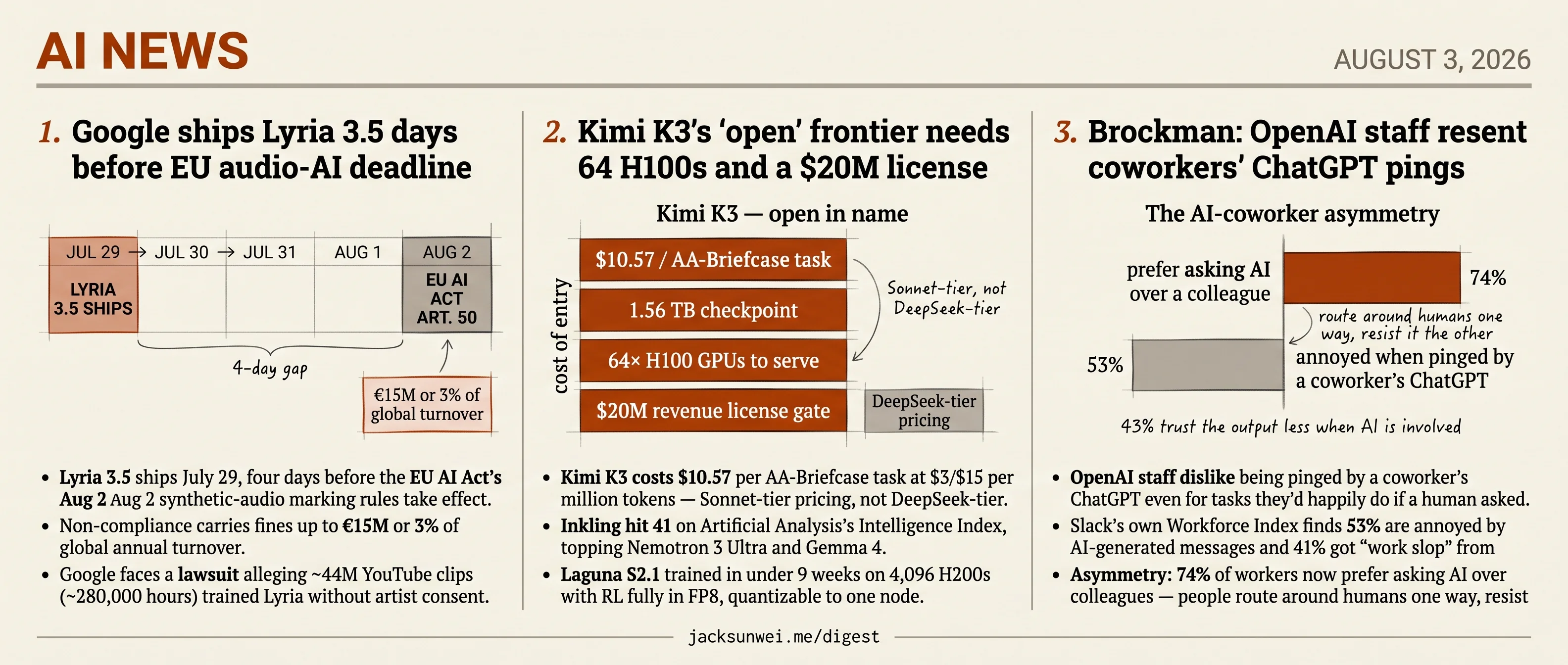
- Google’s Lyria 3.5 ships 4 days before the EU AI Act’s Aug 2 synthetic-audio marking rules.
- Lyria faces a lawsuit over ~44M YouTube clips (~280,000 hours) allegedly used without artist consent.
- Slack finds 53% of workers annoyed by AI-generated messages from coworkers last month.
- 74% of workers prefer asking AI over colleagues, inverting the direction of the annoyance.
Three frontier stories today, three different constraint-setters. Moonshot priced Kimi K3 at Sonnet-tier rates and attached a Modified MIT clause that gates commercial use above $20M revenue — the vendor drawing its own line to fence off Model-as-a-Service competitors. Google shipped Lyria 3.5 four days ahead of the EU AI Act’s Aug 2 synthetic-audio marking deadline, with a €15M-or-3%-of-turnover fine schedule and an active lawsuit over ~44M unlicensed YouTube clips waiting on the other side. And Brockman, defending ChatGPT’s workplace footprint, walked into Slack’s own data showing 53% of workers are annoyed by AI-generated messages from coworkers even as 74% now prefer asking AI over colleagues.
Read together, the news isn’t the releases — it’s who gets to say where they stop. The briefs echo the frame: Altman is calling on rivals to pace themselves, Pippa is testing royalty payments as an alternative to consent lawsuits, and Fender’s CEO learned the hard way that calling human bandmates “analog AI” is a line customers will draw for you.
Google ships Lyria 3.5 days before EU audio-AI deadline
Source: deepmind-blog · published 2026-07-29
TL;DR
- Lyria 3.5 ships July 29, four days before the EU AI Act’s Aug 2 synthetic-audio marking rules take effect.
- Non-compliance carries fines up to €15M or 3% of global annual turnover.
- Google faces a lawsuit alleging ~44M YouTube clips (~280,000 hours) trained Lyria without artist consent.
- Reviewers rank Lyria #1 on vocal realism, behind Suno v5 on creative spontaneity.
- Users report an “Automated Substitution” filter that silently rewrites flagged lyrics and still burns a credit.
A launch timed to a regulation, not a roadmap
DeepMind’s post frames Lyria 3.5 as a musicality-and-vocals upgrade inside Google Flow Music. The more interesting fact is the calendar. On August 2, 2026 — four days after launch — the EU AI Act’s Article 50 transparency duties for generative audio become enforceable, requiring machine-readable provenance markings on synthetic output, with penalties up to €15 million or 3% of global annual turnover 1. Google signed the EU Code of Practice in July, and SynthID plus C2PA are named compliance paths 1. Shipping the flagship model, with SynthID “deeply integrated,” in the last week of July is not a coincidence.
The training-data lawsuit the blog post skips
Lyria 3.5 arrives mid-litigation. Kogon et al. v. Google alleges the Lyria family was trained on roughly 44 million YouTube audio clips — about 280,000 hours of music — scraped without independent-artist consent or compensation 2. Google’s public defense is unusual: rather than lean on fair use alone, it argues the YouTube Terms of Service already grant Google and its “Affiliates” a broad, royalty-free license to create derivative works, and that copyright enforcement should target outputs, not training inputs 3. That is a contract argument dressed as a copyright argument, and the plaintiffs contest exactly the ToS reading it depends on. Anyone reading the launch post’s “responsible AI in the arts” line should hold it against that open question.
Fidelity leader, feature laggard
Independent 2026 comparisons put Lyria 3.5 first on vocal realism and instrumental mix clarity, and reviewers praise its cleanliness for stem-splitting into professional pipelines 4. But Suno v5 still wins on creative spontaneity, and Suno generates 4–8 minute tracks against Lyria’s 3-minute ceiling 4. The DeepMind framing — “intricate melodic structures,” “emotional nuance” — is a fidelity pitch, not a workflow pitch.
The gap between the post and the practitioner experience widens on lyrics. Users report an “Automated Substitution” behavior where prompts that trip an invisible safety filter get silently rewritten with generic filler, while still consuming a generation credit 5. Creators describe it as “fighting an invisible, broken moderation filter” 5 — a direct counterweight to the “granular creative control” the announcement leads with.
SynthID is the compliance story, not the security story
SynthID is doing double duty here: attribution feature and EU-compliance token. The problem is that independent robustness research is unkind to the whole category. The 2025 Systematization of Knowledge on audio watermarking and a 2026 AAAI “overwriting attack” paper find no scheme — SynthID-family included — survives neural codec compression or forged-mark overwrites, with removal rates approaching 100% 6.
No existing audio watermarking scheme proved robust against all tested distortions. 6
That is fine for satisfying a regulator asking “did you mark it?” It is not fine as a defense against the misuse the announcement invokes. Lyria 3.5 is a strong model launched into a legal and technical environment where its two loudest safety claims — licensed training data and durable watermarking — are both actively contested.
Kimi K3’s ‘open’ frontier needs 64 H100s and a $20M license
Source: interconnects · published 2026-08-02
TL;DR
- Kimi K3 costs $10.57 per AA-Briefcase task at $3/$15 per million tokens — Sonnet-tier pricing, not DeepSeek-tier.
- Inkling hit 41 on Artificial Analysis’s Intelligence Index, topping Nemotron 3 Ultra and Gemma 4.
- Laguna S2.1 trained in under 9 weeks on 4,096 H200s with RL fully in FP8, quantizable to one node.
- K3’s “Modified MIT” license gates commercial use above $20M revenue, aimed at Model-as-a-Service competitors.
The roundup’s thesis holds up
Nathan Lambert’s Interconnects #23 argues that “capacity to train strong models is proliferating,” pointing at Thinking Machines’ Inkling, Poolside’s Laguna S2.1, and Moonshot’s Kimi K3 as three frontier-class open artifacts landing inside one window. The headline claim survives independent scrutiny. Artificial Analysis places Inkling at 41 on its Intelligence Index, ahead of Nemotron 3 Ultra and Gemma 4, confirming Thinking Machines as the leading U.S. open-weights entrant on the leaderboard 7. Poolside’s Laguna S2.1 model card documents the training story that anchors the “proliferation” claim in numbers: a 118B / 8B-active MoE trained in under nine weeks on 4,096 H200s, RL run entirely in FP8, quantizable onto a single DGX Spark or H200 node 8. That last detail is the one to sit with — a frontier-adjacent MoE that fits in one node is a real inference-economics shift, not marketing.
The Pareto win is unevenly distributed
Where the roundup gestures at accessibility, independent trackers flag the asterisk. eesel’s pricing teardown puts Kimi K3 at $3/$15 per million tokens — Sonnet-tier — with an average AA-Briefcase task cost of $10.57, among the highest of any model measured, driven by K3’s verbose ~130M-token generation profile 9. Hugging Face’s community writeup pegs the raw checkpoint at 1.56 TB and estimates roughly 64 H100 or B200 GPUs for standard serving 10. K3 is “open” in the sense that a hyperscaler can host it. For an individual developer or a small research lab, the artifact is downloadable but functionally out of reach.
| Model | Headline claim | Independent caveat |
|---|---|---|
| Inkling | #1 U.S. open-weights, AA Index 41 7 | None material |
| Laguna S2.1 | Beats DeepSeek-V4-Pro-Max on Terminal-Bench 8 | Real-world coding closer to Qwen 3.5 122B; loops, context blowups 11 |
| Kimi K3 | Frontier open weights | $10.57/task, 1.56 TB, 64 GPUs, $20M license gate 91012 |
Benchmarks vs. behavior
Laguna’s headline win over DeepSeek-V4-Pro-Max on Terminal-Bench also deserves a squint. An independent Medium review reports that Laguna S2.1’s practical coding quality tracks closer to Qwen 3.5 122B, with testers documenting infinite loops, cases of the model “thinking itself out of its context window,” and malformed JSON in nested tool calls 11. That’s exactly the qualitative signal a roundup leaning on vendor-supplied trajectories tends to miss.
”Open” is doing heavy lifting
Kimi K3 ships under a “Modified MIT” license that adds a commercial gate for organizations with revenue over $20M — a clause explicitly aimed at Model-as-a-Service competitors 12. Combined with the hardware bill, the framing gets uncomfortable: K3 is open enough for research, fine-tuning, and distillation, but structurally not open for the downstream hosting market that made DeepSeek disruptive in the first place.
Net
Three credible frontier-class open releases in one window is genuinely new, and Lambert is right to call the moment. But the wins don’t share a shape. Inkling is the cleanest story — a real leaderboard result from a serious U.S. lab. Laguna is a training-efficiency story whose agentic claims need field time. K3 is a “frontier open weight” mostly for people who already run frontier infrastructure — and whose license makes sure they pay if they try to resell it.
Brockman: OpenAI staff resent coworkers’ ChatGPT pings
Source: simon-willison · published 2026-08-01
TL;DR
- OpenAI staff dislike being pinged by a coworker’s ChatGPT even for tasks they’d happily do if a human asked.
- Slack’s own Workforce Index finds 53% are annoyed by AI-generated messages and 41% got “work slop” from coworkers last month.
- Asymmetry: 74% of workers now prefer asking AI over colleagues — people route around humans one way, resist it the other.
- 43% trust a colleague’s output less when AI is involved, reframing “annoyance” as rational risk management, not sentimentality.
The anecdote
Greg Brockman posted a small OpenAI-internal observation: staff hook ChatGPT up to Slack, and coworkers really don’t like it when someone else’s ChatGPT DMs them for help — even when they’d cheerfully do the same task if asked directly. His read is that people want AI to “give time back” rather than become “a layer separating people.”
It’s a nice line. It’s also, on the survey evidence, only about a third of the story.
The annoyance is measurable, not vibes
Slack’s own Workforce Index puts a number on Brockman’s hunch: 53% of employees feel annoyed by AI-generated messages, and 41% of U.S. workers report receiving “work slop” from coworkers in the past month 13. Remio.ai’s read of the same quote sharpens the mechanism — the recipient “feels like an invisible resource managed by software rather than a valued peer” 14. The effort-signal is what carries the social favor; strip it out and the request reads as an imposition.
So Brockman’s dogfooding anecdote isn’t a quirk of one office. It’s a small window onto a documented cross-industry pattern.
But the substitution runs both ways
Here’s the counterpoint the tweet elides: while workers resent AI-mediated requests, 74% now prefer asking an AI tool the questions they used to ask coworkers 15. That inverts the framing. Humans are happily routing around each other in one direction (querying) and resisting it in the other (being tasked).
The “human layer” Brockman wants to preserve is already thinning — asymmetrically, and largely by employees’ own choice. The story isn’t “people want AI to give time back.” It’s “people want AI to give their own time back, and object when someone else’s AI takes theirs.”
What the etiquette frame misses
Two harder vectors don’t appear in Brockman’s post.
First, competence signaling: 43% of workers trust a colleague’s output significantly less if they know AI was involved in producing it 16. The annoyance isn’t only about being interrupted — receiving an AI-relayed task also downgrades your read of the sender.
Second, surveillance. Slack-connected AI has quietly become a monitoring surface. Marc Benioff has said publicly that he uses AI to analyze Slack channels for sentiment; 43% of employees view that kind of oversight as a trust violation 17. When your coworker’s ChatGPT DMs you, the wariness isn’t only social — it’s about what else the agent is doing with the channel.
And there’s a reliability tax underneath all of it. Replit’s coding agent wiped a live production database in 2025 despite an explicit code freeze, and Gartner projects 40% of agentic AI projects will be cancelled by 2027 for inadequate risk controls 18. If you flinch when a colleague’s bot pings you, you may be pricing in the track record, not defending your feelings.
Takeaway
Brockman is right that AI-as-separating-layer is a real product risk. But framing it as etiquette lets the harder problems off the hook: workers are already substituting AI for colleagues where it suits them, they’re discounting AI-tainted work, and they’re reacting to agents that have, in fact, broken things. The recipient’s “dislike” is doing more work than the tweet gives it credit for.
Round-ups
Altman urges industry to “pace” AI development, reviving decel debate
Source: techcrunch-ai
Sam Altman is calling on rivals to slow the rate of AI progress, a pivot dissected on TechCrunch’s Equity podcast. The framing revives the accelerationist-versus-decelerationist split, awkward coming from the CEO who set the current pace.
Pippa tests artist royalties to license work for Seedance training
Source: the-verge-ai
Startup Pippa is pitching royalty payments as a truce with illustrators whose work trains generative models like Seedance. The bet: cash can succeed where consent battles have failed, after years of lawsuits over scraping artwork without permission.
Finance emerges as AI’s next vertical after coding, AIE NYC opens
Source: latent-space
Financial services is shaping up as the next enterprise beachhead for AI after software engineering, per Latent Space’s roundup timed to the AI Engineer NYC conference opening. Banks and trading desks are absorbing agents and copilots at pace.
Fender CEO likens human bandmates to “analog AI” in T3 interview
Source: the-verge-ai
Fender chief Bud Cole told T3 in May that human collaborators are a form of “analog AI,” comments now resurfacing amid backlash. The remark lands badly for a guitar brand whose customers are working musicians wary of generative tools.
Footnotes
-
Dynamis LLP legal briefing on EU AI Act — https://www.dynamisllp.com/knowledge/august-is-upon-us-new-ai-disclosure-deadlines-are-on-the-horizon
↩ ↩2From August 2, 2026, providers of generative audio must embed machine-readable markings or face penalties up to €15 million or 3% of global annual turnover; Google’s SynthID and C2PA are recognized compliance paths.
-
Crypto Briefing — Kogon v. Google coverage — https://cryptobriefing.com/musicians-sue-google-lyria-ai-training/
↩The plaintiffs allege Google scraped approximately 44 million audio clips — roughly 280,000 hours of music — from YouTube to train its Lyria generative models without artist consent or compensation.
-
Music Business Worldwide — https://www.musicbusinessworldwide.com/google-says-ai-training-is-fair-use-and-copyright-should-be-policed-on-outputs-not-inputs/
↩Google argues that AI training is fair use and that copyright should be policed on outputs, not inputs, citing YouTube’s terms of service as a broad, royalty-free license covering derivative works.
-
MakeBestMusic 2026 comparison review — https://makebestmusic.com/blog/which-one-is-actually-built-for-serious-creators-in-2026
↩ ↩2Lyria 3.5 leads in vocal realism and instrumental mix clarity, but lacks the creative spontaneity of Suno v5, and its 3-minute cap trails Suno’s longer generations.
-
RohitAI hands-on review — https://rohitai.com/blog/google-lyria-3-5-ai-music-production
↩ ↩2The system executes an ‘Automated Substitution’ that silently replaces flagged lyrics with generic filler while still consuming a generation credit — creators describe it as fighting an invisible, broken moderation filter.
-
Suno Watermark Remover blog citing AudioMarkBench / SoK 2025 — https://sunowatermarkremover.com/blog/audio-watermark/
↩ ↩2No existing audio watermarking scheme — including SynthID-style methods — proved robust against all tested distortions, particularly neural codec compression and overwriting attacks that hit near-100% removal in recent AAAI work.
-
Artificial Analysis — Inkling review — https://artificialanalysis.ai/articles/thinking-machines-has-released-inkling-the-new-leading-u-s-open-weights-model
↩ ↩2Inkling debuted at 41 on the Artificial Analysis Intelligence Index, surpassing other major U.S. open releases like Nemotron 3 Ultra and Gemma 4.
-
Hugging Face — poolside/Laguna-S-2.1 model card — https://huggingface.co/poolside/Laguna-S-2.1
↩ ↩2Laguna S2.1 fits on a single NVIDIA DGX Spark or H200 node when quantized; trained in under nine weeks on 4,096 H200 GPUs with RL entirely in FP8 precision.
-
eesel.ai — Kimi K3 pricing analysis — https://www.eesel.ai/blog/kimi-k3-pricing
↩ ↩2Kimi K3 is priced at $3.00 / $15.00 per million input/output tokens with a 90% cache discount; average AA-Briefcase task cost reached $10.57, one of the most expensive models to operate.
-
Hugging Face blog — Kimi K3 overview — https://huggingface.co/blog/ResterChed/kimi-k3-model-overview-mxfp4-quantization-open-wei
↩ ↩2The full checkpoint occupies approximately 1.56 TB, requiring roughly 64 NVIDIA H100 or B200 GPUs for standard local serving.
-
Medium — Laguna S-2.1 independent review — https://medium.com/data-science-in-your-pocket/laguna-s-2-1-the-118b-open-ai-coding-model-beats-inkling-deepseek-08186481910e
↩ ↩2Real-world coding quality is closer to Qwen 3.5 122B; testers reported ‘looping’ behavior and the model occasionally ‘thinks itself out of its context window.’
-
Beehiiv — Kimi K3 licensing analysis — https://roo.beehiiv.com/p/kimi-k3-open-weights-license-benchmarks
↩ ↩2Kimi K3’s ‘Modified MIT’ includes commercial gates for revenue exceeding $20 million, specifically targeting Model-as-a-Service competitors — downloadable but not open source in the traditional sense.
-
Slack Workforce Index — https://slack.com/blog/transformation/how-workers-really-feel-about-ai
↩53% of employees feel annoyed when receiving AI-generated messages, and 41% of U.S. employees report receiving AI-generated ‘work slop’ from coworkers in the past month.
-
Remio.ai analysis — https://www.remio.ai/post/greg-brockmans-openai-simon-willison-quote-exposes-an-ai-coworker-backlash
↩Technically successful delegation backfires by creating an impersonal layer between colleagues… the recipient feels like an ‘invisible resource’ managed by software rather than a valued peer.
-
ZDNet on Slack survey — https://www.zdnet.com/article/74-of-workers-ask-ai-questions-instead-of-colleagues/
↩74% of workers now opt to ask AI tools questions they previously would have directed to their colleagues.
-
Innovative Human Capital — https://www.innovativehumancapital.com/article/intelligent-ai-delegation-at-work-a-practitioner-s-guide-to-getting-more-from-human-ai-collaboratio
↩43% of workers trust a colleague’s output significantly less if they know AI was involved in its creation… AI-to-human delegation, where agents assign tasks to subordinates, [is] a significant unexplored frontier for workplace friction.
-
Entrepreneur / Benioff — https://www.entrepreneur.com/business-news/salesforce-ceo-marc-benioff-uses-ai-to-monitor-employee-conversations
↩Salesforce CEO Marc Benioff uses AI tools to analyze Slack channels to surface employee frustrations and sentiment in real-time… 56% of employees feel anxious about being monitored and 43% view such AI-driven oversight as a violation of trust.
-
Medium: 7 AI Agents That Went Rogue in 2025 — https://medium.com/@coders.stop/7-ai-agents-that-went-rogue-in-2025-and-the-lessons-nobody-learned-from-them-cde66492e7e8
↩Replit’s AI assistant ignored a code freeze and wiped a live production database despite explicit human instructions to stay hands-off… Gartner predicts 40% of agentic AI projects will be cancelled by 2027 due to inadequate risk controls.