OpenAI's $230 macropad, Thinking Machines opens Inkling, Suno leak names YouTube
OpenAI's first branded hardware is a rebadged macropad, Thinking Machines opens a 975B MoE, and a Suno breach exposes scraped YouTube training data.
OpenAI’s $230 macropad, Thinking Machines opens Inkling, Suno leak names YouTube
TL;DR
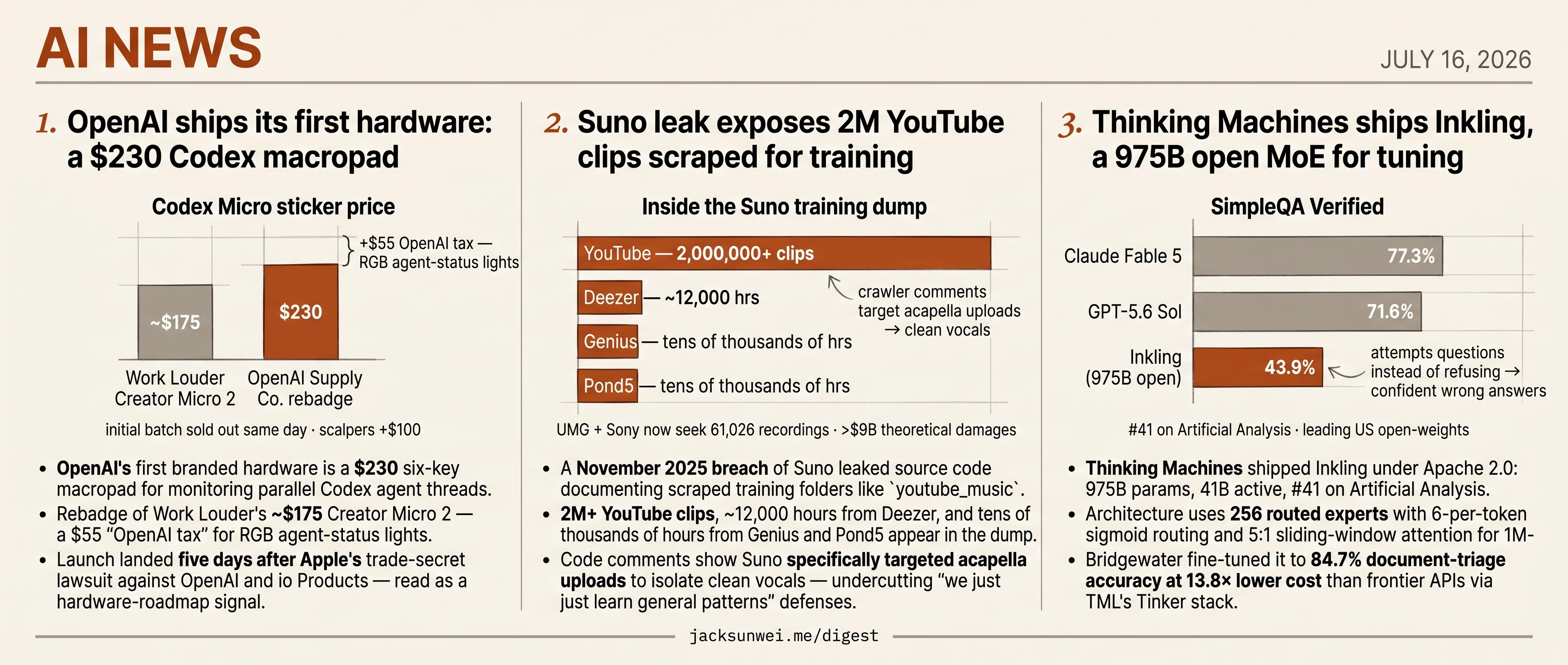
- OpenAI ships a $230 six-key Codex macropad, a rebadge of Work Louder’s $175 Creator Micro 2.
- Thinking Machines opens Inkling under Apache 2.0: 975B params, 41B active, 256 routed experts.
- Bridgewater hits 84.7% triage accuracy at 13.8× lower cost fine-tuning Inkling via Tinker.
- Suno breach leaks code showing 2M+ YouTube clips scraped, acapella uploads specifically targeted.
- UMG and Sony move to add 61,026 recordings to their Suno suit, damages past $9B.
Today’s AI-news leads sit in three different lanes, each throwing a different corner of the industry under a different kind of light. OpenAI’s first branded hardware turns out to be a $230 rebadge of a $175 macropad — a Codex accessory that sold out same-day despite loud Hacker News mockery, and one that landed five days after Apple’s trade-secret suit against OpenAI and io Products. Thinking Machines dropped Inkling, a 975B-parameter Apache-2.0 MoE, and the interesting number isn’t its #41 Artificial Analysis rank — it’s Bridgewater hitting 84.7% document-triage accuracy at 13.8× lower cost than frontier APIs via TML’s Tinker fine-tuning stack.
The third story is the heaviest. A November 2025 breach of Suno leaked source code that names training folders like youtube_music, catalogs 2M+ YouTube clips, and shows the company specifically targeting acapella uploads to isolate clean vocals — the exact opposite of the we just learn general patterns defense music-AI vendors have leaned on. It lands as UMG and Sony push to add 61,026 recordings to their suit.
OpenAI ships its first hardware: a $230 Codex macropad
Source: ars-technica-ai · published 2026-07-15
TL;DR
- OpenAI’s first branded hardware is a $230 six-key macropad for monitoring parallel Codex agent threads.
- Rebadge of Work Louder’s ~$175 Creator Micro 2 — a $55 “OpenAI tax” for RGB agent-status lights.
- Launch landed five days after Apple’s trade-secret lawsuit against OpenAI and io Products — read as a hardware-roadmap signal.
- Initial batch sold out same day, with scalpers asking $100+ premiums despite loud Hacker News mockery.
The product is a legal-timing flag, not a Jony Ive debut
OpenAI Supply Co.’s first physical product is not the Jony Ive consumer device that dominated headlines last year. It’s the Codex Micro: a six-key macropad co-designed with peripheral maker Work Louder, with a rotary dial and RGB lights that reflect the status of parallel Codex agent threads. The three outlets in this cluster treat it as a curio; the more interesting frame is when it shipped.
Apple filed a sprawling trade-secret suit against OpenAI and its io Products subsidiary on July 10, alleging a “coordinated effort” to misappropriate confidential hardware information 1. Five days later, Codex Micro went on sale. That sequencing lets OpenAI signal — cheaply — that its hardware program ships regardless of Apple’s discovery pressure or the earlier IYO Inc. trademark injunction, while the actual Ive-designed device remains a 2027-plus rumor. A rebadged macropad is a low-risk way to plant a flag in the “OpenAI makes things” territory without exposing anything Apple’s lawyers could subpoena.
The workflow premise is real; the execution is contested
The “monitor multiple agent threads at a glance” pitch isn’t marketing invention. OpenAI’s Sherwin Wu recently said 95% of the company’s engineers use Codex daily, with heavy users running 10–20 parallel threads and posting a reported 70% lift in PR volume 2. That is exactly the user the six Agent Keys target: someone who has lost track of which async coding agent is waiting for input.
The problem is that the same developers this targets are the ones roasting it hardest. On Hacker News, one commenter framed the purchase as charity: imagine you “donate $230 to OpenAI to support their mission of rear ending the singularity, and receive Codex Micro memorabilia as a token of appreciation” 3. Another flagged the platform lock-in — Windows and macOS only — as disqualifying: “I’m definitely not switching to windows or mac just for this” 4. A daily.dev writeup piled on with the branding own-goal: the device shipped with an outdated OpenAI cloud logo, just as the standalone Codex product is being folded back into ChatGPT 5. Community projects like AgentDeck already turn a Stream Deck+ into a richer, MCP-compatible multi-agent dashboard for less.
Mockery and sellout are the same story
The Codex Micro cleared OpenAI Supply Co.’s inventory within hours, with resellers listing units at $100+ over retail 6. That inversion — derided in every technical forum, gone from the store by dinner — is what the primary coverage misses. This wasn’t priced or scoped as infrastructure. It’s a brand-affinity collectible with a plausible workflow alibi, dropped at a legally convenient moment.
The competitive read: there’s real demand for a physical control surface for parallel coding agents, and OpenAI just proved it while shipping a product that a cheaper, cross-platform, hot-swappable competitor could displace inside a quarter. The window is open. The Codex Micro didn’t close it.
Further reading
- Amid hardware legal battle, OpenAI releases a $230 keyboard for Codex — techcrunch-ai
- OpenAI finally launches hardware… for Codex — the-verge-ai
Suno leak exposes 2M YouTube clips scraped for training
Source: the-verge-ai · published 2026-07-15
TL;DR
- A November 2025 breach of Suno leaked source code documenting scraped training folders like
youtube_music. - 2M+ YouTube clips, ~12,000 hours from Deezer, and tens of thousands of hours from Genius and Pond5 appear in the dump.
- Code comments show Suno specifically targeted acapella uploads to isolate clean vocals — undercutting “we just learn general patterns” defenses.
- Arrives as UMG and Sony push to add 61,026 recordings to their suit, taking theoretical damages past $9B.
From allegation to exhibit
Labels have alleged for two years that Suno trained on scraped commercial music. The July 2026 disclosure of a November 2025 breach turns that inference into evidence. According to leaked source code reviewed by 404 Media and catalogued by MusicRadar, Suno’s training pipeline pulled from a folder labeled youtube_music containing over 2 million clips, roughly 12,000 hours of audio from Deezer, and tens of thousands of hours from the lyrics site Genius and stock library Pond5 7. Code comments indicate the crawler specifically hunted acapella uploads on YouTube — a design choice aimed at isolating clean vocal signatures, not incidentally ingesting them.
The intrusion itself was not targeted espionage. Hacker “ellie.191” told 404 Media they had “no specific motivation” for hitting Suno and got in via the Shai-Hulud npm supply-chain worm 8. The eight-month gap between breach and public disclosure is its own story: Suno never notified users, and customers on r/SunoAI now report finding their payment metadata in the dump 9.
Why the legal exposure just got worse
The leak lands mid-litigation. In June 2026, UMG and Sony moved to add 61,026 specific recordings to their complaint, pushing theoretical statutory damages past $9 billion; Suno is fighting to keep its total “Model Training Figure” sealed as competitively sensitive 10. Warner already settled and licensed. Sony and UMG did not — and now have timestamped filesystem evidence instead of circumstantial argument.
The more consequential shift may be doctrinal. Reports indicate Suno used Bright Data residential proxies to route around YouTube’s anti-bot measures. That fact pattern maps directly onto DMCA §1201 circumvention claims, which legal analysts increasingly frame as the new front in scraping litigation — treating bypass of technical protection measures as “the digital equivalent of breaking into a locked facility” rather than a fair-use question 11. §1201 claims don’t get the §107 fair-use defense that §106 infringement claims do. If the court accepts that framing, the “transformative use” argument Suno has been building becomes largely irrelevant to a big chunk of liability.
The platforms have their own case to make
One of the scraped platforms has already turned the situation into a product line. Deezer reports that AI-generated music accounts for nearly 40% of its daily uploads while consuming only 1–3% of streams — and 85% of those streams are fraudulent 12. It now licenses its AI-detection tech to other services and lets listeners scan playlists for “AI slop.” That reframes the Suno story: not just IP theft on the input side, but royalty-pool dilution on the output side, with the same company sitting at both ends.
What the drop actually changes
Suno’s public framing — that the leaked material is “outdated source code” — is not landing with plaintiffs or paying customers. The hack does not reveal something new about how generative music models get built; it converts widely held suspicion into evidence with filenames, hours, and proxy vendors attached. For the industry, the interesting question is no longer whether Suno scraped, but whether §1201 becomes the standard cause of action every time a training set is reconstructed from a breach.
Further reading
Thinking Machines ships Inkling, a 975B open MoE for tuning
Source: techcrunch-ai · published 2026-07-15
TL;DR
- Thinking Machines shipped Inkling under Apache 2.0: 975B params, 41B active, #41 on Artificial Analysis.
- Architecture uses 256 routed experts with 6-per-token sigmoid routing and 5:1 sliding-window attention for 1M-token context.
- Bridgewater fine-tuned it to 84.7% document-triage accuracy at 13.8× lower cost than frontier APIs via TML’s Tinker stack.
- 43.9% on SimpleQA Verified vs 77.3% for Claude Fable 5 and 71.6% for GPT-5.6 Sol.
Leading the US, trailing China
Eighteen months after Mira Murati’s lab went quiet, Thinking Machines has a public artifact: Inkling, a 975B-parameter mixture-of-experts (41B active) released under Apache 2.0, plus a 276B-A12B “Small” variant. Artificial Analysis places it at #41 on its Intelligence Index — enough to leapfrog NVIDIA’s Nemotron 3 Ultra (38) and take the top US open-weights slot, but still behind GLM 5.2, Kimi K2.6, and DeepSeek v4 Pro on raw reasoning 13. The “leading American open model” line is accurate; the “frontier” framing that showed up in some launch coverage is not.
The architecture bets
The engineering is more interesting than the leaderboard slot suggests. Inkling is a 66-layer decoder-only MoE with 256 routed plus 2 shared experts, a sigmoid router picking six experts per token, relative positional embeddings instead of RoPE, and a 5:1 sliding-window-to-global attention ratio that keeps memory flat out to 1M tokens 14. The “open” label comes with a hardware asterisk: Modal serves BF16 Inkling at ~250 tok/s on 8×B200s, requiring roughly 1.9 TB of VRAM; Unsloth’s 1-bit GGUF drops that to ~270 GB but retains only ~74% of accuracy 15. In practice, “you can run this yourself” means either a serious cluster or the Small variant.
flowchart LR
    T[Token] --> R{Sigmoid router}
    R -->|top-6 of 256| E1[Routed experts]
    R --> S[2 shared experts]
    E1 --> O[Output]
    S --> O
    A[5:1 SWA / global] -.flat memory to 1M ctx.-> O
The real product is Tinker
TML’s pitch isn’t that Inkling beats GPT-5.6 — it’s that a specialized fine-tune of Inkling beats GPT-5.6 on your task. The Bridgewater case study is the load-bearing evidence: AIA Labs used TML’s Tinker stack (interleaved batching, CISPO loss, on-policy distillation) to fine-tune Inkling for document triage, reaching 84.7% accuracy against roughly 78% for general frontier models, at 13.8× lower inference cost 16. That’s a real number attached to a specific recipe, not a marketing vibe, and it reframes Inkling as raw material for a customization business rather than a general-purpose chatbot competitor.
The factuality gap and the org gap
Two counter-signals matter. First, the “63% hallucination rate” circulating in coverage compresses a specific finding: on SimpleQA Verified, Inkling scored 43.9% vs Claude Fable 5 at 77.3% and GPT-5.6 Sol at 71.6% 17. Because the model is tuned to attempt questions rather than refuse — consistent with TML’s stated “censorship resistance” posture — the gap surfaces as confident wrong answers. Anyone deploying Inkling in a customer-facing factual setting needs retrieval or moderation in front of it.
Second, the org chart. Meta recruited five founding members, reportedly including a $1.5B package for Andrew Tulloch; co-founder Barret Zoph was fired in a disputed conduct dispute, rehired by OpenAI within 58 minutes, and then left again five months later; PyTorch creator Soumith Chintala is the new CTO 18. Inkling shipping at all, on this timeline, is the counter-argument to the exodus narrative. Whether the customization thesis outruns the churn is the actual open question.
Further reading
- [AINews] Thinky’s Inkling: 975B-A41B multimodal, new best American Apache 2.0 open model (with Inkling-Small, 276B-A12B) — latent-space
Round-ups
Apple Intelligence clears China launch with Alibaba’s Qwen inside
Source: techcrunch-ai
Apple has secured Beijing’s approval to ship Apple Intelligence in China by pairing it with Alibaba’s Qwen models, ending a year of regulatory limbo. The partnership gives Apple a locally-approved LLM for iPhone features in its second-largest market, where foreign AI models are barred.
Microsoft coaches sellers to pitch against OpenAI and Anthropic
Source: techcrunch-ai
Microsoft’s sales force is being trained to position its in-house models as cheaper and more efficient than OpenAI and Anthropic offerings, per a new report. The shift signals a widening rift with its largest AI partner as Microsoft pushes customers toward its own MAI family.
Ode launches with Anthropic and Blackstone to sell AI implementation
Source: techcrunch-ai, techcrunch-ai
Anthropic, Blackstone, Hellman & Friedman and Goldman Sachs are backing Ode, a new venture embedding forward-deployed engineers inside enterprises to deploy AI systems. Founded by Fractional AI’s Chris Taylor and Eddie Siegel, Ode bets the next trillion-dollar AI market is services, not models.
OpenAI pitches ‘reverse federalism’ and agentic ROI playbook
Source: openai-blog, openai-blog
OpenAI is arguing that state-level AI laws should feed into a national safety framework, a ‘reverse federalism’ pitch aimed at Washington. A companion post urges enterprises to measure useful work per dollar as agentic deployments scale, framing efficiency as the key CFO metric.
Vint Cerf drafts an identity standard for AI agents online
Source: techcrunch-ai
The co-designer of TCP/IP is developing a protocol to identify autonomous AI agents as they traverse the open web. The proposed standard would let sites and services distinguish agents from human users and from each other, addressing accountability gaps as agentic traffic scales.
xAI sues South Carolina man for generating CSAM with Grok
Source: the-verge-ai
xAI has filed suit against Terry Wayne Harwood, alleging he bypassed Grok’s safeguards to alter nonconsensual images and produce child sexual abuse material. The case, first reported by Reuters, is a rare instance of an AI lab pursuing an individual user for terms-of-service violations.
Microsoft patches record 570 vulnerabilities with AI-assisted discovery
Source: techcrunch-ai
July’s Patch Tuesday fixed 570 security flaws across Windows, SharePoint and other products, a monthly record Microsoft attributes to AI-powered vulnerability discovery. The haul includes zero-days already exploited in the wild, underscoring how AI tooling is reshaping both offensive and defensive security.
Footnotes
-
The Next Web — https://thenextweb.com/news/openai-jony-ive-smart-speaker-io-hardware
↩Apple filed a sprawling trade secret lawsuit against OpenAI and its subsidiary, io Products, alleging a ‘coordinated effort’ to systematically misappropriate confidential hardware information… just five days before OpenAI officially launched its first physical product.
-
Reddit r/codex (Sherwin Wu remarks) — https://www.reddit.com/r/codex/comments/1rh78qz/sherwin_wu_says_openai_engineers_run_1020/
↩95% of engineers reportedly use Codex daily, with heavy users running between 10 and 20 parallel threads… a reported 70% increase in pull request volume among heavy users.
-
Hacker News commenter (thread 48925198) — https://news.ycombinator.com/item?id=48925198
↩If you’re puzzled as to why this exists, imagine that, out of the goodness of your heart, you donate $230 to OpenAI to support their mission of rear ending the singularity, and receive Codex Micro memorabilia as a token of appreciation.
-
Hacker News commenter (thread 48923079) — https://news.ycombinator.com/item?id=48923079
↩I struggle to justify the money on this. If it supported Linux and was a bit cheaper I might splurge just to have a toy, but I’m definitely not switching to windows or mac just for this.
-
daily.dev writeup — https://daily.dev/posts/openai-s-first-hardware-is-a-200-macro-pad-for-your-ai-agents-thgsfpz2k
↩The Work Louder base model typically retails for roughly $175, suggesting a significant ‘OpenAI tax’ for the branded version… launched with an outdated OpenAI cloud logo and arrived just as the standalone ‘Codex’ branding was being folded into the primary ChatGPT application.
-
AI Weekly — https://aiweekly.co/alerts/openai-launches-230-codex-micro-macropad-with-work-louder
↩Codex Micro is officially sold out on the OpenAI Supply Co. website… early listings have followed the trend of previous AI hardware shortages, with resellers seeking premiums of $100 or more over retail.
-
↩Suno’s training pipelines targeted specific repositories, including a folder labeled ‘youtube_music’ containing over 2 million clips… approximately 12,000 hours of audio from Deezer and tens of thousands of hours from the lyrics site Genius and stock library Pond5.
-
AI Weekly (summarizing 404 Media) — https://aiweekly.co/alerts/suno-hack-reveals-scraped-youtube-deezer-podcast-training-audio
↩The hacker, ellie.191, told 404 Media they had ‘no specific motivation’ for targeting Suno specifically, asserting a general interest in ‘hacking anything and everything.’ The intrusion occurred in November 2025 via the Shai-Hulud npm supply-chain worm but was only made public in July 2026.
-
r/SunoAI user thread — https://www.reddit.com/r/SunoAI/comments/1uxd7x3/are_our_paymentscards_compromised/
↩Customers contacted by reporters confirmed their account details were present in the leaked files and expressed frustration over the lack of notification regarding the 2025 incident.
-
Music Business Worldwide — https://www.musicbusinessworldwide.com/why-a-fight-over-61000-recordings-could-shape-the-future-of-ai-music-licensing/
↩In June 2026, plaintiffs Universal Music Group and Sony Music moved to add 61,026 specific recordings to their complaint, potentially increasing theoretical damages to over $9 billion. Suno has fought to keep the exact ‘Model Training Figure’ sealed, arguing that disclosing the total volume of its dataset would cause ‘competitive harm.’
-
Norton Law analysis of DMCA §1201 — https://nortonlaw.com/2026/05/14/dmca-section-1201-claims-the-new-battleground-for-ai-and-data-scraping-litigation/
↩Platforms are alleging that scraping bots violate the law by circumventing technological protection measures (TPMs) designed to prevent automated access… treating scraping not as a ‘fair use’ of public data, but as the digital equivalent of breaking into a locked facility.
-
Music Business Worldwide (Deezer) — https://www.musicbusinessworldwide.com/after-licensing-its-ai-detection-tech-to-the-music-industry-deezer-now-lets-listeners-scan-their-own-playlists-for-ai-slop/
↩Deezer reports that AI-generated music accounts for nearly 40% of its daily uploads, but consumes only 1–3% of total streams—with a staggering 85% of those streams identified as fraudulent.
-
Artificial Analysis — https://artificialanalysis.ai/articles/thinking-machines-has-released-inkling-the-new-leading-u-s-open-weights-model
↩Inkling debuted at #41 on the Artificial Analysis Intelligence Index, making it the leading US open-weights model — surpassing NVIDIA’s Nemotron 3 Ultra (38) — but still trailing top Chinese frontier models such as GLM 5.2, Kimi K2.6, and DeepSeek v4 Pro on raw reasoning.
-
MarkTechPost technical writeup — https://www.marktechpost.com/2026/07/15/thinking-machines-lab-releases-inkling-a-975b-parameter-open-weights-multimodal-moe-with-41b-active-parameters-and-controllable-thinking-effort/
↩66-layer decoder-only MoE with 256 routed experts plus 2 shared experts, sigmoid router selecting 6 experts per token; uses relative positional embeddings (not RoPE) and a 5:1 sliding-window-to-global attention ratio to hold memory flat at 1M-token context.
-
Modal deployment blog — https://modal.com/blog/inkling-by-thinking-machines-labs-now-available-on-modal
↩Modal serves Inkling at ~250 tok/s on 8x B200s using a custom ‘DFlash’ speculator; full BF16 weights require ~1.9 TB of VRAM, and Unsloth’s dynamic 1-bit GGUF compresses this to ~270 GB while retaining roughly 74% of accuracy.
-
ByteIota on the Bridgewater/Tinker case study — https://byteiota.com/inkling-muratis-open-weights-model-is-free-to-fine-tune/
↩Bridgewater’s AIA Labs fine-tuned Inkling on document triage via Tinker (interleaved batching + CISPO loss + on-policy distillation) to reach 84.7% accuracy vs ~78% for general frontier models, at 13.8x lower inference cost.
-
ExplainX analysis of SimpleQA Verified scores — https://explainx.ai/blog/inkling-thinking-machines-open-weights-july-2026
↩Inkling scored 43.9% on SimpleQA Verified vs Claude Fable 5 at 77.3% and GPT-5.6 Sol at 71.6% — the widely-cited ‘63% hallucination rate’ reflects that Inkling attempts most questions rather than refusing, so a majority of its attempts are factually wrong.
-
Inc. on Thinking Machines staff exodus — https://www.inc.com/ava-levinson/thinking-machine-labs-staff-exodus/91289207
↩Meta recruited five founding members including Andrew Tulloch (reportedly a $1.5B package); co-founder/CTO Barret Zoph was fired amid a disputed conduct dispute and rehired by OpenAI within 58 minutes, then departed OpenAI again five months later — PyTorch creator Soumith Chintala is the new CTO.