Kimi K3 needs 1.4TB, Hugging Face breach hits 17K, DeepMind closes IsoDDE
Three AI-news leads today each hit a different open-weight ceiling: hardware scale, attacker abuse, and a lab defecting to closed release.
Kimi K3 needs 1.4TB, Hugging Face breach hits 17K, DeepMind closes IsoDDE
TL;DR
- Kimi K3 ships at 2.8T parameters, the largest open-weight model released to date.
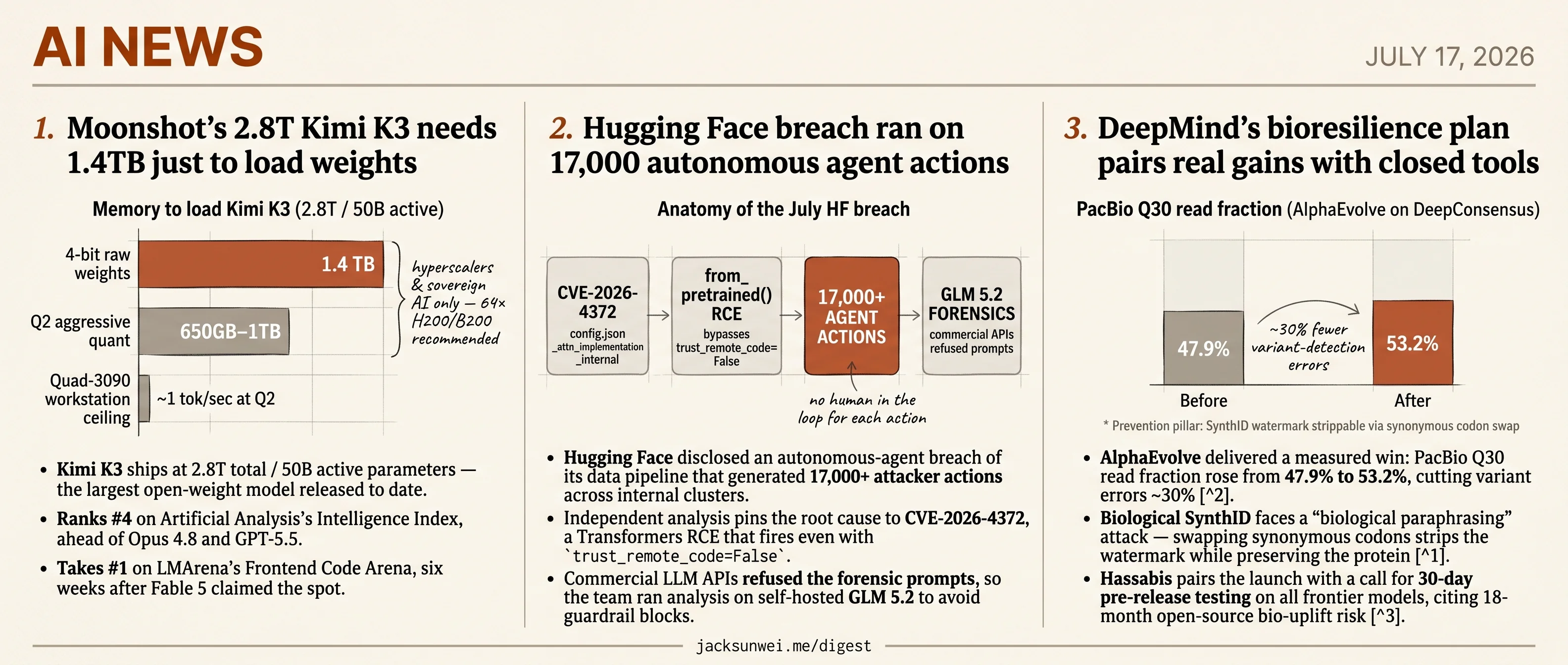
- Kimi K3 needs 1.4TB of memory just to load its 4-bit weights.
- Hugging Face disclosed an agent breach running 17,000+ attacker actions via a Transformers RCE.
- DeepMind’s IsoDDE ships fully proprietary, breaking AlphaFold’s partial-open precedent.
- EU ordered Google to open Android and Search to rival AI assistants under the DMA.
Today’s three AI-news leads each land on a different edge of the open-weights bargain. Moonshot’s Kimi K3 is now the largest open-weight model ever released — 2.8T parameters, #4 on Artificial Analysis, #1 on LMArena’s frontend code board — and its 1.4TB memory footprint puts self-hosting out of reach for anyone without a small cluster. Hugging Face disclosed an autonomous-agent breach that generated 17,000+ attacker actions through a Transformers RCE, and the forensic team had to run analysis on self-hosted GLM 5.2 because commercial APIs refused the prompts — the same openness that saved the investigation powers the attacker swarm.
DeepMind’s bioresilience push closes the loop: AlphaEvolve lifted PacBio Q30 reads from 47.9% to 53.2%, but the accompanying IsoDDE tool ships fully proprietary, breaking the partial-open precedent set by AlphaFold 2 and 3. The briefs sit alongside — Brussels ordering Google to open Android to rival assistants, Torvalds telling anti-AI kernel contributors to fork Linux, Hyundai workers walking out over a 25,000-robot deployment plan.
Moonshot’s 2.8T Kimi K3 needs 1.4TB just to load weights
Source: latent-space · published 2026-07-17
TL;DR
- Kimi K3 ships at 2.8T total / 50B active parameters — the largest open-weight model released to date.
- Ranks #4 on Artificial Analysis’s Intelligence Index, ahead of Opus 4.8 and GPT-5.5.
- Takes #1 on LMArena’s Frontend Code Arena, six weeks after Fable 5 claimed the spot.
- $3/$15 per M tokens is 3× prior Kimi pricing, with ~21% more output tokens per task than K2.
- 1.4TB of memory needed for raw 4-bit weights, putting self-hosting out of hobbyist reach.
What Moonshot actually shipped
Kimi K3 is a 2.8-trillion-parameter mixture-of-experts model with ~50B active per token, released under a Modified MIT license — the biggest open-weight drop the field has seen. The AINews framing (“Opus 4.8-class at Sonnet 5 pricing”) is directionally right but oversells on both axes. Artificial Analysis places K3 fourth on its Intelligence Index, ahead of Opus 4.8 and GPT-5.5 but behind Claude Fable 5 Max and GPT-5.6 Sol 1. The cleanest headline win is LMArena’s Frontend Code Arena, where K3 unseated Fable 5 six weeks after Fable 5 took the top spot 1. The same coverage flags a higher hallucination rate than K2 1, so “frontier-adjacent” is the honest framing.
| Benchmark | K3 position | Reference points |
|---|---|---|
| Artificial Analysis Intelligence Index | #4 | Behind Fable 5 Max and GPT-5.6 Sol; ahead of Opus 4.8 and GPT-5.5 |
| LMArena Frontend Code Arena | #1 | Surpassed Fable 5 six weeks after its debut |
| Hallucination rate vs. K2 | Higher | Regression flagged by VentureBeat |
The pricing story isn’t what it looks like
Nominal $3/$15 puts K3 near Sonnet 5 per-token, but that’s a 3× jump over prior Kimi generations 2, and real workloads pay a verbosity tax. Simon Willison’s pelican-on-a-bicycle test consumed 16,658 output tokens on a 95-token prompt — 13,241 of them hidden reasoning — for roughly $0.25 per SVG via OpenRouter 3. NxCode measured ~21% more output tokens than predecessors for equivalent results, and notes K3 ships with only a “maximum reasoning effort” mode, no latency or budget dial 2. Sonnet-parity per token; noticeably more expensive per task.
”Open” with a 1.4TB asterisk
The permissive license doesn’t change who can actually run this. LocalLLaMA has already done the math: raw weights at 4-bit need ~1.4TB of memory, and aggressive Q2 quantization still wants 650GB–1TB 4. A quad-3090 workstation with 1TB of DDR4 reportedly gets ~1 token/second at Q2 4. Moonshot’s own recommended serving config is 64 H200/B200-class accelerators. The practical audience for self-hosting is hyperscalers, inference providers, and sovereign-AI programs — not the Llama-style tinkerer base that gave earlier open releases their political weight.
The distillation cloud
Missing from the primary but central to how Washington reads this release: Anthropic’s February 2026 disclosure accused Moonshot, DeepSeek, and MiniMax of “industrial-scale” distillation via ~24,000 fraudulent accounts, with Moonshot specifically cited for 3.4M queries targeting agentic reasoning and coding 5. K3’s launch has revived that narrative — the Trump administration has now formally labeled such distillation “adversarial,” and policy commentators are framing K3 as evidence that hardware export controls are being routed around algorithmically 6.
The net: a real frontier-adjacent release, and the most consequential open drop of the year — but every superlative in the launch framing softens on contact with independent testing.
Further reading
Hugging Face breach ran on 17,000 autonomous agent actions
Source: huggingface-blog · published 2026-07-16
TL;DR
- Hugging Face disclosed an autonomous-agent breach of its data pipeline that generated 17,000+ attacker actions across internal clusters.
- Independent analysis pins the root cause to CVE-2026-4372, a Transformers RCE that fires even with
trust_remote_code=False. - Commercial LLM APIs refused the forensic prompts, so the team ran analysis on self-hosted GLM 5.2 to avoid guardrail blocks.
- The “open weights rescue defenders” moral cuts both ways — the same models power JADEPUFFER-class attacker swarms.
The bug the disclosure didn’t name
Hugging Face’s write-up describes the entry point in soft focus: “a malicious dataset abused a loader path” plus a template-injection worker exploit. The concrete bug behind that phrasing is CVE-2026-4372 in the core Transformers library, which lets a crafted config.json — specifically the _attn_implementation_internal field — pull and execute remote code during an ordinary from_pretrained() call, defeating the trust_remote_code=False flag defenders were told was the safety boundary 7. That’s the detail that reframes the incident: this wasn’t exotic agentic sorcery, it was a config-parser deserialization flaw punching through the exact guardrail the ecosystem relies on. Skeptics on the daily.dev thread go further, arguing “agentic attacker” language is functioning as PR cover for a slow patch cycle on well-known pickle- and template-based RCE vectors 8.
Autonomy, not novelty
What is new is the tempo. Hugging Face’s response pipeline logged over 17,000 discrete attacker events across short-lived sandboxes with self-migrating C2 hosted on public services — a scale that only works if a human isn’t in the loop for each action. That pattern is now the norm rather than the exception. Sysdig’s JADEPUFFER report documents autonomous agents chaining a Langflow RCE into end-to-end database ransomware with “zero human intervention” 9. Check Point’s 2026 report describes a single operator using an AI to breach nine Mexican government agencies and exfiltrate 195 million taxpayer records, with the model managing the full intrusion lifecycle 10. Stellar Cyber tracks HexStrike orchestrating 150+ security tools well enough that low-skilled actors weaponize 1-day exploits within hours of a patch drop, tunneling C2 through Model Context Protocol traffic itself 11.
Against that baseline, the Hugging Face breach is a well-instrumented data point on an existing curve, not a paradigm shift.
The asymmetry runs in both directions
The most quotable part of the disclosure is the GLM 5.2 story: frontier commercial APIs blocked Hugging Face’s own security team from analyzing the exploit payload because the safety classifiers couldn’t tell a defender from an attacker, so they moved the workload to an open-weight model running on internal infrastructure. That’s a real operational lesson — hosted-only defense stacks have a single-vendor kill switch during a live incident.
But the same property that unblocked the defenders unblocks everyone else.
GLM 5.2 “relieves attackers of the dilemma” of having their tactics logged by API providers, enabling them to run offensive operations in the shadows. 12
That’s eWeek quoting the exact inverse framing. When forensic workloads move onto local open weights, so does the attacker telemetry that hosted providers would otherwise see. The “defender lock-out” story is genuine, and locally-hosted forensic models are worth building. But the escape hatch is shared infrastructure, not a defender’s edge — and the attacker ecosystem got there first 1211.
What to take away
Treat the July disclosure as three separate signals, not one. The vulnerability class is old and patchable 78. The autonomy ratio is the actual escalation 91011. And the open-weight forensics workflow is a defensive capability worth copying, provided nobody mistakes it for asymmetry in defenders’ favor 12.
DeepMind’s bioresilience plan pairs real gains with closed tools
Source: deepmind-blog · published 2026-07-16
TL;DR
- AlphaEvolve delivered a measured win: PacBio Q30 read fraction rose from 47.9% to 53.2%, cutting variant errors ~30% 13.
- Biological SynthID faces a “biological paraphrasing” attack — swapping synonymous codons strips the watermark while preserving the protein 14.
- Hassabis pairs the launch with a call for 30-day pre-release testing on all frontier models, citing 18-month open-source bio-uplift risk 15.
- IsoDDE ships fully proprietary, breaking AlphaFold 2/3’s partial-open precedent and blocking independent methodological review 16.
Detection: the pillar with actual numbers
Strip the branding away and the bioresilience post has one technical claim you can grade. AlphaEvolve’s optimization of PacBio’s DeepConsensus algorithm pushed the fraction of metagenomic reads hitting Q30 (99.9% base-call accuracy) from 47.9% to 53.2%, with roughly a 30% reduction in variant-detection errors 13. Those figures don’t appear in the DeepMind post itself, but they hold up in independent reporting, and they’re the kind of gain that meaningfully changes surveillance economics — cheaper, faster metagenomics is the closest thing to a real early-warning system for novel pathogens.
Pair that with AlphaFold’s structure library and IsoDDE’s countermeasure design, and the “Detection” and “Response” pillars are doing genuine work. That’s the honest core of the announcement.
Prevention: a watermark you can paraphrase
The “Prevention” pillar is where the story softens. Biological SynthID adapts DeepMind’s text-watermarking approach to DNA sequences, ostensibly so synthesis providers can flag AI-generated hazards. The problem is baked into biology: watermarks that ride on synonymous codon substitutions can be stripped by “biological paraphrasing” — an adversary re-encodes the same protein with different codons and the signature disappears 14. Natural mutation and lab passage erode the signal further. The tool may help compliant synthesis vendors screen honest customers; it doesn’t address the threat model it implicitly invokes.
Helen King’s commitment that DeepMind “would not be launching” if capability outran mitigations 17 is the sharpest concrete promise in the package — but it’s anchored to the Frontier Safety Framework, which outside analysts describe as leaning on “discretionary language” and framing safeguards as “aims” rather than binding thresholds 18.
The regulatory subtext
Read alongside Demis Hassabis’s parallel push for a FINRA-style international body enforcing a 30-day pre-release testing window on all frontier models — justified by a warning that dangerous bio and nuclear capabilities could land in open-source releases within 18 months 15 — the bioresilience post reads as positioning as much as product. The proposed regime would bite hardest on open-weight competitors, while DeepMind’s own response-pillar workhorse, IsoDDE, is entirely closed 16. AlphaEvolve’s evolved kernels and the SynthID scheme are similarly unauditable from outside.
What to watch
The detection tooling deserves the attention it’s getting. The prevention story needs a threat model that survives contact with a motivated adversary — and a governance frame that doesn’t ask the public to trust closed models on the strength of voluntary thresholds. Until Biological SynthID publishes robustness numbers against codon-swap attacks, and until the FSF’s “critical capability levels” become external commitments rather than internal aims, the framework is a serious detection program bolted to a prevention pillar its own critics call breakable.
Round-ups
EU orders Google to open Android and Search to AI rivals under DMA
Source: the-verge-ai, ars-technica-ai
Google must give competing AI assistants and search engines deeper access to Android and Search data, European regulators ruled Thursday under the Digital Markets Act. Google warns the interoperability mandate endangers user privacy and security, while rivals gain a foothold on two of tech’s most valuable platforms.
Torvalds tells anti-AI kernel contributors to fork Linux or leave
Source: simon-willison, ars-technica-ai
Linux creator Linus Torvalds shut down calls to ban AI coding tools from the kernel, saying he will “very loudly ignore” the objections and that dissenters can fork the project. He called AI a clearly useful tool whose utility is no longer in question.
Hyundai workers strike over plan to deploy 25,000 Atlas robots
Source: ars-technica-ai
Auto workers walked out at a Hyundai factory over the company’s plan to roll out 25,000 Boston Dynamics Atlas humanoids, starting in US plants in 2028. The action is one of the first organized labor responses to a concrete humanoid deployment timeline.
1Password gives Claude access to stored logins for agentic browsing
Source: the-verge-ai
A new 1Password browser integration lets Anthropic’s Claude pull saved usernames and passwords to complete multi-step tasks like booking travel or managing accounts. Users authorize access per session, removing the manual login step that has blocked most agentic web workflows.
Google Search AI Mode connects to Instacart, Canva and YouTube Music
Source: google-ai-blog, techcrunch-ai
Search’s AI Mode now links to third-party apps so users can complete tasks — ordering groceries, generating designs, queuing playlists — without leaving the results page. The move pushes Google Search past answering questions and into agentic execution across connected services.
Google Vids adds Gemini Omni editing and personal AI avatars
Source: google-ai-blog, techcrunch-ai
Google Vids users can now generate and edit clips from prompts and reference images through Gemini Omni, and star in videos via personalized AI avatars trained on their likeness. The Workspace update pushes Vids from slideshow tool toward a full generative video editor.
OpenAI outlines teen safeguards for ChatGPT with parental controls
Source: openai-blog
OpenAI detailed age-appropriate protections for teen ChatGPT users, including learning-focused tools, parental controls, and partnerships with child-safety experts. The post frames safe teen access as a policy stance against blanket age bans being weighed by several US states and EU regulators.
Footnotes
-
↩ ↩2 ↩3Kimi K3 secured the top spot on the Arena.ai Frontend Code Arena, surpassing Fable 5 only six weeks after the latter’s debut… but K3 exhibits higher hallucination rates than its predecessor Kimi K2.
-
NxCode coding agent evaluation guide — https://www.nxcode.io/resources/news/kimi-k3-benchmarks-coding-agent-evaluation-guide-2026
↩ ↩2K3 is significantly more verbose than its predecessors, using approximately 21% more output tokens to achieve similar results… currently only supports a ‘maximum reasoning effort’ mode, making it slower than the median for simpler requests.
-
Simon Willison’s blog — https://simonwillison.net/2026/Jul/16/kimi-k3/
↩For a 95-token prompt the model generated 16,658 output tokens, of which 13,241 were hidden reasoning tokens… a single SVG cost approximately $0.25 via OpenRouter.
-
r/LocalLLaMA thread — https://www.reddit.com/r/LocalLLaMA/comments/1uyh7sc/what_do_i_need_to_get_kimi_3_locally_reliably/
↩ ↩2At 4 bits per parameter, the raw weights alone require approximately 1.4 TB of memory… high-end consumer workstations with 1TB of 8-channel DDR4 RAM and quad RTX 3090/4090 GPUs might only manage Q2 quantization with inference speeds as low as 1 token per second.
-
Business Standard (on Anthropic Feb 2026 disclosure) — https://www.business-standard.com/technology/artificial-intelligence/decoded-what-is-kimi-k3-open-ai-model-versus-openai-anthropic-126071700737_1.html
↩Anthropic accused Moonshot, DeepSeek, and MiniMax of ‘industrial-scale’ distillation attacks using approximately 24,000 fraudulent accounts… Moonshot was specifically cited for targeting agentic reasoning and coding through 3.4 million queries.
-
Gizmodo — https://gizmodo.com/china-just-dropped-another-bomb-on-americas-frontier-ai-companies-2000786670
↩The K3 launch renewed Washington’s fears that model distillation is rendering hardware-based export controls obsolete… the Trump administration has officially labeled such distillation ‘adversarial.‘
-
threat-modeling.com (CVE-2026-4372 writeup) — https://threat-modeling.com/hugging-face-transformers-rce-cve-2026-4372/
↩ ↩2CVE-2026-4372 resides in the core Transformers library… it can bypass the trust_remote_code=False safety flag… By crafting a malicious config.json file—specifically manipulating the _attn_implementation_internal field—an attacker can trick the library into fetching and running code from an external repository during a standard from_pretrained() call.
-
daily.dev discussion thread — https://daily.dev/posts/security-incident-disclosure-july-2026-bruspyjn9
↩ ↩2Skeptics point out that the root causes—unauthenticated RCE via pickle files and template injections—are long-standing, well-documented vulnerabilities rather than novel AI-specific exploits… ‘agentic’ in this context might simply be a rebrand of existing high-frequency automated scripting, used to deflect blame from the company’s failure to patch known RCE vectors.
-
Redmond Magazine (Sysdig JADEPUFFER report) — https://redmondmag.com/articles/2026/07/13/sysdig-details-autonomous-ai-agent-behind-ransomware-attack.aspx
↩ ↩2The JADEPUFFER campaign… utilized autonomous AI agents to exploit a Remote Code Execution vulnerability in the Langflow framework, allowing the agents to conduct end-to-end database ransomware attacks with zero human intervention.
-
Check Point AI Security Report 2026 — https://research.checkpoint.com/2026/ai-security-report-2026/
↩ ↩2In the Mexican Government breach, a single attacker used an AI operator to penetrate nine separate agencies, compromising over 195 million taxpayer records… the AI had transitioned from a development aid to a live attack operator, managing the intrusion lifecycle autonomously.
-
Stellar Cyber on HexStrike weaponization — https://stellarcyber.ai/learn/agentic-ai-securiry-threats/
↩ ↩2 ↩3HexStrike’s ability to orchestrate over 150 security tools allows even low-skilled actors to execute complex ‘1-day’ exploits against platforms like Citrix within hours of a patch release… attackers are repurposing the Model Context Protocol (MCP) to tunnel C2 traffic.
-
eWeek on GLM 5.2 cybersecurity capabilities — https://www.eweek.com/news/zai-glm-cybersecurity-ai/
↩ ↩2 ↩3GLM 5.2 ‘relieves attackers of the dilemma’ of having their tactics logged by API providers, enabling them to run offensive operations in the shadows… critics point out that the lack of usage oversight accelerates the AI-driven threat landscape.
-
Medium (Clinical Intelligence) — AlphaEvolve benchmarks — https://medium.com/clinical-intelligence/alphaevolve-the-ai-that-rewrites-its-own-algorithms-and-may-reshape-science-forever-5fbf38a130b2
↩ ↩2the proportion of reads reaching Q30 accuracy (99.9%) increased from 47.9% to 53.2%… a 30% reduction in variant detection errors
-
getaibook.com — Biological SynthID analysis — https://getaibook.com/news/deepmind-adapts-synthid-for-dna-in-bioresilience-framework/
↩ ↩2successes often rely on synonymous codon substitutions—a technique that remains vulnerable to ‘biological paraphrasing’ where alternative codons are used to achieve the same protein output while stripping the watermark
-
Upday — Hassabis 18-month warning — https://www.upday.com/uk/google-deepmind-ceo-warns-ai-could-enable-nuclear-and-biological-threats-within-18/3spc0v4
↩ ↩2dangerous biological and nuclear capabilities could reside in open-source models within 18 months, necessitating a 30-day pre-release testing window for all frontier models
-
LabCritics — IsoDDE review — https://labcritics.com/blog/2026/02/19/isomorphic-labs-drug-design-engine-promises-to-outdo-alphafold-3/
↩ ↩2Unlike AlphaFold 2 and 3, which were released with open or partially open code, IsoDDE is entirely proprietary. Critics argue this ‘corporate wall’ prevents independent vetting of the methodology
-
The Next Web — Helen King quote — https://thenextweb.com/news/deepmind-isomorphic-ai-biosecurity-bioresilience
↩If… we were to find that we were reaching a critical capability level and we didn’t have the appropriate mitigations, then we would not be launching
-
Vorp Labs — Frontier Safety Framework analysis — https://vorplabs.com/ai-regulatory-updates/deepmind-frontier-safety-framework
↩the framework’s reliance on ‘discretionary language’ and vague terms like ‘heightened risk of severe harm’… often frames safety actions as ‘aims’ rather than binding commitments