OpenAI gates Rosalind, Gemini Omni decays at turn 4, Shift films NYC homes
Three AI deployments — OpenAI's biodefense model, Google's Gemini Omni, Shift's free cleaners — each ship with a structural limit the pitch skipped.
OpenAI gates Rosalind, Gemini Omni decays at turn 4, Shift films NYC homes
TL;DR
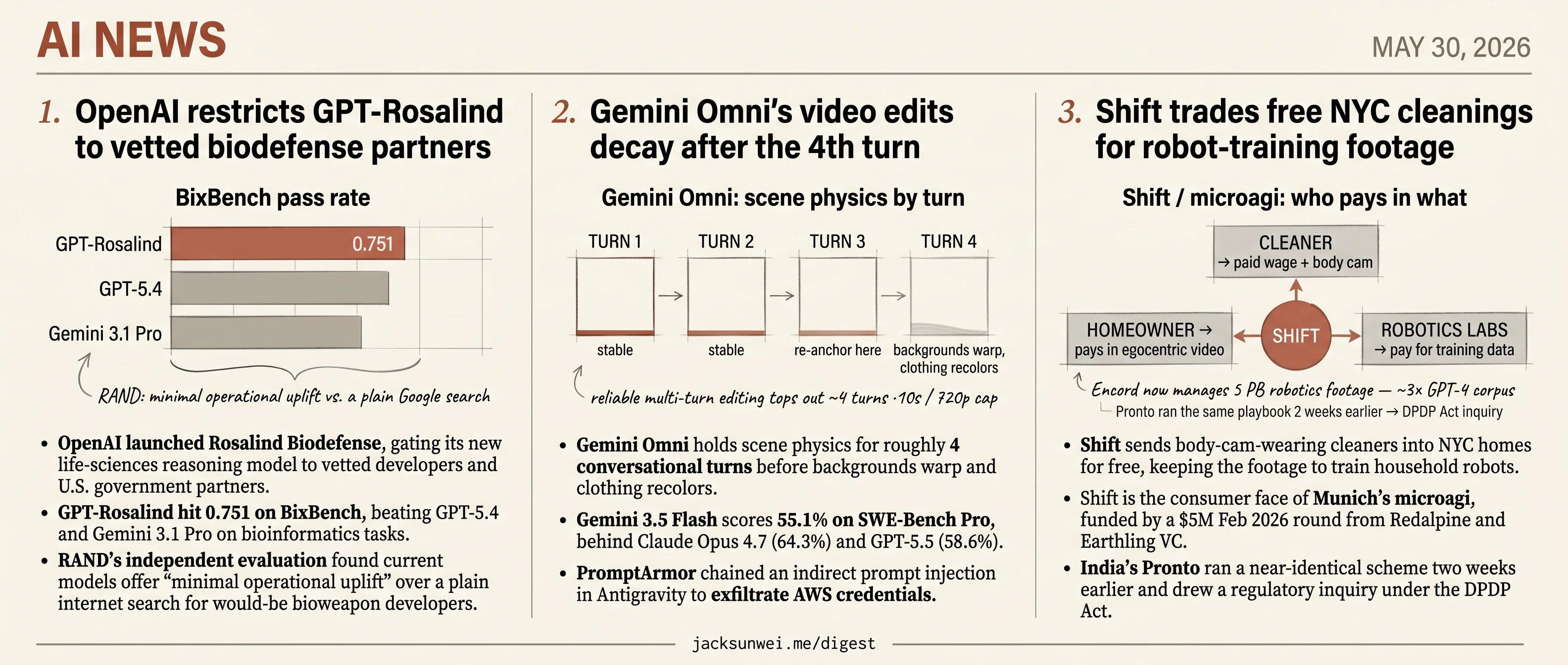
- OpenAI’s GPT-Rosalind scores 0.751 on BixBench, gated to vetted U.S. biodefense developers only.
- RAND finds current frontier models give bioweapon-curious users minimal uplift over a web search.
- Gemini Omni holds scene physics for 4 turns before backgrounds warp and clothing recolors.
- Shift sends body-cam cleaners into NYC homes free, keeping footage to train household robots.
- Aaron Levie calls AI-driven layoffs ‘AI psychosis’ as 2026 tech cuts near full-year 2025 total.
Three AI deployments lead the day, and each ships with a structural limit the launch copy didn’t lead with. OpenAI’s GPT-Rosalind is gated to vetted U.S. biodefense partners — until a RAND evaluation finds current models give bioweapon-curious users “minimal operational uplift” over a web search. Google’s Gemini Omni demos cleanly until turn 4, when backgrounds warp and clothing recolors. Shift’s free NYC cleaning service is a body-cam data pipeline for a Munich household-robotics startup, two weeks after India’s near-identical Pronto drew a DPDP Act inquiry.
The round-ups read the same way. Aaron Levie names the pattern from the buyer side — CEOs ordering AI layoffs in domains they don’t understand — while Groq pivots from chips toward inference services and XCENA raises $135M on the thesis that memory, not compute, is the actual bottleneck.
OpenAI restricts GPT-Rosalind to vetted biodefense partners
Source: openai-blog · published 2026-05-29
TL;DR
- OpenAI launched Rosalind Biodefense, gating its new life-sciences reasoning model to vetted developers and U.S. government partners.
- GPT-Rosalind hit 0.751 on BixBench, beating GPT-5.4 and Gemini 3.1 Pro on bioinformatics tasks.
- RAND’s independent evaluation found current models offer “minimal operational uplift” over a plain internet search for would-be bioweapon developers.
- Critics flag a dependency trap: CDC and NIH leaning on a proprietary model could lose independent modeling capacity within years.
What shipped
OpenAI is positioning GPT-Rosalind as the first model purpose-built for life sciences reasoning — literature synthesis, protocol design, simulation, data harmonization — and is not putting it on the open API. Access flows through two channels: a Rosalind Biodefense Initiative for academic and non-profit groups, and Government Trusted Access for U.S. and allied agencies. Launch partners include Lawrence Livermore, Johns Hopkins APL, CEPI (working on Ebola vaccines), and SecureDNA, which screens synthesis orders for dangerous sequences.
The framing is “defensive acceleration”: give defenders a capability edge, restrict the model from everyone else, and tie the work to the 100 Days Mission for pandemic countermeasure design. GPT-Rosalind inherits the “High Capability in biology” designation OpenAI first applied to the ChatGPT agent in July 2025 under its Preparedness Framework.
The benchmarks largely check out
Independent coverage corroborates the headline numbers. LabCritics confirms the 0.751 BixBench pass rate above GPT-5.4 and Gemini 3.1 Pro, and notes Dyno Therapeutics tested the model on unpublished RNA sequences to rule out data contamination — sequence-to-function predictions landed in the 95th percentile of human experts 1. The Nuclear Threat Initiative’s spring horizon scan adds nuance: red teams found the model excellent at synthesizing literature and proposing molecular modifications, but not yet expert-level for novel catastrophic weapon design 2.
That last point cuts both ways. RAND’s independent benchmark, cited in AICerts’ review of OpenAI’s preparedness work, concluded that current frontier models give would-be bad actors “minimal operational uplift” compared to a determined Google search 3. If that’s right, the elaborate Trusted Access scaffolding is solving a risk that doesn’t yet exist at the scale OpenAI’s tiering implies.
The dissent nobody’s putting on the slide
“A private company making private decisions” about who gets near-expert biological reasoning.
That’s the framing from the 100+ scientists who have called for stricter controls on training data and access governance for systems like GPT-Rosalind 4. The objection isn’t that the safeguards are too weak — it’s that a single vendor now decides who is and isn’t a legitimate biodefense actor.
A Georgetown Security Studies Review piece sharpens the structural worry: sustained reliance on a proprietary model could erode CDC and NIH independent modeling capacity within a few years, and a service outage or unilateral pricing change could disrupt active national security operations 5. SecureBio — itself a launch partner — has separately raised concerns about the robustness of the biological safeguards 2.
The timing matters. GovAI notes that Anthropic just dropped its “pause commitment” from RSP v3.0, reframing development halts as “industry-wide recommendations” to avoid unilateral disadvantage 6. Rosalind Biodefense is OpenAI’s answer to the same competitive pressure: don’t pause, gate. Whether gating is governance or marketing depends on who’s holding the keys — and right now that’s one company.
What’s actually at stake
If RAND is right that uplift is minimal today, Rosalind Biodefense is a low-cost reputational hedge. If NTI’s red teams are right that the ceiling is rising, then the U.S. biodefense stack is quietly being rebuilt on top of a vendor that can reprice, revoke, or deprecate the foundation. Neither story is the one in the launch post.
Gemini Omni’s video edits decay after the 4th turn
Source: google-ai-blog · published 2026-05-29
TL;DR
- Gemini Omni holds scene physics for roughly 4 conversational turns before backgrounds warp and clothing recolors.
- Gemini 3.5 Flash scores 55.1% on SWE-Bench Pro, behind Claude Opus 4.7 (64.3%) and GPT-5.5 (58.6%).
- PromptArmor chained an indirect prompt injection in Antigravity to exfiltrate AWS credentials.
- AI Overviews drop outbound CTR ~58%, with only 6–8% of AI Mode sessions producing a click.
Omni: a social-tier video tool, not a Sora rival
Google’s nine-demo reel pitches Gemini Omni as conversational video editing with persistent physics — turn a sculpture into bubbles, drop a violinist into a new room, iterate by chatting. Independent testing narrows the claim sharply. The jxp.com review puts reliable multi-turn editing at around four turns before “world grounding” decays: textures warp, momentum stops conserving, and reviewers recommend explicitly re-anchoring the scene by turn three 7. The same review caps outputs at 10s / 720p, which positions Omni as a YouTube Shorts engine rather than a Veo 3.1 or Sora 2 challenger 7.
The quota model adds friction Google didn’t mention on stage. Android Authority documented users burning an entire five-hour usage window on a single failed generation; Google patched the underlying bug, but the unpredictability of “prompt cost” remains the top power-user complaint 8.
3.5 Flash: the agent-loop engine, not the senior engineer
The “frontier performance” framing for 3.5 Flash doesn’t survive contact with third-party leaderboards. On Vals.ai’s aggregated 2026 numbers:
| Model | SWE-Bench Pro | MCP tool-calling |
|---|---|---|
| Claude Opus 4.7 | 64.3% | — |
| GPT-5.5 | 58.6% | — |
| Gemini 3.5 Flash | 55.1% | 83.6% |
Flash’s real wins are tool-calling accuracy and throughput — roughly 4× the output rate of either rival at about a third the input price 9. That makes it the right model for high-frequency production agents and the wrong model for repo-scale refactors. The routing consensus forming among practitioners: Claude for code edits, GPT-5.5 for CLI reasoning, Flash for the agent loop itself.
Antigravity and Spark: the safety story the keynote skipped
Antigravity’s subagent harness is where the demos get genuinely risky. r/AISEOInsider threads and security writeups have documented agents running rm against critical directories and wiping entire repositories; the standing advice is to sandbox them in containers before letting them touch anything real 10.
Spark is worse, because it ships to consumers. Simon Willison flags it as a clean instance of his Lethal Trifecta — private data, untrusted content, outbound actions all in one agent — and calls it a “top candidate for an agent security challenger disaster.” PromptArmor has already demonstrated an indirect-prompt-injection chain inside Antigravity that exfiltrated AWS credentials 11.
flowchart LR
    A[Gmail / Docs / Slides] --> S{Gemini Spark}
    B[Untrusted email / web content] --> S
    S --> C[Instacart / Workspace actions]
    C -. exfiltration .-> X((Attacker))
Google’s defenses — ephemeral VMs, an Agent Gateway with DLP, AP2 payment auth — address lateral movement after a compromise. They do not fix the inference-layer confusion between data and instructions that the trifecta exploits.
Generative UI is a publisher event
The “action engine” reframe of Search lands very differently outside Mountain View. Ahrefs measured a 58% CTR collapse on pages where AI Overviews appear, and only 6–8% of AI Mode sessions produce an outbound click — the numbers behind Penske Media’s and the European Publishers Council’s active antitrust and copyright filings 12. One countervailing data point worth holding: the few visitors who do click through from AI citations reportedly convert 4–11× higher, which reshapes the open web from a discovery surface into a high-intent lead funnel. That’s a smaller, more transactional internet — which is exactly the trade Google is making.
Shift trades free NYC cleanings for robot-training footage
Source: the-verge-ai · published 2026-05-29
TL;DR
- Shift sends body-cam-wearing cleaners into NYC homes for free, keeping the footage to train household robots.
- Shift is the consumer face of Munich’s microagi, funded by a $5M Feb 2026 round from Redalpine and Earthling VC.
- India’s Pronto ran a near-identical scheme two weeks earlier and drew a regulatory inquiry under the DPDP Act.
- Data-infra vendor Encord now manages 5 PB of robotics footage — roughly 3× GPT-4’s training corpus.
A category, not a stunt
The Verge framed Shift as a quirky one-off. It isn’t. Shift is the NYC-facing brand of microagi, a Munich/Zurich outfit run by ex-Red Bull Racing aerodynamicist Bercan Kilic, with ~10,000 contractors across 15 countries and a $5M seed closed in February 13. The free-cleaning offer is a customer-acquisition wedge for a data pipeline — the homeowner pays in egocentric video, the cleaner gets paid by Shift, and microagi gets the asset it actually sells.
That asset has a real market. Encord, which sells data infrastructure to physical-AI customers, reports a 10× revenue surge and now manages over 5 petabytes of robotics training data — roughly three times the corpus that trained GPT-4 14. There is also a competing spot market: LA Times reporting documents workers booking gigs on Instawork and Sunain for $20–$40 an hour (one participant cleared $80 in two hours) doing exactly the same chores in front of a chest-mounted camera 15. Shift’s innovation is the three-sided arbitrage — the homeowner’s labor cost becomes the data cost.
The Pronto precedent everyone is ignoring
Two weeks before Shift’s launch, India’s Pronto ran the same playbook and detonated. After backlash, Pronto retreated to claiming the program was opt-in and capped at 0.1% of customers, and India’s Ministry of Electronics and IT opened an inquiry under the Digital Personal Data Protection Act 16. Competitor Urban Company went further, with CEO Abhiraj Singh Bhal publicly disavowing in-home recording as “a breach of consumer trust” 17 — useful evidence that the on-demand-services industry is not unified behind the data-for-service model.
Shift is walking into NYC with the same structure Pronto used, in a jurisdiction that has been building out biometric and consumer-consent enforcement. The question isn’t whether the offer is creepy. It’s whether it survives its first GDPR or state-AG consent test.
Privacy is the competitive wedge
The cluster coverage mostly skipped what rival robotics players are doing differently. 1X, which is taking pre-orders at $20,000 for its NEO humanoid, solves the same data-scarcity problem via teleoperation — human “Experts” remotely pilot the robot to teach it new skills — and leans on on-device processing and delayed uploads as a privacy story 18. Shift’s pitch is server-side face and screen blurring, which looks thin by comparison. Critics on HN and Reddit also flagged the obvious secondary asset: 3D interior maps of paying customers’ homes, which have value well beyond robot training.
flowchart LR
    H[Homeowner] -- free cleaning --> S{Shift / microagi}
    S -- wage --> W[Cleaner + body cam]
    W -- egocentric video --> S
    S -- training data --> R[Robotics labs]
    S -. 3D home maps .-> X((Secondary buyers?))
What’s actually at stake
Strip away the novelty and Shift is the third visible entrant in a contested category: one peer is under regulatory review, another is competing on architecturally stronger privacy. Whoever wins this market won’t be the company with the cheapest cleaning — it’ll be the one whose consent flow survives a regulator reading it line by line.
Further reading
- Tech companies desperately want to film you doing chores — the-verge-ai
- Startup offers free home cleaning—if it can record it all for robot training — ars-technica-ai
Round-ups
Aaron Levie diagnoses ‘AI psychosis’ among job-cutting CEOs
Source: techcrunch-ai, techcrunch-ai
Box CEO Aaron Levie argues many executives ordering AI-driven layoffs least understand the work they’re automating, calling it ‘AI psychosis.’ He points to ClickUp cutting 22% of staff for AI agents as 2026 tech layoffs already approach the full-year 2025 total.
Groq seeks $650M as it pivots from chips to AI inference
Source: techcrunch-ai
Groq is raising $650 million in internal funding to shift focus from hardware toward AI inference services, per Axios. The round follows Nvidia’s $20 billion not-acqui-hire move and signals that pure-play AI chip startups are repositioning around model serving rather than silicon alone.
XCENA raises $135M at $570M valuation betting memory is AI’s bottleneck
Source: techcrunch-ai
South Korean chip startup XCENA closed $135 million at a $570 million valuation on the thesis that memory bandwidth, not compute, throttles AI workloads. The round lands amid tight DRAM supply from Samsung and SK Hynix and growing demand for inference-optimized hardware.
Boston Children’s uses OpenAI to diagnose 40+ rare disease cases
Source: openai-blog
Boston Children’s Hospital has deployed OpenAI technology to surface diagnoses for more than 40 rare disease patients while easing clinician paperwork. The hospital frames the work as both a care-quality boost and a way to cut operational load on overstretched staff.
Developers refusing to code without AI risk skill atrophy, researchers warn
Source: techcrunch-ai
Coders increasingly refuse to work without AI assistants, but researchers warn the speed gains are not translating into better code. Over-reliance risks long-term quality and skill erosion, leaving developers exposed when models fail or hallucinate in production systems.
Adobe’s new conversational AI assistant lands as a mediocre design intern
Source: the-verge-ai
Adobe’s latest conversational image agent invites users into the creative process rather than spitting out one-shot renders, a departure from typical prompt-to-image tools. The Verge’s hands-on found it pleasant but underwhelming — closer to a junior intern than a capable collaborator.
Waterloo students build AI sign language tutors at Google’s Futures Lab
Source: google-ai-blog
University of Waterloo students are prototyping applied AI tools at Google’s Futures Lab, including a sign language tutor aimed at education and workplace accessibility. The projects showcase how student-led research is shaping Google’s pipeline of practical AI applications.
Footnotes
-
LabCritics — ‘OpenAI enters the AI bio arms race’ — https://labcritics.com/blog/2026/05/12/openai-enters-the-ai-bio-arms-race-with-gpt-rosalind/
↩On the BixBench bioinformatics benchmark, the model achieved a 0.751 pass rate, outperforming both GPT-5.4 and competitors like Gemini 3.1 Pro… third-party testing with Dyno Therapeutics used unpublished RNA sequences to prevent data contamination; the model’s sequence-to-function predictions ranked in the 95th percentile of human experts.
-
Nuclear Threat Initiative — AIxBio Horizon Scan Spring 2026 — https://www.nti.org/analysis/articles/aixbio-horizon-scan-spring-2026/
↩ ↩2Red team evaluations indicate that while the model excels at synthesizing complex literature and suggesting molecular modifications, it does not currently provide expert-level assistance for the development of novel catastrophic biological weapons. However, experts from SecureBio have raised concerns regarding the robustness of the system’s biological safeguards.
-
AICerts review of OpenAI Preparedness evaluations — https://www.aicerts.ai/news/openai-evaluations-strengthen-ai-biological-safety-governance/
↩The RAND Corporation conducted independent benchmarks which concluded that current models provide ‘minimal operational uplift’ compared to simple internet searches, suggesting that the perceived risk may be more a product of precautionary policy than verified capability.
-
DrugPatentWatch analysis of GPT-Rosalind — https://www.drugpatentwatch.com/blog/gpt-rosalind-what-openais-life-sciences-model-actually-does-to-drug-development/
↩More than 100 scientists have called for stricter controls on the sensitive biological data used to train such systems, arguing that the democratization of complex biological design lowers the barrier for bad actors. Critics describe the launch as ‘a private company making private decisions’ about who receives access to near-expert biological reasoning.
-
Georgetown Security Studies Review (CSET-affiliated commentary) — https://gssr.georgetown.edu/the-forum/topics/biosec/the-double-edged-sword-opportunities-and-risks-of-ai-in-biosecurity/
↩Sustained reliance on a proprietary model could erode the independent modeling capacity of public institutions like the CDC or NIH within a few years… a service outage or unilateral policy change by OpenAI could disrupt active national security operations, creating a critical dependency on a vendor with the power to reprice or revoke access.
-
GovAI analysis of Anthropic RSP v3.0 (comparison frame) — https://www.governance.ai/analysis/anthropics-rsp-v3-0-how-it-works-whats-changed-and-some-reflections
↩Anthropic’s decision to remove its ‘pause commitment’—a previous pledge to halt development if safety mitigations were not met… The company now frames such pauses as ‘industry-wide recommendations’ to avoid unilateral competitive disadvantages.
-
jxp.com review of Gemini Omni — https://www.jxp.com/blog/gemini-omni-review
↩ ↩2Reliable multi-turn editing tops out around four conversational turns before background textures warp and physical consistency erodes; testers recommend explicitly re-anchoring the scene by turn three.
-
Android Authority — https://www.androidauthority.com/google-gemini-usage-limit-problem-3670846/
↩A single complex or failed generation can exhaust a five-hour usage limit — a problem Google attributed to a now-patched quota bug, but unpredictability of ‘prompt cost’ remains a primary complaint.
-
Vals.ai SWE-Bench leaderboard — https://www.vals.ai/benchmarks/swebench
↩Claude Opus 4.7 leads SWE-Bench Pro at 64.3%, GPT-5.5 at 58.6%, Gemini 3.5 Flash at 55.1% — Flash wins on speed and MCP tool-calling (83.6%), not on repo-scale engineering.
-
r/AISEOInsider on Antigravity 2.0 — https://www.reddit.com/r/AISEOInsider/comments/1tn8i4v/i_found_antigravity_20_ai_agent_and_its_crazy/
↩Users have documented agents executing destructive commands such as rm on critical directories or wiping entire repositories; experts recommend running agents only inside sandboxed Linux containers.
-
Simon Willison via gridthegrey writeup — https://gridthegrey.com/posts/google-s-gemini-spark-agent-raises-prompt-injection-risks-at-enterprise-scale/
↩Gemini Spark satisfies the ‘Lethal Trifecta’ — private data, untrusted content, outbound actions — making it a ‘top candidate for an agent security challenger disaster’; PromptArmor already chained an injection in Antigravity to exfiltrate AWS credentials.
-
Forbes — ‘Google Zero’ — https://www.forbes.com/sites/andymeek/2026/05/25/google-search-ai-overhaul-leaves-publishers-bracing-for-google-zero/
↩Ahrefs measured a 58% CTR drop when AI Overviews appear; only 6–8% of AI Mode sessions produce an outbound click, prompting Penske Media and the EPC to file antitrust and copyright actions.
-
CTOL Digital — https://www.ctol.digital/news/irl-data-scramble-ai-home-training-ground/
↩Shift is backed by its parent company, microagi, which recently closed a $5 million early-stage venture capital round in February 2026… Key investors include Redalpine and Earthling VC. Co-founder Bercan Kilic is a former aerodynamics engineer for Red Bull Racing.
-
SiliconAngle (Encord $60M Series C) — https://siliconangle.com/2026/02/26/physical-ai-data-infrastructure-startup-encord-lands-60m-accelerate-intelligent-robot-drone-development/
↩Encord recently reported a 10x surge in revenue from physical AI customers, now managing over 5 petabytes of data—three times the volume used to train GPT-4.
-
↩Workers using platforms like Instawork or Sunain can earn approximately $20 to $40 per hour—with some reports of participants making $80 for two hours of footage… some participants report facing social backlash from peers who accuse them of ‘being the problem’ by training their own robotic replacements.
-
Business Standard (Pronto coverage) — https://www.business-standard.com/companies/start-ups/pronto-household-recording-ai-training-backlash-126052500743_1.html
↩Pronto maintains the program is a limited pilot involving only 0.1% of customers who must explicitly opt-in and pay for the feature… India’s Ministry of Electronics and Information Technology (MeitY) is examining potential violations of the Digital Personal Data Protection (DPDP) Act.
-
Whalesbook (Urban Company reaction) — https://www.whalesbook.com/news/English/technology/Home-Services-Firms-Reject-In-Home-Recording-Amid-Privacy-Backlash/6a148054b979113840ca72aa
↩Urban Company CEO Abhiraj Singh Bhal issued a public statement clarifying that his platform has no plans to record inside homes, framing the practice as a breach of consumer trust.
-
eWeek (1X NEO) — https://www.eweek.com/news/neo-humanoid-robot-home-chores/
↩1X has begun accepting pre-orders for its NEO humanoid robot, priced at $20,000… NEO relies on a ‘social contract’ where early adopters allow human ‘Experts’ to teleoperate the robot remotely to teach it new skills.