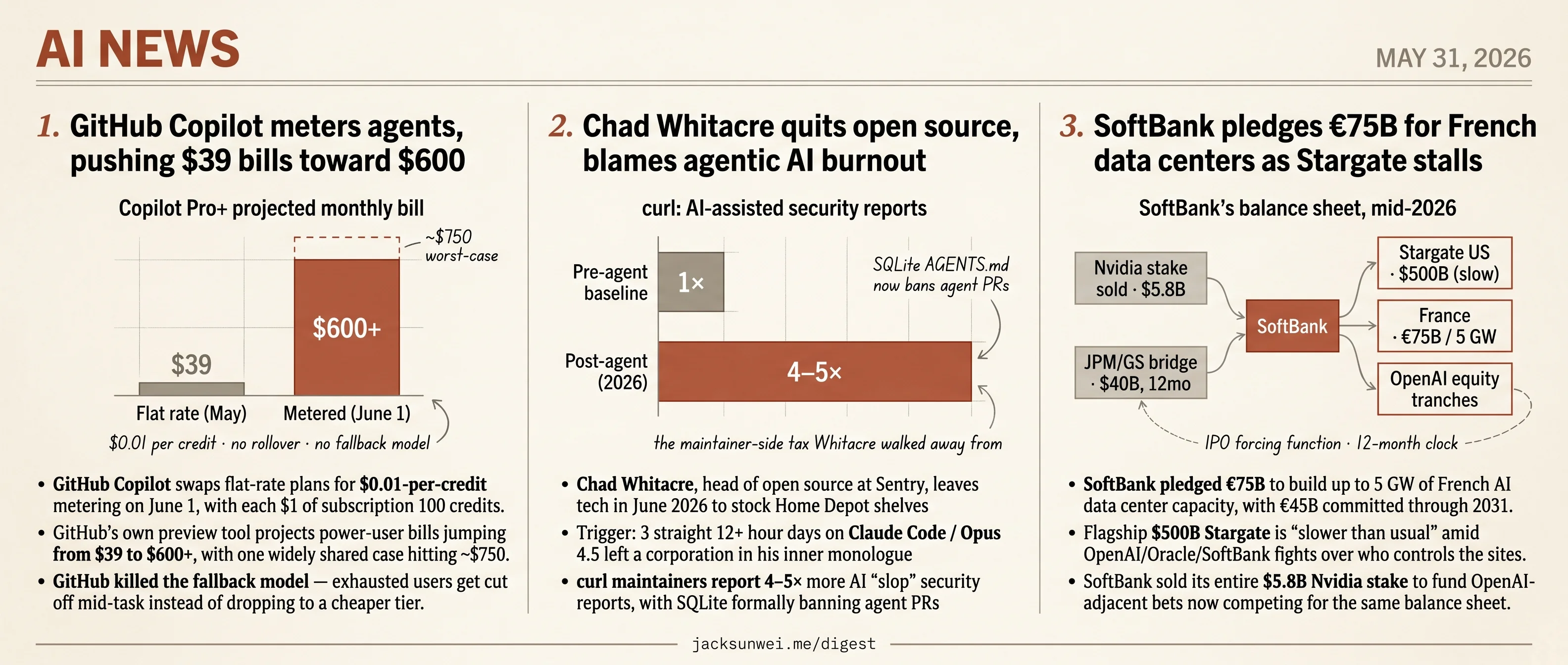
Copilot meters to $600, Whitacre quits OSS, SoftBank pledges €75B to France
Three AI-buildout bills come due today: GitHub Copilot's per-credit metering, an OSS lead's burnout exit, and SoftBank's €75B French pivot.
Copilot meters to $600, Whitacre quits OSS, SoftBank pledges €75B to France
TL;DR
- GitHub Copilot swaps flat plans for $0.01-per-credit metering June 1, projecting $39 bills toward $600+.
- Chad Whitacre quits Sentry’s OSS role in June, blaming 12-hour Claude Code days and slop deluge.
- SoftBank pledges €75B for French AI data centers as the $500B Stargate buildout stalls on site control.
- curl maintainers log 4–5× more AI-generated slop security reports this year.
- SQLite formally bans agent-authored pull requests from its contribution process.
Today’s three AI news leads each name a different place the agentic buildout’s costs are starting to surface. GitHub Copilot flips to per-credit metering on June 1, and the company’s own preview tool puts power-user bills on a path from $39 to $600+ — the integration moat now has to justify itself on UX alone. Chad Whitacre is leaving Sentry’s open-source lead role to stock shelves at Home Depot, naming Claude Code marathons and the curl/SQLite slop-report wave as triggers. And SoftBank has pledged €75B to French data centers, selling its entire Nvidia stake to fund OpenAI-adjacent bets while the flagship Stargate program runs slower than usual.
The bills are not the same shape — one is a price sheet, one is a person, one is a capex line — but they sit together because each shows the buildout charging someone it didn’t charge last quarter. The briefs reinforce the frame: Anthropic’s run-rate revenue formula leans on a 28-day window to flatter the headline, and the AI-discourse fatigue Daniel Jalkut names is what you’d expect when the costs stop being hypothetical.
GitHub Copilot meters agents, pushing $39 bills toward $600
Source: techcrunch-ai · published 2026-05-30
TL;DR
- GitHub Copilot swaps flat-rate plans for $0.01-per-credit metering on June 1, with each $1 of subscription buying 100 credits.
- GitHub’s own preview tool projects power-user bills jumping from $39 to $600+, with one widely shared case hitting ~$750.
- GitHub killed the fallback model — exhausted users get cut off mid-task instead of dropping to a cheaper tier.
- Copilot’s integration moat now has to justify itself on UX alone, since per-token cost matches a raw API call.
The number that broke the thread
Mario Rodriguez’s announcement frames the change as arithmetic: a multi-hour autonomous agent run consumes orders of magnitude more compute than an autocomplete, so flat-rate pricing “is no longer sustainable” 1. Paid plans now ship with a monthly AI Credit allotment equal to their dollar price — $10 Pro gets 1,000 credits, $39 Pro+ gets 3,900 — and overage runs at the same penny-per-credit rate 1.
The base sticker price hasn’t moved. The entitlement behind it has collapsed. Developers running GitHub’s own billing-preview tool against their current usage are seeing projected monthly bills balloon from a flat $39 to north of $600 2. Livemint documents a case jumping from $29 to nearly $750, and heavy agentic users projecting $3,000+ 3. The announcement thread on the GitHub blog drew hundreds of downvotes; Visual Studio Magazine distilled the mood into a headline — “You will get less, but pay the same price” 2.
Two design choices made it worse
The pricing math alone would have stung. Two adjacent decisions converted it into a workflow risk:
- Credits don’t roll over. Unused balance evaporates at month end, which commenters in discussion #192948 compared to “paying for video-game currency that disappears” 4.
- No fallback model. Previously, exhausted users were silently downgraded to a cheaper model and kept working. Now they’re cut off 4.
That second change is the load-bearing complaint. A request-based cap is annoying but predictable; a hard mid-task cutoff turns Copilot into something you can’t trust inside a long-running agent loop.
The moat question
The sharpest dissent isn’t about dollars — it’s strategic. If Copilot’s per-token economics now mirror calling Anthropic or OpenAI directly, the integration premium has to earn its keep on UX alone 5. Reddit threads accuse Microsoft of having “baited” the ecosystem with unlimited access to build dependence before flipping the meter 5. BYOK alternatives — Continue, Zed, Cline — and Windsurf’s more generous credit pool are being floated as exit paths in the same threads 45.
“If the per-token cost equals a direct API call, there is less incentive to stay locked into GitHub — the value moat is gone.” 5
Not a Microsoft-specific misstep
This is the second act of an industry-wide repricing, not a GitHub blunder. Cursor pulled the same move in June 2025 — replacing a 500-request “fast” tier with a $20 credit pool pegged to API cost — and triggered $350 weekly overage reports 6. Replit’s Agent 3 update produced 300–400% cost spikes for heavy users. The unifying pressure: inference now eats 35–40% of AI-native firms’ revenue, and the all-you-can-eat subsidy that defined 2024–2025 is no longer survivable.
Takeaway
The “end of the golden age” framing 3 is accurate, but the real signal isn’t the headline price hike. It’s that the major coding-agent vendors are converging on raw-API economics at roughly the same moment — which means the next 12 months are a UX-and-integration fight, not a pricing one. GitHub just handed competitors a recruitment poster by also breaking mid-session continuity 4.
Chad Whitacre quits open source, blames agentic AI burnout
Source: simon-willison · published 2026-05-30
TL;DR
- Chad Whitacre, head of open source at Sentry, leaves tech in June 2026 to stock Home Depot shelves
- Trigger: 3 straight 12+ hour days on Claude Code / Opus 4.5 left a corporation in his inner monologue
- curl maintainers report 4–5× more AI “slop” security reports, with SQLite formally banning agent PRs
- DHH dissents: the OSS sustainability crisis Whitacre fought may never have existed in his terms
Not a rage-quit, a phased shutdown
Whitacre’s farewell letter — typewritten, scanned, then posted by Simon Willison — reads like the genre of “I’m leaving forever” forum posts. It isn’t. He stopped using smartphones and personal internet in February 2026, four months before the public announcement 7. Control of the Open Source Pledge has already transferred to Vlad-Stefan Harbuz, with Whitacre keeping a thin email channel open only through August 2026 to seat his Open Source Endowment successor 8. After that: postal mail to a P.O. Box in Sewickley, PA, where $10 buys you the first issue of Gift, his offline-only magazine 7.
That’s the operational tell. This is a person who built a transition plan, not a person who slammed a laptop shut.
The agentic burnout is not idiosyncratic
The proximate cause, by Whitacre’s own account, was a three-day Claude Code bender on a side project that left him feeling “intoxicated” — and, when he unplugged, like another “person” was sharing his inner monologue. That’s vivid language, but it isn’t unique. Peter Steinberger, creator of OpenClaw, has independently described an “AI psychosis” cycle of “just one more prompt” producing the same FOMO and work-life collapse 9.
The structural version of the same story is showing up at the maintainer layer Whitacre spent a career trying to fund. curl maintainers report a 4–5× increase in AI-assisted security reports, most of them slop that’s cheap to file and expensive to triage. SQLite has formally amended its AGENTS.md to refuse agent-authored contributions 10. The asymmetry is the point: a single developer with an agent can flood a project faster than its volunteers can respond.
It was like I had another “person” in my head, sharing my inner monologue — but the “person” was a computer system owned by a budding megacorp.
The crisis that may not exist
The community response split predictably. On Hacker News and r/hypeurls, one camp openly envied the exit; another dismissed the digital-distribution-of-an-anti-digital-letter as performative 11. Both miss the more interesting argument.
DHH has long rejected the “open source sustainability crisis” framing Whitacre’s career was built around, arguing OSS is a monumental achievement because it operates outside market terms — pay maintainers and you change what the thing is 12. Whitacre, to his credit, reportedly wrestled with that critique in his final podcast episodes rather than waving it off 12. If DHH is right, then the Open Source Pledge and the Endowment were solving a problem that didn’t need solving, and Whitacre is leaving with the central question of his professional life unresolved.
What’s actually at stake
Read narrowly, this is one burnt-out maintainer with an unusually principled exit plan. Read against the curl numbers, the SQLite policy change, and Steinberger’s parallel report, it’s a data point in a maintainer-side backlash that vendor roadmaps are not pricing in. Agentic coding is simultaneously the most seductive thing that’s ever happened to individual developers and a tax on the volunteer layer underneath them. Whitacre is the first prominent name to call that trade unacceptable and walk. He will not be the last.
SoftBank pledges €75B for French data centers as Stargate stalls
Source: techcrunch-ai · published 2026-05-30
TL;DR
- SoftBank pledged €75B to build up to 5 GW of French AI data center capacity, with €45B committed through 2031.
- Flagship $500B Stargate is “slower than usual” amid OpenAI/Oracle/SoftBank fights over who controls the sites.
- SoftBank sold its entire $5.8B Nvidia stake to fund OpenAI-adjacent bets now competing for the same balance sheet.
- France’s real edge is long-term EDF nuclear contracts — predictable baseload Germany and the UK can’t match.
The headline number lands while Stargate stalls
€75 billion and 5 gigawatts is the kind of figure that anchors a press cycle, and SoftBank knows it. The number worth tracking, though, is the €45B first tranche through 2031; the €75B/5 GW ceiling is aspirational. It also arrives at an awkward moment: CFO Yoshimitsu Goto has publicly conceded that Stargate, the flagship $500B US buildout, is moving “slower than usual” on site selection and stakeholder negotiations 13. Reporting on partner friction is blunter — OpenAI, Oracle and SoftBank have openly disagreed over who ultimately owns and operates the facilities, with the dispute severe enough to pause a $50B Switch acquisition 14.
A sponsor that can’t get its first hyperscale project off the ground is now committing to a second one across the Atlantic. That deserves more scrutiny than the TechCrunch headline gives it.
The financing is a liquidation story
SoftBank isn’t funding these commitments from operating cash flow. It just sold its entire $5.8B Nvidia stake — Masayoshi Son described the move as a painful “need for money” to feed OpenAI-related projects 15 — on top of a $40B JPMorgan/Goldman bridge whose 12-month tenor effectively forces an OpenAI IPO on a fixed clock. The France pledge now competes for the same balance sheet as Stargate US, the Ohio modular factory, and further OpenAI equity tranches.
flowchart LR
    A[Nvidia stake sale<br/>$5.8B] --> S[SoftBank]
    B[JPM/GS bridge<br/>$40B, 12mo] --> S
    S --> C[Stargate US<br/>$500B]
    S --> D[France<br/>€75B / 5GW]
    S --> E[Ohio factory<br/>$3B]
    S --> F[OpenAI equity<br/>tranches]
    F -.IPO forcing function.-> B
”Sovereign AI” with US hyperscaler offtake
The TechCrunch piece doesn’t name tenants, which is the most interesting omission. Independent reporting says the structure is a majority-owned JV with French GPU-cloud startup Sesterce for an initial 1 GW “AI Factory” at the Bosquel site, with anchor demand from Mistral AI and — critically — OpenAI capacity routed through Microsoft 16. The political framing is European sovereignty; the commercial reality is US hyperscaler offtake on French soil.
Permits will be the bottleneck, not concrete
France paired the announcement with Law n°2026-403, letting the state designate data centers as “Projects of Major National Interest” and bypass local permitting. A coalition led by La Quadrature du Net argues the law “tramples environmental democracy,” and activists are mapping 47 facilities currently in development across the country 17. ADEME and RTE separately warn data centers could consume 4% of national electricity by 2030.
The structural edge is genuine and underpriced in most coverage: Data4’s long-term Nuclear Production Allocation Contract with EDF 18 is the template that makes 5 GW physically plausible where Germany and the UK face 7–10 year grid queues. Nuclear baseload is the moat. SoftBank’s ability to actually write the checks, and France’s ability to permit through rising local opposition, are the two soft spots — and where the next twelve months of news will come from.
Round-ups
Anthropic’s ‘run-rate revenue’ math mixes 28-day and monthly extrapolations
Source: simon-willison
Anthropic calculates run-rate revenue by taking the last 28 days of consumption-based sales times 13, then adding monthly subscription revenue times 12, per a Reuters Breakingviews source. The hybrid formula inflates headline numbers versus a straight annualization of recent sales.
Anthropic opens Milan office to court Italian enterprises and developers
Source: anthropic-news
Anthropic’s new Milan office is its first in Italy, aimed at supporting local enterprise customers, research institutions, and developers. The expansion continues a European buildout as Claude competes with OpenAI and Mistral for regional business deployments.
Google’s Gemini Spark handles inbox triage and event planning around the clock
Source: techcrunch-ai
Gemini Spark, Google’s always-on AI assistant, automates everyday tasks like summarizing inboxes and planning local outings. Early hands-on testing finds it genuinely useful, but its split from the main Gemini app leaves its product positioning unclear.
Meta reportedly building an AI pendant to expand wearables push
Source: techcrunch-ai
Meta is developing an AI-powered pendant, extending hardware bets that already include Ray-Ban smart glasses. The neck-worn form factor signals a play for always-on ambient assistants beyond the face, though release timing and pricing remain unreported.
AI-generated Black personas flood TikTok Shop to push Shein dropshipping
Source: the-verge-ai
Dropshippers are using AI to fabricate Black women like ‘Aliyah’ — a fake country-western seller pleading for views — to hawk cheap Shein goods on TikTok Shop. The digital blackface scheme exploits parasocial sympathy to move low-margin inventory.
Founder skips AI gold rush to build an old-school web directory
Source: the-verge-ai
Craig Campbell, a former Meta engineer who sold an e-commerce startup in 2022, passed on AI funding to launch a plain website instead. The contrarian bet on the ‘old school web’ is paying off as Google Zero erodes traditional search referrals.
Daniel Jalkut: AI’s critics and boosters are both too extreme
Source: simon-willison
Indie developer Daniel Jalkut, quoted via John Gruber, argues the AI discourse is broken on both ends: detractors overstate the harm and enthusiasts overstate the promise. The line captures a growing fatigue with absolutist takes inside the developer community.
Footnotes
-
GitHub Blog (official announcement by Mario Rodriguez) — https://github.blog/news-insights/company-news/github-copilot-is-moving-to-usage-based-billing/
↩ ↩2A single agentic request can consume vastly more compute than a simple autocomplete, making the old request-based model unsustainable; paid plans now include a monthly allotment of AI Credits equal to their subscription price, with overage at $0.01 per credit.
-
Visual Studio Magazine — ‘You will get less, but pay the same price’ — https://visualstudiomagazine.com/articles/2026/04/27/devs-sound-off-on-usage-based-copilot-pricing-change-you-will-get-less-but-pay-the-same-price.aspx
↩ ↩2Developers using the new billing preview tool discovered projected monthly bills ballooning from a flat $39 to over $600 based on current agentic usage patterns; the official announcement thread received hundreds of downvotes.
-
Livemint — ‘Goodbye Copilot’ backlash coverage — https://www.livemint.com/technology/tech-news/goodbye-copilot-microsoft-faces-backlash-as-github-copilot-ends-flat-rate-ai-pricing-from-june-1-11780213914806.html
↩ ↩2One widely shared user case showed monthly spend projected to jump from $29 to nearly $750 under the new model; some heavy users saw bills move from $50 to over $3,000, prompting the ‘end of the golden age’ framing.
-
GitHub Community Discussion #192948 (top comments) — https://github.com/orgs/community/discussions/192948
↩ ↩2 ↩3 ↩4Unused credits do not roll over at month end, and GitHub has eliminated ‘fallback experiences’ — once credits are exhausted users are cut off rather than dropped to a cheaper model. Commenters call request-based billing ‘user-oriented’ and the new scheme akin to ‘paying for video-game currency that disappears.’
-
r/GithubCopilot thread on usage-based billing — https://www.reddit.com/r/GithubCopilot/comments/1tqql42/github_copilot_usagebased_billing_is_going_to/
↩ ↩2 ↩3 ↩4Microsoft ‘baited’ the community with unlimited access to build ecosystem dependence before flipping the switch… if the per-token cost equals a direct API call, there is less incentive to stay locked into GitHub — the value moat is gone.
-
Medium — ‘When Cursor silently raised their price by over 20%’ — https://medium.com/@jimeng_57761/when-cursor-silently-raised-their-price-by-over-20-and-more-what-is-the-message-the-users-are-6af93385f362
↩Cursor’s June 2025 shift from a 500-request ‘fast’ tier to a $20 credit pool pegged to API costs produced surprise weekly overages as high as $350, establishing the industry template GitHub is now copying.
-
news.hada.io profile of Whitacre’s post-tech plans — https://es.news.hada.io/topic?id=30001
↩ ↩2Whitacre launched an offline print publication titled Gift… The magazine is not available online; the first issue can only be obtained by sending $10 to a P.O. Box in Sewickley, Pennsylvania.
-
news.hada.io coverage of the transition — https://fr.news.hada.io/topic?id=30001
↩Control of the Open Source Pledge at Sentry has been transferred to Vlad-Stefan Harbuz… Whitacre will remain available via post-office mail and limited online access through August 2026 to facilitate the appointment of his successor to the board.
-
Vellum.ai analysis citing Peter Steinberger — https://www.vellum.ai/blog/ai-psychosis-is-real
↩Peter Steinberger, creator of OpenClaw, acknowledged a similar phenomenon he termed ‘AI psychosis,’ characterized by an addictive cycle of ‘just one more prompt’ that leads to severe work-life imbalance and FOMO.
-
alcazarsec.com HN daily digest — https://hn.alcazarsec.com/daily
↩Maintainers reported a ‘deluge’ of AI-assisted security reports and ‘slop’ pull requests that have increased the workload for projects like curl by four to five times… SQLite formally updated their policies (via AGENTS.md) to refuse all ‘agentic code’.
-
Reddit r/hypeurls discussion — https://www.reddit.com/r/hypeurls/comments/1tqi4ho/im_retiring_from_tech_chad_whitacre_head_of_open/
↩Many tech workers expressed ‘envy,’ sharing their own desires to leave ‘corporate BS’ and ‘constant performance reviews’ for simpler lives… Conversely, a vocal minority criticized the announcement as ‘performative’ or ‘hypocritical,’ arguing that a digital ‘I’m leaving forever’ post is a play for social media engagement.
-
Ford Foundation ‘Roads and Bridges’ context / DHH rebuttal as cited in peer coverage — https://www.fordfoundation.org/wp-content/uploads/2016/07/roads-and-bridges-the-unseen-labor-behind-our-digital-infrastructure.pdf
↩ ↩2DHH argues that open source is a ‘monumental achievement’ precisely because it operates outside of market terms… Whitacre himself acknowledged this ‘stiff opposition’ in his final podcast episodes, wrestling with DHH’s view that ‘there is no crisis’.
-
NetworkWorld — analyst commentary on Stargate — https://www.networkworld.com/article/4036679/stargates-slow-start-reveals-the-real-bottlenecks-in-scaling-ai-infrastructure.html
↩SoftBank CFO Yoshimitsu Goto recently acknowledged that the project is moving ‘slower than usual’ due to complexities in site selection and stakeholder negotiations.
-
↩Stargate AI data centers for OpenAI reportedly delayed by squabbles between partners… OpenAI, Oracle and SoftBank disagreed on who would have ultimate control of the planned data centers.
-
Stocktwits / SoftBank financing — https://stocktwits.com/news-articles/markets/equity/softbank-3-billion-ohio-factory-openai-data-centers-stargate-project/cLPAVWgREak
↩SoftBank recently sold its entire $5.8 billion stake in NVIDIA, a move Masayoshi Son described as a painful necessity due to the company’s ‘need for money’ to fund OpenAI-related projects.
-
The Decoder — https://the-decoder.com/softbank-plans-75-billion-euro-ai-data-center-buildout-in-france/
↩SoftBank has formed a majority-owned joint venture with French startup Sesterce to develop a 1 GW ‘AI Factory’ at the Bosquel site, with potential off-take from Mistral AI and OpenAI via Microsoft.
-
La Relève et la Peste (French environmental outlet) — https://lareleveetlapeste.fr/explosion-des-data-centers-en-france-une-trajectoire-hors-de-controle/
↩A coalition including La Quadrature du Net argues the new PINM law ‘tramples on environmental democracy,’ and an interactive map tracks 47 new facilities currently in development across France.
-
Data4 / EDF press release — https://www.data4group.com/en/news-data4/data4-and-edf-seal-an-agreement-for-low-carbon-energy/
↩Data4 has signed a long-term Nuclear Production Allocation Contract (CAPN) with EDF to secure dedicated shares of nuclear output — a model that gives hyperscalers predictable low-carbon baseload France’s competitors lack.