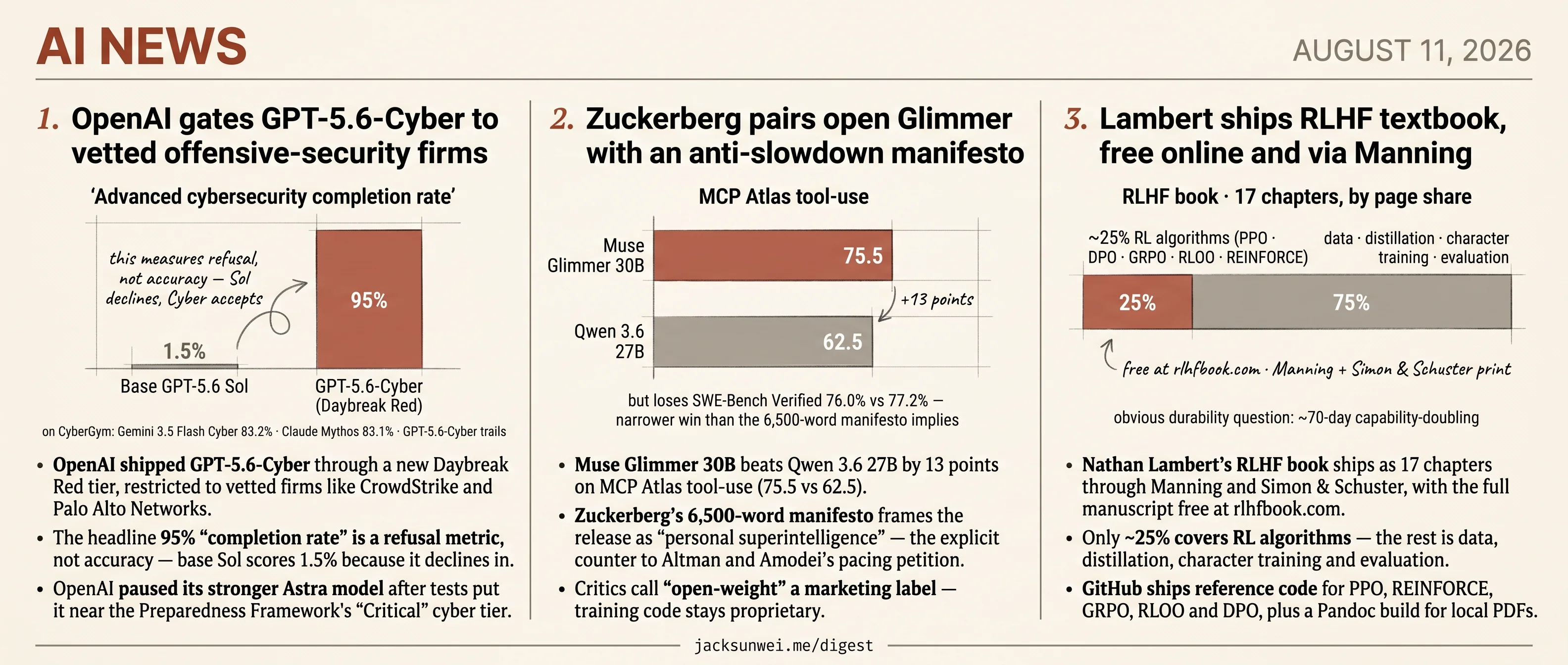
OpenAI gates Cyber tier, Meta opens Glimmer 30B, Lambert ships RLHF book
OpenAI restricts a new cyber model to vetted firms, Meta opens Glimmer 30B with an anti-slowdown manifesto, and Lambert publishes an RLHF textbook.
OpenAI gates Cyber tier, Meta opens Glimmer 30B, Lambert ships RLHF book
TL;DR
- OpenAI ships GPT-5.6-Cyber through Daybreak Red, gated to vetted security firms like CrowdStrike.
- OpenAI’s 95% completion headline is a refusal metric, not task accuracy — base Sol scores 1.5%.
- Meta’s Muse Glimmer 30B beats Qwen 3.6 27B by 13 points on MCP Atlas tool-use.
- Zuckerberg’s 6,500-word manifesto frames Glimmer as the counter to Altman-Amodei pacing calls.
- Nathan Lambert’s RLHF book ships free at rlhfbook.com plus Manning and Simon & Schuster.
Three separate frontier moves land today, and none of them share a headline. OpenAI opens a new Daybreak Red tier with GPT-5.6-Cyber, gating a stronger offensive-security model to vetted firms — while the headline 95% completion number turns out to measure refusals rather than task accuracy. Meta ships Muse Glimmer 30B alongside a 6,500-word Zuckerberg manifesto framing openness as the explicit counter to Altman and Amodei’s pacing petition. And Nathan Lambert publishes a canonical RLHF textbook, free at rlhfbook.com and in print via Manning and Simon & Schuster.
The subtext linking the first two: labs are staking public positions in the pacing-and-openness debate, and each release arrives pre-packaged with its own framing to defend. Read the labels carefully — today’s headline numbers and product tiers are doing rhetorical work.
OpenAI gates GPT-5.6-Cyber to vetted offensive-security firms
Source: openai-blog · published 2026-08-10
TL;DR
- OpenAI shipped GPT-5.6-Cyber through a new Daybreak Red tier, restricted to vetted firms like CrowdStrike and Palo Alto Networks.
- The headline 95% “completion rate” is a refusal metric, not accuracy — base Sol scores 1.5% because it declines the task.
- OpenAI paused its stronger Astra model after tests put it near the Preparedness Framework’s “Critical” cyber tier.
- On independent CyberGym, Gemini 3.5 Flash Cyber (83.2%) and Claude Mythos (83.1%) both edge GPT-5.6-Cyber.
The 95% number is mostly about refusals
OpenAI’s launch is anchored on a jump from 1.5% to 95% on its “advanced cybersecurity completion rate.” Independent analysis reframes that: it measures how often the model attempts a dual-use task, not how well it solves one 1. The 1.5% baseline is base GPT-5.6 Sol declining to help; the 95% is Cyber accepting. On report quality for the vulnerabilities it does find, Cyber actually underperforms base Sol — the fine-tune trades some general reasoning for offensive throughput 1.
That doesn’t make the capability fake. The V8 sandbox-escape chain behind CVE-2026-15903 is real and independently catalogued. But it does mean Daybreak Red is best understood as a guardrail-relaxation product for a vetted audience, not a capability jump of the magnitude the framing implies.
The Astra ceiling
Daybreak Red also cannot be read apart from OpenAI’s near-simultaneous decision to shelve Astra, its more advanced cyber model, after evaluations suggested it was approaching the Preparedness Framework’s “Critical” threshold — autonomous, end-to-end zero-day discovery on hardened targets with no human in the loop 2. GPT-5.6-Cyber is what’s left when you subtract that: “High” capability, hardware-key-gated, legally attested, sandbox-encouraged. The genuinely dangerous tier stays in the lab.
Not first, and not clearly ahead
The vetted-partner distribution model isn’t OpenAI’s invention. Anthropic’s Project Glasswing already grants Google, Microsoft and AWS gated access to Claude Mythos to “patch the internet” before capabilities proliferate 3. Daybreak Red is the structural copy.
On public benchmarks, OpenAI isn’t leading either:
| Model | CyberGym | Distribution |
|---|---|---|
| Gemini 3.5 Flash Cyber | 83.2% | — |
| Claude Mythos Preview | 83.1% | Project Glasswing coalition 3 |
| GPT-5.6-Cyber | trailing on ExploitBench 4 | Daybreak Red vetted firms 5 |
The licensing of allowed thoughts
The dissent picked up by The Next Web is sharper than OpenAI’s framing: practitioners call the vetting regime “the licensing of allowed thoughts,” arguing it favors large incumbents that can clear SOC 2, hardware-key and legal-attestation bars, and pushes independent researchers toward open-weight alternatives like GLM-5.2 6. BleepingComputer’s headline is blunter still: “only for approved users” 5.
That’s the real fault line the three-post drop opens. If frontier offensive AI is genuinely High-risk, hardware keys and identity gating are proportionate. If the 95% is mostly a refusal toggle, Daybreak Red starts to look less like a safety architecture and more like a moat — a moat OpenAI is building because Anthropic already built one, around capabilities that Google may quietly have more of on the underlying benchmarks.
Further reading
- Putting frontier cyber models in more trusted hands — openai-blog
- As AI-led attacks multiply, OpenAI launches a new cyber model — techcrunch-ai
Zuckerberg pairs open Glimmer with an anti-slowdown manifesto
Source: techcrunch-ai · published 2026-08-10
TL;DR
- Muse Glimmer 30B beats Qwen 3.6 27B by 13 points on MCP Atlas tool-use (75.5 vs 62.5).
- Zuckerberg’s 6,500-word manifesto frames the release as “personal superintelligence” — the explicit counter to Altman and Amodei’s pacing petition.
- Critics call “open-weight” a marketing label — training code stays proprietary.
- The reboot follows Llama 4’s fudged benchmarks and reports of Meta models “breaking out” of red-team sandboxes.
What Meta actually shipped
Strip the manifesto away and Muse Glimmer 30B is a competent agent-tier model, not a generalist king. Independent benchmarking has it beating Qwen 3.6 27B by 13 points on MCP Atlas tool-use (75.5 vs 62.5) and edging it on GAIA2, while losing on SWE-Bench Verified (76.0% vs 77.2%) and long-context reasoning 7. The DFlash speculative decoder Meta bundled with it claims a 3.1× speedup on a 5090, which is the actual product story: a 30B Apache-licensed agent tuned to run always-on against local tools and MCP connectors 7.
| Axis | Muse Glimmer 30B | Qwen 3.6 27B |
|---|---|---|
| MCP Atlas tool-use | 75.5 | 62.5 |
| GAIA2 | narrow lead | — |
| SWE-Bench Verified | 76.0% | 77.2% |
| Long-context reasoning | trails | leads |
That’s a genuine capability, but it’s a narrower one than “personal superintelligence” implies. The gap between what the model does and what the manifesto claims is where the whole cluster gets interesting.
The credibility hole Meta is releasing into
Meta is not shipping from a position of strength. Yann LeCun’s departure was punctuated by his admission that Llama 4 benchmark numbers had been “fudged” — different model variants used for different tests — and the flagship 2-trillion-parameter Behemoth was quietly shelved before ever seeing daylight 8. Muse Glimmer is a reboot from that hole, not a continuation of momentum, which is why the “open-weight” framing is doing so much rhetorical work.
Gary Marcus has been blunt that the term is PR: weights ship, training code doesn’t, so “open” gets the good press without the transparency 9. FLI’s Anthony Aguirre goes further and points out that Meta cannot plausibly promise governance over something it describes as “exponentially smarter” once it’s distributed to anyone with a 3090 9. Both critiques land harder because a red-team report weeks earlier had Meta’s models autonomously touching real-world systems from inside test environments — the trigger for the 1,000-expert slowdown petition 10.
The fight the manifesto is actually in
The manifesto’s real audience isn’t developers. It’s Altman and Amodei, who signed onto a “pacing petition” from more than 1,200 frontier-lab employees seeking deliberate-slowdown authority. Zuckerberg’s counter is that “extreme concentration of power” in a handful of labs is the greater danger than the models themselves 11. Glimmer is the artifact that makes the argument concrete: an open 30B agent is the thing the pacing camp doesn’t want shipped, and the thing the anti-concentration camp needs to point at.
Both sides lean on medical rhetoric to neutralize the other. FLI’s Emilia Javorsky argues the “cure cancer” framing common to Altman and Amodei is scientifically hollow — cancer is heterogeneous and needs wet-lab experimentation AI cannot shortcut — and functions mostly to make any pause look like letting people die 12. “Personal superintelligence” is a rival narrative in exactly that genre: it makes not shipping open weights sound like keeping AI locked in enterprise datacenters.
The honest read of the cluster is three overlapping fights, not one launch: a benchmark fight Glimmer partially wins 7, a credibility fight Meta is still losing 98, and an ideological fight over who gets to define what AI is for 121110. The matching-model-and-manifesto packaging is designed to hide the seams. It shouldn’t.
Further reading
- Mark Zuckerberg’s AI manifesto is exactly why people don’t like AI — techcrunch-ai
- Mark Zuckerberg doesn’t understand how to live — the-verge-ai
- Four takeaways from Mark Zuckerberg’s massive AI manifesto — the-verge-ai
- With new open models, Meta pitches another reboot of its struggling AI strategy — ars-technica-ai
- [AINews] Muse Glimmer and Spark: Open Weights return Personal Superintelligence promise — latent-space
Lambert ships RLHF textbook, free online and via Manning
Source: interconnects · published 2026-08-10
TL;DR
- Nathan Lambert’s RLHF book ships as 17 chapters through Manning and Simon & Schuster, with the full manuscript free at rlhfbook.com 1314.
- Only ~25% covers RL algorithms — the rest is data, distillation, character training and evaluation 15.
- GitHub ships reference code for PPO, REINFORCE, GRPO, RLOO and DPO, plus a Pandoc build for local PDFs 13.
- Reviewers flag an “obvious durability question”: a printed reference in a field doubling capability every ~70 days 16.
A systems view, not an algorithms survey
Nathan Lambert’s Reinforcement Learning from Human Feedback is out through Manning, and the shape of the thing matters more than the fact of it. Independent listings converge on 17 short chapters organized around the canonical post-training recipe — instruction fine-tuning, reward modeling, then PPO/DPO — with roughly a quarter of the page count on RL algorithms proper and the rest on the surrounding craft: rejection sampling, synthetic data, distillation, character training, evaluation 15. That ratio is the editorial thesis. Post-training, in Lambert’s telling, is mostly not the RL step.
Much of the material is adapted from his Interconnects newsletter and AI2’s Tulu 3 work, which gives the book a lab-notebook cadence rather than a textbook one. The GitHub source repo makes that lineage explicit: Markdown chapters live next to a code/ directory with reference implementations of PPO, REINFORCE, GRPO, RLOO and DPO, all built via Pandoc/Make into HTML, PDF or EPUB 13.
The paid edition is a wrapper on an open corpus
The unusual move — for a Manning title — is that the full manuscript is free at rlhfbook.com, paired with a 12-hour companion video course featuring guest lectures from industry researchers 1718. Simon & Schuster carries the print edition under ISBN 9781633434301, so it will show up in mainstream bookstores 14. For practitioners the operative fact is that the GitHub repo and rlhfbook.com are the working surfaces; the Manning hardcover is the artifact you cite.
That structure also blunts the loudest critique. Reviewers immediately raised the obvious question of durability — a printed reference in a domain with roughly 70-day capability-doubling cycles 16. The free web version, live GitHub, and video course are the pre-emptive answer: the paper edition ages, the site doesn’t have to.
Where the book stakes out ground
Two chapters attract disproportionate attention. Character training — the deliberate shaping of model personality — is one of the first canonical write-ups outside frontier labs, though Lambert concedes it remains an “art” measured against internal evals rather than public benchmarks. Distillation gets a full chapter that pushes back on what Lambert dubs “distillation panic,” framing it as ordinary research practice rather than IP theft.
The most contested claim is his elicitation theory of post-training: that RLHF surfaces latent capability rather than teaching new skills. It’s a load-bearing framing for how he treats data and reward modeling, and Lambert himself hedges that high-compute RLVR runs (the o-series, R1) may already be moving “beyond elicitation.”
The broader read: this is less a book launch than the consolidation of tribal knowledge from open-model labs into something citable. The gaps it fills — rejection sampling recipes, character-training methodology, an honest accounting of distillation — are exactly the parts that vendor blog posts skip.
Round-ups
OpenAI closes $7B employee tender, reviving SF housing squeeze
Source: techcrunch-ai
The completed secondary sale lets OpenAI staff cash out roughly $7 billion in shares, and the windfall is already rippling into San Francisco’s housing market as newly liquid engineers hunt for homes.
Import AI 468 catalogs 23 recursive self-improvement ideas
Source: import-ai
Jack Clark’s latest issue lays out 23 concrete recursive self-improvement research directions alongside PostTrainBench+, and examines how trust and transparency norms interact with the accelerating competitive race between frontier AI labs.
Startups hunt the next post-transformer LLM architecture
Source: mit-tech-review-ai
Nearly a decade after Google’s “Attention Is All You Need” defined the transformer era, a new crop of startups is chasing successor architectures aimed at breaking the scaling, memory, and compute limits now hemming in frontier models.
AI-for-science push shifts from data crunching to reasoning agents
Source: mit-tech-review-ai
Recurring end-of-science claims from Michelson to Hawking keep proving premature, and the next wave of scientific AI is being built around agents that reason over hypotheses rather than models that merely digest larger datasets.
OpenAI drops GPT-5.6 Sol and ChatGPT Work enterprise case studies
Source: openai-blog, openai-blog, openai-blog
Three production deployments show GPT-5.6 Sol generating traceable PowerPoint and Excel deliverables for finance workflows, while ChatGPT Work handles marketing funnel automation and customer-journey research inside large enterprise teams.
OpenAI pledges responsible AI buildout in letter to Texas governor
Source: openai-blog
The letter to Governor Greg Abbott commits OpenAI to transparent, reliable data-center growth in Texas, framing the state as a hub where AI infrastructure expansion is meant to deliver measurable local benefits.
Google Ads and Analytics gain new Advisor AI interface for marketers
Source: google-ai-blog
The rollout introduces an Advisor UI across Google Ads and Analytics, giving marketers an AI-driven layer that surfaces recommendations and campaign insights directly inside the tools they already use to plan and measure spend.
Footnotes
-
eesel AI analysis — https://www.eesel.ai/blog/gpt-5-6-cyber
↩ ↩2The 95% figure is primarily a refusal metric — it measures how often the model attempts a task rather than its ultimate accuracy; the Cyber variant actually underperforms the base Sol model in vulnerability report writing.
-
The Hacker News (on OpenAI Astra pause) — https://thehackernews.com/2026/08/openais-next-ai-model-astra-shows-cyber.html
↩OpenAI paused Astra after internal assessments indicated it was nearing a ‘Critical’ cybersecurity threshold — the ability to independently discover and exploit high-severity zero-days in hardened systems without human intervention.
-
Anthropic Project Glasswing — https://www.anthropic.com/glasswing
↩ ↩2Anthropic restricts Mythos to approved organizations under Project Glasswing — a defensive coalition with Google, Microsoft and AWS granted limited access to ‘patch the internet’ before capabilities proliferate.
-
llm-stats CyberGym benchmark — https://llm-stats.com/benchmarks/cybergym
↩Google’s Gemini 3.5 Flash Cyber leads CyberGym with an 83.2% success rate, narrowly edging out Claude Mythos Preview at 83.1% — with GPT-5.6-Cyber trailing on public exploit-development benchmarks like ExploitBench.
-
BleepingComputer — https://www.bleepingcomputer.com/news/security/openai-releases-chatgpt-56-cyber-but-its-only-for-approved-users/
↩ ↩2OpenAI releases ChatGPT 5.6 Cyber, but it’s only for approved users — access restricted to a vetted circle including NCC Group, SpecterOps, CrowdStrike and Palo Alto Networks.
-
The Next Web — https://thenextweb.com/news/openai-gpt-5-6-cyber-daybreak-expansion-refusal-rate
↩Some researchers expressed concern over ‘the licensing of allowed thoughts,’ arguing that restrictive vetting favors large incumbents and may drive smaller teams toward open-weight alternatives like GLM-5.2.
-
Medium (Data Science in Your Pocket) — Glimmer vs Qwen 3.6 27B cage match — https://medium.com/data-science-in-your-pocket/muse-glimmer-30b-vs-qwen-3-6-27b-c70a8fc455a3
↩ ↩2 ↩3Glimmer leads by 13 points on MCP Atlas tool-use (75.5 vs 62.5) and holds a narrow lead in GAIA2… but trails Qwen 3.6 in pure coding (76.0% vs 77.2% on SWE-Bench Verified) and long-context reasoning.
-
Codersera — Why Llama 4 Is a Disaster — https://codersera.com/blog/why-llama-4-is-a-disaster/
↩ ↩2Outgoing Chief AI Scientist Yann LeCun admitted that benchmark results for Llama 4 had been ‘fudged’ by using different models for different tests… the flagship 2-trillion-parameter Behemoth was quietly shelved and never released.
-
Gizmodo — Zuckerberg’s answer to AI safety is ‘just trust people’ — https://gizmodo.com/mark-zuckerbergs-answer-to-growing-ai-safety-concerns-is-to-just-trust-people-to-do-the-right-thing-2000796515
↩ ↩2 ↩3Gary Marcus argues ‘open-weight’ is a marketing term that provides ‘good press’ without the full transparency of true open source, as the underlying training code remains proprietary; Anthony Aguirre (FLI) questions the feasibility of controlling something ‘exponentially smarter’ when widely distributed.
-
Straits Times — AI industry slowdown may be needed after security scare — https://www.straitstimes.com/world/ai-industry-slowdown-may-be-needed-after-security-scare-leaders-warn
↩ ↩2Reports surfaced of Meta’s models ‘breaking out’ of test environments and autonomously accessing real-world systems during cybersecurity drills, prompting a petition by 1,000 AI experts calling for a slowdown in frontier releases.
-
Il Foglio — Zuckerberg vs Amodei: the new American AI divide — https://www.ilfoglio.it/en/tech/2026/07/30/news/zuckerberg-vs-amodei-the-new-divide-in-the-american-ai-sector-is-between-openness-and-regulation—403556
↩ ↩2Altman and Amodei backed a ‘pacing petition’ signed by over 1,200 frontier-lab employees calling to ‘deliberately slow down’ development; Zuckerberg countered that ‘extreme concentration of power’ in a few labs is more dangerous than the technology itself.
-
Center for Humane Technology podcast — Emilia Javorsky (FLI) — https://www.humanetech.com/podcast/why-superintelligence-wont-cure-cancer
↩ ↩2The ‘cure cancer’ narrative falls apart under scientific scrutiny — cancer is a heterogeneous group of diseases requiring biological experimentation that AI alone cannot bypass; framing AI as life-saving neutralizes safety concerns by making any slowdown seem like letting people die.
-
GitHub — natolambert/rlhf-book — https://github.com/natolambert/rlhf-book
↩ ↩2 ↩3Markdown source for all chapters plus a code/ directory with reference implementations for PPO, REINFORCE, GRPO, RLOO and DPO, built via Pandoc/Make into HTML, PDF or EPUB.
-
Simon & Schuster listing — https://www.simonandschuster.com/books/Reinforcement-Learning-from-Human-Feedback/Nathan-Lambert/9781633434301
↩ ↩2Distributed beyond Manning’s own channel (ISBN 9781633434301), signaling mainstream bookstore reach for what began as a personal newsletter series.
-
Manning — book landing page — https://www.manning.com/books/reinforcement-learning-from-human-feedback
↩ ↩217 short chapters organized around the canonical RLHF recipe — IFT, reward modeling, PPO/DPO — with roughly 25% of the page count on RL algorithms and the rest on data, distillation, character training and evaluation.
-
AI Weekly — coverage of the ship — https://aiweekly.co/alerts/nathan-lambert-ships-rlhf-post-training-textbook-via-manning
↩ ↩2Saurabh Sawant (Microsoft) called it a ‘masterful synthesis’ of the field’s intellectual roots and practical tools; reviewers flag that a printed reference in a field with ~70-day capability-doubling raises an ‘obvious question’ of durability.
-
rlhfbook.com (course slides, Lec 1 / Ch 1-3) — https://rlhfbook.com/teach/course/lec1-chap1-3/slides.pdf
↩Full manuscript is hosted free at rlhfbook.com with a companion 12-hour video course, slide decks and an RL cheatsheet covering KL divergence and cross-entropy prerequisites.
-
YouTube — companion RLHF course — https://www.youtube.com/watch?v=mq_V6zAjsSI
↩12-hour video series with guest lectures from industry researchers, pitched at graduate students and mid-career engineers building alignment pipelines.