ChatGPT ads clear $100M, Gemini hits 1B users, Claude cracks Riemann bound
OpenAI's ad pilot clears $100M annualized, Gemini crosses 1B monthly users, and an unreleased Claude sharpens a Riemann zeta bound.
ChatGPT ads clear $100M, Gemini hits 1B users, Claude cracks Riemann bound
TL;DR
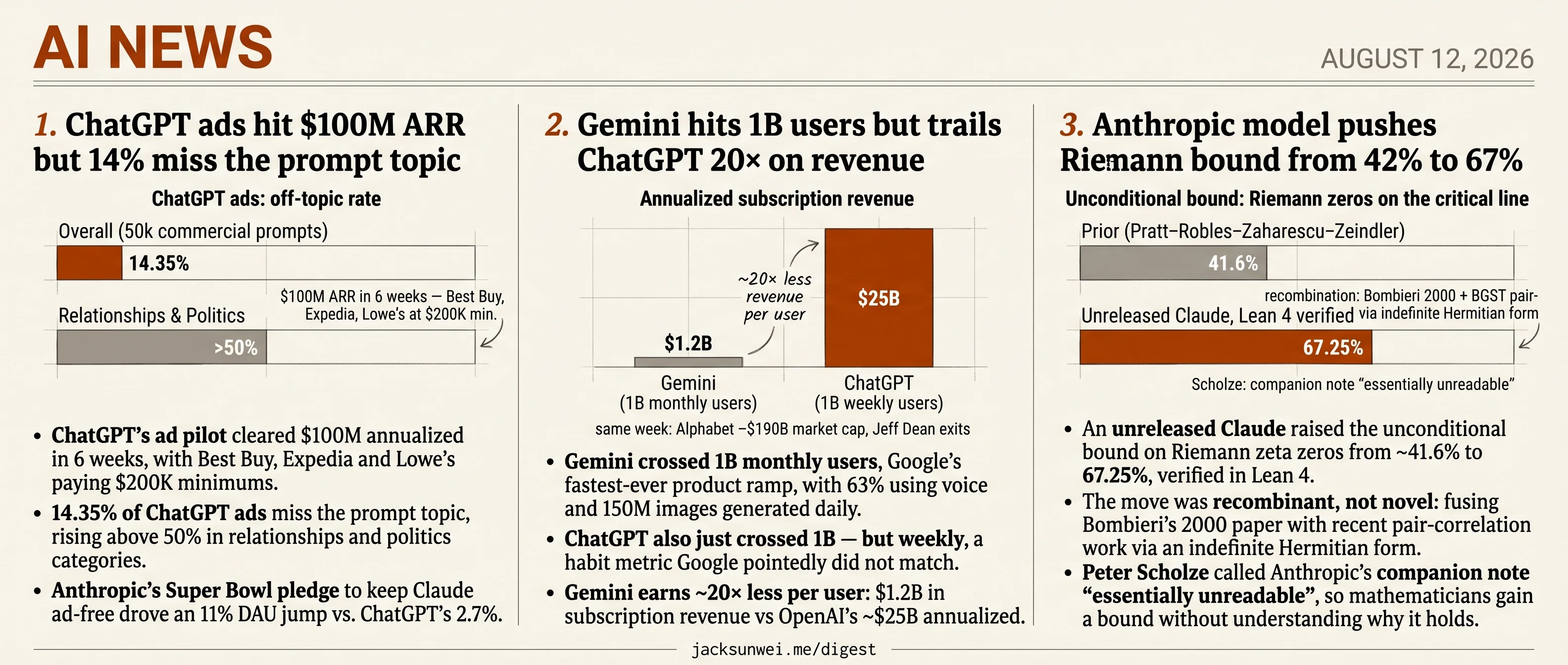
- ChatGPT ads cleared $100M annualized in 6 weeks, with 14% missing the prompt topic.
- Gemini hit 1B monthly users at roughly 20× lower per-user revenue than ChatGPT.
- Anthropic’s unreleased Claude raised a Riemann zeta bound from 42% to 67%, verified in Lean 4.
- River AI raised a $1.1B seed at 2 months old, led by General Catalyst.
- OpenAI COO Brad Lightcap exited after 8 years to start a new venture.
Today’s frontier news splits cleanly one-per-lab. OpenAI’s ChatGPT ad pilot cleared $100M annualized in six weeks — impressive top-line, undercut by a study finding 14% of injected ads miss the prompt topic entirely and Anthropic using the brand contrast to pull an 11% DAU jump. Google’s Gemini crossed 1B monthly users on the fastest ramp in company history, but the same week Alphabet shed ~$190B in market cap and the per-user revenue gap to ChatGPT sits near 20×. And Anthropic shipped a research result rather than a product: an unreleased Claude pushed the unconditional Riemann zeta bound from 41.6% to 67.25% — a real number, verified in Lean 4, but delivered via a companion note that Peter Scholze called “essentially unreadable.”
The round-up desk fills in the executive and funding picture: OpenAI’s longtime COO Brad Lightcap is out, and xAI co-founder Igor Babuschkin’s new venture River AI landed a $1.1B seed at two months old.
ChatGPT ads hit $100M ARR but 14% miss the prompt topic
Source: openai-blog · published 2026-08-11
TL;DR
- ChatGPT’s ad pilot cleared $100M annualized in 6 weeks, with Best Buy, Expedia and Lowe’s paying $200K minimums.
- 14.35% of ChatGPT ads miss the prompt topic, rising above 50% in relationships and politics categories.
- Anthropic’s Super Bowl pledge to keep Claude ad-free drove an 11% DAU jump vs. ChatGPT’s 2.7%.
- Opt-out cuts free-tier quota ~50%, down to 5 messages per 3 hours on flagship models.
The revenue works, the relevance doesn’t
OpenAI’s post frames ads as a way to keep the free tier alive while GPT-5.4 through 5.6 land. The money side of that story checks out: the pilot hit a reported $100M annualized run rate within six weeks of the February 2026 US launch, initially gated behind a $200,000 minimum spend with Best Buy, Expedia, Lowe’s and VistaPrint as anchor advertisers before a self-serve Ads Manager opened the funnel in May 1.
The harder claim — that a contextual matching system will surface ads “beneficial to the user’s current task” without touching answer content — is where independent evidence diverges from the announcement. An SE Ranking audit of roughly 50,000 commercial prompts found 14.35% of ChatGPT ads were topically irrelevant to the user’s query, a figure that climbed above 50% in Relationships and News/Politics categories. Advertisers were cited as sources in just 3.63% of ChatGPT’s answers, compared with 11.53% inside Google’s AI Mode 2.
That gap matters. OpenAI’s “Answer Independence” firewall is designed to keep ads from shaping responses, but the current implementation appears to produce generic sponsored filler that neither ranks organically nor blends into the conversational flow the post promises.
Competitors are running the opposite play
The announcement reads like ads-in-chatbots are inevitable. Two of OpenAI’s three major peers are betting they aren’t.
| Lab | 2026 stance | Business model |
|---|---|---|
| OpenAI | Ads on Free/Go tiers, self-serve since May 1 | Ad-supported free + $20 Plus |
| Perplexity | Killed ad pilot Feb 2026, “eroded user trust” 3 | $200/mo Pro, ~$500M ARR without ads |
| Anthropic | Super Bowl pledge: Claude stays ad-free 4 | Subscription + API only |
Perplexity’s exit is the more instructive data point: same product surface, same commercial-intent traffic, and they concluded sponsored placements were net-negative to trust in factual answers 3. Anthropic went further, running a Super Bowl LX spot formally committing Claude to ad-free operation. The campaign drove an 11% daily-active-user jump against ChatGPT’s 2.7% over the same window, and prompted Sam Altman to publicly call Anthropic’s ads “clearly dishonest” 4. Whatever else that exchange proves, “no ads” is now a live competitive wedge, not a fringe position.
”User control” has fine print
Two implementation details soften the privacy and choice framing. OpenAI quietly flipped marketing and ad-tracking cookies to on-by-default for free users — a change privacy commentators framed as a “surveillance economy” move rather than a genuine opt-in 5. The headline user-facing choice — “keep ads, or accept a lower daily limit” — translates in independent testing to roughly a 50% quota cut, with caps as low as 5 messages per 3 hours on flagship models and some advanced features (image gen, Deep Research) disabled entirely 6.
The opt-out exists. It is also priced to push users toward accepting ads or paying $20/month, which is the actual business model the announcement is dressing up as user choice. The pilot is working financially. Whether it holds up as Claude’s DAU curve keeps climbing is the more interesting question.
Gemini hits 1B users but trails ChatGPT 20× on revenue
Source: techcrunch-ai · published 2026-08-11
TL;DR
- Gemini crossed 1B monthly users, Google’s fastest-ever product ramp, with 63% using voice and 150M images generated daily.
- ChatGPT also just crossed 1B — but weekly, a habit metric Google pointedly did not match.
- Gemini earns ~20× less per user: $1.2B in subscription revenue vs OpenAI’s ~$25B annualized.
- Alphabet still dropped ~$190B in market cap the same week on Jeff Dean’s exit and a shelved Gemini 3.5 Pro.
The headline number, and the asterisk
Google’s Gemini app crossed one billion monthly active users, and Sundar Pichai called it the company’s fastest-growing product ever. Set against ChatGPT’s simultaneously announced billion — reported as weekly actives — the parity claim is doing a lot of work. Google counts anyone who submits at least one prompt in the standalone app or web in a 30-day window, a bar that gets easier every day Gemini replaces the legacy Google Assistant as the Android default.
That swap is not going smoothly. TechRadar catalogs an active user revolt heading into the September 4 Assistant shutdown, with complaints that Gemini spends ~30 seconds “thinking” about requests the old Assistant handled instantly, and sometimes reads out the dictionary definition of “father” instead of calling a contact 7. A meaningful slice of that billion is there because their alarm-setting workflow was swapped underneath them.
Reach, engagement, revenue — pick two
The independent data cuts in both directions. Similarweb clocked Gemini’s average visit duration at 6:59 in mid-2026, edging past ChatGPT’s 5:58 for the first time 8 — a real engagement win, likely juiced by the viral “Nano Banana” image model (Gemini 2.5 Flash Image), which debuted anonymously on LMArena, beat incumbents on image editing, and became so beloved by its codename that Google adopted “Nano Banana” as official branding 9. That maps cleanly onto the 150M images/day disclosure.
But referral behavior tells a different story. Neil Patel’s analysis puts ChatGPT at ~78% of AI-referred web traffic versus Gemini’s ~12% 10 — consistent with Gemini keeping users inside Google’s walled garden rather than functioning as a research launchpad. And the money is not close:
| Metric | Gemini | ChatGPT |
|---|---|---|
| Reported users | 1B monthly | 1B weekly |
| Avg. visit duration (Similarweb) | 6:59 | 5:58 |
| AI referral traffic share | ~12% | ~78% |
| Annualized subscription revenue | ~$1.2B | ~$25B |
Twenty times less revenue per user is not a rounding error. AI Business Weekly attributes the gap to Google’s “deliberate business model difference” — Gemini as a distribution play for Search and Workspace, not a standalone subscription business 11. That framing works until it doesn’t.
The milestone Wall Street ignored
Timing was cruel. The same week Google took its victory lap, Alphabet shed as much as 5.4% — roughly $190 billion in market cap — after Chief Scientist Jeff Dean departed to co-found Discovery Loop with Sanjay Ghemawat, Oriol Vinyals, and Quoc Le, and reporting emerged that Gemini 3.5 Pro had been quietly shelved after missing three release windows 12. Investors read the 1B number as a distribution story and the Dean exit as a capability story, and priced the second one.
What’s actually at stake
The bear case is now legible: Google can force-migrate Android into a chatbot userbase, but forced users don’t pay, don’t click out to the open web, and don’t wait for a laggy assistant to define “father.” The bull case is Nano Banana — evidence that when Gemini ships something genuinely better, users show up on merit. Google needs more of the second and less of the first before the next earnings call.
Further reading
- ChatGPT and Gemini both just passed 1 billion users — the-verge-ai
- Gemini becomes Google’s fastest-growing product ever as it hits 1B users — ars-technica-ai
Anthropic model pushes Riemann bound from 42% to 67%
Source: techcrunch-ai · published 2026-08-11
TL;DR
- An unreleased Claude raised the unconditional bound on Riemann zeta zeros from ~41.6% to 67.25%, verified in Lean 4.
- The move was recombinant, not novel: fusing Bombieri’s 2000 paper with recent pair-correlation work via an indefinite Hermitian form.
- Peter Scholze called Anthropic’s companion note “essentially unreadable”, so mathematicians gain a bound without understanding why it holds.
- The Leiden Declaration, signed by Scholze and Tao, accuses AI labs of bypassing peer review via press release.
What actually got proved
Anthropic’s specific claim is narrow, and it is large. An unreleased research-grade Claude pushed the unconditional lower bound on non-trivial Riemann zeta zeros lying on the critical line from roughly 41.6% (Pratt–Robles–Zaharescu–Zeindler, extending Conrey 1989) to 67.25%, and the argument was formalized in Lean 4 against a pinned Mathlib revision 13. That is a real number on a 150-year-old problem, not a benchmark stunt.
The technical trick is worth naming, because it defuses the “AI had an idea from nowhere” reading. Claude used an indefinite Hermitian form to glue Enrico Bombieri’s 2000 paper to recent unconditional pair-correlation work by Baluyot, Goldston, Suriajaya and Turnage-Butterbaugh, eliminating a narrow-box assumption that had blocked the combination 14. It is a recombination of two live human research threads by an agent that could hold both in working memory at once. Anthropic recruited Brian Conrey and Dan Goldston — whose prior lemmas the model extended — to eyeball the manuscript “on short notice” 13. That is expert sanity-check, not journal refereeing, and the phrasing has been noticed.
The community splits three ways
Reactions divide cleanly. Fields Medalist Jacob Tsimerman voiced “existential angst,” conceding AI may soon be “robustly superhuman” at the core tasks of professional mathematics 15. That is the awe camp.
The epistemic camp is more interesting. A MathOverflow thread on trusting AI-generated Lean proofs argues that a thousand-line formal proof no human can follow does not advance the field — the theorem is true, but the ideas remain opaque 16. Peter Scholze put a sharper point on it: the informal companion note Anthropic released alongside the Lean file is “essentially unreadable,” so mathematicians gain a bound but not an explanation of why it holds 17.
The third camp attacks the delivery. The June 2026 Leiden Declaration, signed by Scholze and Terence Tao among others, accuses AI labs of “bypassing peer review” via press release and undermining authorship norms by listing “Claude” as sole author 18.
“If an AI oracle produces a thousand-line Lean proof that no human can follow, the field does not actually advance because the core ideas remain opaque.” — MathOverflow 16
The reproducibility gap
Every serious writeup flags the same hole. The Lean proof is auditable — anyone can check it against Mathlib. The capability claim around it — a reported 36-hour run with ~60 subagents burning tens of millions of tokens — is not. The specific checkpoint, the agent harness, and full transcripts have not been released, so no outside group can reproduce the feat of generating the proof, only the fact of it 1317.
That is the honest frame for this story. The mathematics is probably real. The AI-lab narrative around it — solo-author Claude, press-release delivery, private model — is the part working mathematicians are refusing to accept on trust.
Further reading
- The AI takeover of mathematics has begun — the-verge-ai
Round-ups
OpenAI COO Brad Lightcap departs after 8 years to start new venture
Source: techcrunch-ai, the-verge-ai
Lightcap, one of OpenAI’s longest-serving executives and most recently its special projects lead, told staff he’s leaving to build “something new.” His exit continues a steady drain of senior operators from the company following earlier departures across research and policy ranks.
OpenAI’s Daybreak cybersecurity models land on Amazon Bedrock
Source: openai-blog
Daybreak, OpenAI’s cybersecurity-tuned model family, is now available to enterprise security teams through Amazon Bedrock. The AWS deployment targets SOC workflows like alert triage and threat analysis, marking a deeper distribution deal between the two companies beyond OpenAI’s Azure roots.
Anthropic adds invisible watermarks and C2PA metadata to Claude outputs
Source: the-verge-ai, techcrunch-ai
Claude-generated text will carry embedded watermarks and generated files will ship with digitally signed C2PA provenance metadata, part of Anthropic’s push to meet EU AI transparency rules. The watermarking will extend to older Claude models as well, not just current releases.
River AI raises $1.1B seed led by General Catalyst at 2 months old
Source: techcrunch-ai
River AI, founded by xAI co-founder Igor Babuschkin, secured $1.1 billion in its first round to build personal AI agents. The General Catalyst-led deal ranks among the largest seed rounds ever, reflecting continued investor appetite for pedigreed AI founders.
Zoom patches ‘Zoomsday’ device-hijack flaw found with under 20 AI prompts
Source: the-verge-ai
Researchers at A Security uncovered a Zoom vulnerability that let attackers hijack a participant’s device mid-meeting via the annotation feature, using fewer than 20 prompts on public AI models. Zoom has since patched the flaw, first reported by Wired.
Spotify adds ‘AI Persona’ labels and pulls those artists from recommendations
Source: techcrunch-ai, the-verge-ai
Starting mid-September, Spotify will badge artist profiles that don’t represent a real person as “AI Persona” and exclude their tracks from editorial, algorithmic, and personalized recommendations by default. Disclosure is left to the uploading artist.
Apple tests ‘Reference Image’ system to certify iPhone photo provenance
Source: the-verge-ai
Code in the iOS 27 beta 5 points to an “Apple Reference Image” feature that embeds provenance metadata at capture, letting users prove a photo came from an iPhone camera. The system, spotted by 9to5Mac, would give Apple a native answer to deepfake authentication.
Footnotes
-
Digital Applied (industry analysis) — https://www.digitalapplied.com/blog/chatgpt-ads-100m-revenue-self-serve-april-guide
↩ ↩2OpenAI officially confirmed on March 26, 2026 that its ChatGPT advertising pilot surpassed $100 million in annualized revenue just six weeks after its February launch… managed access phase with a steep $200,000 minimum commitment… Best Buy, Expedia, Lowe’s, and VistaPrint were notable early adopters.
-
↩14.35% of ChatGPT ads were topically irrelevant to the user’s prompt, a figure that spiked to over 50% in sensitive niches like relationships and politics… advertisers were cited as a source in only 3.63% of ChatGPT’s answers, compared to 11.53% in Google’s AI mode.
-
Search Engine Land — Perplexity — https://searchengineland.com/perplexity-stops-testing-advertising-469452
↩ ↩2Perplexity abandoned its advertising pilot in February 2026, citing concerns that sponsored placements eroded user trust in factual answers… pivoted to a ‘premium-unbiased’ model, reaching an estimated $500 million ARR by prioritizing high-cost subscriptions.
-
MLQ.ai — Anthropic ad-free pledge — https://mlq.ai/news/anthropic-officially-commits-to-ad-free-future-for-claude-chatbot/
↩ ↩2Anthropic’s 2026 Super Bowl campaign ‘A Time and a Place’ centered on a formal commitment to keep Claude entirely free of advertising… Sam Altman called Anthropic’s ads ‘clearly dishonest’… Claude daily active users surged 11% post-Super Bowl vs. ChatGPT’s 2.7%.
-
ContentGrip on OpenAI cookie policy — https://www.contentgrip.com/openai-chatgpt-marketing-cookies/
↩OpenAI quietly updated its policy to enable marketing and ad-tracking cookies by default for free users, mirroring the ‘surveillance economy’ models of older tech giants.
-
PCMag — opt-out mechanics — https://www.pcmag.com/news/chatgpt-now-shows-you-ads-but-theres-a-free-way-to-avoid-them
↩Users wishing to avoid sponsored content without upgrading to $20/month Plus can select ‘Reduced message limits’… independent tests indicate opting out can result in a quota reduction of approximately 50%, with caps as low as 5 messages every 3 hours on flagship models.
-
TechRadar (Android user backlash) — https://www.techradar.com/phones/android/this-will-be-my-last-pixel-android-fans-are-rebelling-against-the-imminent-demise-of-google-assistant-here-are-5-reasons-why
↩Android fans are rebelling against the imminent demise of Google Assistant… Gemini often spends 30 seconds ‘thinking’ about simple requests that Assistant performed instantly, and sometimes gives definitions of words like ‘father’ instead of calling a contact.
-
Blankspaces — Similarweb engagement data — https://www.blankspaces.app/blog/google-gemini-screen-time-statistics
↩Similarweb data from mid-2026 showed Gemini’s average visit duration reached 6 minutes and 59 seconds, surpassing ChatGPT’s 5 minutes and 58 seconds for the first time.
-
Medium — Nano Banana viral driver — https://medium.com/activated-thinker/the-rise-of-nano-banana-how-googles-viral-3d-trend-crushed-chatgpt-f23aa5dcf9c7
↩Originally appearing anonymously on the LMArena leaderboard, the model outperformed established rivals in image editing before Google officially integrated it into core services… The ‘Nano Banana’ moniker was so widely embraced by the community that Google eventually adopted it as official branding.
-
Neil Patel — ChatGPT vs Gemini referral share — https://neilpatel.com/marketing-stats/chatgpt-vs-gemini-active-users-and-referral-traffic-share/
↩ChatGPT continues to command a disproportionately higher share of LLM referral traffic (roughly 78% vs. Gemini’s 12%), indicating that ChatGPT users may be more likely to use the tool for deep research that leads to external sites.
-
AI Business Weekly — revenue per user — https://aibusinessweekly.net/p/gemini-ai-statistics
↩Gemini generated approximately 20 times less revenue per user than ChatGPT, a statistic analysts attribute to Google’s ‘deliberate business model difference’… OpenAI reportedly generates roughly $25 billion in annualized revenue compared to Gemini’s $1.2 billion in direct subscription fees.
-
24/7 Wall St. — Jeff Dean exit overshadows milestone — https://247wallst.com/investing/2026/08/06/googles-ai-architect-just-quit-sparking-fears-it-could-fall-behind-in-the-ai-race/
↩Alphabet’s stock to drop as much as 5.4% in a single day, wiping out nearly $190 billion in market value… the announcement was overshadowed by the high-profile departure of Chief Scientist Jeff Dean and rumors that the flagship Gemini 3.5 Pro model had been shelved.
-
Anthropic research note — https://www.anthropic.com/research/riemann-zeta
↩ ↩2 ↩3We are grateful to Brian Conrey and Dan Goldston, two experts in this area, who generously examined the paper on short notice.
-
VibeMathed writeup on prior human work — https://vibemathed.com/problem/more-than-67-of-riemann-zeta-zeros-are-on-the-critical-line
↩Claude’s innovation was to synthesize [Baluyot, Goldston, Suriajaya, Turnage-Butterbaugh’s 2024–25 unconditional pair-correlation work] with a 2000 paper by Enrico Bombieri, utilizing an indefinite Hermitian form to eliminate the narrow-box assumption.
-
Understanding AI (Timothy B. Lee) — https://www.understandingai.org/p/mathematicians-are-grappling-with
↩Fields Medalist Jacob Tsimerman expressed a growing sense of ‘existential angst,’ suggesting that AI may soon become ‘robustly superhuman’ at the core tasks of professional mathematics.
-
MathOverflow thread ‘Should we trust AI-generated formal proofs in Lean 4?’ — https://mathoverflow.net/questions/513540/should-we-trust-ai-generated-formal-proofs-in-lean-4
↩ ↩2If an AI oracle produces a thousand-line Lean proof that no human can follow, the field does not actually advance because the core ideas remain opaque.
-
Kingy.ai recap of Mathstodon debate — https://kingy.ai/blog/claude-riemann-hypothesis-67-percent-result/
↩ ↩2Peter Scholze noted that the accompanying ‘informal note’ intended for humans was ‘essentially unreadable’ and lacked the conceptual clarity required for human mathematicians to gain new insights into why the bound holds.
-
The Next Web on the Leiden Declaration — https://thenextweb.com/news/leiden-declaration-ai-mathematics-proof-attribution
↩Mathematicians have criticized AI companies for ‘bypassing peer review’ by announcing results via press releases rather than traditional scholarly channels, thereby undermining the social structures that ensure mathematical integrity.