Musk leases Colossus to Anthropic, Terafab pegged at $5T, OpenAI suit narrows
Three AI news stories today reprice Musk's leverage: he supplies a rival's compute, faces a $5T Terafab estimate, and loses fraud claims.
Musk leases Colossus to Anthropic, Terafab pegged at $5T, OpenAI suit narrows
TL;DR
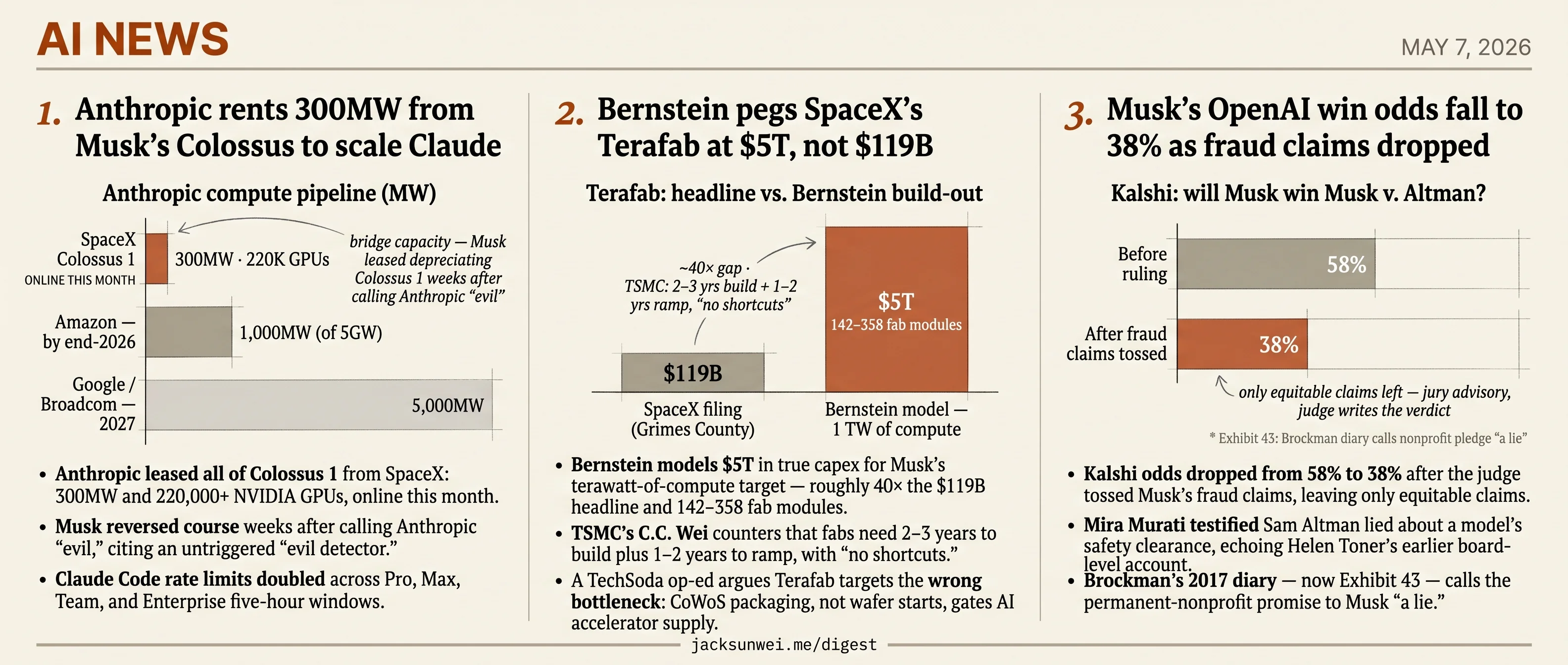
- Anthropic leased all of Colossus 1 from Musk’s SpaceX, 300MW and 220,000+ GPUs online this month.
- Bernstein models $5T in true capex for Musk’s Terafab, 40× the $119B headline figure.
- Musk’s OpenAI win odds dropped from 58% to 38% after the judge tossed his fraud claims.
- Samsung crossed $1T market cap on AI chip demand, the second Asian firm after TSMC.
- Google shut down Project Mariner, folding its browser-agent tech into other products.
Today’s AI news runs through one person. Elon Musk leased all of Colossus 1 — 300MW and 220,000+ NVIDIA GPUs — to Anthropic, the lab he called evil weeks ago. Bernstein then put a $5T price tag on his Terafab compute target, roughly 40× the $119B headline he’s been quoting. And in Delaware, Kalshi odds on his OpenAI lawsuit fell from 58% to 38% after the judge tossed the fraud claims and Mira Murati testified that Sam Altman lied about a model’s safety clearance.
Read together, the three stories don’t say Musk is winning or losing — they say his position is being repriced on three different surfaces at once: as a compute supplier forced to sell to a rival, as a megaproject sponsor whose true bill is 40× larger than advertised, and as a plaintiff whose strongest claim just got dismissed. The briefs round out the day: Samsung crossed $1T on AI chip demand, DeepSeek is chasing a $45B valuation, and Google quietly killed Project Mariner.
Anthropic rents 300MW from Musk’s Colossus to scale Claude
Source: anthropic-news · published 2026-05-06
TL;DR
- Anthropic leased all of Colossus 1 from SpaceX: 300MW and 220,000+ NVIDIA GPUs, online this month.
- Musk reversed course weeks after calling Anthropic “evil,” citing an untriggered “evil detector.”
- Claude Code rate limits doubled across Pro, Max, Team, and Enterprise five-hour windows.
- “Dreaming” shipped: an async job mining up to 100 prior sessions, billed at standard API rates.
- Colossus 1 faces an NAACP/Earthjustice suit over 35 unpermitted methane turbines, 1,200–2,000 tons NOx/yr.
The deal nobody had on their bingo card
Three months ago Elon Musk was calling Anthropic “misanthropic” and “woke.” On May 6 he leased them the entirety of Colossus 1 — over 300MW and 220,000+ NVIDIA GPUs — and told reporters his “evil detector” failed to trigger in meetings with the Amodeis 1. The less mystical reading: xAI has already migrated frontier training to Colossus 2, so Colossus 1 is depreciating inventory that SpaceX would rather monetize before its rumored IPO 1. Anthropic, for its part, needs a bridge before the Amazon (5GW) and Google/Broadcom (5GW) clusters come online in late 2026 and 2027.
| Partner | Capacity | Timing |
|---|---|---|
| SpaceX (Colossus 1) | 300MW / 220K GPUs | This month |
| Amazon | up to 5GW | 1GW by end of 2026 |
| Google / Broadcom | 5GW | 2027 |
| Microsoft / NVIDIA (Azure) | $30B partnership | Ongoing |
| Fluidstack | $50B (US infra) | Multi-year |
The capacity unlock is real and immediate: Tier 5 API limits jump to 20,000 RPM and 5M TPM on Opus, and Claude Code’s 5-hour windows double across every paid tier, with peak-hour throttling removed for Pro and Max.
What Code w/ Claude actually shipped
Past the rate-limit headlines, the keynote’s substantive launch was Dreaming — a scheduled async job that reviews up to ~100 prior agent sessions, identifies recurring failure modes, and writes itself a playbook. In Simon Willison’s live-blog example, an agent that flunked a lunar-landing task overnight produced a descent-playbook.md to guide its next attempt 2. It’s a productized Ralph loop, billed at standard API rates, and runs take tens of minutes. Developers liked the memory-consolidation angle; the anthropomorphic framing and token-cost runaway got less love (Uber reportedly torched its annual AI budget in four months).
Combined with managed agents, the stack now looks like this:
flowchart LR
    A[Live agent sessions] --> B[Session log store]
    B --> C{{Dreaming job<br/>async, ~100 sessions}}
    C --> D[playbook.md artifacts]
    D --> E[Next agent run]
    F[Human review] -. optional .-> D
The fault lines the press release skips
Anthropic’s announcement leans hard on “democratic alignment” and a pledge to offset US consumer electricity hikes. It does not mention that Colossus 1 sits in a majority-Black Memphis neighborhood where the NAACP and Earthjustice are suing over up to 35 unpermitted methane turbines emitting 1,200–2,000 tons of NOx annually 3. The ratepayer pledge addresses bills, not air quality.
It also doesn’t mention that in March the Pentagon designated Anthropic a “supply-chain risk” for refusing to drop guardrails on mass surveillance and autonomous weapons, then onboarded seven replacement vendors — SpaceX among them 4. Anthropic is now renting from a company the DoD picked over it. The press release’s other flourish — “multiple gigawatts of AI compute in orbit” — is contradicted inside SpaceX’s own April 22 S-1, which calls orbital compute “unproven” and warns it may never reach “commercial viability” 5.
Net read
The product news is shipping and useful. The scaffolding around it — Musk détente, Pentagon irony, environmental-justice litigation, and the circular-financing critique that frames Anthropic as a “liquidity transfer mechanism” pumping a $900B IPO 6 — is where the May 6 story actually lives.
Further reading
- Anthropic raises Claude Code usage limits, credits new deal with SpaceX — ars-technica-ai
- Anthropic’s Claude Managed Agents can now “dream,” sort of — ars-technica-ai
- Live blog: Code w/ Claude 2026 — simon-willison
- [AINews] Anthropic-SpaceXai’s 300MW/$5B/yr deal for Colossus I, ARR growth is 8000% annualized — latent-space
Bernstein pegs SpaceX’s Terafab at $5T, not $119B
Source: techcrunch-ai · published 2026-05-06
TL;DR
- Bernstein models $5T in true capex for Musk’s terawatt-of-compute target — roughly 40× the $119B headline and 142–358 fab modules.
- TSMC’s C.C. Wei counters that fabs need 2–3 years to build plus 1–2 years to ramp, with “no shortcuts.”
- A TechSoda op-ed argues Terafab targets the wrong bottleneck: CoWoS packaging, not wafer starts, gates AI accelerator supply.
- Grimes County residents are openly contesting the tax abatement as “light speed” approval against thin oversight.
- Central Texas needs ~33,000 new semi workers by 2030 — Terafab is already posting yield-engineer roles up to $338K.
SpaceX’s filing for a “multi-phase, vertically integrated” fab in Grimes County, Texas puts a $55B–$119B price tag on what Musk is calling Terafab. Treat that as the entry ticket. Every serious external read of the project — from sell-side analysts to the incumbent foundry CEO to local zoning hearings — says the headline number is the least interesting figure in the file.
The capex math doesn’t close
Bernstein modeled what it would actually take to deliver Musk’s stated goal of one terawatt of AI compute and arrived at roughly $5 trillion, built from 142 to 358 individual fab modules and a multiple of ASML’s entire annual EUV tool output 7. That’s a ~40× gap to the proposal’s ceiling. Either Terafab is a phase-one number masquerading as a project budget, or the terawatt target is a marketing line not a build plan.
TSMC CEO C.C. Wei, asked about Terafab on the Q1 2026 call, declined to engage with the dollar figure and instead pointed at the calendar: 2–3 years of construction, then another 1–2 years of yield ramp, and “no shortcuts” 8. Coming from the operator who actually runs the leading-edge node, that’s the closest thing to an industry-consensus reality check. Musk’s reply on X — that Terafab exists because “TSMC simply cannot produce the vast quantity of chips needed,” which he puts at 50× current global output — is a demand-side claim, not a schedule answer 9.
Wrong bottleneck?
The sharpest technical critique comes from a TechSoda op-ed arguing that the binding constraint on AI accelerators isn’t front-end wafer starts at all — it’s Chip-on-Wafer-on-Substrate (CoWoS) advanced packaging and HBM integration 10. If that’s right, a fully built Terafab risks producing a surplus of unassembled silicon unless Intel’s EMIB/Foveros lines (Terafab’s packaging fallback) scale alongside it. Musk’s framing of the problem as raw capacity sidesteps this entirely. The capacity-vs.-packaging dispute is the unresolved technical question the TechCrunch brief glosses past.
Local consent and the talent floor
Grimes County is moving on a tax abatement that residents are openly contesting. Public comments at the hearing flagged that incentives designed to stimulate low-income areas are being routed to a Musk entity, with officials moving at “light speed” against thin oversight and unresolved water-rights questions 11. Independent of politics, the workforce arithmetic is brutal: Central Texas needs roughly 33,000 new semiconductor workers by 2030, and Terafab is already posting Module Process Engineer and Yield Engineer roles into the $338K range to pull staff from existing leading-edge fabs 12. Hiring at that scale, for jobs that take years to train into, is plausibly a harder constraint than capex.
What’s actually at stake
Read the bundle and Terafab reframes from audacious vertical-integration play to negotiating posture: a number large enough to pressure TSMC’s allocation conversations and seed an IPO narrative, secured against physical-economy realities — capex, yield ramp, packaging, water, headcount — that none of Musk’s prior factories have had to clear at this node. The interesting question isn’t whether $119B gets spent. It’s which of the four constraints binds first.
Musk’s OpenAI win odds fall to 38% as fraud claims dropped
Source: the-verge-ai · published 2026-05-06
TL;DR
- Kalshi odds dropped from 58% to 38% after the judge tossed Musk’s fraud claims, leaving only equitable claims.
- Mira Murati testified Sam Altman lied about a model’s safety clearance, echoing Helen Toner’s earlier board-level account.
- Brockman’s 2017 diary — now Exhibit 43 — calls the permanent-nonprofit promise to Musk “a lie.”
- Brockman’s OpenAI stake is worth ~$30B on $0 personally invested, per his own sworn testimony.
The witnesses are landing punches — on both sides
Week two of Musk v. Altman produced the kind of governance disclosures OpenAI has spent years keeping out of court. Mira Murati, the former CTO, told jurors via video deposition that Altman falsely claimed Legal had cleared a new model from safety-board review. That isn’t an isolated complaint: ex-board member Helen Toner had already testified that Altman told the board three ChatGPT variants were safety-approved when only one had completed the full testing cycle 13. Two senior insiders, independently, describing the same pattern of misrepresenting safety sign-off — that’s the line the AI-safety community is going to remember regardless of how the verdict lands.
Greg Brockman cut the other way. He told the jury Musk demanded a 51% controlling stake and CEO authority in 2017 to bankroll an $80B Mars-colonization plan, recasting the founding dispute as a thwarted power grab rather than a betrayed charity 14. Shivon Zilis’s testimony, framed by The Verge as Musk’s loyalist becoming his liability, pulled in the same direction. OpenAI’s defense is using its own co-founder to argue Musk left because he couldn’t run the place, not because anyone broke a promise.
The diary is the case
The single most consequential piece of evidence isn’t a deposition — it’s Brockman’s personal journal. Judge Yvonne Gonzalez Rogers cited “Exhibit 43” specifically when she denied OpenAI’s motion for summary judgment, pointing to a late-2017 entry in which Brockman wrote that promising Musk a permanent nonprofit while planning a commercial pivot would be “a lie” 15. Forced to read the entries aloud to jurors, Brockman framed them as “stream-of-consciousness” and “cherry-picked.” That defense has to coexist with the disclosure that his OpenAI stake is now worth roughly $30 billion on zero personal capital invested 14 — the cleanest factual hook Musk’s “unjust enrichment” theory has.
Why Musk is still losing on the scoreboard
Despite the bombshell week, prediction markets moved against Musk. Kalshi odds fell from 58% to 38% after Gonzalez Rogers dismissed the fraud claims, narrowing the case to breach of charitable trust and unjust enrichment 16. Those are equitable claims — the jury’s role is primarily advisory, with the judge writing the final verdict. Puck notes that the Delaware and California Attorneys General have already endorsed OpenAI’s conversion, which badly undermines Musk’s standing to argue a breach of charitable trust in the first place 17. A pre-trial filing surfaced this week revealed Musk himself tried to settle days before opening arguments 18 — his own team appears to have read the odds the same way Kalshi did.
What actually changes
The legal vehicle for reverting OpenAI’s structure has narrowed to a slot the judge is likely to close. The reputational and regulatory exposure is the opposite trajectory. Two former senior leaders are now on record describing a pattern of Altman misrepresenting safety review; a co-founder’s diary, in his own hand, frames the nonprofit pledge as a lie; and the dollar figures attached to that lie are now in the public record. AG offices and IPO underwriters read transcripts too. Musk probably loses the case. OpenAI does not walk away clean.
Further reading
- How Elon Musk left OpenAI, according to Greg Brockman — techcrunch-ai
- Musk’s biggest loyalist became his biggest liability — the-verge-ai
- OpenAI president forced to read his personal diary entries to jury — ars-technica-ai
Round-ups
AI boom pushes Samsung to $1T
Source: techcrunch-ai
Samsung crossed a $1 trillion market cap on surging AI chip demand, becoming only the second Asian company to hit the milestone after TSMC. The rally reflects investor confidence in its HBM memory and foundry pipeline supplying AI accelerators.
DeepSeek could hit $45B valuation from its first investment round
Source: techcrunch-ai
DeepSeek is targeting a $45 billion valuation in its first-ever funding round, a sharp rerating for the Chinese lab that drew global attention in early 2025 by training a frontier-grade LLM on a fraction of the compute and budget of OpenAI and Anthropic.
Spooked by Mythos, Trump suddenly realized AI safety testing might be good
Source: ars-technica-ai
After being rattled by the Mythos incident, Trump reversed course to embrace AI safety testing he had previously dismissed as a Biden-era overreach. Ars surveys experts on what could still go wrong with the administration’s hastily assembled testing regime involving Google DeepMind, Microsoft, and xAI.
Google shuts down Project Mariner
Source: the-verge-ai
Google shut down Project Mariner on May 4th, ending its experimental browser agent that performed multi-step web tasks on a user’s behalf. The landing page now thanks users and notes the underlying technology is being folded into other Google products.
Khosla-backed robotics startup Genesis AI has gone full stack, demo shows
Source: techcrunch-ai
Genesis AI, the Khosla-backed robotics startup that raised a $105 million seed, unveiled its first foundation model GENE-26.5 alongside a demo of dexterous robotic hands performing complex manipulation tasks, signaling a full-stack play spanning model, hardware, and data.
OpenAI B2B Signals launch with Uber and Singular Bank case studies
Source: openai-blog
OpenAI launched B2B Signals, a research effort tracking how frontier enterprises scale AI adoption, paired with two flagship case studies showing Uber using OpenAI models for driver and rider workflows and Singular Bank deploying ChatGPT and Codex to speed up banker tooling.
Further reading:
- Uber uses OpenAI to help people earn smarter and book faster — openai-blog
- Singular Bank helps bankers move fast with ChatGPT and Codex — openai-blog
A blueprint for using AI to strengthen democracy
Source: mit-tech-review-ai
MIT Technology Review lays out a framework for deploying AI to reinforce democratic institutions rather than erode them, drawing parallels to how the printing press, telegraph, and broadcast media each rewired governance, and proposing concrete uses in deliberation, administration, and civic participation.
Footnotes
-
Seoul Economic Daily (sedaily.com) — https://en.sedaily.com/international/2026/05/07/musk-and-anthropic-team-up-against-common-rival-openai
↩ ↩2Musk justified the partnership by claiming his internal ‘evil detector’ was not triggered during meetings with Anthropic’s leadership… he felt comfortable leasing Colossus 1 because xAI had already migrated its own training workloads to the more advanced Colossus 2 facility.
-
Simon Willison live blog — https://simonwillison.net/2026/May/6/code-w-claude-2026/
↩Dreaming is a scheduled asynchronous job that reviews up to 100 prior sessions to identify recurring mistakes; in one demo an agent that failed a lunar landing task ‘dreamed’ overnight and produced a descent-playbook.md to guide its next attempt—effectively a ‘Ralph loop’ of self-correction, billed at standard API rates and taking tens of minutes per run.
-
Earthjustice — https://earthjustice.org/article/a-community-takes-a-data-center-colossus-to-court
↩The NAACP’s legal challenge demands that the company install the ‘best available control technology’ and pay civil penalties for every day of unpermitted operation; xAI is alleged to have run up to 35 unpermitted methane turbines at Colossus 1, emitting 1,200–2,000 tons of NOx annually.
-
CBS News — https://www.cbsnews.com/news/anthropic-pentagon-supply-chain-risk-lawsuit/
↩Defense Secretary Pete Hegseth ordered all federal agencies to cease using Anthropic technology after the company refused to waive ‘red lines’ barring Claude’s use in mass surveillance or autonomous lethal weapons; the Pentagon then onboarded seven other AI vendors—including SpaceX—pointedly excluding Anthropic.
-
Seeking Alpha (citing SpaceX S-1) — https://seekingalpha.com/news/4587198-rivals-turn-partners-as-anthropic-inks-deal-to-secure-computing-power-from-xais-colossus-1
↩SpaceX’s April 22 S-1 warns that orbital AI compute remains in ‘early stages,’ relies on ‘unproven technologies,’ and may never achieve ‘commercial viability’—directly contradicting the joint multi-gigawatt orbital vision Anthropic touted.
-
Shanaka Perera, Substack (‘The Great Liquidity Transfer’) — https://shanakaanslemperera.substack.com/p/the-great-liquidity-transfer-how
↩Critics describe Anthropic as a ‘load-bearing failson’ whose >$100B Amazon and >$200B Google commitments form a closed loop where investor capital is immediately pledged back to the same providers for compute—a ‘liquidity transfer mechanism’ pumping valuations ahead of IPO rather than reflecting organic demand.
-
Tom’s Hardware (Bernstein analysis) — https://www.tomshardware.com/tech-industry/semiconductors/analyzing-elon-musks-terafab-a-step-towards-tesla-and-spacexs-partial-vertical-integration-or-an-unattainable-dream
↩Bernstein analysts estimate that achieving such output would require between 142 and 358 individual fab modules and a total capital investment approaching $5 trillion—far exceeding the currently proposed $119 billion budget
-
Taipei Times (TSMC CEO C.C. Wei) — https://www.taipeitimes.com/News/biz/archives/2026/04/17/2003855733
↩Wei emphasized that the foundry business has ‘no shortcuts,’ noting that building a new facility requires two to three years of construction followed by another one to two years for a full production ramp
-
Wccftech (Musk reply to TSMC) — https://wccftech.com/elon-musk-tells-tsmcs-ceo-that-terafab-wouldnt-exist-if-the-foundry-could-keep-up-with-his-chip-demand/
↩Musk stated that the Terafab project is a necessity because ‘TSMC simply cannot produce the vast quantity of chips needed’… estimated by him to be 50x the world’s current output
-
TechSoda Substack (op-ed) — https://techsoda.substack.com/p/op-ed-what-elon-musk-gets-wrong-on?utm_medium=email&action=share
↩the primary bottleneck for high-end AI accelerators is not front-end foundry capacity (wafer starts), but specifically Chip-on-Wafer-on-Substrate (CoWoS) packaging
-
Reddit r/texas thread on Grimes County hearing — https://www.reddit.com/r/texas/comments/1t5e016/spacex_terafab_eyes_grimes_county_tx_for_119b/
↩Residents have questioned why a multi-billion-dollar entity led by Elon Musk requires local tax exemptions intended for stimulating growth in low-income areas… officials are moving at ‘light speed’ to approve the abatement without sufficient public oversight
-
Business Insider (hiring/talent) — https://www.businessinsider.com/tesla-spacex-terafab-hiring-elon-musk-chip-salaries-texas-california-2026-3
↩Job listings for roles like Module Process Engineers and Yield Engineers in Austin offer base salaries ranging from $88,000 to over $338,000… Central Texas may need 33,000 new semiconductor and advanced manufacturing workers by 2030
-
Forbes (Alicia Park) — Toner corroboration — https://www.forbes.com/sites/aliciapark/2026/05/06/ex-openai-cto-mira-murati-testifies-sam-altman-pit-openai-leaders-against-each-other-undermined-her/
↩Former board member Helen Toner… testified that Altman had previously informed the board that three versions of ChatGPT were safety-approved when only one had undergone the full testing cycle.
-
Business Insider — Brockman testimony — https://www.businessinsider.com/openai-trial-greg-brockman-testimony-elon-musk-breakup-compute-costs-2026-5
↩ ↩2Brockman told the jury that Musk demanded a 51% controlling stake and full CEO authority in 2017 to fund an ambitious $80 billion plan for Mars colonization… Brockman admitted under oath that his personal stake in OpenAI is now valued at approximately $30 billion, despite him having invested zero dollars of his own capital.
-
Medium analysis of Exhibit 43 (Brockman diary) — https://medium.com/@neuralnikitha/he-wrote-it-was-a-lie-in-his-private-diary-a-judge-just-made-it-exhibit-a-8418fcdfdb47
↩Federal Judge Yvonne Gonzalez Rogers identified Brockman’s journal as a decisive factor in denying OpenAI’s motion for summary judgment… In a late 2017 entry, Brockman wrote that explicitly promising Musk a permanent nonprofit structure while planning a commercial pivot would be ‘a lie.’
-
Oddschecker (Kalshi prediction markets) — https://www.oddschecker.com/us/insight/specials/entertainment/20260505-elon-musk-court-case-odds-will-musk-win-lawsuit-against-sam-altman-open-ai-in-2026
↩Prediction odds on Kalshi dropped from 58% to 38% after Judge Gonzalez Rogers dismissed Musk’s fraud claims, narrowing the case to ‘breach of charitable trust’ and ‘unjust enrichment.’
-
Puck News — legal analysis — https://puck.news/what-happens-if-elon-wins-the-openai-trial/
↩Because these are equitable claims, the jury’s role is primarily advisory, leaving the final verdict to the judge… the endorsement of OpenAI’s conversion by the Attorneys General of Delaware and California significantly undermines Musk’s standing to claim a breach of trust.
-
CNN/KEYT — pre-trial filing — https://keyt.com/news/money-and-business/cnn-business-consumer/2026/05/04/musk-wanted-to-settle-with-openai-just-days-before-their-courtroom-showdown-new-filing-says/
↩Musk wanted to settle with OpenAI just days before their courtroom showdown, new filing says.