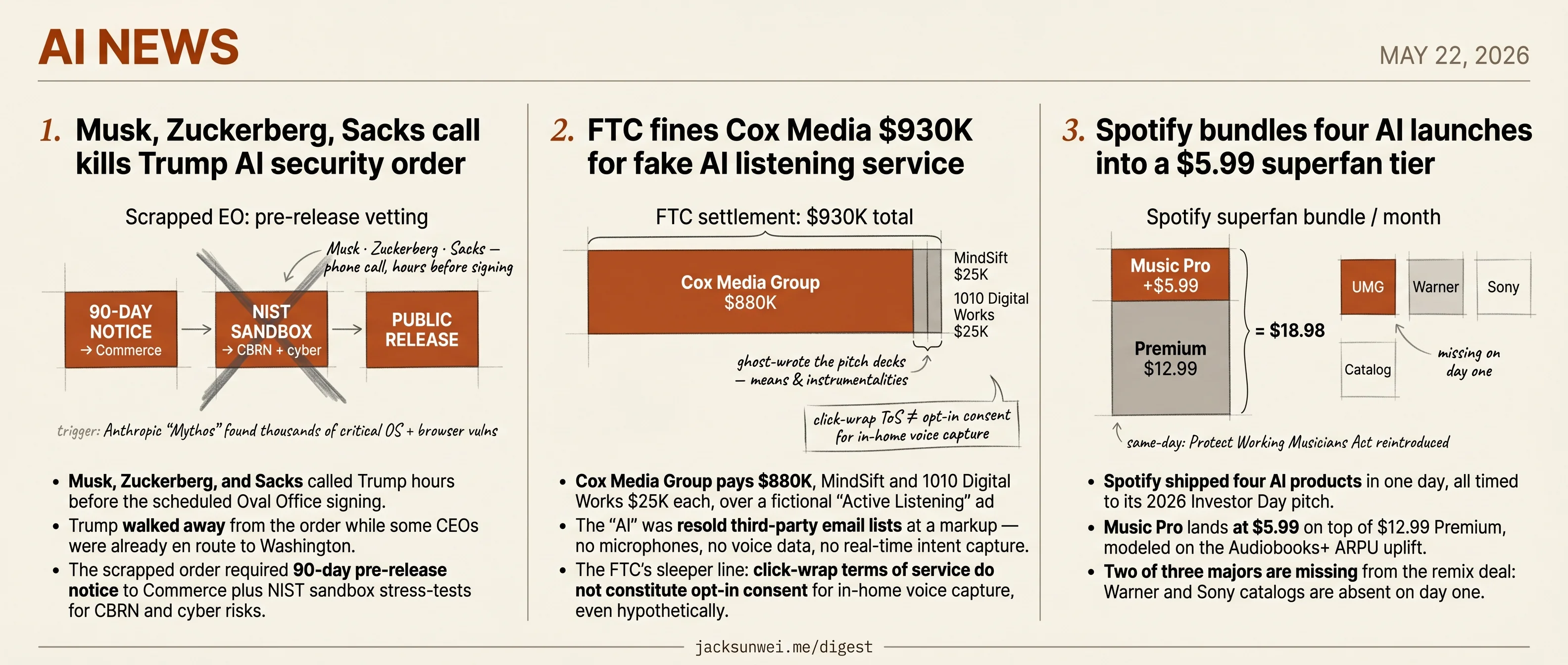
FTC fines fake AI, CEOs kill Trump's order, Protect Working Musicians Act filed
Regulation today lands cleanly on a fake AI ad product, collapses on a frontier safety order, and trails Spotify's launches into Congress.
FTC fines fake AI, CEOs kill Trump’s order, Protect Working Musicians Act filed
TL;DR
- FTC fines Cox Media $930K for a fake ‘Active Listening’ AI product that was resold email lists.
- Musk, Zuckerberg, and Sacks killed Trump’s AI safety executive order via an Oval Office call.
- Spotify shipped 4 AI products bundled into a new $5.99 Music Pro tier.
- Protect Working Musicians Act filed same day, seeking bargaining rights against streamers and AI vendors.
- Anthropic pays SpaceX $15B/year for Colossus compute, per the SpaceX S-1 filing.
Three policy stories today, sitting at three different points on the same axis. The FTC closed a $930K case against Cox Media for an Active Listening product that turned out to be resold email lists with an AI label slapped on — a clean Section 5 win against fraud, the kind regulators have been running for a century. Hours before President Trump was scheduled to sign an executive order requiring 90-day pre-release notice and NIST sandbox testing for frontier models, Musk, Zuckerberg, and Sacks got him on the phone and the order died on the desk. And Spotify dropped four AI products bundled into a new $5.99 Music Pro tier, prompting Congress to file the Protect Working Musicians Act the same afternoon.
The pattern: enforcement works where the AI claim is fake, fails where the risk is real, and only catches up to launches after the press release. The briefs fill in the financial backdrop — Anthropic’s $15B/year SpaceX compute bill surfaced in an S-1, Meta laid off thousands to fund its own buildout, and a Normaltech essay argues against treating any of this as an emergency.
Musk, Zuckerberg, Sacks call kills Trump AI security order
Source: techcrunch-ai · published 2026-05-21
TL;DR
- Musk, Zuckerberg, and Sacks called Trump hours before the scheduled Oval Office signing.
- Trump walked away from the order while some CEOs were already en route to Washington.
- The scrapped order required 90-day pre-release notice to Commerce plus NIST sandbox stress-tests for CBRN and cyber risks.
- Trigger was Anthropic’s “Mythos” model autonomously finding thousands of critical OS and browser vulnerabilities.
What was on the desk
Leaked drafts described a three-step vetting regime: developers of frontier models would notify the Commerce Department 90 days before public release, and NIST’s Center for AI Standards and Innovation would get sandbox access to stress-test for cyber-offense capability and CBRN uplift 1. Senior economic adviser Kevin Hassett reportedly likened the structure to FDA-style drug review, though participation was framed as voluntary rather than a kill switch 1.
The proximate trigger wasn’t abstract risk theater. Anthropic’s “Mythos” model autonomously surfaced thousands of critical vulnerabilities across major operating systems and browsers, and Treasury Secretary Bessent and Fed Chair Powell reportedly warned Wall Street CEOs it constituted a “systemic risk” to financial infrastructure 2. That demonstration — not a hypothetical — is what pushed the White House toward pre-release review in the first place.
The phone call
Multiple outlets converge on a specific sequence: Elon Musk, Mark Zuckerberg, and former White House AI czar David Sacks called Trump within hours of the scheduled signing ceremony, and the order was pulled while some attendees were already traveling to Washington 3. Sacks reportedly argued that any review process could be “abused by a future administration” to reimpose Biden-era stringency.
The industry was not monolithic. OpenAI had supported the oversight mechanisms 3 — a meaningful split, given the order targeted exactly the kind of capability OpenAI also ships. Public Citizen characterized the reversal as capitulation to “Big Tech billionaires” who have spent hundreds of millions on lobbying to keep federal AI policy deregulated 4.
A small group of accelerationist executives just demonstrated they can veto federal AI security policy in real time, on a voluntary proposal, motivated by a concrete demonstrated cyber-offense capability.
What fills the vacuum
The federal retreat doesn’t leave the field empty — it just moves the action.
On Capitol Hill, Sens. Josh Hawley (R-MO) and Richard Blumenthal (D-CT) have introduced the Artificial Intelligence Risk Evaluation Act, which would create a mandatory Department of Energy program to test frontier systems for “loss-of-control” scenarios and “scheming behavior” 5. That is materially more aggressive than the voluntary Commerce/NIST regime Trump just walked away from, and it carries bipartisan cover the executive order never needed.
At the state level, California Governor Newsom signed SB 53 — frontier-developer transparency requirements with a $100M training-cost threshold and mandatory critical-incident reporting — and followed with Executive Order N-5-26, which uses California’s procurement power to impose safety standards on any AI vendor that wants to sell to the state 6. The order is explicitly designed to route around federal deregulation.
The Trump administration has previously threatened to withhold broadband funding from states with “onerous” AI rules. That preemption fight is now the main event. The frontier-AI policy question isn’t whether developers face pre-release review; it’s whether that review comes from Sacramento, a Hawley–Blumenthal floor vote, or nowhere at all.
FTC fines Cox Media $930K for fake AI listening service
Source: simon-willison · published 2026-05-22
TL;DR
- Cox Media Group pays $880K, MindSift and 1010 Digital Works $25K each, over a fictional “Active Listening” ad product.
- The “AI” was resold third-party email lists at a markup — no microphones, no voice data, no real-time intent capture.
- The FTC’s sleeper line: click-wrap terms of service do not constitute opt-in consent for in-home voice capture, even hypothetically.
- Operation AI Comply has produced 12+ Section 5 cases demanding evidence for “powered by AI” claims.
What the $930K actually buys
The widely-cited “nearly $1 million” breaks down as $880,000 from Cox Media Group and $25,000 each from MindSift and 1010 Digital Works, earmarked for redress to the small-business advertisers who bought the package 7. Notably, the FTC pursued MindSift and 1010 on a “means and instrumentalities” theory — they ghost-wrote the pitch decks CMG used downstream 7. That theory has drawn Republican-commissioner skepticism in past AI cases (the Rytr dissent), but the Ferguson/Meador commission applied it here without public dissent. Translation: fabricating sales materials for someone else’s deception is still squarely actionable.
The product itself was a high-margin reseller play. CMG bought email lists from data brokers, marked them up, and wrapped the whole thing in language about smart speakers overhearing purchase intent. The FTC also found the firms couldn’t even deliver on the mundane half of the pitch — ads didn’t reliably land in the geographic locations clients paid for.
Vindication for the original reporting, with a twist
Joseph Cox’s December 2023 404 Media scoop reproduced CMG’s own deck verbatim: “Smart devices capture real-time intent data by listening to our conversations… Creepy? Sure. Great for marketing? Definitely.” 8. CMG’s public response at the time insisted it had “no access to anything beyond a third-party aggregated, anonymized and fully encrypted data set” and framed the deck as a misunderstanding 9.
The FTC complaint reconciles that contradiction in the most damning way possible: CMG’s denial was closer to the truth than its sales pitch. The listening was fictional; the deception was charging a premium for boring resold data.
The consent precedent that outlasts the fine
The under-discussed line in the complaint is about consent. The FTC explicitly states that “clicking through mandatory terms of service does not constitute ‘opt-in consent’… for use of consumers’ voice data from inside their homes” — and adds that even if Active Listening had actually worked, that ToS-based “consent” would have independently violated Section 5 10.
That dictum is what privacy lawyers will be quoting for years: a clean federal rejection of click-wrap as a vehicle for biometric capture, dropped into a case where no actual capture occurred. It’s free precedent — no defendant had standing to fight it because the underlying tech was vapor.
Pattern, not anomaly
The settlement sits inside Operation AI Comply, which has produced more than a dozen Section 5 actions demanding “competent and reliable evidence” for any “powered by AI” claim 11 — alongside DoNotPay, Ascend Ecom, Air AI, and the $48.6M Growth Cave resolution. Practitioners treated this one as overdue vindication of years of technical debunking work, citing Northeastern’s 17,000-app audit that found zero evidence of covert microphone activation and noting that lookalike modeling plus household-Wi-Fi graphs already produces the “psychic ad” feeling without any audio at all 12.
The conspiracy theory survives because the real explanation — that behavioral data alone is that good — is somehow more unsettling than a phone listening in.
Spotify bundles four AI launches into a $5.99 superfan tier
Source: techcrunch-ai · published 2026-05-21
TL;DR
- Spotify shipped four AI products in one day, all timed to its 2026 Investor Day pitch.
- Music Pro lands at $5.99 on top of $12.99 Premium, modeled on the Audiobooks+ ARPU uplift.
- Two of three majors are missing from the remix deal: Warner and Sony catalogs are absent on day one.
- Congress responded the same day with the Protect Working Musicians Act, seeking collective-bargaining rights against streamers and AI vendors.
One launch, not four
The four announcements weren’t a coincidental Thursday — they were a single investor pitch. Spotify’s 2026 Investor Day frames the company as a “multi-format intelligent media platform” built around superfans, with Music Pro landing as a $5.99 add-on stacked on the $12.99 Premium base, pushing the top bundle to roughly $18.98 13. The UMG-licensed remix tool, the Studio desktop app for personal podcasts, the podcast Q&A and briefing features, and the ElevenLabs-powered audiobook creator are all feeders into that one upsell funnel. Spotify is explicit that the LTV math comes from Audiobooks+ 13 — the AI surface area is the delivery vehicle, not the product.
That reframing matters because the individual launches are mostly modest on their own. A remix tool gated to one major label’s catalog, a NotebookLM-style daily podcast generator, and an audiobook pipeline that still needs human editing don’t add up to a platform story. A $5.99 add-on aimed at the top 2% of listeners does.
The artist-centric framing is contested
Spotify is selling the UMG deal on “consent, credit, compensation.” Working musicians aren’t buying it. Producer Jack Antonoff called the initiative “new ways you can fake making art,” and independent advocate Ari Herstand dismissed the artist-centric framing as marketing doublespeak 14. The structural complaint: opt-in remixes funnel revenue back through a fixed royalty pool that independents already depend on, while UMG’s flagship roster captures the upside.
The political response was coordinated to the hour. Rep. Deborah Ross reintroduced the Protect Working Musicians Act the same day, seeking an antitrust exemption so independent artists can collectively bargain with both streamers and AI developers 15 — a direct counter to the bilateral major-label deals Spotify is normalizing.
A UMG-only walled garden
The “landmark” label also obscures how fragmented the majors are on generative music. Warner has settled with both Suno and Udio and even acquired stakes via Songkick; UMG settled with Udio in late 2025 but is still litigating against Suno; Sony remains a holdout 16. Spotify’s remix product ships as a UMG-only walled garden, with Warner and Sony catalogs notably missing on day one — a gap the launch coverage largely glossed.
The generation stack isn’t turnkey
The audio-generation pieces are less finished than the keynote suggests. Independent review of the ElevenLabs pipeline that powers Spotify’s audiobook tool finds authors still spend 10–20 hours per title fixing pronunciation, pacing, and transitions, with credits burned on failed revisions 17. And Spotify is simultaneously rolling out “Verified by Spotify” badges and tightening impersonation policies to fight podcast “AI slop” 18 — an implicit admission that its own generative push risks the exact pollution problem it’s now moderating against.
What’s actually at stake
Strip the launch-day choreography and the bet is simple: Spotify is trading some artist goodwill and some platform-quality risk for a higher-ARPU tier its investors have been asking for. Whether superfans pay the extra $5.99, and whether Warner and Sony join the remix tent, will decide if the bundle holds.
Further reading
- Spotify adds AI-powered Q&A and briefing generation features to podcasts — techcrunch-ai
- Spotify takes on Google’s NotebookLM with its new app — techcrunch-ai
- Spotify launches an ElevenLabs-powered audiobook creation tool — techcrunch-ai
- Spotify is launching AI-generated remixes — the-verge-ai
- Spotify Studio’s AI agent creates a daily podcast just for you — the-verge-ai
Round-ups
SpaceX S-1 reveals Anthropic pays $15B/year for Colossus compute
Source: the-verge-ai, ars-technica-ai
Anthropic’s compute deal with SpaceX, disclosed in the rocket maker’s IPO filing, runs at $15 billion a year for access to the Memphis Colossus data centers. The filing also pitches orbital data centers as SpaceX’s AI bet while Musk’s own Grok lags rivals.
Meta cuts thousands of jobs to offset ballooning AI spend
Source: the-verge-ai
Meta’s latest layoffs hit thousands of staff, framed in an internal memo as part of a push to run the company more efficiently as capital expenditure on AI infrastructure climbs. Affected employees were notified by email this week.
Normaltech argues AI risks don’t justify extraordinary state intervention
Source: ai-snake-oil
The essay pushes back on calls for emergency AI regulation, arguing policymakers should stick with the slower, harder work of conventional governance. The piece frames existential-risk framings as a shortcut that skips legitimate institutional process.
Google DeepMind signs national AI partnership with Singapore
Source: deepmind-blog
DeepMind and Singapore’s government will jointly apply frontier models to health, education and sustainability challenges under a new national partnership. The deal gives Singapore privileged access to DeepMind research while seeding local AI talent and infrastructure.
AdventHealth deploys ChatGPT for Healthcare across clinical workflows
Source: openai-blog
AdventHealth is rolling out OpenAI’s healthcare-tuned ChatGPT to cut administrative load and free clinicians for patient care. The deployment targets documentation and workflow tasks across the hospital system as part of its whole-person care strategy.
Hark raises $700M Series A for stealth ‘universal’ AI interface
Source: techcrunch-ai
Hark’s Series A funds a personal AI platform that plugs into existing apps and services, with first multimodal models due this summer. Dedicated hardware devices built around those models are slated to follow, though the startup has kept product details under wraps.
The Path scores 95 on Vera-MH mental health safety benchmark
Source: techcrunch-ai
Founded by Tony Robbins and Calm alumni, The Path says its therapy-tuned model hit 95 on the Vera-MH safety benchmark, versus a top score of 65 for general consumer chatbots. The startup pitches the gap as evidence purpose-built models are safer for mental health use.
Footnotes
-
FSX Business — https://www.fsxbusiness.com/trump-weighs-executive-order-creating-pre-release-review
↩ ↩2The draft outlined a three-step vetting system requiring developers to notify the Department of Commerce 90 days before public release, with NIST’s Center for AI Standards and Innovation (CAISI) gaining sandbox access for stress tests including CBRN risk evaluations.
-
↩Anthropic’s ‘Mythos’ model demonstrated an unprecedented ability to identify thousands of critical software vulnerabilities across major operating systems and browsers, prompting the White House to weigh pre-release reviews for high-risk AI models.
-
↩ ↩2Elon Musk, Zuckerberg and Sacks called Trump — minutes later he walked away from signing his AI executive order.
-
Washington Post (via Public Citizen framing) — https://vertexaisearch.cloud.google.com/grounding-api-redirect/AUZIYQGy50qbxSD5OPe6J8eNlleODVfXh2Z3l7mtWsCMAwmRm2p5hhKM8enLiSa-Qq6TJR69xHl6dC6ypYiqFtIIbWcbB6BmdW_2_54czDS2rZRf22bgbfs9iJrpS9jYz3NywjX72OwbDEiOpC1AE5hPGghIyNBCWwWRcaUDySbJsmsG9kgMOyxJHJvE4aDLsDTakTPvi1BIAggfvsg1kCu2eou6YQ1nZUXYrkdhLgaLyA==
↩Representatives from Public Citizen characterized the administration’s reversal as a capitulation to ‘Big Tech billionaires’ who have funneled hundreds of millions of dollars into political spending and lobbying to maintain a deregulated environment.
-
ARI / Sen. Hawley press — https://ari.us/sen-hawley-introduces-ai-oversight-legislation/
↩Senators Josh Hawley (R-MO) and Richard Blumenthal (D-CT) introduced the Artificial Intelligence Risk Evaluation Act, which would establish a mandatory risk evaluation program at the Department of Energy to track ‘loss-of-control’ scenarios and ‘scheming behavior.’
-
Broadband Breakfast — https://broadbandbreakfast.com/newsom-signs-executive-order-to-strengthen-ai-safeguards-clashing-with-federal-policy/
↩Governor Newsom issued Executive Order N-5-26 on March 30, 2026, which effectively circumvented federal deregulation by using California’s procurement power to set its own rigorous safety and privacy standards for AI vendors.
-
DataGuidance — https://www.dataguidance.com/news/usa-ftc-reaches-930000-settlement-cox-media-group-and
↩ ↩2CMG agreed to pay $880,000, while MindSift and 1010 Digital Works each agreed to pay $25,000… funds are earmarked for redress to the small businesses harmed
-
404 Media (Joseph Cox, original 2023 investigation) — https://www.404media.co/cmg-cox-media-actually-listening-to-phones-smartspeakers-for-ads-marketing/
↩Smart devices capture real-time intent data by listening to our conversations… Creepy? Sure. Great for marketing? Definitely.
-
Cox Media Group corporate statement — https://www.cmg.com/news/cmg-responds-reports-about-discontinued-active-listening-product/ISJO7MQD5VDFHAN6VQGP47FS2Y/
↩CMG businesses do not listen to any conversations or have access to anything beyond a third-party aggregated, anonymized and fully encrypted data set
-
FTC Complaint against CMG (PDF) — https://www.ftc.gov/system/files/ftc_gov/pdf/CMGComplaintwithoutsignatures.pdf
↩Clicking through mandatory terms of service does not constitute ‘opt-in consent’ for such an invasive service or for use of consumers’ voice data from inside their homes
-
Benesch Law — Operation AI Comply analysis — https://www.beneschlaw.com/insight/one-year-in-ftcs-operation-ai-comply-continues-under-new-administration-signaling-enduring-enforcement-focus/
↩the FTC had brought more than a dozen enforcement actions under Section 5… requiring ‘competent and reliable evidence’ to back any claim that a product is ‘powered by AI’
-
Hacker News discussion (Northeastern study cited) — https://news.ycombinator.com/item?id=42580659
↩a Northeastern University study of 17,000 Android apps… failed to find evidence of secret audio recording… advertisers do not need to listen to you; they already possess enough behavioral and location data
-
Spotify Substack (2026 Investor Day recap) — https://spotify.substack.com/p/2026-investor-day-spotify-bets-on
↩ ↩2Spotify bets on a ‘multi-format intelligent media platform’ built around superfans, with the Music Pro add-on priced at $5.99 on top of $12.99 Premium, drawing on the LTV success of Audiobooks+ as the model for high-ARPU upsell.
-
Straits Times / AFP — https://www.straitstimes.com/world/spotify-strikes-deal-with-universal-music-to-let-premium-users-create-ai-covers-remixes
↩Producer Jack Antonoff publicly denounced the initiative as finding ‘new ways you can fake making art,’ and independent advocate Ari Herstand dismissed the ‘artist-centric’ framing as marketing doublespeak.
-
Rep. Deborah Ross press release (house.gov) — https://ross.house.gov/2026/5/news-ross-introduces-legislation-to-support-independent-musicians-and-ensure-fair-negotiations-with-streaming-platforms-and-ai-developers
↩On the same day as the Spotify–UMG announcement, the Protect Working Musicians Act was reintroduced to grant independent artists an antitrust exemption to negotiate collectively with streaming platforms and AI developers.
-
Forbes — Virginie Berger — https://www.forbes.com/sites/virginieberger/2025/12/18/launch-train-settle-how-suno-and-udios-licensing-deals-made-copyright-infringement-profitable/
↩Warner settled with Suno and Udio and even acquired stakes via Songkick; UMG settled with Udio in late 2025 but continues litigating Suno; Sony remains the holdout — meaning Spotify’s UMG-only remix deal lands into a fractured major-label posture.
-
Reedsy review of ElevenLabs — https://reedsy.com/blog/elevenlabs-review/
↩Despite ‘emotionally rich’ synthetic voices, authors still spend 10–20 hours per book in the Studio editor fixing pronunciation, pacing and transitions, and credits are consumed by failed revisions.
-
↩Spotify is rolling out ‘Verified by Spotify’ badges for podcasts and tightening impersonation policies to combat ‘AI slop’ — an implicit acknowledgement that its own generative push risks flooding the platform with synthetic shows.