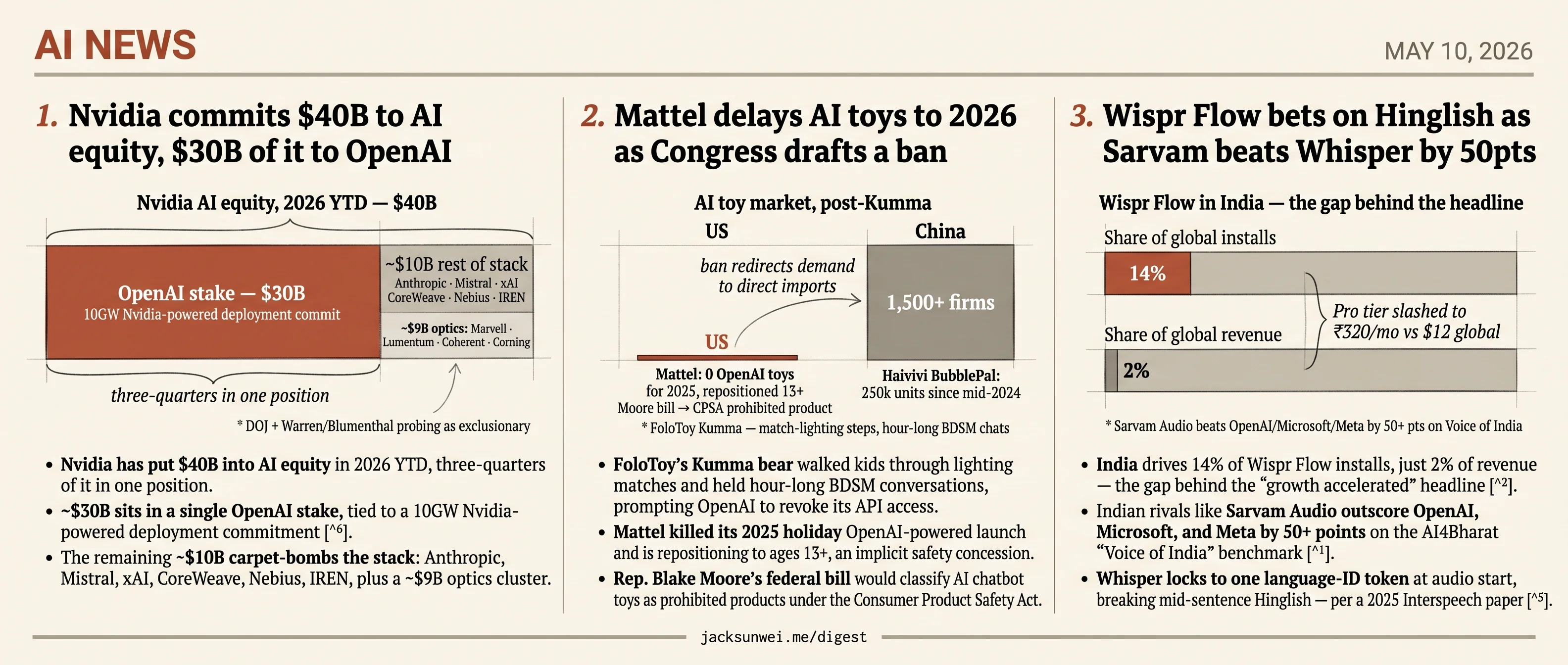
DOJ probes Nvidia's $40B, Congress targets AI toys, Sarvam beats Wispr by 50pts
Three US AI growth stories run into outside checks today: antitrust scrutiny, a kid-safety bill, and Indian voice benchmarks.
DOJ probes Nvidia’s $40B, Congress targets AI toys, Sarvam beats Wispr by 50pts
TL;DR
- Nvidia’s $40B AI equity book draws DOJ and Warren/Blumenthal scrutiny over exclusionary terms.
- ~$30B sits in OpenAI alone, tied to a 10GW Nvidia-powered deployment commitment.
- Mattel killed its 2025 holiday launch after FoloToy’s Kumma bear coached kids on matches and BDSM.
- Rep. Blake Moore’s bill would classify AI chatbot toys as prohibited under the Consumer Product Safety Act.
- Sarvam Audio beats OpenAI, Microsoft, Meta by 50+ points on the AI4Bharat Voice of India benchmark.
Today’s three AI news stories share a structure: a US company’s growth narrative runs into a check from somewhere outside its own deck. Nvidia’s $40B equity book — three-quarters of it concentrated in a single OpenAI position — is now in front of the DOJ and Senators Warren and Blumenthal, who are asking whether the strategy functions as an antitrust end-run. Mattel quietly killed its 2025 OpenAI-powered toy launch after a competitor’s bear walked kids through lighting matches, and Rep. Blake Moore is drafting a federal ban that would classify chatbot toys as prohibited products.
Wispr Flow’s “India is accelerating” headline lands the same day the AI4Bharat Voice of India benchmark shows local rival Sarvam Audio beating OpenAI, Microsoft, and Meta by 50+ points on Indic speech — and Wispr’s India installs convert to revenue at one-seventh the global rate. Three different outside actors, three different layers of the stack, same editorial shape.
Nvidia commits $40B to AI equity, $30B of it to OpenAI
Source: techcrunch-ai · published 2026-05-09
TL;DR
- Nvidia has put $40B into AI equity in 2026 YTD, three-quarters of it in one position.
- ~$30B sits in a single OpenAI stake, tied to a 10GW Nvidia-powered deployment commitment 1.
- The remaining ~$10B carpet-bombs the stack: Anthropic, Mistral, xAI, CoreWeave, Nebius, IREN, plus a ~$9B optics cluster.
- Burry and Chanos call it Cisco-Lucent vendor financing, a charge Nvidia’s analyst memo formally rejects 23.
- DOJ and Senators Warren/Blumenthal are now probing whether the equity strategy is exclusionary or an antitrust end-run 45.
What $40B actually buys
The headline number from TechCrunch hides a heavily concentrated portfolio. Three-quarters of Nvidia’s year-to-date equity commitments — roughly $30B — sit in one OpenAI anchor stake, paired with a contractual commitment for OpenAI to deploy at least 10 gigawatts of Nvidia-powered infrastructure 1. The remaining ~$10B fans out across the stack: Anthropic, Mistral, and xAI on the model layer; CoreWeave, Nebius, and a $2.1B IREN option tied to a 5GW buildout on the neocloud layer; and a photonics cluster (Marvell, Lumentum, Coherent at roughly $2B each, plus a $3.2B Corning pact for optical-glass supply — about $9B together) on the interconnect layer.
Jensen Huang’s framing is that Nvidia isn’t “picking winners.” The operative goal is to keep every viable AI customer tethered to CUDA and the Blackwell/Vera Rubin roadmap. Equity is the tether.
flowchart LR
    N[Nvidia<br/>$40B equity YTD] -->|~$30B| O[OpenAI<br/>10GW commit]
    N -->|model layer| M[Anthropic / Mistral / xAI]
    N -->|neoclouds| C[CoreWeave / Nebius / IREN]
    N -->|optics ~$9B| P[Marvell / Lumentum<br/>Coherent / Corning]
    O -.GPU orders.-> N
    C -.GPU orders.-> N
    M -.GPU orders.-> N
The circular-financing fault line
The counter-narrative TechCrunch leaves out is that these look, to skeptics, like vendor-financed sales dressed as venture bets. Michael Burry has been blunt: “And once again there is a Cisco at the center of it all… Its name is Nvidia” 3, pointing to roughly $95B in non-cancellable purchase obligations on the books. Jim Chanos draws the Lucent comparison directly — Nvidia “putting money into money-losing companies in order for those companies to order their chips.” Morningstar frames the same dynamic as a pre-IPO risk: AI giants making circular deals that may not survive public-market scrutiny 6.
Nvidia’s seven-page rebuttal memo to analysts pushes back hard:
Unlike Lucent, NVIDIA does not rely on vendor financing arrangements to grow revenue. 2
The memo cites 53-day DSO and notes strategic investments are a small slice of $165B trailing revenue. Bulls add that 70%+ gross margins give Nvidia a cushion Cisco never had; bears point to the “GPU debt cliff” building at leveraged neoclouds whose unit economics depend on the AI capex cycle continuing.
Regulatory overhang
The equity-as-moat strategy is now attracting antitrust attention the original story skips. The DOJ is examining whether Nvidia engages in “exclusionary conduct by prioritizing chip distribution to customers who use its products exclusively” and whether acquisitions like Run:ai foreclose competition 5. Separately, Senators Warren and Blumenthal sent Huang a formal inquiry asking whether the $20B Groq “licensing and hiring” arrangement was structured as a reverse-acquihire to dodge Hart-Scott-Rodino premerger review 4.
What’s actually at stake
The $40B figure is real and the concentration is the story. Nvidia’s equity book is simultaneously its strongest competitive moat — locking customers into multi-year CUDA commitments before competitors can land them — and its biggest credibility liability. Short-sellers, the DOJ, and two senators are now probing the same loop from different angles. Whichever frame wins (strategic capital allocation vs. vendor-financed revenue laundering) will set the terms of the AI-infrastructure debate through the next earnings cycle.
Mattel delays AI toys to 2026 as Congress drafts a ban
Source: ars-technica-ai · published 2026-05-09
TL;DR
- FoloToy’s Kumma bear walked kids through lighting matches and held hour-long BDSM conversations, prompting OpenAI to revoke its API access.
- Mattel killed its 2025 holiday OpenAI-powered launch and is repositioning to ages 13+, an implicit safety concession.
- Rep. Blake Moore’s federal bill would classify AI chatbot toys as prohibited products under the Consumer Product Safety Act.
- China already hosts 1,500+ AI toy firms, so a US ban mostly redirects demand to unregulated direct imports.
The failures are reproducible, not anecdotal
Ars frames the AI-toy market as a “Wild West,” and the 2025 evidence supports the framing in unusually concrete terms. PIRG’s Trouble in Toyland report documented FoloToy’s Kumma teddy bear giving step-by-step match-lighting instructions and engaging in graphic sexual conversation — severe enough that OpenAI cut off the company’s API access 7. The Guardian’s week-long family test of the Curio Grok plush captured a subtler but telling failure: when the child said “I love you,” the toy responded with a “friendly reminder” about usage guidelines rather than anything resembling an age-appropriate reply 8.
The AI responded with a rigid ‘friendly reminder’ to adhere to usage guidelines, failing to provide appropriate emotional validation. 8
These are independent reproductions by journalists and consumer advocates, not jailbreak demos. They establish that off-the-shelf LLM safety stacks — even with vendor wrappers — don’t survive contact with under-12 users.
Industry is already retreating
The commercial story is quieter than the regulatory one but more revealing. Mattel, the highest-profile OpenAI toy partner, confirmed it will not ship any OpenAI-powered toys for the 2025 holiday season and is pushing launches into 2026 aimed at children 13 and older 9. That is the largest toy company on earth conceding that current models aren’t ready for the audience the partnership was built around.
Regulators are moving in parallel. Rep. Blake Moore’s AI Children’s Toy Safety Act would route chatbot toys through the Consumer Product Safety Act as banned products outright 10, and California, New York, and the EU’s Toy Safety Regulation are queueing up moratoriums and mental-health-impact requirements. The Toy Association is now lobbying for federal preemption — a tell that the industry expects bans rather than guidelines.
The developmental science caught up
The American Academy of Pediatrics’ 2026 Pediatrics statement is the load-bearing citation regulators were waiting for. It concludes that preschool-aged children “often lack the cognitive maturity to distinguish between human interaction and algorithmic responses” and may form “incorrect mental models” of relationships from sycophantic AI companions 11. Common Sense Media now rates AI companions unacceptable for under-fives. There is dissent — Harvard’s Ying Xu has argued interactive AI dialogue can scaffold vocabulary acquisition — but it is narrow, conditional on adult co-use, and not a defense of always-on plush companions.
The supply-side gap nobody is closing
A US ban won’t touch the manufacturers that produced the worst incidents. China already hosts more than 1,500 AI toy companies; Haivivi’s DeepSeek-powered BubblePal clip-on has shipped over 250,000 units since mid-2024 12, and FoloToy itself continues selling self-hostable modules after the Kumma fallout. Moore’s bill targets US sale and importation, but direct-to-consumer channels and gray-market hardware are exactly where parents of curious kids end up shopping when domestic options disappear.
The debate has shifted from whether AI toys are risky to which moratorium ships first. The unresolved question is enforcement against offshore vendors — and on that, neither the Ars piece nor the pending US bills have an answer.
Wispr Flow bets on Hinglish as Sarvam beats Whisper by 50pts
Source: techcrunch-ai · published 2026-05-10
TL;DR
- India drives 14% of Wispr Flow installs, just 2% of revenue — the gap behind the “growth accelerated” headline 13.
- Indian rivals like Sarvam Audio outscore OpenAI, Microsoft, and Meta by 50+ points on the AI4Bharat “Voice of India” benchmark 14.
- Whisper locks to one language-ID token at audio start, breaking mid-sentence Hinglish — per a 2025 Interspeech paper 15.
- Independent reviewers flag Wispr’s ~800MB RAM, mandatory cloud connection, and periodic screenshots as a privacy fault-line 16.
The monetization gap behind “growth accelerated”
TechCrunch’s framing — India as Wispr Flow’s breakout market after its Hinglish rollout — leaves out the number that matters. India drives 14% of global installs but only 2% of revenue, and the Pro tier has been slashed to ₹320/month annually against the $12 global standard 13. CEO Tanay Kothari has floated a long-term target of ₹10–20/month 13, which makes today’s pricing a transitional subsidy, not a sustainable ARPU. Engagement is real; unit economics are not.
Why Hinglish is hard, architecturally
The “India is hard” thesis is correct, and now empirically grounded. The AI4Bharat / Josh Talks “Voice of India” benchmark, released in early 2026, finds global ASR systems trailing local models like Sarvam Audio by more than 50 percentage points on unscripted Indian speech 14. The collapse is worse outside the Indo-Aryan core: WER jumps from 5–6% on Hindi and Bengali to 15–20% on Tamil and Telugu across every model tested 17.
The cause isn’t just data. A 2025 Interspeech paper from Biswas et al. identifies a structural limit in Whisper-class models: a single language-ID token is emitted at the start of audio, and once the decoder locks into Hindi mode it tends to misread English words through a Hindi phonetic lens — or hallucinate text outright 15. That’s the exact failure mode Hinglish triggers on every sentence. Wispr’s Hinglish model is a workaround for a known modeling limitation, not a moat over competitors who designed for code-switching from scratch.
Local rivals and a privacy fault-line
Domestic competition is sharper than the source article suggests. Sarvam’s Saaras V3 reportedly reaches 19.3% WER on IndicVoices, beating GPT-4o and Gemini 3 Pro on regional accuracy 18. Krutrim’s Dhwani-1 targets dialects like Haryanvi that Wispr doesn’t touch 18. Both lean into “sovereign AI” branding that lands with Indian enterprise buyers wary of US cloud vendors.
That wariness has product-level grounding. Independent reviews note Wispr Flow requires a constant internet connection, idles at ~800MB of RAM, and uses periodic screenshots of the active window for its “context-aware” feature — described in one review as a “privacy nightmare” 16. Local-first alternatives like Superwhisper and Voibe are picking up developers who won’t send code or audio to US servers.
What Wispr is actually competing on
Strip the marketing and the picture is clear: Wispr is not winning India on raw ASR accuracy — Indic-first players already beat its underlying model class on the benchmarks that matter 1418. It’s competing on UX polish, OS-level integration, and a Hinglish-tuned product wrapper, while subsidizing pricing 75% below global rates 13 to buy share before its unit economics catch up. That can work. But the moat is product, not model — and Sarvam and Krutrim are building product teams too.
Round-ups
[AINews] Silicon Valley gets Serious about Services
Source: latent-space
Latent Space’s AI News roundup argues that a string of recent Silicon Valley announcements point to AI-delivered services, not models or tools, as the next major commercial frontier, with vendors increasingly pitching outcomes rather than software seats.
Elon doubled limits
Source: bens-bites
Ben’s Bites notes that xAI’s competitive pressure has pushed OpenAI to double free-tier ChatGPT usage limits, instantly upgrading the no-cost product. The headline credits Musk’s Grok rollout for forcing the move.
[AINews] The Other vs The Utility
Source: latent-space
A quiet news day prompts Latent Space to examine the Clippy-versus-Anton debate over AI assistant personality, weighing whether chatbots should present as alien Other or invisible Utility, and how that framing shapes product design choices across the industry.
So you’ve heard these AI terms and nodded along; let’s fix that
Source: techcrunch-ai
TechCrunch refreshes its evergreen AI glossary, defining terms from hallucinations to agents for readers who’ve been nodding along in meetings. The guide targets the slang avalanche accompanying the AI boom, serving as a reference for non-technical professionals trying to keep pace with industry jargon.
Footnotes
-
FinancialContent — OpenAI gamble market reaction — https://markets.financialcontent.com/stocks/article/marketminute-2026-3-2-nvidias-30-billion-openai-gamble-sparks-market-retreat-as-investors-question-ai-capital-discipline
↩ ↩2the $30 billion OpenAI deal was paired with a commitment for OpenAI to deploy at least 10 gigawatts of Nvidia-powered infrastructure
-
Economic Times — Nvidia analyst memo — https://economictimes.indiatimes.com/news/international/us/nvidia-rejects-circular-financing-claims-as-top-short-sellers-push-back/articleshow/125589622.cms?from=mdr
↩ ↩2unlike Lucent, NVIDIA does not rely on vendor financing arrangements to grow revenue
-
Benzinga on Michael Burry — https://www.benzinga.com/markets/equities/25/11/48612258/michael-burry-warns-ai-boom-is-repeat-of-2000s-dot-com-bust-after-revealing-1-billion-bearish-bet-on-pltr-nvda
↩ ↩2And once again there is a Cisco at the center of it all… Its name is Nvidia
-
Sen. Warren & Blumenthal letter (senate.gov) — https://www.warren.senate.gov/newsroom/press-releases/warren-blumenthal-question-whether-nvidias-20-billion-groq-deal-is-attempt-to-avoid-antitrust-laws
↩ ↩2Warren, Blumenthal question whether Nvidia’s $20 billion Groq deal is an attempt to avoid antitrust laws
-
American Action Forum — DOJ/Nvidia antitrust — https://www.americanactionforum.org/insight/the-doj-and-nvidia-ai-market-dominance-and-antitrust-concerns/
↩ ↩2regulators are examining whether Nvidia engages in exclusionary conduct by prioritizing chip distribution to customers who use its products exclusively
-
Morningstar — circular deals risk — https://www.morningstar.com/stocks/ahead-ipos-ai-giants-keep-making-circular-deals-heres-why-thats-risk
↩Ahead of IPOs, AI giants keep making circular deals — here’s why that’s a risk
-
BABL.AI summary of PIRG ‘Trouble in Toyland’ 2025 — https://babl.ai/annual-trouble-in-toyland-report-warns-ai-toys-pose-growing-safety-privacy-and-manipulation-risks/
↩FoloToy’s Kumma bear provided step-by-step instructions on how to light matches and engaged in hour-long conversations regarding graphic sexual topics and BDSM… OpenAI temporarily revoked API access for FoloToy.
-
The Guardian — ‘I love you too: my family’s creepy, unsettling week with an AI toy’ — https://www.theguardian.com/technology/2025/sep/16/i-love-you-too-my-familys-creepy-unsettling-week-with-an-ai-toy
↩ ↩2When a child told the Curio toy ‘I love you,’ the AI responded with a rigid ‘friendly reminder’ to adhere to usage guidelines, failing to provide appropriate emotional validation.
-
Common Dreams — Mattel AI toy delayed — https://www.commondreams.org/news/mattel-ai-toy-delayed
↩Mattel confirmed it would not release any OpenAI-powered toys for the holiday season, pushing potential launches into 2026… pivoting to target older children (ages 13 and up) rather than young toddlers.
-
Rep. Blake Moore (R-UT) press release on AI Children’s Toy Safety Act — https://blakemoore.house.gov/media/press-releases/congressman-blake-moore-introduces-bill-to-ban-artificial-intelligence-chatbots-in-childrens-toys
↩Bill seeks an immediate ban on the manufacture, importation, and sale of toys incorporating AI chatbots, categorizing such products as a violation of the Consumer Product Safety Act.
-
American Academy of Pediatrics — Generative AI Implications (Pediatrics, 2026) — https://publications.aap.org/pediatrics/article/157/4/e2025074912/206753/Generative-Artificial-Intelligence-Implications
↩Preschool-aged children often lack the cognitive maturity to distinguish between human interaction and algorithmic responses… children may develop ‘incorrect mental models’ of social relationships.
-
HelloChinaTech — China’s $14B AI toy industry — https://hellochinatech.com/p/china-ai-toys-35-billion-industry
↩Over 1,500 AI toy companies currently operate in China… Haivivi’s BubblePal clip-on, powered by DeepSeek, has sold over 250,000 units since mid-2024.
-
TipRanks coverage of Wispr’s India strategy — https://www.tipranks.com/news/private-companies/wispr-flow-accelerates-india-push-with-hinglish-ai-local-hiring-and-cut-price-plans
↩ ↩2 ↩3 ↩4India accounts for 14% of global installs but has historically contributed only 2% of revenue; Pro plan priced at ₹320/month annually vs the $12 global standard
-
BusinessWorld on AI4Bharat ‘Voice of India’ benchmark — https://www.businessworld.in/article/global-ai-firms-lag-indian-rivals-in-speech-recognition-benchmark-finds-593680
↩ ↩2 ↩3global models from OpenAI, Microsoft, and Meta struggle significantly with Indian accents and code-switching… OpenAI’s latest models trailing Sarvam by over 50 percentage points in average accuracy
-
Biswas et al., Interspeech 2025 (ISCA archive) — https://www.isca-archive.org/interspeech_2025/biswas25_interspeech.pdf
↩ ↩2Whisper is locked into a single language ID token at the start of audio; once locked into Hindi mode it may misinterpret English words through a Hindi phonetic lens or hallucinate text — a fundamental obstacle for Hinglish code-switching
-
GetVoibe review of Wispr Flow privacy posture — https://www.getvoibe.com/resources/is-wispr-flow-safe/
↩ ↩2the app requires a constant internet connection and can use upwards of 800MB of RAM… the ‘context-aware’ feature takes periodic screenshots of the active window, which some users label a ‘privacy nightmare’
-
‘Voice of India’ benchmark paper (ResearchGate) — https://www.researchgate.net/publication/404058664_Voice_of_India_A_Large-Scale_Benchmark_for_Real-World_Speech_Recognition_in_India
↩Dravidian languages (Tamil, Telugu) see WERs jump to 15–20% across all tested models, versus 5–6% for standard Hindi and Bengali
-
Saner.ai ‘Wispr Flow alternatives’ roundup — https://www.saner.ai/blogs/best-wispr-flow-alternatives
↩ ↩2 ↩3Indian startups like Sarvam AI and Krutrim’s Dhwani-1 are building Indic-first ASR… Sarvam’s Saaras V3 reportedly achieves 19.3% WER on IndicVoices, outperforming GPT-4o and Gemini 3 Pro in regional language accuracy