Anthropic pays $570K, Google adds AI Overview citations, GPT-Realtime-2 at 1.12s
Today's three AI moves each push cost outward: Anthropic poaches at $570K, Google papers over publisher losses, OpenAI voice misses spec.
Anthropic pays $570K, Google adds AI Overview citations, GPT-Realtime-2 at 1.12s
TL;DR
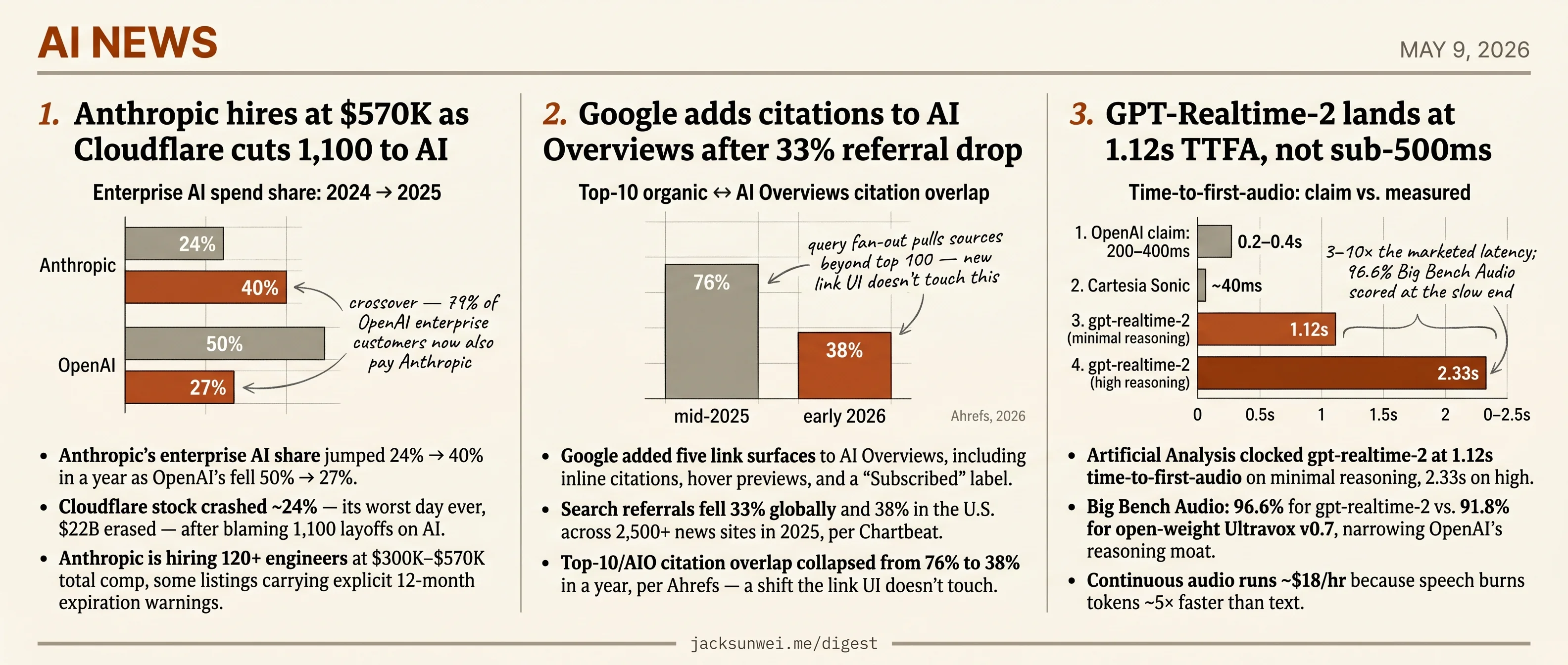
- Anthropic is hiring 120+ engineers at $300K–$570K total comp, some listings carrying 12-month expiration warnings.
- Cloudflare stock crashed ~24% in its worst day ever, erasing $22B after blaming 1,100 layoffs on AI.
- Google added five citation surfaces to AI Overviews after publisher referrals fell 33% globally in 2025.
- Anthropic enterprise share rose 24%→40% as OpenAI’s fell 50%→27% over the past year.
- GPT-Realtime-2 clocks 1.12s time-to-first-audio, well short of sub-500ms voice targets.
Three AI stories land today, and each one routes the cost of an AI player’s move onto a different outside group. Anthropic is hiring 120+ engineers at up to $570K total comp while Cloudflare blames 1,100 layoffs on AI and loses $22B of market cap in a single session — the labor market is paying. Google rolled out five new citation surfaces in AI Overviews, a UI fix arriving after publisher referrals already fell 33% globally and the top-10/AI Overview citation overlap collapsed from 76% to 38% — publishers are paying. And OpenAI’s gpt-realtime-2 hits 1.12s time-to-first-audio against a sub-500ms target, with EU Article 5(1)(f) leaving deployers on the hook for emotion-inference compliance — voice deployers are paying.
The brief pile reinforces the labor thread: Oracle refused severance negotiations after misclassifying laid-off staff to dodge WARN Act notice, and the Musk v. Altman trial entered week two with fresh testimony that Musk himself tried to poach Sam Altman.
Anthropic hires at $570K as Cloudflare cuts 1,100 to AI
Source: latent-space · published 2026-05-09
TL;DR
- Anthropic’s enterprise AI share jumped 24% → 40% in a year as OpenAI’s fell 50% → 27%.
- Cloudflare stock crashed ~24% — its worst day ever, $22B erased — after blaming 1,100 layoffs on AI.
- Anthropic is hiring 120+ engineers at $300K–$570K total comp, some listings carrying explicit 12-month expiration warnings.
- 95% of AI-investing firms saw zero ROI in a 2026 MIT study, undercutting the productivity narrative.
A dichotomy with a real winner and a suspicious loser
The week’s labor story writes itself: Anthropic is reportedly growing 10x year-over-year while Cloudflare cuts 1,100 jobs and credits the agents. But the cleaner read is that only one half of that dichotomy survives scrutiny.
The Anthropic side is concrete. Menlo Ventures’ enterprise spend data shows Claude’s share of new enterprise AI spend climbing from 24% to 40% in a year, while OpenAI’s collapsed from 50% to 27%; 79% of OpenAI’s enterprise customers now also pay Anthropic 1. That’s the demand-side evidence behind the “10x” claim — multi-sourcing, not displacement of one lab by another, with Anthropic capturing the marginal dollar.
The Cloudflare side is where the story falls apart.
Markets and engineers called the bluff in the same week
Wall Street did not reward the AI-first framing. Cloudflare’s stock fell roughly 24% in a single session — its worst day ever, around $22B in market cap — even as Q1 revenue rose 34% and the company raised full-year guidance 2. Investors apparently read “AI made these jobs obsolete” as a tell about demand or execution, not a productivity flex.
Engineers were less polite. HN threads zeroed in on a Cloudflare-published “production-grade” Matrix-on-Workers demo whose public repo carried hallucinated code, misaligned ASCII diagrams, and TODO stubs where authentication should have been — exhibit A that the company’s claimed “600% AI usage surge” is shipping slop rather than 100x output 3.
A 2026 MIT study found 95% of firms investing in AI saw zero ROI; skeptics cite a roughly 30:1 ratio between announced AI-driven layoffs and confirmed automation-caused ones 4.
Ed Zitron and Brian Merchant have been arguing for a year that the layoff wave is Wall-Street-facing fiction covering ZIRP-era overhiring. The Cloudflare reaction is the first time the market visibly agreed.
The hiring paradox inside the “winner”
The cleanest evidence that the labor story is messier than “AI replaces humans” comes from inside Anthropic itself. The lab whose CEO predicts AI will handle 100% of coding by 2027 is running 120+ open software engineering roles at $300K–$570K total comp, with some listings carrying explicit “12-month expiration” warnings 5. The frontier lab most aggressively automating coding is also the most aggressive buyer of coders.
The displacement that is visible isn’t at Cloudflare or Anthropic — it’s at the entry level. Yale finds recent-graduate unemployment near 6%, rising twice as fast as the broader workforce, with a 16% drop in early-career employment for high-AI-exposure roles 6. Juniors are the actual cohort being squeezed; senior engineers at the frontier are getting paid more than ever.
What’s actually happening
Strip the narrative and two things are true at once. Anthropic’s revenue trajectory is real and independently verifiable 1. Cloudflare’s “AI made them obsolete” pitch is a story the market and its own engineers don’t believe 234. The dichotomy in the headline is real; the causation behind half of it is mostly press release.
Further reading
Google adds citations to AI Overviews after 33% referral drop
Source: ars-technica-ai · published 2026-05-08
TL;DR
- Google added five link surfaces to AI Overviews, including inline citations, hover previews, and a “Subscribed” label.
- Search referrals fell 33% globally and 38% in the U.S. across 2,500+ news sites in 2025, per Chartbeat.
- Top-10/AIO citation overlap collapsed from 76% to 38% in a year, per Ahrefs — a shift the link UI doesn’t touch.
- Google properties already eat ~20% of AI Mode citations, over 50% in travel and entertainment.
What shipped
The May 2026 update bundles five outbound-link features into AI Overviews: inline citations next to specific claims, a “Further Exploration” panel, desktop hover previews with publisher and page title, a “first-hand perspectives” section sourcing Reddit and personal blogs, and a “Subscribed” label that highlights sources from outlets a reader already pays for 7. The subscription perk only fires when users connect their paid accounts via Google’s Reader Revenue Manager / Subscribe with Google plumbing, so initial reach is limited to publishers already on those rails 7. Google’s headline efficacy claim is a hedge — readers are “significantly more likely” to click labeled links — with no baseline disclosed.
The numbers Google isn’t quoting
Independent data reframes this as damage control rather than generosity. Chartbeat tracking across more than 2,500 news sites shows search referrals down 33% globally in 2025 and 38% for U.S. publishers 8. More damaging to the SEO compact itself: Ahrefs found the overlap between top-10 organic results and AI Overviews citations dropped from 76% in mid-2025 to 38% by early 2026, as Google’s “query fan-out” retrieves sources from beyond the top 100 results 9. The new link-prominence UI does nothing about that. A publisher who ranks #3 today has roughly even odds of being cited at all, and “Subscribed” badges don’t change which URLs the model decided to fetch in the first place.
Where the citations actually go
An SE Ranking study found Google-owned properties — Google.com and YouTube — now account for nearly 20% of AI Mode citations, exceeding 50% in travel and entertainment niches, with many of those “citations” looping readers back into another Google search panel rather than out to a publisher 10. The new link surfaces sit on top of that retrieval mix. More links, yes; a growing share of them point inward.
The dissent the update doesn’t address
The European Publishers Council filed a formal antitrust complaint with the European Commission, alleging AIO cannibalizes publisher content while leaving no meaningful opt-out short of disappearing from general search entirely 11. In the U.S., Penske Media — parent of Rolling Stone, Variety, and WWD — sued, alleging Google “coerced” publishers into feeding its AI models as a condition of appearing in search 12. Both actions predate the May rollout and target the structural arrangement, not the citation chrome. Neither publisher group has signaled the link changes shift their position.
Net read
This is a UX patch — better citation placement plus a subscription perk for the publishers already wired into Google’s payment stack — layered over a retrieval architecture that has already decoupled ranking from citation and tilted the citation pool toward Google’s own surfaces. Treating “more links” as a course correction misses that the loudest beneficiary of those links may be Google itself.
GPT-Realtime-2 lands at 1.12s TTFA, not sub-500ms
Source: latent-space · published 2026-05-08
TL;DR
- Artificial Analysis clocked gpt-realtime-2 at 1.12s time-to-first-audio on minimal reasoning, 2.33s on high.
- Big Bench Audio: 96.6% for gpt-realtime-2 vs. 91.8% for open-weight Ultravox v0.7, narrowing OpenAI’s reasoning moat.
- Continuous audio runs ~$18/hr because speech burns tokens ~5× faster than text.
- EU AI Act Article 5(1)(f) bans workplace/school emotion inference, leaving deployers legally on the hook.
The latency claim doesn’t survive instrumentation
Latent Space’s writeup repeats OpenAI’s framing: 200–400ms response times, “near the human threshold,” a 50% round-trip reduction. Instrumented testing tells a different story. Artificial Analysis measured time-to-first-audio at 1.12 seconds at minimal reasoning, rising to 2.33 seconds at high reasoning — and the 96.6% Big Bench Audio score that anchors most of the coverage was achieved at the slow end of that range 13. T-Mobile’s IntentCX deployment leans on “preamble” filler speech to mask the gap, which is a tell: if the model were genuinely sub-500ms, you wouldn’t need to play “let me check that for you” while it thinks.
The sub-second framing holds for short, low-reasoning turns. It does not hold for the agentic workloads OpenAI is positioning the API for.
Cheaper, faster specialists still own pieces of the stack
The “new SOTA” framing also flattens a market where the Pareto frontier is more crowded than OpenAI’s launch suggests.
| Model | TTFA | Big Bench Audio | Notes |
|---|---|---|---|
| gpt-realtime-2 | 1.12s (min) / 2.33s (high) 13 | 96.6% 13 | Preset voices only |
| Cartesia Sonic | ~40ms 14 | — | Speed leader |
| Kyutai Moshi (open) | ~200ms practical, 160ms floor 15 | — | Native-audio pioneer |
| Ultravox v0.7 (open) | — | 91.8% 15 | Open-weight reasoning |
| Deepgram | — | — | ~40% cheaper at scale, on-prem/HIPAA 14 |
Cost compounds the picture. Developers on the gpt-realtime-2 API report bills exceeding $18/hour for continuous sessions, because natural speech consumes tokens at roughly 5× the rate of text — and the dual metering (per-token for Realtime-2, per-minute for Translate and Whisper) has produced billing anomalies in production 16. ElevenLabs still leads on prosody, and gpt-realtime-2’s safety-driven preset-voice restriction is a real limitation for brand-driven deployments.
Regulatory and licensing friction is already here
The article’s enthusiasm for emotion-aware voice collides with EU AI Act Article 5(1)(f), which strictly prohibits AI inference of emotions in workplace and educational settings. OpenAI’s compliance documentation acknowledges the ban and explicitly tells developers that deployers carry the legal exposure 17 — a meaningful gotcha for any HR, edtech, or contact-center pilot in the EU.
The flagship enterprise rollout is already attracting heat from a different direction. Zillow’s GPT integration, cited in launch materials as a quality win, is drawing industry criticism that surfacing MLS listing data inside ChatGPT may violate IDX licensing terms because the data is effectively republished on a non-broker domain 18. That’s not a model problem — it’s a distribution-layer problem the “voice engine era” framing doesn’t address.
What’s actually true
gpt-realtime-2 is a real reasoning-quality jump for voice; 96.6% on Big Bench Audio is not marketing fluff. But the latency story is overstated by roughly 3–10×, the cost story is omitted entirely, open-weight competitors are within striking distance on intelligence and ahead on speed, and the first marquee deployments are already running into regulatory and licensing walls. “Voice Engine era” is a marketing frame; the engineering reality is a more competitive, more expensive, and more legally fraught market than the announcement suggests.
Round-ups
Musk v. Altman trial week 2 — OpenAI counter-punches and the Murati/Microsoft fallout
Source: mit-tech-review-ai
Week two of the Musk v. Altman trial saw OpenAI counter Musk’s claim that Altman and Brockman tricked him out of $38 million, with Shivon Zilis testifying Musk had tried to poach Altman, alongside revelations of Microsoft’s anxiety that OpenAI would defect to Amazon.
Further reading:
- Microsoft was worried OpenAI would run off to Amazon and ‘shit-talk’ Azure — the-verge-ai
- Everybody wants to rule the AI world — the-verge-ai
Laid-off Oracle workers tried to negotiate better severance. Oracle said no.
Source: techcrunch-ai
Oracle refused to negotiate with laid-off staff seeking improved severance, and some workers discovered they were ineligible for WARN Act protections like 60-day notice because Oracle had classified them as remote employees.
Intel’s comeback story is even wilder than it seems
Source: techcrunch-ai
Intel shares are up 490% over the past year on Wall Street’s bet on CEO Lip-Bu Tan’s turnaround, but the rally appears to be running well ahead of the chipmaker’s actual operational recovery.
Sony PlayStation positions generative AI as a ‘powerful tool’ in earnings call
Source: the-verge-ai
Sony used its Friday earnings presentation to frame generative AI as a ‘powerful tool’ for PlayStation game development, with executives suggesting more efficient AI pipelines will accelerate output across the industry even as many indie studios continue to reject the technology.
Further reading:
Google unveils screenless Fitbit Air and Google Health app to replace Fitbit
Source: ars-technica-ai
Google is retiring the Fitbit app in favor of a new Google Health app and launching the $100 screenless Fitbit Air, a stripped-down tracker available for preorder today that leans on AI-driven health insights rather than an on-device display.
See what happens when creative legends use AI to make ads for small businesses.
Source: google-ai-blog
Google’s ‘Small Brief’ initiative pairs ad-industry veterans Susan Credle, Jayanta Jenkins, and Tiffany Rolfe with small businesses to produce ad campaigns built using Google’s generative AI tools.
Nanoleaf bets its future on robots, red light therapy, and AI
Source: the-verge-ai
Nanoleaf is breaking a two-year product lull by expanding beyond smart lighting into home robotics, red light therapy wellness devices, and AI-driven features, ceding pace to rivals Govee and Philips Hue while it retools.
Footnotes
-
MLQ.ai (Menlo Ventures data) — https://mlq.ai/news/anthropic-captures-majority-share-of-new-enterprise-ai-spending/
↩ ↩2Anthropic’s enterprise market share rose from 24% in 2024 to 40% in 2025, while OpenAI’s share fell from 50% to 27%; 79% of OpenAI enterprise customers now also pay Anthropic.
-
The Stack — https://www.thestack.technology/cloudflare-cuts-jobs-cites-ai/
↩ ↩2Cloudflare’s stock plunged ~24% in a single day — its worst ever — erasing roughly $22 billion in market value, even as Q1 revenue rose 34% YoY and the company raised full-year guidance.
-
Business Insider / HN reaction — https://www.businessinsider.com/cloudflare-announces-1100-layoffs-amid-ai-focus-shift-2026-5
↩ ↩2HN commenters derided Cloudflare’s ‘vibe coding’ framing, citing a public ‘matrix-workers’ repo full of hallucinations, misaligned ASCII diagrams and TODO stubs for authentication as evidence the AI-first claim was ‘slop’ rather than real productivity.
-
Programs.com / Ed Zitron & Brian Merchant analysis — https://programs.com/resources/ai-layoffs/
↩ ↩2A 2026 MIT study found 95% of firms investing in AI saw zero ROI; critics including Zitron point to a 30:1 ratio between announced AI layoffs and confirmed ones, calling the displacement story ‘AI-washing’ to appease Wall Street.
-
Medium / Kanishk S. — https://medium.com/@kanishks772/anthropic-says-engineers-wont-exist-in-a-year-it-s-also-paying-them-570k-today-5ee2a673f1ef
↩Anthropic is actively hiring for over 120 software engineering roles at $300K–$570K total comp, even as Dario Amodei predicts AI will handle 100% of coding by 2027 — some listings carry an explicit ‘12-month expiration’ warning.
-
Yale SOM Insights — https://insights.som.yale.edu/insights/the-real-job-destruction-from-ai-is-hitting-before-careers-can-start
↩Unemployment among recent college graduates has climbed to nearly 6%, rising twice as fast as the broader workforce, with a 16% decline in early-career employment for high-AI-exposure roles.
-
Nieman Lab — https://www.niemanlab.org/2026/05/google-highlights-links-from-subscribed-publications-in-new-ai-overviews-update/
↩ ↩2For the ‘Subscribed’ label to appear, users must link their paid publisher accounts to Google via Subscription Linking; Google says early testing showed users were ‘significantly more likely’ to click these labeled results.
-
Press Gazette — https://pressgazette.co.uk/media-audience-and-business-data/google-traffic-down-2025-trends-report-2026/
↩Search referrals declined by 33% globally in 2025, with U.S. publishers experiencing a sharper 38% drop, according to Chartbeat data tracking over 2,500 news sites.
-
Search Engine Land (Ahrefs ranking-citation gap) — https://searchengineland.com/why-content-doesnt-appear-in-ai-overviews-473325
↩The overlap between top-10 organic results and AI Overviews citations dropped from 76% in mid-2025 to just 38% in early 2026, as Google’s ‘query fan-out’ pulls sources from outside the top 100 results.
-
Search Engine Land (SE Ranking study) — https://searchengineland.com/google-ai-mode-citing-google-more-study-471042
↩Google properties — Google.com and YouTube — now account for nearly 20% of all citations in AI Mode, exceeding 50% in travel and entertainment niches, with many citations leading users back to a new Google search panel rather than an external publisher.
-
European Publishers Council — https://www.epceurope.eu/post/european-publishers-council-files-formal-antitrust-complaint-against-google-over-ai-overviews-and-ai
↩EPC filed a formal antitrust complaint with the European Commission alleging AI Overviews cannibalize publisher content while leaving no meaningful opt-out short of disappearing from search entirely.
-
Mashable (Penske v. Google) — https://mashable.com/article/penske-media-rolling-stone-variety-lawsuit-google-ai-overviews
↩Penske Media Corporation — parent of Rolling Stone and Variety — alleges Google ‘coerced’ publishers into feeding its AI models as a condition for appearing in search results.
-
i-scoop.eu — GPT-Realtime-2 benchmark analysis — https://www.i-scoop.eu/gpt-realtime-2-by-openai-brings-stronger-reasoning-to-voice-agents/
↩ ↩2 ↩3Artificial Analysis verified a 96.6% score on Big Bench Audio… average time-to-first-audio (TTFA) of 1.12 seconds at ‘minimal’ reasoning settings, which rises to 2.33 seconds at ‘high’ reasoning
-
Deepgram benchmark comparison — https://deepgram.com/learn/deepgram-vs-openai-vs-google-stt-accuracy-latency-price-compared
↩ ↩2Cartesia’s Sonic model remains the industry leader for raw speed, achieving a Time to First Audio (TTFA) of approximately 40ms… Deepgram remains nearly 40% cheaper for enterprise-scale workloads
-
softcery.com — open-weight voice models survey — https://softcery.com/lab/ai-voice-agents-real-time-vs-turn-based-tts-stt-architecture
↩ ↩2Kyutai Moshi remains the pioneer of ‘native audio’ architecture… industry-leading practical latency of ~200ms and a theoretical floor of 160ms… Ultravox v0.7 dominates the open-weight category with a 91.8% [Big Bench Audio] score
-
apidog.com — GPT-Realtime-2 API deep-dive — https://apidog.com/blog/gpt-realtime-2-api/
↩developers have expressed frustration over the ‘token vs. minute’ calculation, noting that natural speech consumes tokens at roughly five times the rate of text, often leading to bills exceeding $18 per hour for continuous sessions
-
i-scoop.eu — EU AI Act analysis — https://www.i-scoop.eu/gpt-realtime-2-by-openai-brings-stronger-reasoning-to-voice-agents/
↩Article 5(1)(f) of the Act… strictly prohibits the use of AI to infer emotions in workplace and educational settings… OpenAI’s compliance documentation explicitly acknowledges this ban, advising developers that… deployers are legally responsible
-
onlinemarketplaces.com — Zillow integration controversy — https://www.onlinemarketplaces.com/articles/zillow-criticised-for-openai-integration/
↩Zillow has faced industry backlash regarding data licensing; critics argue that surfacing Multiple Listing Service (MLS) data within a third-party AI environment like ChatGPT potentially violates IDX licensing terms