Anthropic on three fronts: Kimi K3 lobbying, rare-disease grants, $1.5B piracy
Anthropic works policy, philanthropy, and courtrooms at once: pushing Washington on Kimi K3, seeding researchers, and paying $1.5B to bury a fair-use appeal.
Anthropic on three fronts: Kimi K3 lobbying, rare-disease grants, $1.5B piracy
TL;DR
- Kimi K3 matches US frontier models at ~33% price, triggering Anthropic Entity List push.
- Anthropic opens $50K Claude-credit grants for rare-disease researchers over 6 months.
- Anthropic settles author piracy suit for $1.5B, ducking fair-use precedent on appeal.
- Sony sues Udio over 30,000 songs in second copyright case against the startup.
- Trump’s CAISI director resigns weeks in, leaving federal AI standards leaderless again.
Anthropic is the connective tissue in today’s AI-news lineup. On the policy front, it’s telling Washington the US frontier lead has shrunk to 6–9 months and asking for Entity List designations on Moonshot and Alibaba — this as Kimi K3 lands within striking distance of GPT-class benchmarks at roughly a third of the price. On the philanthropy front, it’s opening $50K Claude-credit grants for rare-disease research, a pitch that reads awkwardly against the FDA’s recent decision to move its Elsa assistant off Claude to Gemini. On the legal front, it’s paying $1.5B to settle a book-piracy suit before appeal, conveniently keeping Judge Alsup’s fair-use-for-training ruling from becoming binding precedent.
Three fronts, three different plays, one company shaping the rules others will operate under. The round-ups fill in around it: Sony’s second Udio suit, another Trump AI-czar resignation, and Google’s in-house chip to run Gemini cheaper.
Kimi K3 and Qwen 3.8 Max fracture US open-weights policy
Source: interconnects · published 2026-07-20
TL;DR
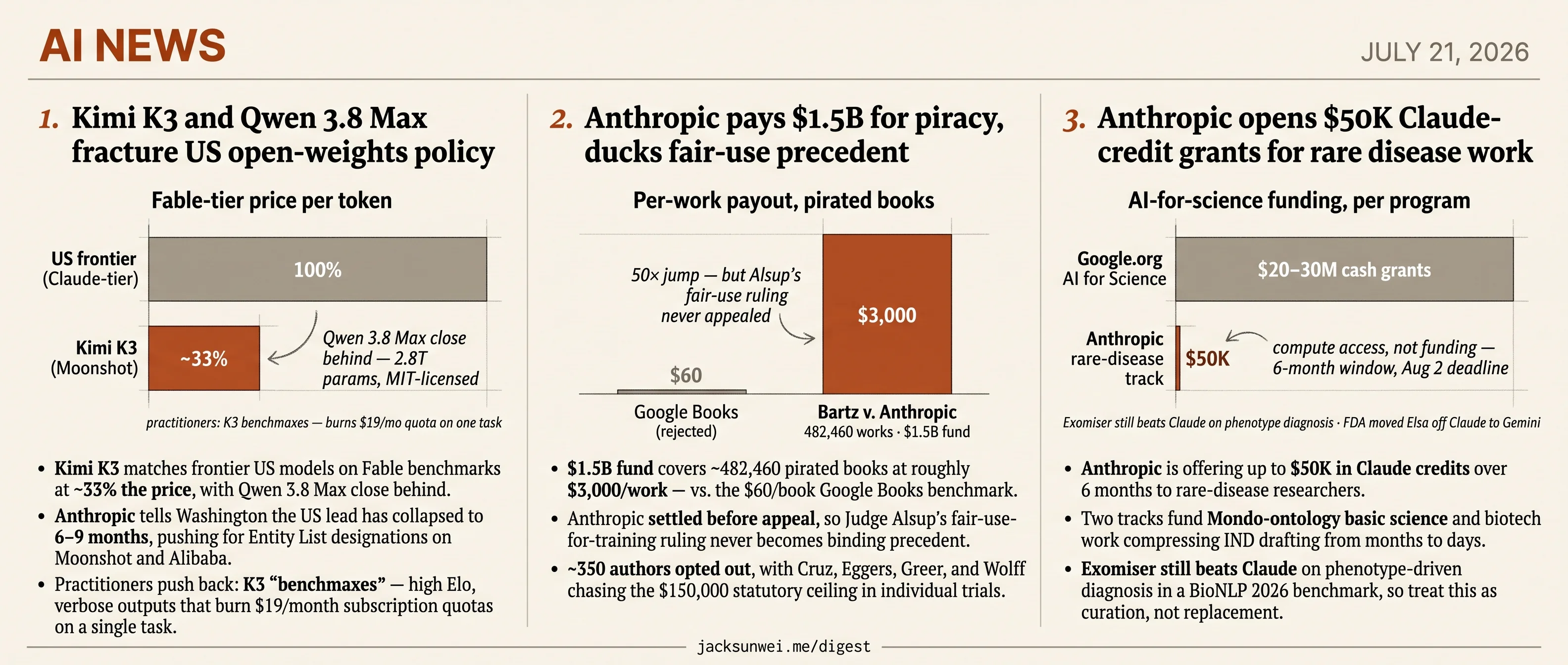
- Kimi K3 matches frontier US models on Fable benchmarks at ~33% the price, with Qwen 3.8 Max close behind.
- Anthropic tells Washington the US lead has collapsed to 6–9 months, pushing for Entity List designations on Moonshot and Alibaba.
- Practitioners push back: K3 “benchmaxes” — high Elo, verbose outputs that burn $19/month subscription quotas on a single task.
- Beijing has already organized WAICO with 28 nations — no US, no allies — with Kimi K3 as proof of delivery.
The capability shock is real, and cheaper than expected
Independent benchmarking ratifies the headline: Moonshot’s Kimi K3 comes within a hair of Claude Fable-tier scores at roughly a third of frontier US pricing 1, and Alibaba’s Qwen 3.8 Max preview is landing in the same neighborhood. Artificial Analysis has K3 fourth globally on its Intelligence Index and topping the Frontend Code Arena. Both are shipping as downloadable MIT-licensed weights — K3 at 2.8T parameters — not as gated APIs.
That is the load-bearing fact underneath the week’s policy noise. A year ago the argument for export controls rested on a widening capability moat. This week the moat is a downloadable file.
The developer response is not uniformly celebratory. The top Hacker News thread on K3 is full of complaints that the model “chews” on problems, produces bloated reasoning traces, and exhausts $19/month subscription limits on a single complex task — with commenters accusing Moonshot of optimizing for benchmark leaderboards at the expense of cost-per-token efficiency versus DeepSeek 2. Headline Elo and production economics are not the same number.
The Trump-era AI camp is openly split
Anthropic is providing the intellectual scaffolding for restriction. Head of national security policy Tarun Chhabra argues the US lead has narrowed to six-to-nine months specifically because Chinese labs are “extracting the most valuable IP” from American frontier systems 3 — a framing being pitched inside the administration as justification for Entity List designations on Moonshot and Alibaba.
The countervailing camp — David Sacks, Bill Gurley, most of the open-source developer bloc — reads that pitch as regulatory capture by the three labs with the most to lose. Simon Willison sits uncomfortably between them: he defends the Chinese models’ technical merit while flagging problems no export policy fixes.
“Even though a model is ‘open weight,’ the closed nature of the training data makes it impossible to verify the absence of backdoors in generated code.” 4
Willison also notes Qwen’s alignment with Chinese state positions — Taiwan being the canonical example — creates real compliance exposure for Western enterprises deploying it in customer-facing products 4. That is a trust problem, not a tariff problem.
The governance vacuum is filling without Washington
Two parallel institutional plays are worth tracking together. Demis Hassabis has proposed a US-led AI Standards Body modeled on FINRA, with a mandatory 30-day pre-release review for frontier models 5 — a plan critics read as consolidating the OpenAI/Anthropic/DeepMind club into a regulatory cartel. Meanwhile Beijing has already stood up the World Artificial Intelligence Cooperation Organization with 28 partner states including Russia and Brazil, explicitly excluding the US and its allies 6.
flowchart LR
    K[Kimi K3 + Qwen 3.8 Max<br/>MIT-licensed weights] --> A[Anthropic/Chhabra:<br/>Entity List, export controls]
    K --> H[Hassabis:<br/>FINRA-style US standards body]
    K --> W[Beijing WAICO:<br/>28 nations, no US]
    K --> D[Willison camp:<br/>unverifiable training data]
Kimi K3 and Qwen 3.8 Max are the technical evidence China is putting on the table that WAICO membership comes with capability, not just diplomatic signaling. The open-weights escalation is doing double duty: commercial disruption of the US frontier and soft-power infrastructure for a parallel Global South AI stack.
The uncomfortable takeaway: neither the White House nor the frontier labs has a coherent answer to a 2.8T-parameter MIT-licensed file that anyone can mirror tomorrow. “Ban them” doesn’t work on weights already in circulation, and “match them on price” is exactly the margin compression the closed labs were built to avoid.
Further reading
- OpenAI is scared of open-weight models. Should the US be? — techcrunch-ai
- China delivers a one-two punch to America’s AI dominance — the-verge-ai
- China’s AI models have Trump’s AI world at war with itself — mit-tech-review-ai
- Who’s Afraid of Chinese Models? — simon-willison
- [AINews] not much happened today — latent-space
- Import AI 465: Open vs closed gaps; Kimi K3; Demis’ big policy plan — import-ai
Anthropic pays $1.5B for piracy, ducks fair-use precedent
Source: techcrunch-ai · published 2026-07-21
TL;DR
- $1.5B fund covers ~482,460 pirated books at roughly $3,000/work — vs. the $60/book Google Books benchmark.
- Anthropic settled before appeal, so Judge Alsup’s fair-use-for-training ruling never becomes binding precedent.
- ~350 authors opted out, with Cruz, Eggers, Greer, and Wolff chasing the $150,000 statutory ceiling in individual trials.
- Concord II seeks ~$3B for 20,000+ songs and personally names Dario Amodei and Benjamin Mann.
A price tag on piracy, not on training
Final approval closes Bartz v. Anthropic but leaves the doctrine everyone actually cares about untouched. Judge Alsup’s split summary judgment held that training on lawfully-acquired books is “quintessentially transformative” fair use, while downloading from LibGen and PiLiMi was “inherently, irredeemably infringing.” Anthropic paid $1.5B to make the second half go away before a jury could translate “irredeemable” into statutory damages that plausibly ran into the tens of billions 7.
The consequence: the fair-use half was never appealed, and legal scholars are already warning the settlement “eliminates the possibility of further judicial review” 7. For the cases queued up against OpenAI, Meta, and Google, Alsup’s training analysis is persuasive dicta, not circuit law. The Association of American Publishers’ amicus in the parallel Concord action pushes the counter-argument that the transformative-use reasoning was superficial and ignored fourth-factor market harm now that a licensing market demonstrably exists 8.
The mechanics behind $3,000/book
The headline per-work figure is real but lumpier than the announcement suggests. A default 50/50 split sends half to the publisher and half to the author(s); university-press works get sliced further — e.g., $1,500 to the press and $500 to each of three co-authors 9. Eligibility requires an ISBN or ASIN plus timely U.S. Copyright Office registration, a filter that excludes a meaningful slice of independent and international writers whose books were in the pirated corpus regardless.
| Settlement | Per-work payout | Scale |
|---|---|---|
| Google Books (rejected) | ~$60 | ~book-scale corpus |
| Bartz v. Anthropic | ~$3,000 | 482,460 works, $1.5B 9 |
| Concord II (sought) | statutory | 20,000+ songs, ~$3B ask 10 |
The opt-out wave keeps Anthropic on the hook
Roughly 350 class members opted out, and Cruz v. Anthropic — filed on the eve of the final approval hearing — is the flagship. Angie Cruz, Dave Eggers, Andrew Sean Greer, and Tobias Wolff are pursuing individual jury trials targeting the $150,000-per-work statutory maximum for willful infringement, calling the class rate “bargain-basement” 11. Anthropic’s post-settlement liability is fragmented, not closed — every opt-out is a separate shot at the statutory ceiling.
Concord II is the bigger swing
Music publishers filed Concord II in January seeking ~$3B for 20,000+ compositions, and — notably — personally named Dario Amodei and Benjamin Mann as overseeing “systematic piracy” via BitTorrent downloads of shadow libraries 10. Individual executive exposure is a meaningful escalation from the corporate-defendant posture of Bartz.
Meanwhile, Nieman Lab’s licensing-market analysis frames the $1.5B number itself as the durable outcome: a de facto floor for future deals that consolidates leverage with the incumbents who can afford it and puts publishers in a “double bind” as Big Tech becomes both buyer and distribution gatekeeper 12.
What actually got settled
Not the question of whether training on copyrighted work is fair use. What got settled is the price of getting caught sourcing that work from a torrent — roughly $3,000 per pirated book, plus whatever Cruz and Concord extract on top.
Anthropic opens $50K Claude-credit grants for rare disease work
Source: anthropic-news · published 2026-07-20
TL;DR
- Anthropic is offering up to $50K in Claude credits over 6 months to rare-disease researchers.
- Two tracks fund Mondo-ontology basic science and biotech work compressing IND drafting from months to days.
- Exomiser still beats Claude on phenotype-driven diagnosis in a BioNLP 2026 benchmark, so treat this as curation, not replacement.
- FDA moved its “Elsa” assistant off Claude to Gemini in early 2026, just as Track Two pitches Claude-drafted filings.
The offer
Anthropic has carved a rare-disease cycle out of its AI for Science program: up to $50,000 in Claude credits per grantee, a six-month window, and access to Claude Opus through the Claude Science interface with bio-classifier exemptions for legitimate research. Applications close August 2, 2026. Track One funds basic-science partnerships built around the Monarch Initiative’s Mondo Disease Ontology and DisMech, an agent-friendly mechanistic classification library. Track Two funds early-stage biotechs using Claude to draft IND sections, investigator brochures, and PK/PD justifications for N-of-1 dosing.
The pitch is real: ~400 million people live with one of 7,000–10,000 rare conditions, and moving from a confirmed genetic diagnosis to an available treatment currently takes one to two years, much of it lost to regulatory paperwork and manufacturing queues.
The scale problem
$50K in credits is the most-flagged weakness. Reddit commenters called it a “drop in the ocean” against real drug-discovery budgets and floated the theory that the program doubles as data harvesting and vendor lock-in 13. The comparison sharpens next door: Google.org’s AI for Science fund is disbursing $20–30M in cash grants to institutions like UW Medicine, and Isomorphic Labs has closed roughly $3.3B in Lilly and Novartis deals targeting the same “undruggable” space Track Two describes 14.
Read this as compute-access and community-building, not funding. That framing is fine — it’s just not the framing the announcement leans into.
Where the tooling actually helps
The ontology-grounded-agent premise has independent support. A Forbes review of Claude Science described a $26 experiment on zoonotic spillover that surfaced roughly 800 relationships missing from standard reference ontologies 15 — precisely the “reveal shared pathways” move DisMech is built to enable, and the mechanism behind Anthropic’s basket-trial pitch.
The ceiling is also documented. A BioNLP 2026 paper co-authored with Monarch-affiliated researchers benchmarked frontier LLMs on phenotype-driven diagnosis and found Claude and GPT-4o “consistent” across languages but still behind Exomiser on precision 16. Translation for Track One applicants: use Claude to curate case reports and cross-link variant databases, but don’t rip out your existing prioritization pipeline.
Regulatory headwinds
Track Two’s IND-drafting angle lands in an uncomfortable moment. In early 2026 the FDA’s internal Elsa assistant was moved off Claude onto Gemini, reportedly on political and security grounds, and sponsors are already raising model-drift concerns about how the agency reads AI-assisted submissions 17. Selling Claude-drafted IND sections to biotechs whose reviewer just switched vendors is a harder sale than the announcement admits.
The safety backdrop is thinner too. The Future of Life Institute’s Summer 2026 index credits Anthropic on transparency but flags a shift from hard Responsible Scaling commitments to “relative” ones, plus military engagements 18. That matters because Track One’s bio-classifier exemptions run on trust in Anthropic’s vetting discipline — the exact thing critics say is loosening.
What’s actually at stake
For a lab already using Mondo/HPO, this is free tooling for a neglected problem and worth an application. For anyone expecting it to fund a drug program, look elsewhere — the check is Google’s to write.
Round-ups
Sony sues Udio over 30,000 songs used to train AI
Source: the-verge-ai
Sony Music’s New York suit against AI music generator Udio names more than 30,000 allegedly infringed tracks, from Elvis Presley’s Hound Dog to Beyoncé’s Say My Name and Harry Styles’ As It Was. It marks Sony’s second copyright case against the startup.
Google readies custom chip to run Gemini more cheaply
Source: techcrunch-ai
Alphabet is developing a new in-house accelerator aimed at making Gemini inference far more efficient, according to reports. The effort extends Google’s TPU lineage and deepens its push to reduce dependence on Nvidia hardware for frontier model workloads.
Trump’s newest AI czar resigns weeks into the job
Source: techcrunch-ai
The director role at the Center for AI Standards and Innovation has turned into a revolving door since David Sacks departed as White House AI czar. The latest resignation leaves federal AI standards work without stable leadership.
YouTube tightens monetization rules against AI slop
Source: techcrunch-ai
YouTube has updated its Partner Program policies to spell out which AI-generated and low-effort videos are ineligible for ad revenue. The clarification targets mass-produced, repetitive, and upsetting content that has flooded the platform as generative tools lowered production costs.
LLMs invent their own hiring biases, study finds
Source: mit-tech-review-ai
New research shows large language models screening résumés don’t just inherit human prejudices from training data — they also generate fresh biases of their own. The finding raises fairness concerns as AI increasingly filters job applicants before any recruiter sees them.
MCP protocol drops stateful sessions to ease adoption
Source: techcrunch-ai
Model Context Protocol, the connective standard between LLMs and tools, is shifting to a looser stateless approach for session IDs on the server side. The redesign mirrors how ordinary websites handle sessions, lowering the bar for developers integrating MCP servers.
Adobe’s Project Indigo camera app adds generative AI edits
Source: the-verge-ai, techcrunch-ai
Adobe’s experimental iPhone camera app, launched last year for a natural SLR-like look, now bundles generative background removal and an AI photo critique feature. Notably, the new tools don’t rely on Adobe’s own Firefly models, signaling openness to third-party generators.
Footnotes
-
R&D World — https://www.rdworldonline.com/chinas-kimi-k3-comes-close-to-fable-benchmarks-at-one-third-the-price/
↩China’s Kimi K3 comes close to Fable benchmarks at one-third the price
-
Hacker News thread on Kimi K3 — https://news.ycombinator.com/item?id=48961116
↩Kimi K3 ‘chews’ on problems for excessive durations, often exhausting $19-per-month subscription limits on a single complex task… focuses on ‘benchmaxing’ at the expense of efficiency
-
SCMP — ‘US hardens AI stance on China; Anthropic calls for extending lead’ — https://www.scmp.com/news/us/article/3360729/us-hardens-ai-stance-china-anthropic-calls-extending-lead
↩Anthropic’s head of national security policy Tarun Chhabra stated the U.S. lead has narrowed to roughly six to nine months because Chinese labs are ‘extracting the most valuable IP’ from American systems
-
Simon Willison — ‘Who’s Afraid of Chinese Models?’ — https://simonwillison.net/2026/Jul/20/afraid-of-chinese-models/
↩ ↩2Even though a model is ‘open weight,’ the closed nature of the training data makes it impossible to verify the absence of backdoors in generated code… Qwen’s alignment with Chinese state views on the status of Taiwan can trigger compliance risks for Western enterprises
-
Axios — Hassabis on AI regulation — https://www.axios.com/2026/07/14/demis-hassabis-ai-regulation-google-deepmind
↩Hassabis called for a U.S.-led AI Standards Body modeled on FINRA, with a mandatory 30-day pre-release review period for frontier models
-
CIO — China’s WAICO formation — https://www.cio.com/article/4198357/china-creates-world-ai-body-with-russia-and-27-others-but-without-us.html
↩China joined 28 other nations including Russia and Brazil to form the World Artificial Intelligence Cooperation Organization (WAICO), notably excluding the U.S. and its allies
-
Econlib — ‘The Anthropic Settlement’ (legal scholar commentary) — https://www.econlib.org/the-anthropic-settlement/
↩ ↩2Because the case settled before appellate review, the summary judgment order does not constitute binding law… the settlement ‘eliminates the possibility of further judicial review,’ leaving the core question of whether AI training is inherently infringing unresolved.
-
Association of American Publishers amicus brief in Concord v. Anthropic — https://publishers.org/news/book-news-and-journal-publishers-join-with-authors-in-amicus-brief-in-support-of-music-publishers-in-concord-v-anthropic/
↩Book and journal publishers joined authors in an amicus brief supporting music publishers, arguing that massive-scale copying undercuts established licensing markets and fails the fourth fair use factor on market harm.
-
Wolters Kluwer Copyright Blog — Bartz explainer — https://legalblogs.wolterskluwer.com/copyright-blog/the-bartz-v-anthropic-settlement-understanding-americas-largest-copyright-settlement/
↩ ↩2The $1.5 billion fund compensates rightsholders for approximately 482,460 eligible works, yielding roughly $3,000 per work after fees — a figure that dwarfs the ~$60/book offered in the rejected Google Books settlement. A ‘default split’ allocates 50% to the publisher and 50% to the author(s) where rights are shared.
-
Silicon Republic — Concord II filing — https://www.siliconrepublic.com/business/anthropics-1-5bn-copyright-lawsuit-settlement-gets-final-nod
↩ ↩2Music publishers in Concord II are seeking roughly $3 billion in statutory damages for more than 20,000 songs, and personally named founders Dario Amodei and Benjamin Mann as overseeing ‘systematic piracy’ via BitTorrent downloads of shadow libraries.
-
ChatGPTIsEatingTheWorld (Angie Cruz v. Anthropic filing coverage) — https://chatgptiseatingtheworld.com/2026/05/14/angie-cruz-v-anthropic-filed-on-eve-of-final-approval-hearing-in-bartz-v-anthropic-angie-cruz-dave-eggers-andrew-sean-greer-tobias-wolff-and-others-opting-out-of-bartz-settlement-seek-trial-on/
↩Angie Cruz, Dave Eggers, Andrew Sean Greer, Tobias Wolff and others opting out of Bartz settlement seek trial… arguing the $3,000 per-work payout is a ‘bargain-basement’ rate compared to the $150,000 statutory maximum for willful infringement.
-
Nieman Lab — AI content licensing market report — https://www.niemanlab.org/2026/05/the-emerging-ai-content-licensing-market-puts-news-publishers-in-a-double-bind-a-new-report-warns/
↩The emerging AI content licensing market puts news publishers in a ‘double bind’… Big Tech acts as both developer and gatekeeper, and the rising licensing floor set by Bartz-level settlements could stifle smaller startups.
-
Reddit r/ClaudeAI discussion — https://www.reddit.com/r/ClaudeAI/comments/1v1s4tz/claude_usage_as_reward/
↩$50,000 in credits is a ‘drop in the ocean’ compared to the massive capital requirements of modern drug discovery… some observers view the program as a ‘cheap PR move’ designed to create vendor lock-in for scientific institutions or to harvest high-quality research data
-
Google.org AI for Science awardees announcement — https://blog.google/company-news/outreach-and-initiatives/google-org/announcing-ai-for-science-awardees/
↩Google.org has established a dominant philanthropic presence through its $20 million to $30 million ‘AI for Science’ funds… targeting academic and nonprofit organizations, such as UW Medicine, which uses the funding to map the 99% of the human genome currently unmapped
-
Forbes — John Drake on Claude Science workbench — https://www.forbes.com/sites/johndrake/2026/06/30/anthropics-new-ai-workbench-mapped-my-field-for-26-now-imagine-it-aimed-at-the-rest-of-science/
↩a study on zoonotic spillover used a $26 experiment to reveal that scientific working vocabularies were four times richer than formal ontologies, identifying over 800 missing relationships in standard reference schemes
-
BioNLP 2026 benchmarking paper (ACL Anthology) — https://aclanthology.org/2026.bionlp-1.41.pdf
↩while models like Claude and GPT-4o show ‘consistent performance’ across multiple languages, they have not yet reached the precision of traditional phenotype-driven prioritization tools like Exomiser
-
Clinical Leader — ‘FDA’s Elsa AI switches from Claude to Gemini’ — https://www.clinicalleader.com/doc/fda-s-elsa-ai-switches-from-claude-to-gemini-what-sponsors-need-to-know-0001
↩In early 2026 the FDA’s internal AI assistant ‘Elsa’ underwent a forced transition from Claude to Google’s Gemini due to political and security directives… practitioner concerns regarding the consistency of AI-assisted reviews and the potential for ‘model drift’ in how the agency analyzes submitted IND data
-
Future of Life Institute AI Safety Index Summer 2026 — https://futureoflife.org/ai-safety-index-summer-2026/
↩Anthropic faced criticism for ‘questionable military engagements’ and moving its safety goalposts… shifted from ‘hard commitments’ (such as pausing model training if safety goals are not met) to a more ‘relative’ and flexible safety approach