Altman email defunds rivals, Nvidia locks Japan into CUDA, Current AI at 1%
Three AI-news leads today each dress an incumbent-capture move — antitrust, CUDA lock-in, Big Tech co-funding — as public mission.
Altman email defunds rivals, Nvidia locks Japan into CUDA, Current AI at 1%
TL;DR
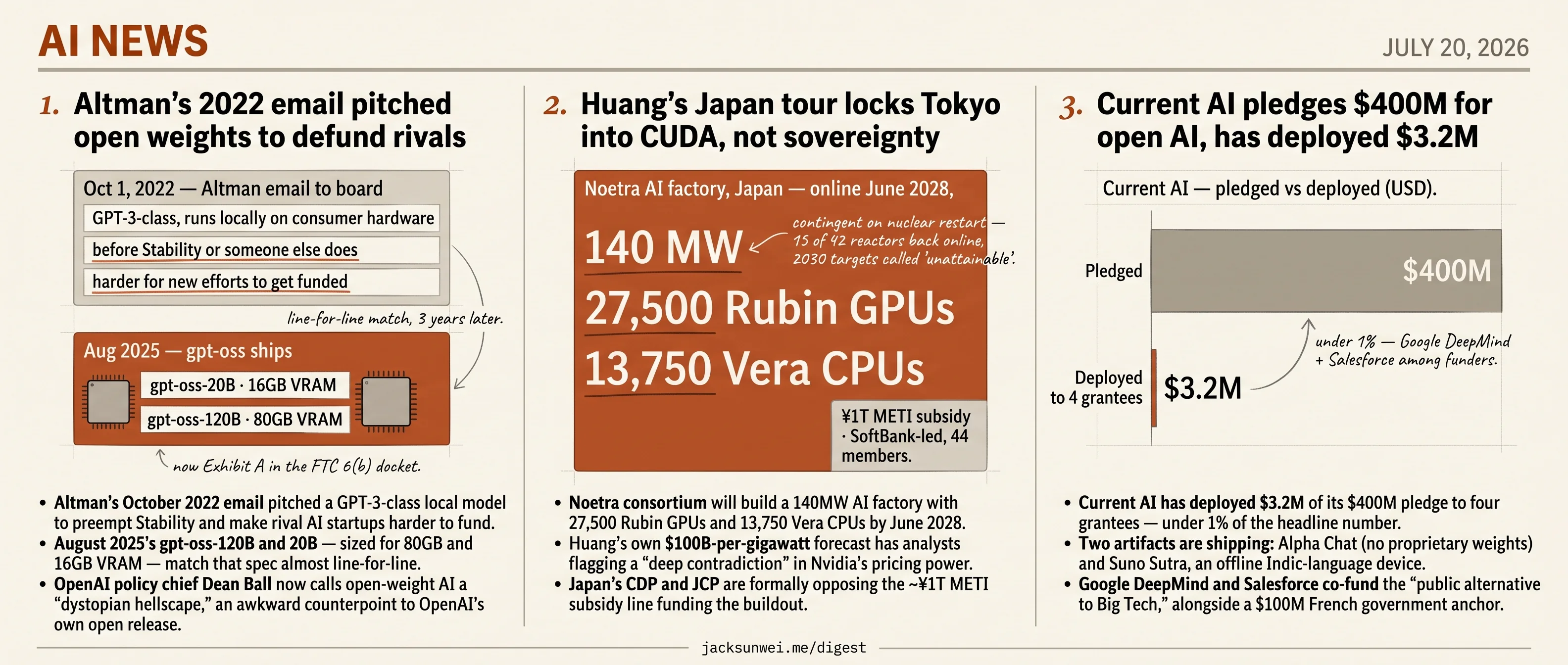
- Altman’s 2022 email pitched open weights to make rival AI startups harder to fund.
- Nvidia’s Noetra deal locks Japan into 27,500 Rubin GPUs by June 2028.
- Current AI has deployed $3.2M of its $400M open-AI pledge, under 1%.
- FTC 6(b) orders now have first-party predatory-intent language to cite against OpenAI.
- Japan’s CDP and JCP formally oppose the ~¥1T METI subsidy funding the Nvidia buildout.
Three AI-news leads today, one shared shape: each starts as a public-mission pitch and ends up looking like an incumbent play. A newly surfaced Altman email from October 2022 reframes OpenAI’s gpt-oss release as the anti-competitive move it was designed to be — and hands the FTC’s 6(b) inquiry first-party language it did not previously have. Jensen Huang’s Japan tour sells Tokyo a sovereign-AI story while wiring 27,500 Rubin GPUs and a ¥1T subsidy line into CUDA, over the objection of two opposition parties. And Current AI, the ostensibly-public alternative to Big Tech, has deployed $3.2M of a $400M pledge — co-funded by Google DeepMind and Salesforce.
The briefs below carry the same undertone from other angles: Apple’s lawsuit as a drag on OpenAI’s hardware-and-IPO push, and Christopher Nolan calling Hollywood’s AI adoption an obvious Trojan horse the studios welcome anyway.
Altman’s 2022 email pitched open weights to defund rivals
Source: simon-willison · published 2026-07-20
TL;DR
- Altman’s October 2022 email pitched a GPT-3-class local model to preempt Stability and make rival AI startups harder to fund.
- August 2025’s gpt-oss-120B and 20B — sized for 80GB and 16GB VRAM — match that spec almost line-for-line.
- OpenAI policy chief Dean Ball now calls open-weight AI a “dystopian hellscape,” an awkward counterpoint to OpenAI’s own open release.
- The FTC’s 6(b) orders into OpenAI, Alphabet and Anthropic now have a first-party predatory-intent quote to cite.
The quote
Disclosed this week in Musk v. Altman (2026), an October 1, 2022 email from Sam Altman to OpenAI’s board lays out the case for shipping a GPT-3-class model that runs on consumer hardware — and does so in unusually candid competitive terms. The goal, in Altman’s own words, was to move “before Stability or someone else does,” to “discourage others from releasing similarly-powerful models,” and to make it “harder for new efforts to get funded.”
That is not a research-mission framing. It is a market-foreclosure framing, written down.
The plan shipped in August 2025
The awkward part for OpenAI is that the hypothetical didn’t stay hypothetical. In August 2025 the company released gpt-oss-120B and gpt-oss-20B under Apache 2.0, explicitly targeting the 80GB and 16GB VRAM tiers of prosumer and consumer GPUs 1. The email’s spec — “approximate capability of GPT-3… run locally on consumer hardware” — is essentially a product brief for the 20B. Simon Willison, who had spent years arguing Altman’s closed posture put OpenAI “on the wrong side of history” on open weights 2, now has a document suggesting gpt-oss was less a change of heart than a delayed execution.
The internal contradiction
Set the email next to OpenAI’s current public line and the compartmentalisation gets vivid. This month, OpenAI’s Head of Strategic Futures Dean Ball called open-weight AI a “dystopian hellscape,” described the category as “inherently decelerationist,” and warned it could lead to “full AI communism” 3. So the same company is (a) shipping an open-weight model designed to starve competitors of oxygen, and (b) employing a policy chief who argues the same category of release is civilisationally dangerous when Meta, DeepSeek or Moonshot do it. The safety rhetoric is applied asymmetrically, and the email makes that harder to hand-wave.
Antitrust framing gets a primary source
Cornell Tech’s David Gray Widder has argued that open source can be “part of a larger strategy to kneecap” rivals by locking developers into a dominant firm’s ecosystem 4 — a framing the Altman email now supplies primary-source evidence for. The FTC has already issued 6(b) compulsory orders to OpenAI, Alphabet and Anthropic to examine whether release and partnership strategies create barriers to entry for smaller firms 5. A board-level admission that a release was designed to make it “harder for new efforts to get funded” reads like a textbook predatory-intent exhibit, and it will almost certainly land in that docket.
What it doesn’t prove
The email establishes intent, not effect. By mid-2023 the open/closed capability gap was collapsing anyway — Meta’s LLaMA leak, Alpaca and Vicuna, and Google’s leaked “We Have No Moat” memo all suggest the ecosystem outran whatever preemption OpenAI could have staged 6. Stability still raised $101M at a $1B valuation. The strategy may have failed on its own terms.
What survives is the intent layer: the missing piece under three years of OpenAI’s confusing zig-zag on open weights, now quotable, dated, and on the record.
Huang’s Japan tour locks Tokyo into CUDA, not sovereignty
Source: techcrunch-ai · published 2026-07-19
TL;DR
- Noetra consortium will build a 140MW AI factory with 27,500 Rubin GPUs and 13,750 Vera CPUs by June 2028.
- Huang’s own $100B-per-gigawatt forecast has analysts flagging a “deep contradiction” in Nvidia’s pricing power.
- Japan’s CDP and JCP are formally opposing the ~¥1T METI subsidy line funding the buildout.
- The site’s power depends on Japan’s nuclear restart — 15 of 42 reactors back online, 2030 targets still called “unattainable.”
The deal beneath the diplomacy
TechCrunch’s framing — “deals spanning Japan’s entire tech ecosystem” — undersells the concrete anchor. Huang left Tokyo with Noetra Corp., a 44-member consortium led by SoftBank and including Sony, Honda, and NEC, committed to a 140MW “AI factory” running 27,500 Rubin GPUs paired with 13,750 Vera CPUs, targeting operations by June 2028 7. A parallel FugakuNEXT deal replaces the all-Fujitsu A64FX lineage with Fujitsu 2nm “Monaka” ARM cores bolted to Nvidia Rubin accelerators. Underwriting most of it: roughly ¥1 trillion in METI subsidies. This is a national compute-procurement program with Nvidia at the center, dressed as industrial policy.
The sovereignty paradox
The “Sovereign AI” branding is doing heavy lifting. TheCube Research’s read is blunt: Japan is tethering its industrial base to CUDA and NVL72 rack architectures, which means any “third pillar” between US and Chinese AI is fundamentally Nvidia-native silicon underneath 8. Domestic opposition is sharper than the TechCrunch piece hints. Constitutional Democratic Party lawmaker Yoshitaka Saito and the JCP are formally opposing the 2026 supplementary budget line for Noetra, arguing public “consensus is overwhelmingly insufficient” — and noting the awkward fact that SoftBank, the consortium’s lead, is simultaneously routing ¥1.6 trillion into OpenAI while headlining a “domestic” stack 9.
Circular deals and $100B gigawatts
Huang’s Tokyo remarks that data-center costs could scale from $50B to $100B per gigawatt have been read as a self-defeating admission. Kalkine’s analyst roundup flags a “deep contradiction”: Nvidia’s pricing power is inflating the cost base of the very sovereign buyers it is courting 10. Seaport’s Jay Goldberg — the lone sell-rated analyst on NVDA — is more direct.
“Circular deals” where Nvidia invests in customers who then buy Nvidia hardware; demand persists because customers feel they “cannot afford not to.” 11
Noetra fits the pattern cleanly: state subsidy plus consortium equity flow through to a single American vendor’s order book, with lock-in that outlasts any one budget cycle.
Watts, not just GPUs
The 140MW figure is the part that makes the rest contingent. Huang publicly linked AI buildout to Japan’s nuclear restart and floated hyperscalers running their own SMRs within a decade 12. METI’s 7th Strategic Energy Plan targets ~20% nuclear by 2040, and 15 of 42 reactors were operating by mid-2026 12. But the Renewable Energy Institute still calls the 2030 targets “unattainable,” and Hamaoka’s restart review was recently paused over falsified seismic data. Rubin racks don’t ship without gigawatts to feed them.
What to actually watch
Three fault lines the TechCrunch framing elides: whether Diet opposition slows the supplementary-budget flow to Noetra; whether Rubin allocations land on schedule against HBM4 supply noise; and whether Japan’s reactor restart cadence physically keeps pace with 140MW-class AI factories the government has already promised to power. The diplomatic photo op is the easy part. The next 24 months are procurement, politics, and neutrons.
Current AI pledges $400M for open AI, has deployed $3.2M
Source: techcrunch-ai · published 2026-07-19
TL;DR
- Current AI has deployed $3.2M of its $400M pledge to four grantees — under 1% of the headline number.
- Two artifacts are shipping: Alpha Chat (no proprietary weights) and Suno Sutra, an offline Indic-language device.
- Google DeepMind and Salesforce co-fund the “public alternative to Big Tech,” alongside a $100M French government anchor.
- Multilingual safety is unaddressed: jailbreaks that fail in English succeed in Maori, Armenian, and Swahili.
The arithmetic problem
TechCrunch’s framing — a “World Wide Web of AI, free for all” — sits uneasily against the ledger. Current AI has pledged $400M and aspires to $2.5B by 2030, but has actually moved $3.2M to its first cohort of four grantees 13. That’s grant-making at the scale of a mid-sized foundation, not the web-scale public infrastructure the pitch invokes, and it lands in a market where Mistral, Anthropic, and Stargate-tier build-outs are counted in tens of billions.
The cohort itself is defensible on the merits: $2.25M to Kenya’s Masakhane for datasets covering 50+ African languages, $285K to Lebanon’s Institute for Worldmaking, plus Portal sem Porteiras (offline tools for Indigenous communities in the Brazilian Amazon) and the African Internet Rights Alliance for audit tooling 14. This is real, targeted work on the long tail of language coverage that commercial labs will not prioritize. It is not, however, a rival stack.
What’s actually shipping
Two deliverables give Current AI more substance than a typical nonprofit launch. Alpha Chat was built in seven weeks by a coalition including Mozilla and Hugging Face, and — unusually — uses no proprietary model weights end to end 15. Suno Sutra is a small embedded Linux device (camera, mic, screen, speaker) running specialized SUTRA models locally for 22+ Indic languages, with source published as currentai-org/suno-sutra-sw. Its tokenizer claims 1.4–2.1 tokens per Indic word versus 4–8 for GPT-4-class models 16 — a genuine efficiency edge that matters for edge inference on cheap hardware.
Both are inspectable code, not slideware. That’s the strongest part of the story and the part TechCrunch under-sells.
The funder problem
The awkward bit is the cap table. Google DeepMind and Salesforce co-fund a nonprofit whose explicit pitch is a public alternative to Big Tech, sitting alongside a $100M anchor from the French government 17. CEO Ayah Bdeir’s distinction between “funders” and “investors” is a real one, but it doesn’t dissolve the question of whose roadmap gets nudged when the incumbents write the checks. Read charitably, this is a European sovereignty play with a global-commons wrapper. Read less charitably, it’s a hedge the incumbents can afford at petty-cash scale.
The safety gap nobody is discussing
The “leave no culture behind” framing has a documented downside the vendor narrative skips. Johns Hopkins researchers have shown that safety alignment doesn’t transfer across languages: malicious prompts blocked in English routinely bypass guardrails in Maori or Armenian, and moderation systems trained on English miss incitement to ethnic violence in Swahili 18. Pushing capable models into low-resource languages without proportional alignment investment is not automatically pro-social — it can be the opposite in exactly the communities the mission names.
Net
Current AI is a credible pilot with two shipping artifacts and a coherent theory of neglected coverage. It is not, on current evidence, the counter-stack its launch language promises. The gap between $400M pledged and $3.2M deployed is the number to watch; the funder roster and the multilingual safety debt are the questions the next round of coverage should press.
Round-ups
Apple lawsuit clouds OpenAI’s hardware and IPO push
Source: techcrunch-ai
OpenAI’s push into consumer hardware and an eventual public offering faces a new drag from Apple’s lawsuit, according to a debate on TechCrunch’s Equity podcast. The suit lands as OpenAI courts device partners and investors betting on a post-ChatGPT form factor.
Nolan calls AI an obvious ‘Trojan horse’ while promoting Odyssey
Source: techcrunch-ai
Christopher Nolan, promoting his upcoming adaptation of The Odyssey, likened AI’s arrival in Hollywood to the Greeks hidden in the wooden horse. “Everybody knows the Greeks are inside,” he told TechCrunch, framing studio adoption as a threat the industry sees coming but welcomes anyway.
Suno-made track by 1010benja wins over skeptical Verge critic
Source: the-verge-ai
Generative music from Suno usually reads as boring filler, but 1010benja’s “Semiramis Dream” is forcing a rethink at The Verge. The piece sits alongside work by artists like Holly Herndon as evidence that AI tools can serve real songwriting rather than replace it.
Footnotes
-
arXiv 2508.12461 — gpt-oss technical report — https://arxiv.org/pdf/2508.12461
↩gpt-oss-120B and gpt-oss-20B were released in August 2025 under Apache 2.0, targeting 80GB and 16GB VRAM tiers for local consumer-hardware deployment.
-
Simon Willison — prior commentary — https://simonwillison.net/
↩For years Altman’s stance had placed OpenAI on ‘the wrong side of history’ regarding transparency and open weights.
-
StartupFortune — on Dean Ball (OpenAI Head of Strategic Futures) — https://startupfortune.com/openai-policy-chief-dean-ball-calls-open-weight-ai-a-dystopian-hellscape/
↩OpenAI’s Dean Ball calls open-weight AI a ‘dystopian hellscape’ and characterises open weights as ‘inherently decelerationist,’ warning they could lead to ‘full AI communism.’
-
Cornell Tech tip-sheet — David Gray Widder — https://news.cornell.edu/media-relations/tip-sheets/cornell-tech-expert-examines-ftcs-open-software-statement
↩Open source can be part of a larger strategy to ‘kneecap’ rivals by creating dependencies on a dominant firm’s infrastructure, rather than a straightforward driver of competition.
-
Open Markets Institute — FTC/DOJ AI inquiry — https://www.openmarketsinstitute.org/publications/ai-companies-targeted-ftc-doj
↩The FTC has issued compulsory orders to OpenAI, Alphabet, and Anthropic to investigate how their partnerships and release strategies may distort innovation or create barriers to entry for smaller firms.
-
Wing VC — Open vs Proprietary AI history — https://www.wing.vc/content/open-source-versus-proprietary-ai-models-the-new-frontiers-of-ai-competition
↩By mid-2023 the ‘monetizable spread’ between open and closed models began to shrink rapidly, with a leaked Google memo conceding ‘We Have No Moat, And Neither Does OpenAI.’
-
Tom’s Hardware — https://www.tomshardware.com/pc-components/gpus/nvidia-and-japans-noetra-consortium-to-build-140mw-rubin-ai-factory-with-27500-gpus
↩NVIDIA and Japan’s Noetra Consortium to build 140MW Rubin AI factory with 27,500 GPUs… 13,750 Vera CPUs paired with 27,500 Rubin GPUs, targeting operations by June 2028.
-
TheCube Research (‘Sovereignty just grew a body’) — https://thecuberesearch.com/sovereignty-just-grew-a-body/
↩Japan’s ‘sovereign’ stack is tethered to CUDA and NVL72 racks; true sovereignty would require hardware-agnostic platforms, whereas any ‘third option’ to US or Chinese AI remains fundamentally dependent on Nvidia’s silicon.
-
Zamin (summary of Nikkei / Diet coverage) — https://zamin.uz/en/technology/213301-nvidia-and-japan-partnership-a-new-ai-era-for-industrial-robots-begins.html
↩CDP lawmaker Yoshitaka Saito and the JCP have opposed the 2026 supplementary budget funding Noetra, arguing public ‘consensus is overwhelmingly insufficient’ — and noting SoftBank simultaneously pours ¥1.6 trillion into OpenAI while leading a ‘domestic’ consortium.
-
Kalkine (analyst roundup) — https://kalkine.com/news/technology/nvidias-nasdaqnvda-ai-economics-under-fire-jensen-huangs-japan-remarks-ignite-fresh-debate-over-data-center-costs-and-pricing-power
↩Huang’s Japan remarks that data-center costs could climb from $50 billion to $100 billion per gigawatt ignited fresh debate over a ‘deep contradiction’ in Nvidia’s model — driving up infrastructure costs for the very customers it seeks to empower.
-
Morningstar / Dow Jones — https://www.morningstar.com/news/dow-jones/202607162272/nvidia-noetra-to-build-ai-factory-to-power-japans-ai-ambitions
↩Seaport’s Jay Goldberg — the lone sell-rated analyst on the stock — warns of ‘circular deals’ where Nvidia invests in customers who then buy Nvidia hardware, and says demand persists because customers feel they ‘cannot afford not to’ buy.
-
roic.ai (energy/nuclear analysis) — https://www.roic.ai/news/nvidias-huang-declares-energy-the-next-global-bottleneck-for-ai-12-03-2025
↩ ↩2Huang endorsed nuclear as vital for ‘AI Factories’ like the 140MW Noetra site and predicted hyperscalers may run their own SMRs within a decade; METI’s 7th Strategic Energy Plan targets ~20% nuclear by 2040, with 15 of 42 reactors already back online by mid-2026.
-
Unite.ai — ‘Current AI Starts Funding Its Open Alternative to Big Tech’ — https://www.unite.ai/current-ai-starts-funding-its-open-alternative-to-big-tech/
↩Only $3.2 million has been distributed to its first cohort of four grantees… a modest scale compared to the tens of billions being poured into private sector AI firms.
-
Current AI blog — Pilot Grant Cohort announcement — https://www.currentai.org/blogs/our-pilot-grant-cohort-cultural-preservation
↩Masakhane received $2.25 million to expand linguistic infrastructure for over 50 African languages; Portal sem Porteiras is building offline AI tools for Indigenous communities in the Brazilian Amazon; Institute for Worldmaking received $285,000.
-
AI Weekly — ‘Current AI Marshals $400M for Public AI Infrastructure Push’ — https://aiweekly.co/alerts/current-ai-marshals-400m-for-public-ai-infrastructure-push
↩Alpha Chat, a fully open-source chatbot built in seven weeks by a coalition including Mozilla and Hugging Face, specifically designed to use no proprietary model weights.
-
GitHub — currentai-org/suno-sutra-sw — https://github.com/currentai-org/suno-sutra-sw
↩Embedded Linux device with camera, microphone, screen and speaker running specialized SUTRA models locally; supports 22+ Indic languages with token efficiency of 1.4–2.1 tokens per word vs. 4–8 for GPT-4-class models.
-
Briefs.co — ‘Nonprofit Startup Aims for Free Public AI Tools’ — https://www.briefs.co/news/nonprofit-startup-aims-for-free-public-ai-tools/
↩A nonprofit backed by the very companies it seeks to challenge — Google DeepMind and Salesforce sit alongside the French government’s $100M seed — may face inherent conflicts of interest.
-
Johns Hopkins CS — ‘Low-Resource, High-Risk’ — https://www.cs.jhu.edu/news/low-resource-high-risk-ai-text-generators-more-likely-to-create-harmful-content-in-certain-languages/
↩Malicious prompts blocked in English often bypass guardrails when translated into languages like Maori or Armenian… systems optimized for English frequently fail to recognize calls for ethnic violence in Swahili.