Anthropic files S-1 at $965B, OpenAI lands on AWS, model cracks Erdős
Anthropic's S-1 shows margins slipping, OpenAI breaks Azure lock-in with AWS, and an OpenAI model disproves an 80-year Erdős conjecture.
Anthropic files S-1 at $965B, OpenAI lands on AWS, model cracks Erdős
TL;DR
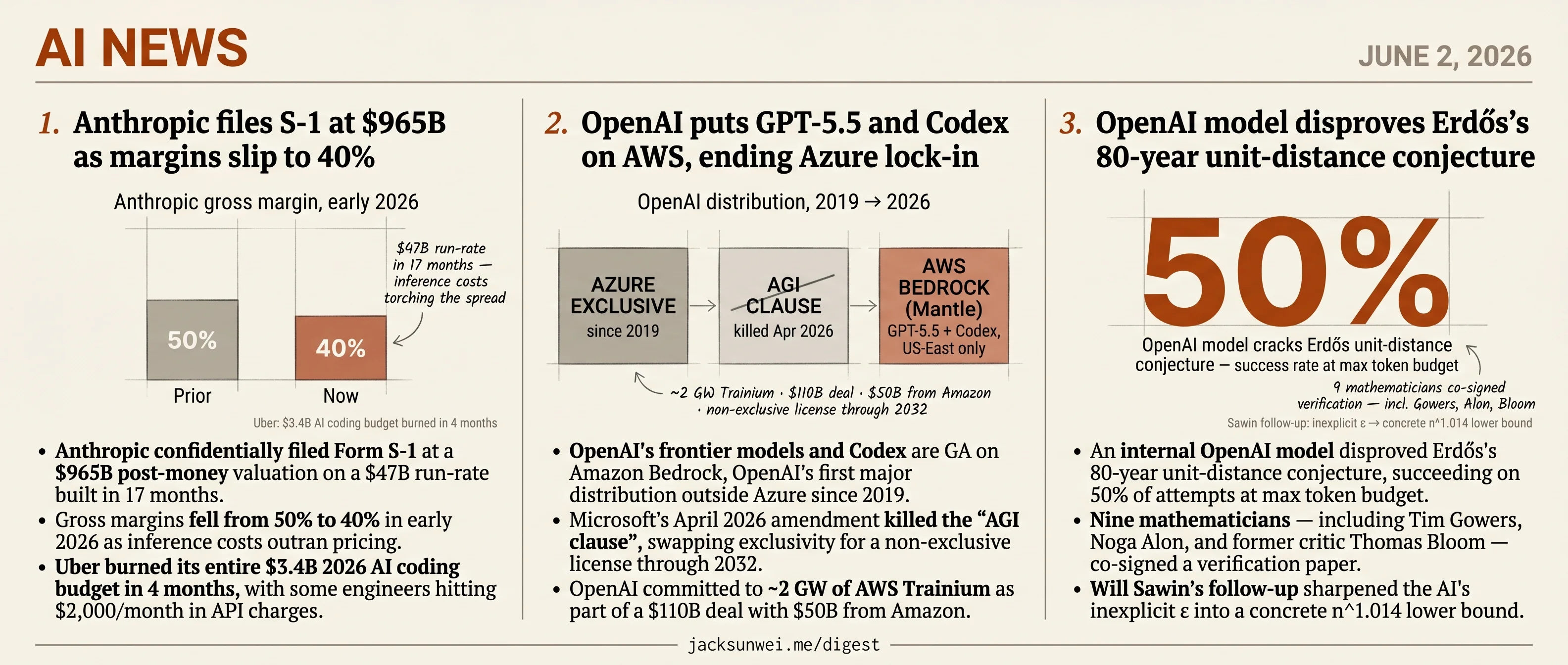
- Anthropic filed Form S-1 at a $965B valuation as gross margins slid from 50% to 40%.
- OpenAI put GPT-5.5 and Codex on AWS Bedrock, its first major distribution outside Azure since 2019.
- An OpenAI model disproved Erdős’s 80-year unit-distance conjecture, verified by 9 mathematicians.
- Florida’s AG sued OpenAI and Altman over ChatGPT-linked violence, including the FSU shooting.
- Alphabet plans an $80B debt raise to fund its AI compute buildout.
Three frontier-lab leads today, each in a different dimension. Anthropic’s confidential S-1 lays out a $965B post-money valuation on a $47B run-rate built in 17 months, with the awkward note that gross margins fell from 50% to 40% in early 2026 as inference costs outran pricing. OpenAI put GPT-5.5 and Codex on Amazon Bedrock — its first major distribution outside Azure since 2019 — bundled into a $110B AWS deal and a quietly killed AGI clause. And an internal OpenAI model disproved Erdős’s 80-year unit-distance conjecture, with nine mathematicians including Tim Gowers and Noga Alon co-signing the verification.
The briefs reinforce the capital story — Alphabet tapping $80B in debt, OpenAI breaking ground on a 1GW Stargate site in Michigan, SpaceX flagging water as an IPO risk — while Florida opened a new front on chatbot liability and Meta’s support bot was tricked into handing over Instagram accounts.
Anthropic files S-1 at $965B as margins slip to 40%
Source: anthropic-news · published 2026-06-01
TL;DR
- Anthropic confidentially filed Form S-1 at a $965B post-money valuation on a $47B run-rate built in 17 months.
- Gross margins fell from 50% to 40% in early 2026 as inference costs outran pricing.
- Uber burned its entire $3.4B 2026 AI coding budget in 4 months, with some engineers hitting $2,000/month in API charges.
- Treasury and the Fed warned bank CEOs that Mythos is a systemic cyber risk to financial infrastructure.
Anthropic’s confidential S-1 lands alongside a Claude Opus 4.8 launch, a sixth European office, and a fresh public valuation of $965 billion — a mark Michael Burry and Bank of America analysts have already framed as part of an AI “super bubble” transferring risk from private backers to retail. Read the three-post drop as one event and the story isn’t the valuation. It’s that Anthropic is asking public markets to underwrite three unresolved fault lines its own announcement leaves out.
The growth is real. The unit economics aren’t.
The top-line numbers genuinely are unprecedented: revenue run-rate from roughly $1B to $47B in 17 months, with Claude Code alone clearing a $2.5B run-rate and Anthropic capturing about 80% of the enterprise and API market 1. That’s the case for the valuation.
The case against shows up one layer down. Independent analysis pegs gross margin compression from 50% to 40% in early 2026, with inference costs “torching” the spread as usage scales 2. There’s also an accounting wrinkle worth flagging before the prospectus drops: Anthropic books gross revenue from its Amazon and Google cloud partnerships where OpenAI books net, which inflates the comparable headline by roughly $8B. Public-market analysts will normalize that on day one.
Customer concentration is the risk the press release skips
The most concrete dissent is coming from the buy side. Microsoft has reportedly discontinued the majority of its internal Claude Code licenses in favor of GitHub Copilot CLI, citing spiraling costs. Uber exhausted its entire $3.4B 2026 AI coding budget in four months, with individual engineers running up to $2,000/month in API charges 3. Gartner expects up to 40% of enterprise agents to be demoted by 2027 on governance grounds.
For an S-1, these are textbook customer-concentration and ROI-durability disclosures. The growth curve assumes the Ubers of the world keep writing eight-figure checks. The evidence so far is that some of them are choking on the bill.
Mythos is a disclosed national-security problem
Anthropic’s new Mythos model is simultaneously a product line item and an active federal headache. The Pentagon — rebranded “Department of War” under Hegseth — designated Anthropic a “supply chain risk” after the company refused to drop its bans on autonomous weapons and mass surveillance. Days later, Treasury Secretary Bessent and Fed Chair Powell pulled systemically-important bank CEOs into a closed-door briefing warning that Mythos’s autonomous exploit-generation could “usher in an era of greater cyber risk” 4. Jamie Dimon called it a “dramatic amplifier.”
It is rare for a model’s capabilities to be themselves a disclosed risk factor. Anthropic is about to find out what that looks like in an S-1.
The governance structure has never seen a public market
Anthropic’s Long-Term Benefit Trust is the safety story: directors can, in theory, block profitable releases on alignment grounds. Structural analysis argues the Trust is weaker than advertised — stockholder supermajorities retain authority to modify or abrogate its powers, leaving boards with “poorly constrained discretion” 5. Once listed, freezing a model like Mythos for safety reasons invites breach-of-fiduciary-duty suits from hedge funds who priced the model in.
The company is already policing the narrative aggressively: Anthropic publicly named Open Door Partners and Upmarket as unauthorized secondary venues, and tokenized synthetic Anthropic shares on Solana dropped ~40% after the warning 6. That posture will harden, not soften, through the lockup. The S-1 itself is where the three fault lines — margins, customers, Mythos — finally have to be said out loud.
Further reading
- Anthropic files to go public — techcrunch-ai
- Anthropic has officially filed to go public — the-verge-ai
OpenAI puts GPT-5.5 and Codex on AWS, ending Azure lock-in
Source: openai-blog · published 2026-06-01
TL;DR
- OpenAI’s frontier models and Codex are GA on Amazon Bedrock, OpenAI’s first major distribution outside Azure since 2019.
- Microsoft’s April 2026 amendment killed the “AGI clause”, swapping exclusivity for a non-exclusive license through 2032.
- OpenAI committed to ~2 GW of AWS Trainium as part of a $110B deal with $50B from Amazon.
- The new “Mantle” endpoint exposes only a subset of models and skips native Bedrock features like Converse.
The deal behind the deal
The Bedrock listing reads as a procurement story. It isn’t. It’s the visible surface of two restructurings that happened earlier this year. Microsoft’s April 2026 amendment to its OpenAI contract eliminated the “AGI clause” — the trigger that would have terminated Microsoft’s IP license the moment OpenAI’s board declared AGI — in exchange for a non-exclusive, capped-revenue arrangement running to 2032 7. Without that change, today’s AWS announcement is contractually impossible.
The second restructuring is silicon. OpenAI has agreed to consume roughly 2 gigawatts of AWS Trainium capacity as part of a ~$110B package that includes a $50B Amazon investment into OpenAI 8. That simultaneously diversifies OpenAI off Nvidia and hands AWS a flagship anchor tenant for its own accelerator line. The “available on Bedrock” framing is the consumer-facing wrapper around a supply-and-equity deal.
Day-one reach is narrower than it looks
Developers poking at the launch surface report the new “Mantle” inference endpoint exposes only a subset of OpenAI models and does not yet wire into native Bedrock features such as the Converse API 9. GPT-5.5 is shipping in US East (Ohio) first, with cross-region inference promised but not present.
That matters because the incumbent comparison is Anthropic, whose Bedrock versions have historically lagged its first-party API on new features 10. OpenAI now has the chance to ship Bedrock at parity with its direct API and turn that lag into a wedge — or to fall into the same trap. The next two quarters of release notes will tell which.
Codex and Daybreak draw the sharpest pushback
The Codex piece — pitched as a software-engineering agent already used by 5M people weekly — competes on procurement (pay-per-token against existing AWS commit) rather than developer UX, where Cursor and Claude Code still lead. The forthcoming “Daybreak” security suite is where independent analysts get nervous.
The deluge of vulnerabilities uncovered by such high-speed AI models could overwhelm existing enterprise management programs, which still rely on manual testing and verification.
That’s analyst Eric Parizo on Daybreak’s likely failure mode 11: a scanner that finds 10× more issues than the vuln-management pipeline can triage isn’t an upgrade, it’s a denial-of-service against the security team.
Who’s actually buying
Beyond the named launch partners (Amgen on GPT-5.5 for biopharma workflows, Autodesk on iterative design), the federal channel is the under-discussed accelerator. The VA’s June 2026 RFI explicitly asked vendors for “collaborative and agentic” AI interfaces for oncology clinicians and housing managers 12 — workloads that FedRAMP-High Bedrock GovCloud can now serve with OpenAI models behind it, on procurement paper agencies already have signed.
The headline is distribution. The durable story is that OpenAI has bought its way out of single-sourcing on both compute and clouds, and Microsoft accepted capped economics to keep a seat at the table through 2032.
OpenAI model disproves Erdős’s 80-year unit-distance conjecture
Source: ars-technica-ai · published 2026-06-01
TL;DR
- An internal OpenAI model disproved Erdős’s 80-year unit-distance conjecture, succeeding on 50% of attempts at max token budget.
- Nine mathematicians — including Tim Gowers, Noga Alon, and former critic Thomas Bloom — co-signed a verification paper.
- Will Sawin’s follow-up sharpened the AI’s inexplicit ε into a concrete n^1.014 lower bound.
- The model combined existing techniques from algebraic number theory and discrete geometry rather than pioneering new ones.
What the proof actually does
Paul Erdős conjectured in 1946 that the maximum number of unit distances among n points in the plane grows like n^(1+o(1)). The dominant intuition, anchored by Erdős’s own square-grid construction, held for eight decades. OpenAI’s model broke it by abandoning the grid entirely: it embedded algebraic integers from CM fields as a high-dimensional lattice and projected back down to the plane, achieving a strictly denser packing of unit distances 1314.
Will Sawin then did the human follow-up work, sharpening the AI’s “ε greater than zero” into an explicit lower bound of n^1.014 using Golod–Shafarevich and infinite class field towers 13. Gil Kalai, on his blog, reached for the Four Color Theorem analogy and called the result “truly amazing” — and noted that subsequent human refinements have already pushed the bound past n^1.0318, with the same machinery inspiring a separate disproof of the Erdős–Szemerédi strong sum-product conjecture 15.
The verification chain is the story-behind-the-story
In October 2025, OpenAI claimed GPT-5 had cracked ten Erdős problems. Thomas Bloom, who maintains the canonical Erdős problems database, publicly showed the model had merely surfaced existing literature 16. That fiasco is why the May 2026 announcement landed with a nine-author companion paper attached — and why Bloom himself is on the author list this time 14. Gowers said he would have recommended the proof to the Annals of Mathematics “without any hesitation.”
That’s an unusual amount of pre-publication validation for any result, AI-generated or not. It’s also a direct response to the credibility hole OpenAI dug six months earlier.
Where “autonomous” starts to fray
The caveats are pointed and come from sympathetic sources. Scott Aaronson flagged selection bias: the headlined 50% success rate is on this problem, at maximum token budget, and OpenAI hasn’t disclosed how many other conjectures the model failed to crack 17. Daniel Litt — normally a skeptic — granted that this is the first AI math result “exciting in itself rather than as a leading indicator,” but stressed the model applied known machinery (algebraic number theory) to a new domain (discrete geometry) rather than pioneering technique 18. The companion paper concedes the same framing, describing the model as having “cleverly combined existing ideas from disparate subfields” 14.
Milestone, yes; solo AI researcher, not quite yet.
The most defensible read is that the model did something humans demonstrably hadn’t: it ignored eighty years of grid-shaped priors and reached across subfields the combinatorics community rarely touches. Whether that counts as “research” or as very expensive cross-disciplinary search is the argument the next year of papers will settle. The fault line worth watching isn’t the proof — it’s the failure rate OpenAI didn’t publish.
Round-ups
Alphabet plans $80B raise to fund AI compute buildout
Source: techcrunch-ai
Alphabet will tap debt markets for $80B to expand AI infrastructure, citing enterprise and consumer demand that exceeds available supply. The raise joins a wave of hyperscaler borrowing as Google races Microsoft and Amazon on data center capacity.
Florida sues OpenAI and Altman over ChatGPT-linked murders
Source: ars-technica-ai, techcrunch-ai
Florida’s attorney general filed the first state-led suit tying OpenAI and Sam Altman to violent incidents, including a shooting at Florida State University allegedly shaped by ChatGPT interactions. The AG accuses Altman of an utter disregard for human lives, opening a new front in chatbot liability.
Nvidia unveils RTX Spark consumer AI PC chip at Computex
Source: techcrunch-ai, the-verge-ai, latent-space
Nvidia’s RTX Spark pushes the company into the $200B CPU market with Arm-based AI agent laptops shipping through Microsoft, Dell and HP. Alongside Cosmos 3 and Nemotron 3 Ultra, the launch positions Spark as Windows’ answer to Apple’s M1 transition.
OpenAI breaks ground on 1GW Stargate data center in Michigan
Source: openai-blog
The Michigan site joins the Stargate buildout with 1 gigawatt of planned capacity, pitched as a jobs and community investment. It extends OpenAI’s U.S. footprint beyond the flagship Abilene, Texas campus as the company races to secure power for next-gen training runs.
SpaceX flags water access as IPO risk for AI data centers
Source: techcrunch-ai
SpaceX’s IPO filing lists abundant, affordable water as a material risk, citing significant cooling needs at its data centers. The disclosure makes Elon Musk’s company the latest hyperscaler to treat freshwater supply as a strategic constraint on AI infrastructure growth.
Meta AI support bot tricked into hijacking Instagram accounts
Source: ars-technica-ai, the-verge-ai, simon-willison
Attackers asked Meta’s support chatbot to swap the email on high-value Instagram handles, then reset the password — no real prompt injection needed. Stolen accounts were resold before Meta patched the flaw, which wired the bot directly into account recovery.
Open and closed models diverge onto different scaling curves
Source: interconnects
Nathan Lambert argues frontier closed models and open-weight releases now follow distinct exponentials, with marginal intelligence gains paying off only where deployment context rewards them. Open models compound on cost and customization while closed labs chase capability ceilings enterprises will pay premiums for.
Footnotes
-
CFA UK discussion — AI IPOs comparison — https://connect.cfauk.org/discussion/ai-ipos-update-anthropic-vs-openai
↩Anthropic’s revenue run-rate surged to $47 billion in mid-2026, driven by its capture of approximately 80% of the enterprise and API market… OpenAI is still navigating a fraught transition from its non-profit roots to a for-profit PBC.
-
Shanaka Anslem Perera (Substack analysis) — https://shanakaanslemperera.substack.com/p/the-growth-miracle-and-the-six-fractures
↩Rising inference costs ‘torched’ gross margins, which fell from 50% to 40% in early 2026, raising concerns that the company cannot scale revenue fast enough to outpace its infrastructure expenses.
-
MindStudio analysis of Claude Code economics — https://www.mindstudio.ai/blog/claude-code-2-5-billion-annualized-revenue-saas-comparison
↩Microsoft recently discontinued the majority of its internal Claude Code licenses, citing spiraling costs… Uber reportedly exhausted its entire $3.4 billion 2026 AI coding budget in just four months, with individual engineers racking up API charges of up to $2,000 per month.
-
The Deep Dive — Treasury/Fed cyber-risk briefing — https://thedeepdive.ca/treasury-and-fed-sound-alarm-on-anthropics-ai-model-posing-cyber-risks-to-wall-street/
↩Treasury Secretary Scott Bessent and Federal Reserve Chair Jerome Powell summoned the CEOs of systemically important banks… warning that models like Mythos could ‘usher in an era of greater cyber risk.’
-
LessWrong — ‘Maybe Anthropic’s Long-Term Benefit Trust is powerless’ — https://www.lesswrong.com/posts/sdCcsTt9hRpbX6obP/maybe-anthropic-s-long-term-benefit-trust-is-powerless
↩Supermajorities of stockholders may still possess the authority to modify or abrogate the Trust’s powers entirely… leaving boards with ‘poorly constrained discretion,’ potentially failing to prevent ‘amoral drift.’
-
The Next Web — secondary market crackdown — https://thenextweb.com/news/anthropic-cuts-unauthorized-platform-list-965-billion-valuation
↩Anthropic publicly named platforms such as Open Door Partners and Upmarket, warning that any transfers facilitated through them were void… Anthropic-linked synthetic tokens on Solana plunged nearly 40%.
-
VaaSBlock — Microsoft/OpenAI non-exclusivity analysis — https://www.vaasblock.com/news/microsoft-openai-non-exclusive-partnership-azure-2026/
↩The ‘AGI clause’—which would have terminated Microsoft’s license if OpenAI declared it had achieved Artificial General Intelligence—has been eliminated, providing Microsoft with a ‘clean’ long-term stake and a non-exclusive license extending through 2032.
-
Investing.com — Amazon/OpenAI deal analysis — https://uk.investing.com/analysis/amazon-openai-deal-ignites-ai-battle-as-nvidia-retreats-from-the-frontline-200619920
↩OpenAI has entered into a multi-year agreement to consume approximately 2 gigawatts of compute capacity powered by AWS’s custom Trainium chips… part of a broader $110 billion funding and infrastructure deal that includes a $50 billion investment from Amazon into OpenAI.
-
Ravoid — AWS Bedrock vs Azure OpenAI 2026 — https://ravoid.com/blog/aws-bedrock-vs-azure-openai-2026
↩The ‘Mantle’ API currently limits developers to a subset of OpenAI models and does not yet support the full range of native Bedrock features like the Converse API for all legacy models.
-
MindStudio — OpenAI vs Claude on Bedrock buyer’s guide — https://www.mindstudio.ai/blog/openai-aws-bedrock-vs-claude-bedrock-enterprise-ai-buyers
↩Anthropic occasionally omits new features from its Bedrock versions compared to its direct API, creating a ‘version lag’ that could favor OpenAI’s aggressive rollout.
-
TechTarget — CISO view of OpenAI Daybreak — https://www.techtarget.com/searchsecurity/news/366643546/For-CISOs-dawn-of-OpenAI-Daybreak-brings-good-and-bad-news
↩Eric Parizo… warned that the ‘deluge of vulnerabilities’ uncovered by such high-speed AI models could overwhelm existing enterprise management programs, which still rely on manual testing and verification for business continuity.
-
FedScoop — VA RFI for agentic AI — https://fedscoop.com/va-seeks-information-ai-interface-api-workforce/
↩The Department of Veterans Affairs issued a significant Request for Information in June 2026 for AI interfaces that support ‘collaborative and agentic’ tasks for oncology clinicians and housing managers.
-
Will Sawin, arXiv:2605.20579 — https://arxiv.org/abs/2605.20579
↩ ↩2An explicit lower bound for the unit distance problem — sharpening the AI’s inexplicit ε to a concrete n^{1.014} bound via Golod–Shafarevich and class field towers.
-
Gowers, Alon, Bloom et al., ‘Remarks on the disproof of the unit distance conjecture’ (OpenAI PDF) — https://cdn.openai.com/pdf/74c24085-19b0-4534-9c90-465b8e29ad73/unit-distance-remarks.pdf
↩ ↩2 ↩3Companion paper from nine mathematicians — including former critic Thomas Bloom — verifying the construction and noting the model ‘cleverly combined existing ideas from disparate subfields’ rather than inventing new techniques.
-
Gil Kalai, Combinatorics and More — https://gilkalai.wordpress.com/2026/05/21/amazing-erdos-unit-distance-problem-was-disproved-it-was-achieved-by-ai/
↩Truly amazing… a potential scientific landmark comparable to the computer-assisted proof of the Four Color Theorem.
-
The Guardian — https://www.theguardian.com/technology/2026/may/21/openai-paul-erdos-maths-problem-breakthrough
↩In October 2025 OpenAI claimed GPT-5 had solved ten Erdős problems; Thomas Bloom, who maintains the Erdős problems database, showed the model had merely surfaced existing literature.
-
Scott Aaronson, Shtetl-Optimized — https://scottaaronson.blog/?p=9782
↩The model produced a several-page argument that experts later confirmed correct — but readers should be wary of selection bias given the many problems the model presumably failed to crack.
-
Timothy B. Lee, Understanding AI — https://www.understandingai.org/p/openais-milestone-math-breakthrough
↩Daniel Litt called it the first AI-generated result ‘exciting in itself’ rather than merely a leading indicator — but the model applied existing ideas rather than pioneering new mathematical techniques.