Willison flags LLM tics, Forrester finds 88% of agent pilots fail, Quixote v3.8
Willison ships a self-editing LLM-tic tool, Forrester puts agent-pilot failure at 88%, and Quixote returns 21 years on.
Willison flags LLM tics, Forrester finds 88% of agent pilots fail, Quixote v3.8
TL;DR
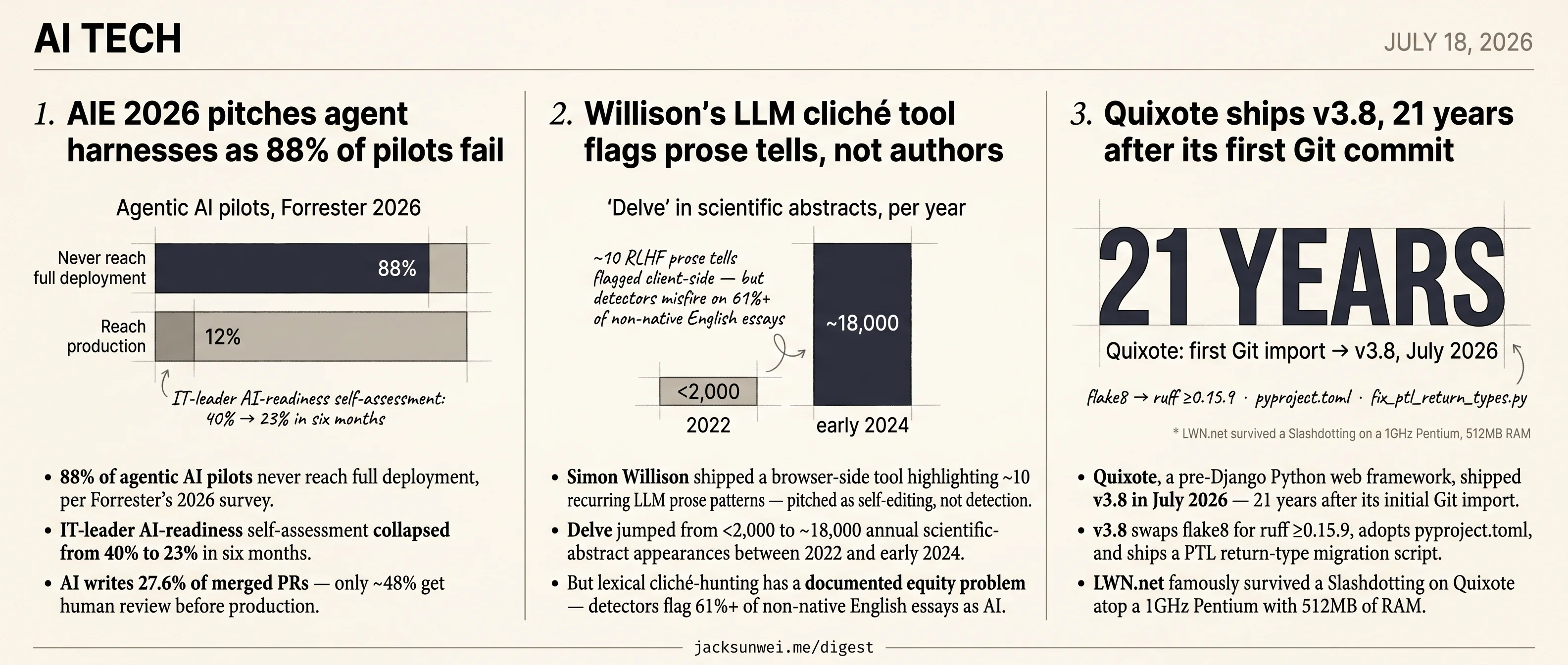
- Forrester finds 88% of agentic AI pilots never reach full deployment in 2026.
- Multi-agent systems fail 41–86% of runs from coordination drift and context loss.
- Simon Willison ships a browser-side tool flagging ~10 recurring LLM prose tics for self-editing.
- AI-written PRs hit 27.6% of merges with only ~48% getting human review.
- Quixote 3.8 ships 21 years after the framework’s first Git commit.
Today’s three AI-tech reads each push back on a default the industry has drifted into. Forrester’s 2026 survey — the drumbeat for next month’s AI Engineer Summit — puts 88% of agentic pilots short of full deployment, with multi-agent runs failing 41–86% of the time from coordination drift and context loss. Simon Willison answers the AI-detection reflex with a browser-side tool that flags roughly ten recurring LLM prose tics for writers to strip before shipping — pitched explicitly as self-editing, not authorship detection, in a field where lexical detectors flag 61%+ of non-native English essays as AI. And Quixote, a pre-Django Python web framework, quietly cut v3.8 twenty-one years after its first Git commit — a release whose HN thread promptly turned into a stability-vs-vibe-coding argument the maintainers never asked to host.
AIE 2026 pitches agent harnesses as 88% of pilots fail
Source: latent-space · published 2026-07-14
TL;DR
- 88% of agentic AI pilots never reach full deployment, per Forrester’s 2026 survey.
- IT-leader AI-readiness self-assessment collapsed from 40% to 23% in six months.
- AI writes 27.6% of merged PRs — only ~48% get human review before production.
- Multi-agent systems fail 41–86% of the time from coordination drift and context loss.
The pitch: build around agents, not with them
Latent Space’s five-trends recap argues AI engineering has crossed a threshold. The model is a commodity; the interesting work is the harness — loops, evals, memory, tool routing, human-in-the-loop scaffolding. GoPubby’s independent AIEWF review lands the same conclusion under a franker headline: “The Model Stopped Being the Hard Part” 1. Dex Horthy’s keynote line — “the hype is outrunning the discipline” — became the conference’s rallying complaint 2. So the framing is real, and it’s roughly what most of the stage said.
The numbers the recap under-weights
The recap treats “software factories” as shipping reality. The independent field data reads differently.
| Claim on stage | Independent number |
|---|---|
| Frontier models are commodity-good | <4% success on real Upwork tasks despite >90% MMLU 3 |
| Agents are running in production | 88% of agentic pilots never reach full deployment 4 |
| AI-assisted dev is the default | 27.6% of merged PRs are AI-written; ~48% get human review 1 |
| Enterprises are ready to build on this | IT-leader AI-readiness dropped 40% → 23% in six months 4 |
The last row is the tell. Practitioners cut their own readiness score nearly in half in a single cycle. The harness discourse exists because the previous discourse — “just call the model” — hit a wall, not because the industry has already climbed the next one.
The fault line: loops vs. reliability
The trend the recap is most bullish on — stacking loops, orchestrating specialist agents — is the one outside literature is most hostile to. The MAST (Multi-Agent System Failure Taxonomy) work found multi-agent systems fail 41–86% of the time from coordination breakdowns and context drift, and estimates ~70% of tasks currently assigned to swarms would be handled more reliably by a single well-scoped agent 5. That reads as a warning label on the “loop engineering” thesis, not a roadmap for it.
“The hype is outrunning the discipline.” — Dex Horthy 2
The Hacker News response split along craftsmanship lines. One popular thread compared AI-assisted development to CNC machining — faster, but the business “can no longer afford the craftsmanship” of manual coding. Others pushed to distinguish AI Engineers, who architect the harness, from Agentic Engineers, who mostly consume it 6. Neither camp reads the trends piece the way swyx wrote it.
Takeaway
The five trends are a fair map of what was on stage. They are not a map of what’s shipping. Anyone using the recap as a planning document should pair it with three denominators the room glossed: an 88% pilot-failure rate 4, a 4% real-task completion rate 3, and a multi-agent literature that reads more like a hazard sign than an architecture guide 5. The harness era is the right ambition. Calling it the state of the art is the mistake — and it’s the mistake the discipline keeps making one abstraction level at a time.
Willison’s LLM cliché tool flags prose tells, not authors
Source: simon-willison · published 2026-07-17
TL;DR
- Simon Willison shipped a browser-side tool highlighting ~10 recurring LLM prose patterns — pitched as self-editing, not detection.
- Delve jumped from <2,000 to ~18,000 annual scientific-abstract appearances between 2022 and early 2024.
- But lexical cliché-hunting has a documented equity problem — detectors flag 61%+ of non-native English essays as AI.
- Runs entirely client-side — no text leaves the browser, no verdict rendered against a writer.
What the tool actually does
Paste text, get a heatmap. The LLM Cliché Highlighter marks about ten patterns that have become fingerprints of RLHF-tuned prose: negative-parallel chains (“no fluff, no filler, no jargon”), the “it’s not just X, it’s Y” pivot, assumptive openers like “you already know,” and pseudo-profound imperatives (“let that sink in”). Rules are toggleable, matches get a jump-to list, and the whole thing runs in the browser — no text leaves the tab. Willison built it with Fable 5 in a “vibe coding” pass, giving conceptual direction while the model wrote the JS and CSS.
Framing matters here. This is pitched as a self-editing linter, not a “was this written by AI?” detector. That distinction is doing more work than it looks.
The patterns are real signal
Willison’s list is not idiosyncratic taste. Longitudinal corpus work shows “delve” jumped from fewer than 2,000 annual appearances in scientific abstracts in 2022 to nearly 18,000 by early 2024 7. Community catalogs of “AI-tells” have grown past 500 entries, spanning both lexical items (tapestry, testament, transformative) and structural moves like the rule of three 8. And the negative-parallelism construction Willison foregrounds is independently called out by writing critics as the single most diagnostic RLHF fingerprint — a shape that “mimics the shape of a significant insight while replacing a concrete detail with a corporate cliché” 9.
It’s not just about [specific thing], it’s about [vague, grander concept].
If that reads as painful, that’s the point. The highlighter operationalizes an informal consensus that has been building in editor Slacks for two years.
The bias trap it (mostly) sidesteps
The load-bearing dissent the tool has to reckon with: lexical AI-detection has a well-documented equity failure. Stanford’s TOEFL analysis found detectors flagged over 61% of human-written non-native essays as AI-generated 10. Nigerian writers have publicly objected that “delve” and similarly “formal” vocabulary are native features of West African and British-colonial English, not synthetic-prose tells 11. Institutions like Vanderbilt and UCLA have already walked back Turnitin-style deployments over exactly this failure mode.
Willison’s tool avoids the worst of that by being advisory and client-side — nothing gets submitted, no verdict gets rendered against a writer. But any user who reads the highlights as evidence someone used ChatGPT is walking straight back into the same false-positive trap. The framing is the safety feature.
Short half-life by design
The same phrase lists are now being used offensively and defensively. On the generation side, “unsloping” system prompts explicitly instruct Claude and GPT to avoid these very patterns 12; GitHub projects like ai-writing-detector ship the lists as lint rules on the detection side 8. Every published cliché list becomes training signal for the next round of models to route around it. Willison’s tool is useful today precisely because it’s a snapshot of what 2026-era LLM prose sounds like — and it will need to be rewritten in eighteen months.
Quixote ships v3.8, 21 years after its first Git commit
Source: simon-willison · published 2026-07-18
TL;DR
- Quixote, a pre-Django Python web framework, shipped v3.8 in July 2026 — 21 years after its initial Git import.
- v3.8 swaps flake8 for ruff ≥0.15.9, adopts
pyproject.toml, and ships a PTL return-type migration script. - LWN.net famously survived a Slashdotting on Quixote atop a 1GHz Pentium with 512MB of RAM.
- HN commenters turned the post into a stability-vs-vibe-coding Rorschach test, invoking Don Quixote against LLM-generated code.
Origins nobody remembers
Quixote was not a hobby project. It was built at MEMS Exchange to run a semiconductor-fabrication brokerage by a team — Andrew Kuchling, Neil Schemenauer, Greg Ward — that found Zope’s insistence on separating “web designers” from “web developers” actively hostile to how they worked 13. The design posture followed from that: programmers already know Python, so don’t make them learn a DSL. Templates are .ptl files compiled to bytecode via a custom import hook. URLs resolve by walking a tree of Python objects instead of matching regexes in a central table.
The proof-of-frugality anecdote everyone cites is LWN.net riding out a Slashdotting on a 1GHz Pentium with 512MB of RAM 14. The proof-of-scale anecdote is less known in the West: China’s Douban maintained its own douban-quixote fork and ran its CODE collaboration platform on it, meaning Quixote quietly served a top-tier social network for years after Western developers wrote it off 15.
Why the design lost
Nostalgia aside, PTL’s tradeoffs are the reason Quixote never crossed into the Django/Flask tier. The custom import hook that transpiles .ptl files breaks IDE autocomplete, linting, and syntax highlighters that assume valid .py 16. Escaping is manual — you wrap strings in htmltext — rather than context-aware auto-escape à la Jinja2, so XSS discipline lives entirely in the developer’s head 16. The “logic and presentation in one file” model Quixote celebrated is precisely what the industry rejected when it standardized on sandboxed template DSLs.
None of this is fatal for a small, maintained codebase. It just explains why a framework that predated both Django and WSGI ended up with roughly 94 GitHub stars instead of 94,000.
What v3.8 actually did
The recent commit Simon Willison flagged isn’t cosmetic. Version 3.8 migrated linting from flake8 to ruff (≥0.15.9), adopted pyproject.toml as the build spec, and shipped a fix_ptl_return_types.py script to help downstream code adapt to stricter typing 17. That’s the modernization pass a live project does, not the death rattle of an archive. Schemenauer is still a CPython core contributor working on 3.14/3.15 interpreter internals, which plausibly explains how Quixote keeps tracking new language features while contemporaries rot.
The AI-digest angle
This wouldn’t be in an AI digest on the technical merits. It’s here because of how the post landed. HN commenters reached for “Don Quixote” as a metaphor for LLM agents “tilting at windmills,” explicitly contrasting a 21-year-old framework’s boring stability with the churn of AI-generated projects that get abandoned in months 18.
The nostalgia is a vehicle for a stability-versus-hype argument.
Whether that comparison is fair is a separate question — Quixote survived by being small, focused, and maintained by one exceptional engineer, not by resisting fashion. But the reception is a useful data point on where sentiment sits in mid-2026: a single commit to a niche framework becomes a referendum on how developers feel about the code their coworkers are shipping this quarter.
Footnotes
-
GoPubby — ‘The Model Stopped Being the Hard Part’ (AIEWF 2026 review) — https://ai.gopubby.com/the-model-stopped-being-the-hard-part-ai-engineer-worlds-fair-2026-review-b3c35506b43a
↩ ↩2AI now accounts for 27.6% of merged pull requests, [but] only approximately 48% of that code is explicitly reviewed by humans before reaching production.
-
AI Insiders — recap of Dex Horthy (HumanLayer) keynote — https://aiinsiders.net/article/latent-space-ai-engineering-in-2026-runs-on-harnesses-not
↩ ↩2The hype is outrunning the discipline… teams are attempting to step up an abstraction level to autonomous agents before the underlying discipline has matured enough to support them.
-
PromptMetrics — ‘AI Benchmarks vs Remote Labor Index’ — https://www.promptmetrics.dev/blog/ai-benchmarks-vs-remote-labor-index
↩ ↩2Frontier models often exceed 90% on academic benchmarks like MMLU, [but] successfully complete less than 4% of real-world freelance tasks found on platforms like Upwork.
-
Forrester — ‘The State of Agentic AI in 2026’ — https://www.forrester.com/blogs/the-state-of-agentic-ai-in-2026-companies-are-chasing-few-are-catching/
↩ ↩2 ↩3Roughly 88% of agentic AI pilots fail to reach full deployment… IT leaders’ self-assessment of their AI readiness has dropped from 40% to 23% in just six months.
-
Komal Parmar, Medium — ‘The Hidden Problem with Multi-Agent Systems’ — https://medium.com/@komalbaparmar007/the-hidden-problem-with-multi-agent-systems-nobody-talks-about-accc8107e96d
↩ ↩2MAST (Multi-Agent System Failure Taxonomy) found that these architectures fail between 41% and 86% of the time due to coordination breakdowns and context drift… 70% of tasks currently assigned to multi-agent swarms could be handled more reliably by a single agent.
-
Hacker News discussion (item 48312377) — https://news.ycombinator.com/item?id=48312377
↩A widely discussed ‘grumpy screed’ compared modern AI-assisted development to CNC machining: while it is faster, the business ‘can no longer afford the craftsmanship’ of manual coding… some contributors argued for a distinction between ‘AI Engineers’ who architect systems and ‘Agentic Engineers’ who primarily use AI tools.
-
The Newcomer — ‘Delve and 12 other words that show…’ — https://thenewcomerspod.com/p/delve-and-12-other-words-that-show
↩In scientific papers, ‘delve’ jumped from fewer than 2,000 annual instances in 2022 to nearly 18,000 by early 2024
-
GitHub — pertrai1/ai-writing-detector — https://github.com/pertrai1/ai-writing-detector
↩ ↩2Popular phrase lists now target over 500 ‘AI-tells,’ including words like delve, navigate, robust, tapestry, testament, and transformative
-
Matthew Vollmer Substack — ‘I asked the machine to tell on itself’ — https://matthewvollmer.substack.com/p/i-asked-the-machine-to-tell-on-itself
↩‘It’s not just about [specific thing], it’s about [vague, grander concept]’ … mimic the shape of a significant insight while often replacing a concrete detail with a corporate cliché
-
UCLA HumTech — ‘The Imperfection of AI Detection Tools’ — https://humtech.ucla.edu/technology/the-imperfection-of-ai-detection-tools/
↩detectors flagged over 61% of human-written TOEFL essays as AI-generated
-
BusinessDay NG — ‘Online uproar over Nigerian English flagged as ChatGPT-ish’ — https://businessday.ng/technology/article/online-uproar-over-nigerian-english-flagged-as-chatgpt-ish/
↩Nigerian writers and those educated in British-colonial systems have pointed out that ‘delve’ and similar formal terms are staples of their everyday professional vocabulary
-
Will Francis — ‘How to stop Claude writing like an AI’ — https://willfrancis.com/how-to-stop-claude-writing-like-an-ai/
↩‘unsloping’ has become a popular prompt engineering technique, where users explicitly command models to avoid these specific list patterns and rhetorical pivots
-
Linux Journal — ‘Quixote: a Python-Centric Web Application Framework’ — https://www.linuxjournal.com/article/6178
↩Quixote was developed at MEMS Exchange to manage a complex, web-driven network of semiconductor fabrication sites… the team found Zope excessively complex and overly focused on the separation of ‘web designers’ from ‘web developers’.
-
Linux Journal (production anecdote) — https://www.linuxjournal.com/article/6178
↩LWN.net famously survived a ‘Slashdotting’ on a modest 1GHz Pentium server with only 512MB of RAM while running Quixote.
-
BuiltWith — Very-High-Traffic Python sites — https://trends.builtwith.com/websitelist/Python/Very-High-Traffic-Volume
↩Douban maintained its own fork (douban-quixote) and used it for critical internal infrastructure including its CODE collaboration platform; LWN.net has relied on Quixote for over two decades.
-
Linux Journal (PTL critique, aggregated) — https://www.linuxjournal.com/article/6178
↩ ↩2PTL relies on a manual system of htmltext objects rather than context-aware auto-escaping; it ‘hacks’ the Python import mechanism via a custom hook, breaking IDE autocomplete, linting, and syntax highlighting.
-
BuiltWith / repo activity signals — https://trends.builtwith.com/websitelist/Python/Very-High-Traffic-Volume
↩The July 2026 release (v3.8) migrated the project from flake8 to ruff (≥0.15.9), adopted pyproject.toml, and added a fix_ptl_return_types.py script — modernization on a ~94-star repo.
-
Simon Willison — Python tag archive (context on ‘vibe coding’ framing) — https://simonwillison.net/tags/python/
↩Commenters used ‘Don Quixote’ as a metaphor for the idealistic but potentially delusional reliance on AI agents that can ‘tilt at windmills’… contrasting Quixote’s 21-year stability with rapidly abandoned AI projects.