Udell rejects 'human in the loop' as AI-driven PR reviews stretch 91% longer
Jon Udell argues agents should join our loop, not the reverse, as AI-driven PR review times surge 91% and queues back up.
Udell rejects ‘human in the loop’ as AI-driven PR reviews stretch 91% longer
TL;DR
- Jon Udell rejects ‘human in the loop’ as a frame that cedes authority to coding agents.
- PR review times have surged 91% as AI-authored code floods reviewer queues.
- AI-authored PRs merge at under half the rate of human-written code.
- Thoughtworks counters with ‘human-on-the-loop’ — fewer humans doing strategic oversight.
- Udell’s Bram tool gates agent edits behind a Proposed → Applied → Committed worklist.
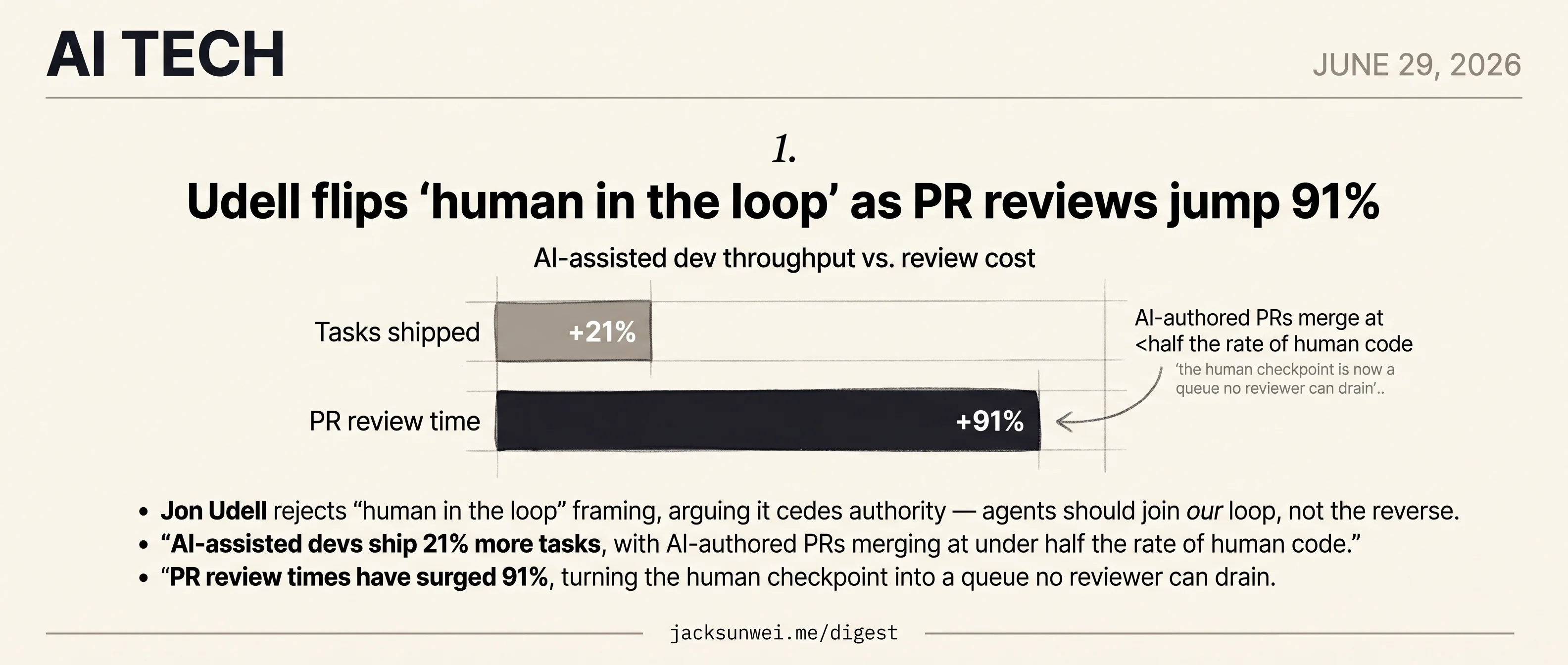
Today’s lone AI-tech feature is a framing piece with teeth. Jon Udell argues that human in the loop gets the agency backward — it casts the human as a checkpoint inside the agent’s workflow, when the relationship should run the other way. The rhetorical move would be easy to dismiss as semantics if the throughput numbers weren’t catching up to it: AI-assisted developers ship 21% more tasks, PR review times are up 91%, and AI-authored PRs merge at under half the rate of human-written code. The checkpoint isn’t holding because there aren’t enough reviewer-hours to drain the queue.
That tension is splitting the field on the cure. Thoughtworks answers with human-on-the-loop — fewer humans, more strategic oversight. Udell answers with Bram, a worklist that gates every agent edit through Proposed → Applied → Committed states with explicit authorization hooks. Same diagnosis, opposite remedies: thin the supervision or instrument it.
Udell flips ‘human in the loop’ as PR reviews jump 91%
Source: simon-willison · published 2026-06-28
TL;DR
- Jon Udell rejects “human in the loop” framing, arguing it cedes authority — agents should join our loop, not the reverse.
- AI-assisted devs ship 21% more tasks, with AI-authored PRs merging at under half the rate of human code.
- PR review times have surged 91%, turning the human checkpoint into a queue no reviewer can drain.
- Thoughtworks counters with “human-on-the-loop” — fewer humans, more strategic oversight — splitting the field on the cure.
- Udell’s Bram tool gates agent edits behind a Proposed → Applied → Committed worklist with explicit authorization hooks.
The terminology fight is downstream of a real crisis
Udell’s reframe — “It’s our loop, we work the same way we always have, now we recruit agents to join the team” — would read as semantic nitpicking if the numbers weren’t backing him up. Mid-2026 telemetry circulating from LinearB-style dashboards shows AI-assisted developers completing 21% more tasks while PR review times have surged 91%, with AI-authored PRs merging at less than half the rate of human-authored code 1. ITK maintainers, writing from a scientific-computing repo drowning in bot submissions, put it more bluntly: “human review does not stop machine-speed failures and may only provide an explanation after damage has occurred” 2.
The checkpoint everyone has been invoking for two years to make agentic coding feel safe has, in practice, become a queue no human can drain.
Three reframes, one diagnosis
Everyone agrees HITL is broken. Nobody agrees what replaces it.
| Frame | Human role | Bet |
|---|---|---|
| Human-in-the-loop (status quo) | Reviews every PR | Volume stays low enough to review |
| Human-on-the-loop (Thoughtworks) | Sets objectives, intervenes by exception 3 | Exhaustive review doesn’t scale; trust the system |
| Agent-in-our-loop (Udell) | Primary author, recruits agents as juniors 4 | Better tooling keeps humans tightly engaged |
Thoughtworks and Udell are pulling in opposite directions from the same evidence. One wants fewer humans doing more strategic oversight; the other wants more humans armed with better introspection. The industry hasn’t picked.
Visible workings, recycled for agents
The substance under Udell’s pithy line is a concept he’s been carrying since 2008: Ward Cunningham’s “visible workings,” where form fields exposed the business rules behind them via inline “Explore” buttons 5. Udell’s current Bram tool operationalizes that idea for agents. Worklist items move through three explicit phases, with authorization hooks blocking agents from silently pruning items or making significant edits 4:
flowchart LR
    A[Agent proposal] --> B[Proposed]
    B -->|human authorizes| C[Applied]
    C -->|human authorizes| D[Committed]
    B -.->|hook blocks| X[Silent prune/edit]
    C -.->|hook blocks| X
The alternative to unreviewable PRs, in this telling, is not smaller PRs — it’s a different artifact entirely: a git-backed audit trail of agent decisions that a human signs off on at each transition.
When the cure becomes the disease
The obvious shortcut — throw more agents at the review problem — has its own cautionary tale. Andrew Nesbitt’s satirical “CVE-2026-LGTM” describes two competing vendor agents entering a “disagreement loop” on a single PR, racking up $41,255 in inference costs before a human pulled the plug 6. It’s a joke that lands because the failure mode is plausible. It validates Udell’s suspicion of the unattended pipeline without endorsing his specific solution.
The takeaway isn’t that Udell has won the terminology fight. It’s that the fight exists at all because the workflow underneath it has already broken, and the three camps forming around the wreckage — more oversight, less oversight, better tooling — are making genuinely different bets about what an engineering org should look like in 2027.
Footnotes
-
The Syntax Diaries, ‘2026 AI Code Review PR Flood Workflow’ — https://thesyntaxdiaries.com/ai-code-review-2026-pr-flood-workflow
↩AI-assisted developers complete 21% more tasks, [but] PR review times have surged by 91%, often resulting in AI-authored code merging at less than half the rate of human code
-
ITK Discourse thread, ‘AI-generated pull requests overwhelming, hard to review carefully’ — https://discourse.itk.org/t/ai-generated-pull-requests-overwhelming-hard-to-review-carefully/7728
↩human review does not stop machine-speed failures and may only provide an explanation after damage has occurred
-
Thoughtworks, ‘Cybernetics and human-on-the-loop in agentic coding’ — https://www.thoughtworks.com/en-us/insights/blog/generative-ai/cybernetics-and-human-on-the-loop-in-agentic-coding
↩‘Human-on-the-loop’ (HOTL) is often a more accurate term than HITL; the human sets high-level objectives and intervenes only by exception
-
Jon Udell, original blog post — https://blog.jonudell.net/2026/06/28/doctor-it-hurts-when-agents-create-unreviewable-prs-dont-do-that/
↩ ↩2Items on a project’s worklist must pass through three distinct phases: Proposed → Applied → Committed… worklist-authorization hooks act as guardrails, preventing agents from pruning worklists or making significant edits without explicit authorization.
-
Jon Udell, ‘Ward Cunningham’s Visible Workings’ (2008) — https://blog.jonudell.net/2008/03/04/ward-cunninghams-visible-workings/
↩Cunningham added ‘Explore’ buttons to standard web forms; clicking these allowed users to inspect the specific business rules or workflows that necessitated each field.
-
Andrew Nesbitt, ‘CVE-2026-LGTM’ (satirical incident report) — https://runtimewire.com/article/andrew-nesbitt-cve-2026-lgtm-ai-security-satire
↩two agents from competing vendors entered a ‘disagreement loop,’ racking up $41,255 in inference costs before being manually shut down